

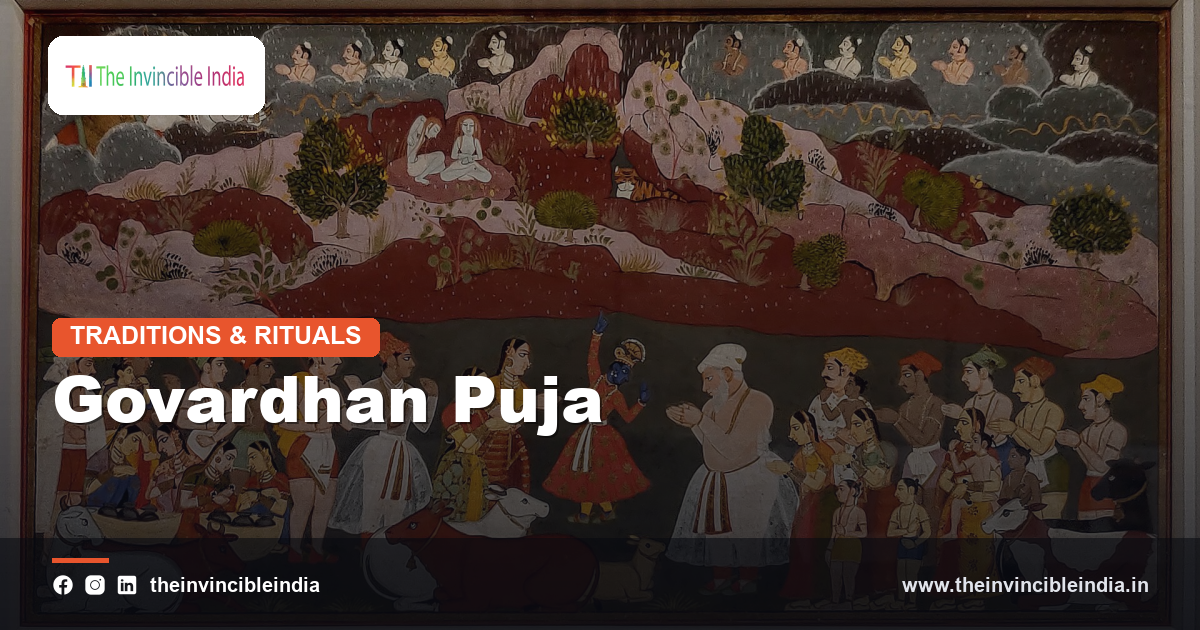
Govardhan Puja is observed the day after the main night of Diwali, commemorating the episode in which Krishna is described as lifting the Govardhan hill to shelter the people of Braj from torrential rain. The festival is marked by the Annakut, an elaborate offering of a great variety of food items, along with rituals honouring cattle and the natural landscape associated with Krishna’s early life. Widely observed across North India, and with particular devotion at temples linked to the Krishna tradition, Govardhan Puja carries themes of humility, gratitude and reverence for nature. This guide outlines its meaning, legend and rituals.
Quick Facts
| Detail | Information |
|---|---|
| Also Known As | Annakut festival |
| Commemorates | Krishna lifting Govardhan hill |
| Type of Observance | Hindu festival honouring Krishna and nature |
| General Timing | Day after the main night of Diwali, Kartik Shukla Pratipada |
| Key Practices | Annakut food offering, cattle worship, symbolic hill-building |
| Region of Prominence | North India, especially Mathura and Vrindavan |
Meaning and Significance
Govardhan Puja commemorates a well-known episode from Krishna’s life in which he is described as lifting the Govardhan hill on his finger to provide shelter for the people and cattle of Braj from a prolonged deluge. The festival celebrates this act as an expression of protection, humility and the triumph of devotion over pride.
Falling the day after Diwali, Govardhan Puja extends the festive season with a distinct devotional focus centred on Krishna and the natural world, rather than on lamps and fireworks. Its themes of gratitude toward nature and protection of community continue to resonate widely today.
The Legend of Govardhan Hill
According to traditional accounts, the people of Braj once prepared to worship Indra, the god of rain and thunder, as was their custom, until Krishna suggested that they instead honour Govardhan hill and the natural resources that directly sustained their lives. This shift in devotion is said to have provoked Indra’s displeasure.
In response, Indra is described as sending torrential rains upon Braj, prompting Krishna to lift the Govardhan hill and hold it aloft as a giant umbrella, sheltering the villagers and their cattle until the rains subsided. The story is understood as a devotional teaching rather than a literal historical record.
Position in the Diwali Festival Cycle
Govardhan Puja falls on Kartik Shukla Pratipada, the first day of the bright fortnight following the new moon of Diwali, placing it immediately after the main night of lamps and Lakshmi worship. This positioning situates the festival within the broader multi-day Diwali celebration observed across much of India.
As with other festivals in the Diwali cycle, the precise Gregorian date shifts each year according to the lunar calendar. The festival’s placement, immediately following the most widely celebrated night of the season, allows it to extend the period of devotion into a distinctly Krishna-centred observance.
Krishna and the Symbolism of the Story
The Govardhan episode is widely interpreted as a lesson in humility, emphasising reverence for nature and community welfare over ritualistic worship of more distant cosmic forces. Krishna’s act of lifting the hill is read as a demonstration that divine protection can be found in unassuming, everyday elements of the natural world.
This interpretation gives the festival a philosophical dimension beyond its narrative content, encouraging reflection on humility and gratitude toward the resources, such as land, water and cattle, that sustain daily life. Such themes have kept the story relevant well beyond its immediate devotional context.
Govardhan Puja and Cattle Worship
Cattle hold a significant place in Govardhan Puja, reflecting their central role in the pastoral life of Braj described in the traditional narrative. In many rural areas, cows are washed, decorated and worshipped as part of the day’s rituals, honouring their importance to agrarian and household life.
This aspect of the festival is closely related to the broader reverence for cattle found throughout Hindu tradition, reinforced here through Krishna’s own associations as a cowherd in his early life. The pairing of hill worship and cattle worship reflects the festival’s deep roots in a pastoral, agrarian setting.
Making of the Govardhan Representation
In many households, a small representation of Govardhan hill is fashioned, traditionally from cow dung, and decorated with flowers, grains and small figures representing cattle and cowherds. This miniature hill becomes the focus of the day’s domestic worship, standing in symbolically for the larger episode being commemorated.
Family members gather around this representation to offer prayers and food items, reenacting in a small, household setting the themes of protection and gratitude central to the original story. This hands-on, creative element of the festival gives it a distinctly participatory character within the home.
The Annakut Offering
Annakut, meaning “mountain of food”, refers to the elaborate array of dishes prepared and offered to Krishna on this day, often arranged to resemble a small hill in reference to Govardhan itself. Temples and households alike prepare an extensive variety of vegetarian dishes for this purpose.
The scale of the Annakut offering, sometimes involving dozens of different dishes, reflects the festival’s broader theme of gratitude for nature’s abundance. After being offered to the deity, the food is typically distributed as prasad among devotees, extending the spirit of sharing central to the occasion.
Temple Celebrations at Mathura and Vrindavan
Mathura and Vrindavan, closely associated with Krishna’s early life, are centres of particularly elaborate Govardhan Puja celebrations, drawing large numbers of pilgrims for the occasion. Temples in this region host grand Annakut displays and special rituals honouring both Krishna and the Govardhan hill itself.
Pilgrims also visit the Govardhan hill directly, located near Mathura, performing a traditional circumambulation around its base as an act of devotion. This physical connection to the landscape described in the original story gives the festival particular resonance for those who make the journey.
Nathdwara and the Pushtimarg Tradition
The Pushtimarg tradition, founded on devotion to Krishna in the form of Shrinathji, places special emphasis on Govardhan Puja, with the temple town of Nathdwara in Rajasthan hosting particularly grand Annakut celebrations. Shrinathji himself is traditionally associated with the Govardhan hill in this tradition’s devotional history.
The scale and artistry of the Annakut display at Nathdwara, involving an extensive and carefully arranged variety of foods, is regarded as one of the most elaborate expressions of this festival anywhere in India, reflecting the deep devotional emphasis this particular tradition places on the occasion.
Regional Names and Variations
Govardhan Puja is known by various names and observed with somewhat different emphases across India. In many parts of North India, it is closely tied to the Annakut offering, while in Maharashtra and Gujarat, the day coincides with the start of the new year in the Vikram Samvat calendar, adding a further layer of celebration.
These regional variations demonstrate how a single festival day can carry multiple overlapping significances depending on local calendrical and cultural tradition, with communities adapting the core themes of gratitude and renewal to their own customary practices.
Home Rituals and Family Observance
In households that observe Govardhan Puja, the day typically begins with the preparation of a variety of dishes for the Annakut offering, followed by prayers before the small Govardhan representation set up at home. Family members often participate together in both the cooking and the ritual itself.
This home-based observance mirrors the larger temple celebrations on a modest scale, allowing families to mark the festival’s themes of gratitude and abundance within their own domestic setting, reinforcing a sense of continuity between temple tradition and everyday household practice.
Community Feasting
The distribution of prasad following the Annakut offering extends the festival’s spirit of sharing beyond the immediate family, with food often distributed among neighbours, relatives and visitors to temples. Community kitchens at larger temples serve the offered food to large numbers of devotees over the course of the day.
This communal feasting dimension reflects a pattern seen across many Hindu festivals, in which an elaborate offering to the divine becomes, in its final stage, an occasion for collective sharing and hospitality among the wider community.
Symbolism of Humility Over Power
A recurring theme drawn from the Govardhan narrative is the preference for humble, sustaining elements of nature over more distant displays of cosmic power, reflected in Krishna’s redirection of worship from Indra to the hill itself. This theme is often invoked in discussions of the festival’s broader moral lessons.
Such symbolism continues to inform how the festival is presented and understood, emphasising values of gratitude toward the immediate environment and community, values that many devotees consider just as relevant in contemporary life as in the traditional setting of the original story.
Govardhan Puja in Folk Art and Song
The story of Govardhan hill has long been a popular subject in devotional folk art, particularly in the Pichwai painting tradition of Nathdwara, which frequently depicts Krishna lifting the hill in vivid, detailed compositions. Devotional songs describing the episode are also sung during the festival period.
This artistic tradition has helped keep the Govardhan narrative vivid across generations, providing visual and musical touchstones that complement the oral and textual retelling of the story during the festival itself.
Govardhan Puja Beyond North India
While most closely associated with North India, particularly the Braj region, Govardhan Puja is also observed, often in a simpler form, by Krishna devotees in other parts of the country and among Indian communities abroad. Temples dedicated to Krishna elsewhere in India frequently mark the day with their own Annakut offerings.
This wider observance reflects the broad reach of Krishna devotion across India, allowing the festival’s core themes of gratitude and protection to be expressed in varying scales and settings well beyond its original regional context.
The Govardhan Parikrama
Many pilgrims visiting the Govardhan hill near Mathura undertake a parikrama, a ritual circumambulation around its base, as an act of devotion connected directly to the festival’s central narrative. The walk, covering the perimeter of the hill, is undertaken by devotees throughout the year but sees especially heavy participation around Govardhan Puja.
Some devotees choose to perform the parikrama barefoot, or in certain cases prostrating along sections of the route, as an expression of particular devotion. The practice reflects a broader pattern in Indian pilgrimage tradition in which physical effort and endurance are treated as meaningful expressions of reverence, directly linking worshippers to the landscape described in the Govardhan story.
Govardhan Puja Today
In present-day India, Govardhan Puja continues to be observed through the familiar combination of Annakut offerings, cattle worship and household ritual, even as celebrations at major temples have grown in scale and organisation. Live broadcasts from temples such as those in Nathdwara now allow devotees elsewhere to witness the elaborate Annakut displays.
Despite these modern additions, the festival’s essential spirit, gratitude for nature’s abundance and reverence for the humble elements that sustain daily life, remains firmly consistent with the themes of the original Govardhan narrative.
Sources & Further Reading
- Ministry of Culture, Government of India (indiaculture.gov.in).
- Sahitya Akademi.
Frequently Asked Questions
What is Govardhan Puja?
Govardhan Puja commemorates Krishna lifting the Govardhan hill to protect the people of Braj, observed the day after Diwali with the Annakut food offering.
What is Annakut?
Annakut, meaning “mountain of food”, is an elaborate offering of a large variety of dishes presented to Krishna during Govardhan Puja.
When is Govardhan Puja celebrated?
It falls on Kartik Shukla Pratipada, the day immediately following the main night of Diwali.
Why is cattle worship part of the festival?
Cattle are honoured due to their central role in the pastoral life of Braj described in the traditional Govardhan narrative and Krishna’s own association as a cowherd.
Where are the grandest Govardhan Puja celebrations held?
Mathura, Vrindavan and Nathdwara are known for particularly elaborate temple celebrations and Annakut displays.


