

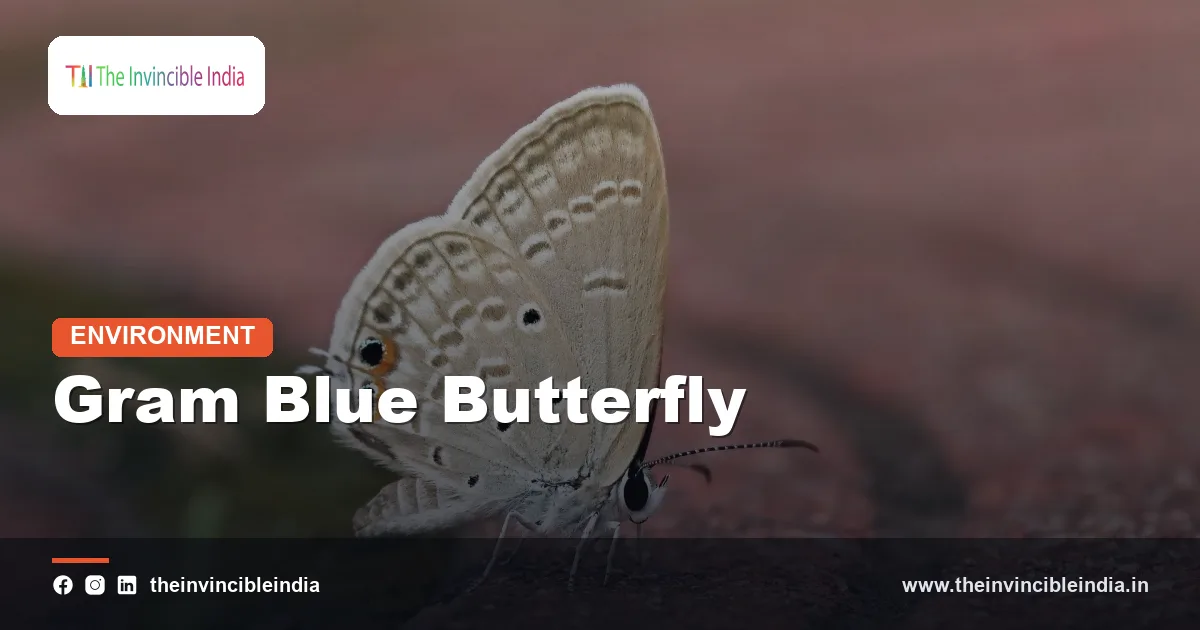
The gram blue (Euchrysops cnejus) is a small lycaenid butterfly of the Indian plains and foothills, recognised by its tiny hindwing tail and a pale underside marked with rows of dark-edged spots. It is a familiar visitor to scrub, grassy wasteland and gardens where pulses and other legumes grow.
Because it is small, quick and often settles with its wings shut, the gram blue is easy to overlook or to confuse with other blues. A few simple clues on the hindwing and underside, however, make it possible to name this species with confidence.
Quick Facts
| Common name | Gram blue |
|---|---|
| Scientific name | Euchrysops cnejus (Fabricius, 1798) |
| Family | Lycaenidae (blues, coppers and hairstreaks), subfamily Polyommatinae |
| Wingspan | Roughly 22 to 32 mm |
| Host plants | Legumes, including Vigna (cowpea relatives), Pueraria, Crotalaria and other pulse-family plants |
| Range and habitat | India, Sri Lanka and parts of South-East Asia; scrub, grassland, farmland edges, gardens and light forest |
| Broods | Multiple broods through the year in warm regions, with numbers peaking after the rains |
| Notable features | Minute tail, a pair of conspicuous spots near the hindwing tail, and caterpillars attended by ants |
Key Takeaways
- The gram blue (Euchrysops cnejus) is a small blue butterfly with a wingspan of roughly 2.2 to 3.2 cm.
- A very short tail on the hindwing and a row of dark-edged spots on the pale underside are the main field marks of the gram blue.
- Gram blue caterpillars feed on legumes, eating flower buds, flowers and young pods.
- The gram blue belongs to the family Lycaenidae, whose caterpillars often live in partnership with ants.
- The gram blue is found across the Indian subcontinent and parts of South-East Asia, mainly in open and scrubby habitats.
- The male gram blue is violet-blue above, while the female is mostly brown with blue only near the wing bases.
What is the gram blue butterfly?
The gram blue is a small butterfly named Euchrysops cnejus, belonging to the family Lycaenidae, whose caterpillars feed on legumes. The word “gram” in the English name is used in the Indian sense of a pulse or legume, and it points to the plant family that nourishes the larvae.
The species was described by the Danish naturalist Johan Christian Fabricius at the end of the eighteenth century. It sits in the genus Euchrysops, a group of African and Asian blues, and it is one of the few members of that genus found in the Indian region.
As lycaenids go, the gram blue is of modest size and ordinary appearance. Its charm lies in the details: the delicate tail, the neat rows of spots under the wings and the busy, close-to-the-ground flight that makes it a rewarding subject for patient observers.
How can you identify a gram blue?
A gram blue is identified by a short, stub-like tail on each hindwing and an underside of pale grey-brown marked with rows of dark spots edged in white. The combination of a small tail, bold spots near the tail end and a smaller body distinguishes it from the pea blue and the zebra blue.
Male and female
The male has a violet-blue upperside with a thin dark border. The female is largely brown, with blue scaling near the base of the wings and a row of dark spots close to the hindwing edge. Seen from above, the two sexes can look quite different, though they match closely below.
The underside pattern
Below, the wings are pale with a band of small dark spots, each surrounded by a thin pale ring. On the hindwing, near the base of the tail, there are one or two larger black spots crowned with colour that mark a false head, a feature common among tailed blues.
- Tail: very short compared with the long tail of the pea blue.
- Underside: pale ground colour with neat rows of dark, white-edged spots.
- Hindwing: conspicuous spots near the tail end, forming a decoy.
- Size: a little smaller than the pea blue, but larger than the tiny grass blue.
Where is the gram blue found in India?
The gram blue is found across most of peninsular and northern India, mainly in plains, scrub and low hills, and it extends into Sri Lanka and parts of South-East Asia. It is generally associated with open country where its legume food plants grow wild or in cultivation.
Typical habitats include dry scrub, grassy wasteland, field bunds, railway embankments, park edges and gardens with a few wild pulse plants. It is less frequent in dense forest interiors but can appear along forest tracks and clearings where sunlight reaches the ground.
The butterfly is on the wing for most of the year in warm areas, with the greatest numbers often seen during and after the monsoon, when legumes are in flower. In cooler foothill regions it is more seasonal and may be absent during winter months.
What does the gram blue eat?
Gram blue caterpillars eat the buds, flowers and young pods of legumes, and adults feed on nectar from small flowers. The name “gram” suggests pulses, and the species does use various members of the pea family, though it is better known from wild and garden legumes than from a single major crop.
Larval host plants
Recorded hosts include Vigna species (relatives of cowpea and green gram), Pueraria (kudzu relatives), Crotalaria and other small herbs and climbers of the pea family. The female lays her eggs on the flower buds or tender parts, so the young caterpillar begins life amid soft, protein-rich tissue.
Adult food
Adults take nectar from small, open flowers of weeds and garden plants. Like many blues, males are often seen on damp ground, sipping moisture and minerals, sometimes in small groups that pause and then flutter up when disturbed.
How does the gram blue grow up?
The gram blue grows through four stages, egg, caterpillar, pupa and adult, and in warm weather a full generation can take only a few weeks. As in other lycaenids, the caterpillar is short and slug-like, and it is closely associated with ants.
- Egg: the female lays small, pale, disc-shaped eggs singly on flower buds or young leaves of the host plant.
- Caterpillar: the larva feeds on buds, flowers and developing pods, and moves slowly. It is flattened, with a slightly woodlouse-like shape, and its colour blends with the plant.
- Pupa: the larva forms a compact pupa, often hidden at the base of the plant or in a sheltered spot, where ants may continue to stay nearby.
- Adult: the butterfly emerges, expands its wings and begins to mate and lay eggs within a few days.
Several broods succeed one another through the year, which is why the species can appear suddenly in large numbers when food plants flush after rain. The length of each stage depends on temperature, with warm weather speeding development.
Why are ants linked to gram blue caterpillars?
Ants are linked to gram blue caterpillars because the caterpillars produce a sweet secretion that ants drink, and the ants in return protect the larvae. This is a typical lycaenid partnership and one of the best-known insect alliances in the tropics.
The caterpillar has a special gland near the end of its body that releases droplets rich in sugars and amino acids. It also has small organs that give off signals to ants. Attending ants walk over the larva, tap it with their antennae and drive off small enemies such as parasitic wasps.
The relationship is not always the same everywhere, and it depends on which ants live in the area. Even so, the presence of ants on a bud or pod is a useful clue for observers searching for lycaenid caterpillars, and it is one of the reasons why a sprayed or sterile garden has far fewer blues.
How is the gram blue different from the pea blue and zebra blue?
The gram blue differs from the pea blue by its much shorter tail and spotted underside, and from the zebra blue by the lack of fine zebra-like stripes. All three are small, tailed lycaenids that share gardens and scrub, so careful comparison is useful.
| Feature | Gram blue | Pea blue | Zebra blue |
|---|---|---|---|
| Scientific name | Euchrysops cnejus | Lampides boeticus | Leptotes plinius |
| Tail | Very short | Thin and distinct | Short and fine |
| Underside | Pale with rows of dark, white-edged spots | Wavy brown and white bands | Fine, zebra-like stripes |
| Wingspan | 22 to 32 mm | 24 to 36 mm | 20 to 28 mm |
| Main larval food | Legumes such as Vigna | Legume flowers and pods | Plumbago and some other plants |
If a photograph shows a bold spot pattern instead of stripes, the gram blue is a likely identification. Checking the tail length and the pattern of the spots near the hindwing edge usually confirms it.
How does the gram blue avoid predators?
The gram blue avoids predators through a mix of camouflage, a decoy false head and quick, erratic flight. Each defence is modest on its own, but together they give this small and fragile insect a fair chance of surviving to lay eggs.
When the butterfly rests with its wings closed, the pale, spotted underside blends with dry grass, pebbles and dappled shade. The adult usually stays low, dropping into vegetation if disturbed and then sitting still until danger has passed.
The spots near the hindwing tail resemble an eye, and the tiny tail resembles an antenna. A bird or lizard that lunges at this decoy tends to catch a piece of the wing edge rather than the head or body. Gram blues with a neat notch in the hindwing are therefore not unusual.
The caterpillars add a further layer of protection through their ant guards, while the pupa is hidden in leaf litter or at the plant base. Despite these defences, predation is heavy at every stage, and that is why females lay many eggs over their short adult lives.
Is the gram blue a pest?
The gram blue is not considered a serious pest in India, although its caterpillars do eat the flowers and pods of legumes. Because the butterfly is generally scarce on crops compared with other pod-feeding insects, its economic impact is small.
In gardens, the caterpillars may leave small holes in buds or pods, but the damage is slight and often goes unnoticed. The natural controls that keep numbers in balance include parasitic wasps, spiders, predatory ants and insectivorous birds.
For anyone growing pulses at home, the practical advice is simple: accept a little leaf and pod damage, inspect plants by hand and avoid broad-spectrum pesticides. These sprays kill pollinators and natural predators along with butterflies, and they usually create more pest problems than they solve.
Why does the gram blue matter?
The gram blue matters because it is a small but widespread member of India’s butterfly fauna, linking legume plants, ants and insect-eating animals in a single food web. It is also a good example of the lycaenid way of life, where caterpillars and ants cooperate.
The butterfly can serve as a simple indicator of habitat quality. Where wild legumes, flowering weeds and bare sunlit ground are present, the gram blue tends to be found, and it declines when land is paved, over-mown or sprayed. Protecting scrubby, weedy patches in cities and villages is therefore good for the species.
Each stage of its life is also food for other animals. Eggs, caterpillars, pupae and adults are eaten by spiders, wasps, reptiles and birds, and adults help carry pollen between small flowers as they feed.
How can you see and record a gram blue?
You can see a gram blue by searching sunny, weedy patches with flowering legumes, scanning low plants and bare ground early in the day and late in the afternoon. Patience matters, as the butterfly is small and often rests with closed wings that blend with dry grass.
- Visit open scrub or garden corners with wild pulse plants, such as Vigna, Crotalaria and Pueraria relatives.
- Walk slowly and watch the ground and low flowers, not just the sky.
- Photograph the underside of the hindwing, including the tail and the spots close to it.
- Note the date, location and plant on which the butterfly rested or laid eggs.
- Submit your record to a community biodiversity platform to help map the species.
Never handle butterflies by their wings, and avoid trampling host plants while stalking a photograph.
Bottom Line
The gram blue is a small, tailed, spot-patterned lycaenid that follows legumes across India’s scrub and gardens. Its tiny tail, spotted underside and ant-tended caterpillars make it a good species for learning how to read the blues.
Frequently Asked Questions
What is a gram blue butterfly?
A gram blue is a small lycaenid butterfly, Euchrysops cnejus, with a wingspan of roughly 2.2 to 3.2 cm. It is named for its caterpillars, which feed on gram, meaning pulse or legume, plants. It occurs across much of India and parts of South-East Asia.
How do I recognise a gram blue?
Look for a very short tail on the hindwing and a pale underside with rows of dark, white-edged spots. The male is violet-blue above, and the female is mostly brown. Bold spots near the tail end form a false head.
What do gram blue caterpillars eat?
Gram blue caterpillars eat the flower buds, flowers and young pods of legumes. Recorded host plants include Vigna species, Pueraria and Crotalaria. They are small and often hidden among the flowers, so they are easy to miss.
Where can I see a gram blue in India?
You can see a gram blue in scrub, grassy wasteland, field edges, gardens and light forest across much of India. It is most often found where wild legumes grow in sunlight. Numbers are usually highest during and after the monsoon.
Why do ants stay near gram blue caterpillars?
Ants stay near gram blue caterpillars because the larvae release a sweet secretion that ants like to drink. In return the ants guard the caterpillars from small predators and parasites. This kind of partnership is common among lycaenid butterflies.
Is the gram blue harmful to crops?
The gram blue is not regarded as a major crop pest in India. Its caterpillars eat some buds and pods of legumes, but the damage is usually slight. Natural enemies and the butterfly’s modest numbers keep its impact low.
{“@context”:”https://schema.org”,”@graph”:[{“@type”:”FAQPage”,”mainEntity”:[{“@type”:”Question”,”name”:”What is a gram blue butterfly?”,”acceptedAnswer”:{“@type”:”Answer”,”text”:”A gram blue is a small lycaenid butterfly, Euchrysops cnejus, with a wingspan of roughly 2.2 to 3.2 cm. It is named for its caterpillars, which feed on gram, meaning pulse or legume, plants. It occurs across much of India and parts of South-East Asia.”}},{“@type”:”Question”,”name”:”How do I recognise a gram blue?”,”acceptedAnswer”:{“@type”:”Answer”,”text”:”Look for a very short tail on the hindwing and a pale underside with rows of dark, white-edged spots. The male is violet-blue above, and the female is mostly brown. Bold spots near the tail end form a false head.”}},{“@type”:”Question”,”name”:”What do gram blue caterpillars eat?”,”acceptedAnswer”:{“@type”:”Answer”,”text”:”Gram blue caterpillars eat the flower buds, flowers and young pods of legumes. Recorded host plants include Vigna species, Pueraria and Crotalaria. They are small and often hidden among the flowers, so they are easy to miss.”}},{“@type”:”Question”,”name”:”Where can I see a gram blue in India?”,”acceptedAnswer”:{“@type”:”Answer”,”text”:”You can see a gram blue in scrub, grassy wasteland, field edges, gardens and light forest across much of India. It is most often found where wild legumes grow in sunlight. Numbers are usually highest during and after the monsoon.”}},{“@type”:”Question”,”name”:”Why do ants stay near gram blue caterpillars?”,”acceptedAnswer”:{“@type”:”Answer”,”text”:”Ants stay near gram blue caterpillars because the larvae release a sweet secretion that ants like to drink. In return the ants guard the caterpillars from small predators and parasites. This kind of partnership is common among lycaenid butterflies.”}},{“@type”:”Question”,”name”:”Is the gram blue harmful to crops?”,”acceptedAnswer”:{“@type”:”Answer”,”text”:”The gram blue is not regarded as a major crop pest in India. Its caterpillars eat some buds and pods of legumes, but the damage is usually slight. Natural enemies and the butterfly’s modest numbers keep its impact low.”}}]}]}


