

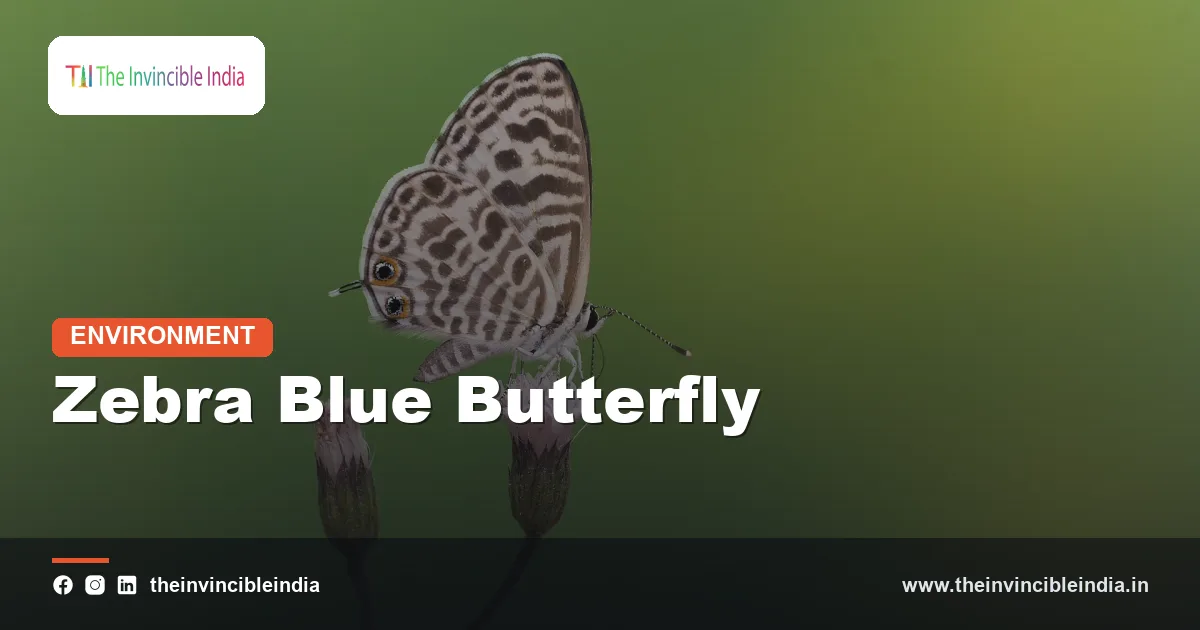
The zebra blue (Leptotes plinius), also called the plumbago blue, is a small lycaenid butterfly of India and Asia, named for the fine zebra-like stripes on its underside and for its caterpillars’ liking for plumbago flowers. It is a common and charming garden butterfly across the Indian plains and foothills.
The zebra blue is small enough to pass unnoticed, yet it is one of the easiest blues to recognise once its striped underwings are seen. It also offers a neat lesson in how a single garden plant, plumbago, can sustain a whole life cycle.
Quick Facts
| Common names | Zebra blue, plumbago blue |
|---|---|
| Scientific name | Leptotes plinius (Fabricius, 1793) |
| Family | Lycaenidae (blues, coppers and hairstreaks), subfamily Polyommatinae |
| Wingspan | Roughly 20 to 28 mm |
| Host plants | Plumbago (leadwort), including Plumbago zeylanica and the garden Plumbago auriculata; also some other shrubs and legumes |
| Range and habitat | India and Sri Lanka through South-East Asia to Australia and Pacific islands; gardens, hedges, scrub, wasteland and forest edges |
| Broods | Several overlapping broods a year in warm regions |
| Notable features | Fine zebra-striped underside, a short hindwing tail, a false head, and caterpillars that feed on flowers and tend to attract ants |
Key Takeaways
- The zebra blue (Leptotes plinius) is a small lycaenid butterfly with a wingspan of roughly 2 to 2.8 cm.
- Fine, closely spaced zebra-like stripes on the underside are the most reliable field mark of the zebra blue.
- The zebra blue is also called the plumbago blue because its caterpillars feed on the flower buds and flowers of plumbago plants.
- The zebra blue has a short hindwing tail and a small black spot with an orange or metallic edge that acts as a false head.
- The zebra blue occurs across India, Sri Lanka and South-East Asia and reaches Australia and the Pacific.
- Zebra blue caterpillars are often accompanied by ants, which defend them in exchange for a sugary secretion.
What is the zebra blue butterfly?
The zebra blue is a small butterfly, Leptotes plinius, in the family Lycaenidae, whose underwings are covered in narrow brown and white bands that resemble zebra stripes. The same species is also known as the plumbago blue, a name that recalls its dependence on plumbago plants.
The butterfly was named by the Danish entomologist Johan Christian Fabricius in the late eighteenth century. It belongs to the genus Leptotes, a group of small, delicately marked blues found in several continents. The genus name is derived from a Greek word that suggests slenderness or delicacy, an apt description of the insect.
In India the zebra blue is a familiar sight in gardens, on hedges and along roadsides where its host plants have been planted or have spread. It may be seen throughout much of the year in warm regions.
How can you identify a zebra blue?
A zebra blue is identified by its finely banded underside, which looks like a mix of white and brown wavy stripes, together with a small tail on the hindwing and a dark spot with orange near the tail. The pattern is more tightly packed than the broader wavy bands of the pea blue.
Upperside
The male is violet-blue above with a narrow dark margin and a pale fringe. The female is paler, with a broad dark border on the forewing and more brown at the edges. When the butterfly basks with its wings slightly open, these colours show clearly.
Underside
Both sexes share the same banded underside. The forewing and hindwing carry dark, narrow lines on a white or pale ground, and at the hindwing tail end there is a black spot partly edged with orange or metallic scales. This spot, with the short tail, forms the false head.
- Pattern: narrow, closely spaced stripes rather than spots or broad bands.
- Tail: short and fine, set above the black tail-end spot.
- Size: small, with a wingspan of about 2 to 2.8 cm.
- Behaviour: low, quick flight and frequent resting on flowers or leaves.
Where does the zebra blue live?
The zebra blue lives across India, Sri Lanka and South-East Asia and extends to Australia and several Pacific islands, usually in gardens, scrub and open woodland edges. It is a species of warm, sunny places where plumbago and other host plants are present.
Within India it occurs from southern coastal regions to the northern plains and the lower hills. Urban gardens and hedges often hold good numbers because plumbago is a popular ornamental shrub, and the butterfly has followed the plant into cities.
It is less common in dense, shaded forest and in very dry deserts. The species is usually seen near human settlements, and it adapts well to disturbed ground as long as there are flowering shrubs and some bare, sunlit surfaces.
Numbers of zebra blues change with the seasons. In many parts of India the butterfly is most abundant after the monsoon and through the cooler, drier months, when plumbago flushes with new growth and flowers. In the hottest weeks, adults tend to stay near shade and moisture, and they are more active in the morning and late afternoon than at midday.
Because the adults are strong enough to move between gardens, a newly planted plumbago hedge is sometimes colonised within a season. This ability to find isolated host plants is one reason the species has spread so widely across Asia and the Pacific.
What does the zebra blue eat?
Zebra blue caterpillars eat the buds, flowers and soft tissues of plumbago, and the adult butterflies drink nectar from small flowers. The plumbago link is so strong that the species is named after it in some regions.
Larval host plants
The main hosts are plants of the genus Plumbago, family Plumbaginaceae. These include the wild chitrak (Plumbago zeylanica), which has white flowers, and the blue-flowered cape leadwort (Plumbago auriculata) widely planted as a hedge. The caterpillars have also been recorded on other plants, including some legumes and shrubs such as Ziziphus.
Adult feeding
Adults visit small flowers of weeds and ornamentals. The plumbago blossom itself is a favourite, and females often hover about plumbago clusters while looking for buds on which to lay. Males may also be seen drinking at damp mud.
How does the zebra blue complete its life cycle?
The zebra blue completes its life cycle in four stages, egg, caterpillar, pupa and adult, and in warm weather a generation can take only a few weeks. Several broods follow in succession, so the butterfly is visible for much of the year.
- Egg: the female lays tiny, pale, round eggs singly on flower buds or young flowers of plumbago.
- Caterpillar: the larva eats into flowers and buds and also nibbles tender parts. It is small, rather flattened and matches the colour of the petals or buds, which helps it hide.
- Pupa: the caterpillar pupates in a sheltered place, such as on a stem or among dead flowers.
- Adult: the butterfly emerges and starts feeding and mating within a short time.
Development speeds up in warm months and slows in cool weather. In regions with a cold winter the species may reduce activity or disappear until the spring, when fresh adults reappear and begin to breed again.
Why is the zebra blue called the plumbago blue?
The zebra blue is called the plumbago blue because its caterpillars develop on plumbago flowers and the adults are so often found around plumbago hedges. In many gardens, a plumbago hedge in bloom is the surest place to find the butterfly.
The two names describe the same butterfly in different ways. “Zebra blue” refers to what the adult looks like, particularly its striped underside. “Plumbago blue” refers to where the butterfly lives and what its caterpillars eat. Naturalists often use both, depending on whether they are describing appearance or ecology.
The plant itself is well known in India. The white-flowered chitrak has a long history in traditional medicine, while the blue-flowered cape leadwort is a garden favourite. Either plant can support the butterfly, so a hedge planted for flowers also becomes a nursery for a tiny blue.
Why does the zebra blue have a false head?
The zebra blue has a false head because the black spot and tail at the end of its hindwing look like an eye and an antenna, which draws predators away from the real head. This decoy is common among blues and hairstreaks.
When the butterfly lands, it usually faces downward or sideways so that the tail end appears to be the front. It may move its hindwings against each other in a slow rubbing motion, which makes the tail seem to twitch like an antenna.
A predator that targets the decoy typically seizes the hindwing edge, and the zebra blue often escapes with a small notch. Many individuals show such damage, which is a visible record of near misses in the wild.
Do ants protect zebra blue caterpillars?
Ants often protect zebra blue caterpillars, because the caterpillars secrete a sugar-rich liquid that ants drink. In return the ants guard the larvae from wasps, flies and other enemies, forming a mutually beneficial partnership.
The partnership is typical of the family Lycaenidae. The caterpillar has a gland on the back that produces the liquid and small organs that give off chemical signals. The ants gather around, stroke the larva with their antennae and consume the droplets.
This link means that ant activity on a plumbago flower can be a clue that caterpillars are present. It is also one reason that heavy use of insecticides in a garden, which kills ants as well as butterflies, tends to reduce blue butterflies sharply.
How does the zebra blue compare with similar butterflies?
The zebra blue differs from the pea blue by its finer stripes and smaller size, and from the gram blue and tiny grass blue by its striped rather than spotted underside. The comparison below puts four small Indian blues side by side.
| Butterfly | Scientific name | Underside pattern | Tail |
|---|---|---|---|
| Zebra blue | Leptotes plinius | Fine zebra-like stripes | Short, fine |
| Pea blue | Lampides boeticus | Broader wavy white and brown bands | Thin, longer |
| Gram blue | Euchrysops cnejus | Rows of dark, white-edged spots | Very short |
| Tiny grass blue | Zizula hylax | Small spots on a pale ground | Absent |
Because the zebra blue is so finely marked, a good close-up photograph is the best way to confirm identification. Looking at the stripe density and the position of the black tail-end spot usually leaves little doubt.
Is the zebra blue a garden pest?
The zebra blue can feed heavily on plumbago flowers, but it is not generally treated as a serious pest. The caterpillars eat buds and flowers, which may reduce blooms on a hedge, though the plant rarely suffers lasting harm.
Gardeners who value flowers above all may notice damaged or fewer blooms where caterpillars are plentiful. For most people, however, the loss is small and the pleasure of watching a butterfly breed in the garden is greater. The plant grows back quickly, and birds, spiders and wasps keep caterpillar numbers in check.
If a hedge is intended for show, a gardener can simply remove a few affected flower clusters by hand. Spraying is best avoided, since it harms pollinators, ants and natural predators and can disturb the balance of the garden.
How can you attract and watch zebra blues?
You can attract zebra blues by planting plumbago in a sunny spot, keeping pesticide use to a minimum and adding other small nectar flowers nearby. A single healthy plumbago shrub can hold a breeding population in a small garden.
- Plant Plumbago zeylanica or Plumbago auriculata in full sun and let it flower.
- Add small-flowered nectar plants, such as Lantana, Tridax or Zinnia, within reach of the hedge.
- Keep a patch of bare, damp ground where males can sip moisture.
- Look closely at buds and flowers for tiny eggs, small caterpillars and attending ants.
- Photograph the underside of the butterfly and record the date and place for community biodiversity platforms.
Early morning, when the butterfly warms itself in the sun, is a good time to watch.
Patience is rewarded. A zebra blue often settles on a flower for several seconds, opens its wings a little to warm up and then closes them to feed, giving a clear view of both the upperside colour and the underside stripes. Slow movements and a shadow-free approach help keep it from flying off.
A garden journal is a useful tool. Writing down when the first eggs appear, how many caterpillars are found and which flowers adults prefer can build a valuable picture of how the butterfly responds to local weather, and the notes can be shared with others who are tracking butterflies in the same city or region.
Bottom Line
The zebra blue is a slender, finely striped lycaenid that depends on plumbago for its caterpillars and follows the plant into Indian gardens. Its stripes, false head and ant partners make it a rewarding butterfly to learn.
Frequently Asked Questions
What is a zebra blue butterfly?
A zebra blue is a small lycaenid butterfly, Leptotes plinius, with a wingspan of roughly 2 to 2.8 cm. It is named for the zebra-like stripes on its underside and is also called the plumbago blue. It is common in Indian gardens and scrub.
Why is it called the plumbago blue?
It is called the plumbago blue because its caterpillars feed on plumbago flowers and the adults are often seen around plumbago hedges. Both the wild chitrak and the garden cape leadwort can serve as hosts. The name describes its ecology, while zebra blue describes its appearance.
How do I tell a zebra blue from a pea blue?
A zebra blue has finer, more closely packed stripes and is slightly smaller than a pea blue. The pea blue shows broader wavy bands and a longer, thinner tail. Close-up photographs of the underside make the difference clear.
What do zebra blue caterpillars eat?
Zebra blue caterpillars mainly eat the buds and flowers of plumbago. They have also been recorded on some other plants, including certain legumes and shrubs. The larvae are small and blend with the flower colour.
Where is the zebra blue found in India?
The zebra blue is found in gardens, hedges, scrub and open woodland edges across much of India. It follows the planting of plumbago and is common in towns as well as in the countryside. Beyond India it ranges across South-East Asia to Australia and the Pacific.
Does the zebra blue need ants?
The zebra blue does not strictly need ants, but its caterpillars often attract them. The larvae release a sweet secretion that ants drink, and the ants guard them from predators. This is a typical partnership among lycaenid butterflies.
{“@context”:”https://schema.org”,”@graph”:[{“@type”:”FAQPage”,”mainEntity”:[{“@type”:”Question”,”name”:”What is a zebra blue butterfly?”,”acceptedAnswer”:{“@type”:”Answer”,”text”:”A zebra blue is a small lycaenid butterfly, Leptotes plinius, with a wingspan of roughly 2 to 2.8 cm. It is named for the zebra-like stripes on its underside and is also called the plumbago blue. It is common in Indian gardens and scrub.”}},{“@type”:”Question”,”name”:”Why is it called the plumbago blue?”,”acceptedAnswer”:{“@type”:”Answer”,”text”:”It is called the plumbago blue because its caterpillars feed on plumbago flowers and the adults are often seen around plumbago hedges. Both the wild chitrak and the garden cape leadwort can serve as hosts. The name describes its ecology, while zebra blue describes its appearance.”}},{“@type”:”Question”,”name”:”How do I tell a zebra blue from a pea blue?”,”acceptedAnswer”:{“@type”:”Answer”,”text”:”A zebra blue has finer, more closely packed stripes and is slightly smaller than a pea blue. The pea blue shows broader wavy bands and a longer, thinner tail. Close-up photographs of the underside make the difference clear.”}},{“@type”:”Question”,”name”:”What do zebra blue caterpillars eat?”,”acceptedAnswer”:{“@type”:”Answer”,”text”:”Zebra blue caterpillars mainly eat the buds and flowers of plumbago. They have also been recorded on some other plants, including certain legumes and shrubs. The larvae are small and blend with the flower colour.”}},{“@type”:”Question”,”name”:”Where is the zebra blue found in India?”,”acceptedAnswer”:{“@type”:”Answer”,”text”:”The zebra blue is found in gardens, hedges, scrub and open woodland edges across much of India. It follows the planting of plumbago and is common in towns as well as in the countryside. Beyond India it ranges across South-East Asia to Australia and the Pacific.”}},{“@type”:”Question”,”name”:”Does the zebra blue need ants?”,”acceptedAnswer”:{“@type”:”Answer”,”text”:”The zebra blue does not strictly need ants, but its caterpillars often attract them. The larvae release a sweet secretion that ants drink, and the ants guard them from predators. This is a typical partnership among lycaenid butterflies.”}}]}]}


