

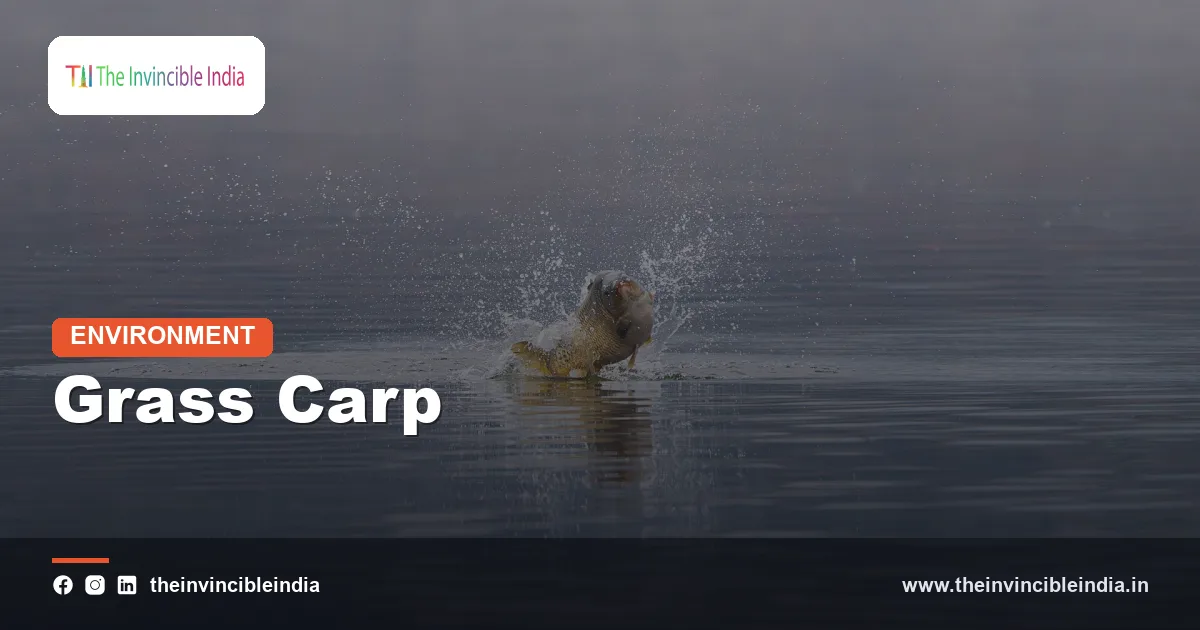
The grass carp (Ctenopharyngodon idella) is a large, fast-growing freshwater fish from eastern Asia that feeds mainly on aquatic plants and was introduced to India in the twentieth century for fish farming and weed control. Known in Indian aquaculture as the grass carp or “white amur”, the fish is one of the exotic carps raised alongside the native catla, rohu and mrigal in ponds across the country.
Unlike most carps, which eat plankton, insects or bottom debris, the grass carp is a true herbivore. That one trait explains why farmers value it, why pond managers use it against weeds, and why ecologists urge caution about releasing it into natural waters. This explainer covers its origin, appearance, diet, breeding, farming role and ecological risks.
| Common name | Grass carp (also white amur) |
|---|---|
| Scientific name | Ctenopharyngodon idella |
| Family | Cyprinidae (carps and minnows) |
| Size | Can exceed a metre in length and many kilograms in weight; farmed fish are usually harvested at one to a few kilograms |
| Native range | Large rivers of eastern Asia, including those of China and the Amur basin |
| Habitat in India | Farm ponds, tanks and some reservoirs, almost always stocked by people |
| Diet | Aquatic plants, soft vegetation and grass; young fish also eat small invertebrates |
| Breeding | Spawns in flowing river water; in India usually bred by hormone-induced spawning in hatcheries |
| Status | Widely farmed and not a conservation concern; considered a risk to wetlands where it is introduced |
Key Takeaways
- The grass carp is an exotic, plant-eating freshwater fish native to eastern Asia and introduced into India for aquaculture and weed control.
- Ctenopharyngodon idella belongs to the carp family Cyprinidae and is one of the world’s most widely farmed freshwater fish.
- Grass carp is a major component of composite carp culture in India, where it is stocked together with catla, rohu, mrigal, silver carp and common carp.
- Grass carp does not normally breed in still ponds, so Indian hatcheries produce seed by hormone-induced breeding.
- Grass carp can clear submerged weeds from a pond, but an overstocked pond can lose nearly all its plant life.
- Introducing grass carp into natural wetlands is discouraged because the fish can strip vegetation that other animals rely on.
What is the grass carp?
The grass carp is a large cyprinid fish that eats plants and has been spread by people to more than a hundred countries for aquaculture. In its native range in eastern Asia, it has been farmed for many centuries, and it is now one of the highest-volume fish species produced anywhere in the world.
In India, the fish is exotic, which means that it is not part of the country’s original fauna. It was brought to India for study and then for farming, and it quickly became part of pond culture because it uses a food source that the native carps do not, namely vegetation. Since it can be fed on grass, leaves and aquatic weeds, it lowers feed costs for small farmers.
What does a grass carp look like?
A grass carp has a long, rounded, torpedo-shaped body, a broad head with no barbels, and large scales that give it a slightly netted look. The upper body is usually olive to dark brown, the flanks are paler and the belly is light yellow or whitish. The fins are mostly greyish, and the mouth is wide and set at the front of the head.
Several features separate it from Indian major carps and other farmed fish:
- Body shape: more elongated and cylindrical than the deep-bodied catla.
- Mouth: terminal and without barbels, unlike the common carp, which has two pairs of barbels.
- Throat teeth: strong, comb-like teeth in the throat, called pharyngeal teeth, which shred leaves and stems. The genus name Ctenopharyngodon refers to these comb-like teeth.
- Size: in ponds, a well-fed fish can grow fast, and in large water bodies it can eventually become very big.
Where did the grass carp come from, and how did it reach India?
The grass carp is native to the large rivers of eastern Asia, and it reached India as a deliberate introduction in the late 1950s, brought in to broaden the choice of species available to fish farmers. Fisheries scientists at Indian research institutions studied the fish, learned to breed it in captivity in the following years and then distributed seed to states.
The introduction followed a global trend. In the middle of the twentieth century, many countries imported the fish to control aquatic weeds, to increase fish production from ponds and to use plants as a cheap source of feed. Today, the grass carp is found in countries across Asia, Europe, Africa and the Americas, in some places as a farmed fish and in others as an established or invasive species.
Since then, the fish has become routine in Indian aquaculture. Major producing regions include Andhra Pradesh, West Bengal, Odisha, Bihar, Punjab and Haryana, where it is raised in earthen ponds.
What does the grass carp eat?
The grass carp eats aquatic and terrestrial plants, preferring soft, tender vegetation, and it can consume a very large share of its body weight in plant material each day. Young fish feed on small invertebrates such as zooplankton and insect larvae, and then shift to plants as they grow.
Because the fish has a short gut and digests plants inefficiently, it eats a great deal and produces a lot of droppings. These droppings are rich in nutrients and fertilise the pond, which in turn supports plankton that other carps feed on. This is one of the reasons the grass carp works well in mixed culture.
Foods used in Indian ponds
- Fresh grasses and fodder crops cut and thrown into the pond.
- Aquatic weeds such as hydrilla, duckweed and other submerged plants.
- Leaves from vegetable crops and kitchen gardens.
- Supplementary feeds such as oilseed cake and rice bran, especially for young fish.
The grass carp tends to ignore tough or bitter plants. It does not control every type of weed equally well, and farmers often find that it clears some species but leaves others behind.
How does the grass carp breed?
The grass carp breeds by spawning in flowing river water during the rains, and it does not normally spawn in still ponds, so hatcheries rely on induced breeding. In the wild, mature fish migrate upstream and release eggs that drift with the current while they develop.
In India, the process works as follows:
- Mature males and females are selected from broodstock ponds shortly before the monsoon.
- Hormone injections, or synthetic hormones sold as commercial kits, stimulate ovulation and release of milt.
- Eggs and milt are mixed, and the fertilised eggs are placed in hatching tanks with flowing water.
- Larvae, called spawn, are moved to nursery ponds and reared to fry and fingerlings.
Grass carp mature in about two to five years, depending on temperature and feeding. Fish in warmer southern regions may mature earlier than fish in colder northern waters.
How is the grass carp used in Indian fish farming?
The grass carp is used in Indian fish farming as part of composite carp culture, in which several species with different feeding habits share one pond. This system makes full use of the pond’s food at all levels of the water.
| Species | Origin | Where it feeds | Main food |
|---|---|---|---|
| Catla | Native to India | Surface | Zooplankton |
| Silver carp | Exotic | Surface | Phytoplankton |
| Rohu | Native to India | Column | Plankton and plant matter |
| Grass carp | Exotic | Column and margins | Aquatic and terrestrial plants |
| Mrigal | Native to India | Bottom | Detritus and decaying matter |
| Common carp | Exotic | Bottom | Detritus, insects and worms |
In this system, the grass carp contributes in two ways: it grows into a marketable fish, and its droppings fertilise the pond. Farmers usually stock it at a small share of the total, since a high density would damage the pond’s plant life.
Can the grass carp really control weeds?
Yes, the grass carp can control certain submerged and soft aquatic weeds in ponds and canals, but results depend on stocking density, fish size and the type of weed. In irrigation canals and farm ponds where weeds block flow or crowd out fish, stocked grass carp can reduce plant growth without chemicals.
The method has limits. A stocking rate that is too low gives little effect, while a rate that is too high can leave water bare, cloudy and low in oxygen. Some plants are eaten only reluctantly, and large floating plants such as water hyacinth are generally less favoured than soft submerged species. Weed control by fish is therefore best seen as a management tool that needs monitoring, not a quick fix for every water body.
Is the grass carp harmful to the environment?
The grass carp can harm natural wetlands when it escapes or is released, because it removes aquatic vegetation that supports insects, young fish, amphibians and waterbirds. Loss of vegetation can raise water turbidity, change nutrient cycles and shift a clear-water wetland into a murky one.
Concerns raised by scientists include:
- Loss of habitat for native fish that spawn or shelter among plants.
- Reduced food and nesting cover for waterbirds.
- Competition with native fish for food in the early life stages.
- Escape from farm ponds into rivers during floods.
Indian fisheries authorities regulate the movement of exotic species, and responsible practice is to keep grass carp in enclosed ponds and not to release it into rivers, lakes or protected wetlands. In some countries, farmers use sterile fish, produced by chromosome manipulation, to avoid the risk of the fish establishing wild populations.
How is the grass carp eaten?
The grass carp is eaten across India and much of Asia as a food fish, and its firm white flesh is sold fresh in local markets. In eastern India, where freshwater fish is a staple, it is cooked in curries, fried as steaks or prepared in mustard-based dishes.
Some consumers consider the flesh a little bland and bony compared with rohu or catla, but its low price and fast growth keep it popular in many regions. The fish is also an affordable protein source for rural households that operate small ponds.
How is grass carp raised in a farm pond?
Grass carp is raised in a farm pond by preparing the pond, stocking fingerlings together with other carps, supplying fresh green fodder every day and harvesting after about one year or more. The method is simple enough for small farmers, and it has helped many rural families earn a living from a modest water body.
Typical steps
- Pond preparation: the pond is dried or treated, limed to correct acidity, and filled with fresh water; fertilisers such as cow dung are often added to encourage plankton for the other carps.
- Stocking: healthy fingerlings of several species are released at recommended densities, with the grass carp forming only a modest share of the total.
- Feeding: green fodder is cut and offered at a fixed place in the pond, usually once or twice daily, with the amount increased as the fish grow.
- Monitoring: farmers watch water colour, oxygen and fish behaviour, and remove uneaten leftovers that could rot.
- Harvest: fish are netted when they reach market size, which can be reached within about a year in warm water with good feeding.
Good water quality matters as much as feed. Because the grass carp produces large amounts of waste, ponds need regular checks to prevent oxygen shortages, especially on hot, cloudy days. Disease management and the use of certified seed from reliable hatcheries also reduce losses.
Grass carp seed is often transported in oxygen-filled bags to farms hundreds of kilometres away. This trade has created a network of hatcheries and nurseries, especially in eastern and southern India, that supplies millions of fry and fingerlings every season.
Bottom Line
The grass carp is an introduced herbivorous carp that has become a useful part of Indian pond aquaculture, thanks to its fast growth and plant diet. Its value comes with a responsibility: it should be kept in managed ponds, stocked with care and never released into natural wetlands.
Frequently Asked Questions
Is the grass carp native to India?
No, the grass carp is not native to India. It comes from the rivers of eastern Asia and was introduced into India in the late 1950s for aquaculture. It is now farmed in many states, mostly in ponds.
What does the grass carp eat?
The grass carp eats plants. It feeds on aquatic weeds, grasses and soft leafy vegetation, and young fish also take small invertebrates. Farmers often feed it cut grass and vegetable leaves.
Why is the grass carp called white amur?
The name “white amur” refers to the Amur river basin in eastern Asia, which is part of the fish’s native range. The “white” refers to the pale colour of the fish compared with some other carps. Grass carp is the more common name in India.
Can the grass carp breed in a pond?
No, the grass carp does not normally breed in still ponds. It needs flowing river-like conditions to spawn, so Indian hatcheries use hormone injections and controlled hatching tanks to produce seed.
Is the grass carp an invasive species?
The grass carp can become invasive where it escapes into natural waters. It eats large amounts of aquatic vegetation, which can damage habitat for native animals. In India it is mainly confined to farm ponds, but release into wild wetlands is discouraged.
How does the grass carp fit into composite carp culture?
The grass carp fills the plant-eating role in composite carp culture. It is stocked with catla, rohu, mrigal, silver carp and common carp, which feed in different parts of the pond. Together, these fish use the pond’s food efficiently.
{“@context”:”https://schema.org”,”@graph”:[{“@type”:”FAQPage”,”mainEntity”:[{“@type”:”Question”,”name”:”Is the grass carp native to India?”,”acceptedAnswer”:{“@type”:”Answer”,”text”:”No, the grass carp is not native to India. It comes from the rivers of eastern Asia and was introduced into India in the late 1950s for aquaculture. It is now farmed in many states, mostly in ponds.”}},{“@type”:”Question”,”name”:”What does the grass carp eat?”,”acceptedAnswer”:{“@type”:”Answer”,”text”:”The grass carp eats plants. It feeds on aquatic weeds, grasses and soft leafy vegetation, and young fish also take small invertebrates. Farmers often feed it cut grass and vegetable leaves.”}},{“@type”:”Question”,”name”:”Why is the grass carp called white amur?”,”acceptedAnswer”:{“@type”:”Answer”,”text”:”The name “white amur” refers to the Amur river basin in eastern Asia, which is part of the fish’s native range. The “white” refers to the pale colour of the fish compared with some other carps. Grass carp is the more common name in India.”}},{“@type”:”Question”,”name”:”Can the grass carp breed in a pond?”,”acceptedAnswer”:{“@type”:”Answer”,”text”:”No, the grass carp does not normally breed in still ponds. It needs flowing river-like conditions to spawn, so Indian hatcheries use hormone injections and controlled hatching tanks to produce seed.”}},{“@type”:”Question”,”name”:”Is the grass carp an invasive species?”,”acceptedAnswer”:{“@type”:”Answer”,”text”:”The grass carp can become invasive where it escapes into natural waters. It eats large amounts of aquatic vegetation, which can damage habitat for native animals. In India it is mainly confined to farm ponds, but release into wild wetlands is discouraged.”}},{“@type”:”Question”,”name”:”How does the grass carp fit into composite carp culture?”,”acceptedAnswer”:{“@type”:”Answer”,”text”:”The grass carp fills the plant-eating role in composite carp culture. It is stocked with catla, rohu, mrigal, silver carp and common carp, which feed in different parts of the pond. Together, these fish use the pond’s food efficiently.”}}]}]}


