

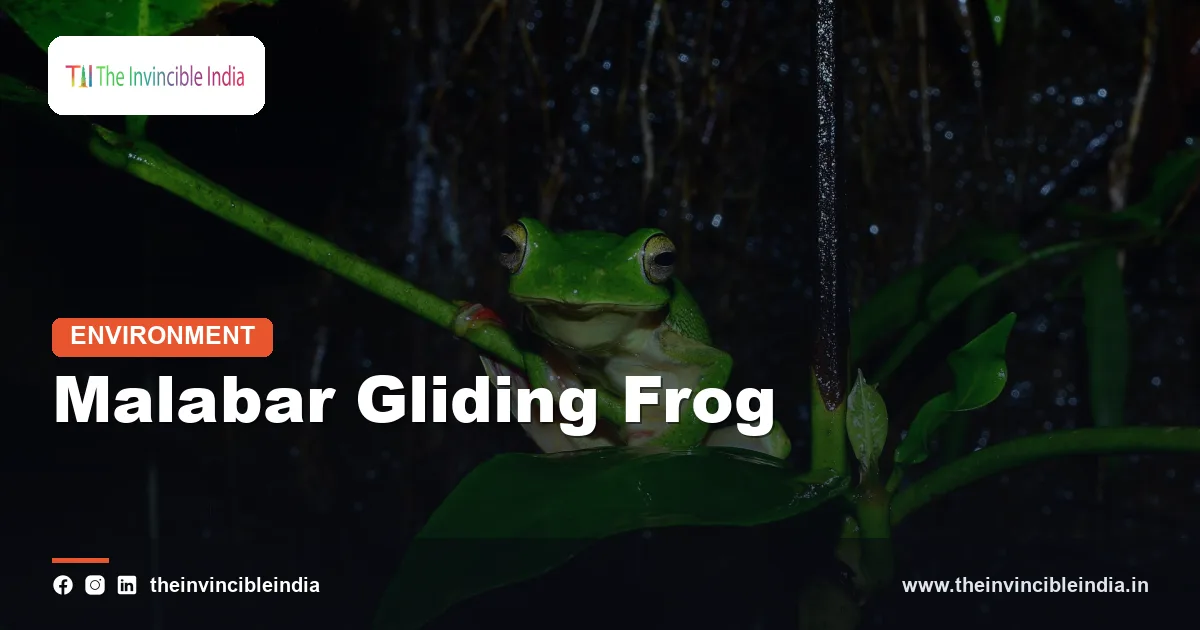
The Malabar gliding frog (Rhacophorus malabaricus) is a large, bright green tree frog of the Western Ghats that uses its big, fully webbed feet as parachutes to glide from tree to tree, and it lays its eggs in foam nests built on branches above water. Also called the Malabar flying frog, the species lives in the wet forests and plantations of southwestern India, and it spends nearly all of its life in the canopy rather than on the ground.
Few Indian amphibians combine so many unusual habits in one animal: night-time hunting, controlled falls through the air, and a breeding method that lets tadpoles drop from the treetops into a pool. This explainer covers what the Malabar gliding frog looks like, where it lives, how it glides, what it eats, how it breeds, and what threatens it.
| Common name | Malabar gliding frog (also Malabar flying frog) |
|---|---|
| Scientific name | Rhacophorus malabaricus, described by T. C. Jerdon in 1870 |
| Family | Rhacophoridae (Old World tree frogs, or shrub frogs) |
| Size | Roughly 7 to 10 cm in body length, with females larger than males |
| Range and habitat | Western Ghats of southwestern India; evergreen and semi-evergreen forest, forest edges and shaded plantations |
| Diet | Insects and other small invertebrates caught at night |
| Breeding | Monsoon season; eggs laid in a foam nest on vegetation overhanging a pool, tadpoles drop into the water |
| Lifestyle | Arboreal and nocturnal; glides rather than flies |
| Conservation status | Not regarded as globally threatened, but dependent on intact Western Ghats forest |
Key Takeaways
- The Malabar gliding frog is a large green tree frog of the Western Ghats that glides, rather than truly flies, using its enlarged webbed feet.
- Rhacophorus malabaricus belongs to the family Rhacophoridae and was scientifically described by the naturalist T. C. Jerdon in 1870.
- The Malabar gliding frog builds a foam nest on branches or leaves above water during the monsoon, and the hatched tadpoles fall into the pool below.
- Adult Malabar gliding frogs are nocturnal insect hunters that spend most of their lives in trees and rarely descend to the ground outside the breeding season.
- The survival of the Malabar gliding frog depends on tree cover and clean, seasonal pools, so forest loss in the Western Ghats is its main long-term concern.
- Gliding allows the Malabar gliding frog to cross gaps between trees and to escape danger without climbing down.
What does the Malabar gliding frog look like?
The Malabar gliding frog is a stocky, leaf-green frog with a pale yellowish or whitish underside, large eyes and very big feet. Adults reach roughly seven to ten centimetres in body length, and females are noticeably larger than males, which is common among tree frogs. The bright green back helps the animal blend into foliage during the day, when it rests pressed against leaves or bark.
The feature that gives the species its name is the feet. The toes are long and are joined by extensive webbing, so that each foot opens out like a small fan. The tips of the toes end in rounded, sticky discs that grip leaves, twigs and tree trunks. The hands are also webbed, although less extensively than the feet.
Other useful identification features
- Skin flaps: narrow fringes of skin along the forearms and heels add a little extra surface area when the limbs are spread.
- Eyes: large and forward-facing, which suits hunting by night and judging distance before a leap or glide.
- Skin: smooth above and granular on the belly, so that it clings well to wet surfaces.
- Colour change: like many tree frogs, an individual can appear a slightly different shade of green depending on light, temperature and activity.
Because several tree frogs share the Western Ghats, an observer should look at the combination of size, green colour and heavily webbed feet instead of relying on colour alone.
Where does the Malabar gliding frog live in India?
The Malabar gliding frog lives along the Western Ghats, the mountain chain that runs down the western side of peninsular India, and it is regarded as a Western Ghats specialist. Its name refers to the Malabar region of the southwest coast, although the frog is not limited to a single state. Records come from the forests of the southern and central Ghats, including parts of Kerala, Karnataka and Tamil Nadu.
The frog is found from the foothills up to mid-elevations, in roughly the range of a few hundred to about thirteen hundred metres in places. Its preferred habitat includes:
- Evergreen and semi-evergreen forest, where the canopy stays humid.
- Moist forest edges and clearings with scattered tall trees.
- Shade-grown plantations such as coffee, cardamom and areca, where tall trees and standing water are both present.
- Areas close to ponds, swamps, streams and water-filled hollows that stay wet through the monsoon.
Because the Western Ghats receive heavy monsoon rain, the Malabar gliding frog is adapted to a strong wet season followed by a drier period, during which adults stay hidden in humid refuges among the trees.
How does the Malabar gliding frog glide?
The Malabar gliding frog glides by jumping from a height, spreading its webbed toes and limbs wide, and using the increased surface area to slow its fall and steer in a controlled glide. It does not flap or generate lift like a bird or a bat. Instead, it behaves like a small, living parachute with some steering control.
During a glide the frog stretches out its legs, spreads its toes and holds its body flat. The webbing and skin flaps catch the air, so the animal travels forward as well as down, ending in a landing on a trunk or a branch where the sticky toe discs hold on. Researchers who study gliding amphibians generally find that the angle of descent is shallow compared with an ordinary fall, which allows a frog to cross a gap of several metres between trees.
Why glide at all?
- Saving energy: gliding is quicker and less tiring than climbing down one trunk and up another.
- Escaping predators: a sudden launch from a branch can carry the frog out of reach of a snake or other predator.
- Staying safe: a frog that remains in the canopy avoids ground-living predators and dry ground.
- Reaching breeding sites: gliding can help individuals travel between trees close to a breeding pool.
What does the Malabar gliding frog eat?
The Malabar gliding frog eats insects and other small invertebrates, which it catches at night on leaves, branches and tree trunks. Like other frogs, it is a sit-and-wait predator that waits in a suitable spot and uses a quick, sticky tongue to snatch prey that comes within range.
Typical prey includes moths, beetles, crickets, flies and other arthropods that are active in the canopy after dark. The frog needs a good supply of insects to fuel its breeding season, and the forest provides them in large numbers during the rains. In turn, the frog is food for snakes, birds, lizards and other predators, which makes it an important link in the forest food chain.
As a consumer of insects, the Malabar gliding frog also helps limit the numbers of many small invertebrates. Frogs are also widely used as indicators of environmental health, because their thin, permeable skin makes them sensitive to pollution and changes in humidity.
How does the Malabar gliding frog breed and build foam nests?
The Malabar gliding frog breeds during the monsoon, when a female and one or more males build a frothy foam nest on a branch or leaf that hangs over water. The pair or group whips the egg-laden fluid into a mass of foam, and the outer layer hardens into a crust while the inside stays moist.
The foam nest has several jobs. It protects the eggs from drying out in the open air, shields them from many aquatic predators and helps keep their temperature steady. After a few days the tadpoles develop inside the foam, and rain softens the nest so that the larvae slide out and fall into the pond, puddle or swamp beneath. This approach lets the species use small, temporary pools that would be risky for eggs laid directly in the water.
Stages of the life cycle
- Calling: males call at night near breeding pools to attract females.
- Nesting: the foam nest is built on vegetation, often a few metres above the water surface.
- Tadpole stage: tadpoles drop into the pool and feed and grow in the water.
- Metamorphosis: tadpoles develop legs, lose their tails and climb out as small froglets.
- Adult life: froglets move into the vegetation and later the canopy.
Why is the Malabar gliding frog active at night?
The Malabar gliding frog is active at night because cooler, humid darkness lowers the risk of drying out and reduces the number of visual predators. Frogs lose water through their skin, so a daytime in the open sun would be dangerous for them. By resting under leaves or against bark during the day and emerging after dusk, the frog keeps its skin moist.
At night, the frog climbs, hunts and, in the breeding season, calls. During dry weather adults tend to remain in humid spots, and they may become much harder to find. This is one reason why the species is not often seen by casual visitors, even in places where it is fairly common. Searches after rain, with a torch, along forest edges and plantation roads are the most likely to turn up an individual.
The nocturnal habit also explains why the frog is rarely noticed by people who walk through its forest during the day, even though it may be sleeping on a leaf only a few metres above their heads.
How is the Malabar gliding frog different from other gliding frogs?
The Malabar gliding frog differs from other gliding frogs mainly in its range, its size and its foam-nesting habit, even though many tree frogs in Asia share the same basic gliding approach. Several genera in the family Rhacophoridae have independently evolved large webbed feet and skin flaps, which is a good example of convergent evolution.
| Feature | Malabar gliding frog | Typical non-gliding tree frog |
|---|---|---|
| Feet | Large, extensively webbed | Small to moderate, less webbing |
| Movement between trees | Glides and leaps | Climbs and jumps |
| Nest | Foam nest above water | Varies; often eggs in water or in foliage |
| Home region | Western Ghats | Varies by species |
| Time of activity | Mainly at night | Often at night |
The Malabar gliding frog is related to other Indian tree frogs of the genus Rhacophorus and to the bush frogs of the Western Ghats, but it is distinguished by its larger size and its prominent webbing. A closely related species from the Anamalai hills was later separated from it on the basis of differences in appearance and genetics. This is a reminder that the Western Ghats hold many hidden species, and that names and ranges of frogs are still being refined.
Is the Malabar gliding frog threatened?
The Malabar gliding frog is not generally listed as globally threatened, but it depends on intact Western Ghats forest, so loss of tree cover is the main long-term risk. A species that lives in the canopy, breeds in seasonal pools and needs a humid climate can decline quickly when forest is cleared or fragmented.
The main concerns for the species and other Western Ghats amphibians include:
- Conversion of forest to monoculture plantations, farms and settlements.
- Fragmentation of forest, which breaks the connection between trees and pools.
- Draining or polluting of small ponds and swamps used for breeding.
- Pesticides and other chemicals, to which amphibian skin is especially sensitive.
- Changing rainfall and temperature patterns, which can disturb breeding.
- The fungal disease chytridiomycosis, which affects amphibians in many parts of the world.
The Western Ghats are recognised as a global biodiversity hotspot and a UNESCO World Heritage region, and many of their amphibians are found nowhere else. Protecting continuous forest and wetland corridors is the most effective way to keep the Malabar gliding frog and its neighbours in the wild.
How should people treat the Malabar gliding frog?
People should treat the Malabar gliding frog as a wild animal to be observed from a distance, without handling, collecting or moving it. Frog skin is delicate, and the oils, soaps and chemicals on human hands can harm it. Taking an individual out of its forest also removes a breeding animal from the population.
Good practice for anyone who finds one includes:
- Look with a gentle torch beam and avoid shining a bright light directly into the eyes for long periods.
- Stay on paths and do not damage foam nests or the branches that hold them.
- Avoid using insect repellent, sunscreen or soap near breeding ponds.
- Photograph without flash where possible, and do not tap or shake branches to make the frog glide.
- Record the sighting in a citizen-science platform if possible, so that scientists can follow the species.
Plantation owners can also help by keeping some tall native trees and small ponds in their estates. In this way, the Malabar gliding frog can continue to use the same landscape that people use for farming.
Bottom Line
The Malabar gliding frog is one of the most remarkable amphibians of the Western Ghats, combining a canopy lifestyle, a controlled glide and a foam nest above water. It is a reminder that India’s forests contain animals with extraordinary adaptations, and that these animals depend on the forest remaining whole.
Frequently Asked Questions
Can the Malabar gliding frog really fly?
No, the Malabar gliding frog cannot truly fly; it glides. It jumps from a height and spreads its webbed feet and limbs so that the air slows its fall and carries it forward. It does not flap, and it needs a height to launch from.
Where is the Malabar gliding frog found in India?
The Malabar gliding frog is found in the Western Ghats of southwestern India. It lives in evergreen and semi-evergreen forests, forest edges and shaded plantations, from the foothills to mid-elevations. It is a Western Ghats specialist and is not found across the rest of India.
How big is the Malabar gliding frog?
The Malabar gliding frog is a large tree frog of roughly seven to ten centimetres in body length. Females grow larger than males. The big, webbed feet make the animal look even larger than its body size suggests.
What is a foam nest and why does the Malabar gliding frog build one?
A foam nest is a frothy mass of eggs and fluid that the frogs whip up and attach to vegetation above water. The Malabar gliding frog builds one so that the eggs stay moist and protected from aquatic predators. When rain softens the foam, the tadpoles fall into the pool below.
What does the Malabar gliding frog eat?
The Malabar gliding frog eats insects and other small invertebrates. It hunts at night, sitting still on leaves or branches and snatching prey with its sticky tongue. Its diet includes moths, beetles and other canopy insects.
Is the Malabar gliding frog dangerous or poisonous to people?
No, the Malabar gliding frog is not dangerous to people. It is a shy, harmless animal that does not bite or sting. It should still not be handled, because human contact can injure the frog and spread chemicals or disease to it.
{“@context”:”https://schema.org”,”@graph”:[{“@type”:”FAQPage”,”mainEntity”:[{“@type”:”Question”,”name”:”Can the Malabar gliding frog really fly?”,”acceptedAnswer”:{“@type”:”Answer”,”text”:”No, the Malabar gliding frog cannot truly fly; it glides. It jumps from a height and spreads its webbed feet and limbs so that the air slows its fall and carries it forward. It does not flap, and it needs a height to launch from.”}},{“@type”:”Question”,”name”:”Where is the Malabar gliding frog found in India?”,”acceptedAnswer”:{“@type”:”Answer”,”text”:”The Malabar gliding frog is found in the Western Ghats of southwestern India. It lives in evergreen and semi-evergreen forests, forest edges and shaded plantations, from the foothills to mid-elevations. It is a Western Ghats specialist and is not found across the rest of India.”}},{“@type”:”Question”,”name”:”How big is the Malabar gliding frog?”,”acceptedAnswer”:{“@type”:”Answer”,”text”:”The Malabar gliding frog is a large tree frog of roughly seven to ten centimetres in body length. Females grow larger than males. The big, webbed feet make the animal look even larger than its body size suggests.”}},{“@type”:”Question”,”name”:”What is a foam nest and why does the Malabar gliding frog build one?”,”acceptedAnswer”:{“@type”:”Answer”,”text”:”A foam nest is a frothy mass of eggs and fluid that the frogs whip up and attach to vegetation above water. The Malabar gliding frog builds one so that the eggs stay moist and protected from aquatic predators. When rain softens the foam, the tadpoles fall into the pool below.”}},{“@type”:”Question”,”name”:”What does the Malabar gliding frog eat?”,”acceptedAnswer”:{“@type”:”Answer”,”text”:”The Malabar gliding frog eats insects and other small invertebrates. It hunts at night, sitting still on leaves or branches and snatching prey with its sticky tongue. Its diet includes moths, beetles and other canopy insects.”}},{“@type”:”Question”,”name”:”Is the Malabar gliding frog dangerous or poisonous to people?”,”acceptedAnswer”:{“@type”:”Answer”,”text”:”No, the Malabar gliding frog is not dangerous to people. It is a shy, harmless animal that does not bite or sting. It should still not be handled, because human contact can injure the frog and spread chemicals or disease to it.”}}]}]}


