

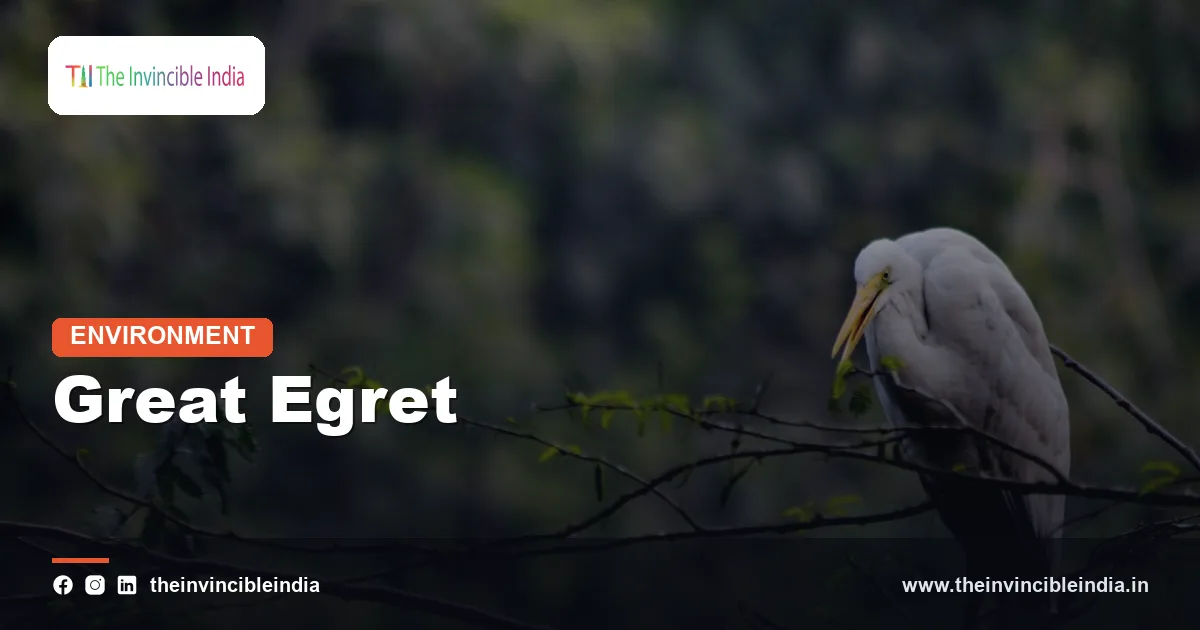
The great egret (Ardea alba) is a large, elegant, all-white heron with a long yellow bill, black legs and a sinuous S-shaped neck that stalks fish slowly in the shallows of lakes, rivers, marshes and paddy fields across India. It is the largest of the white egrets found in the country and is a familiar, graceful sight at almost every sizeable wetland.
Because several white herons share the Indian wetlands, the great egret is often confused with the intermediate egret and the little egret. This explainer describes how to identify the great egret, where it lives, how it hunts and breeds, how its breeding plumes shaped the history of bird protection, and what threatens it today. Figures are given as general ranges, since counts vary by year and by site.
| Attribute | Detail |
|---|---|
| Scientific name | Ardea alba (the Asian and Australasian form is often called Ardea alba modesta) |
| Family and order | Ardeidae (herons, egrets and bitterns); order Pelecaniformes |
| Typical length | About 80 to 104 cm, with a wingspan of roughly 130 to 170 cm |
| Typical weight | Roughly 0.7 to 1.5 kg |
| Key field marks | All white, long yellow bill, black legs and feet, gape line extending behind the eye |
| Breeding changes | Long, fine back plumes; bill darkens and the facial skin turns green |
| Status in India | Widespread resident with local movements and winter additions |
| Nesting | Colonial stick nests in trees or reedbeds; usually 3 to 4 pale blue-green eggs |
| Global conservation status | Least Concern on the IUCN Red List |
Key Takeaways
- The great egret (Ardea alba) is the largest white egret in India, standing about a metre long with a long yellow bill and black legs.
- The great egret is separated from the smaller intermediate egret by its larger size, longer neck and a gape line that extends behind the eye.
- Great egrets hunt by slow, deliberate stalking or by standing motionless in shallow water before striking at fish with their long, dagger-like bill.
- Breeding great egrets grow long, delicate back plumes called aigrettes, and the bill turns dark while the skin between bill and eye turns green.
- Demand for aigrettes in the plume trade of the late nineteenth century nearly wiped out egrets, and the great egret later became the emblem of the National Audubon Society in the United States.
- The IUCN lists the great egret as Least Concern, but wetland drainage, pollution and the felling of nesting trees can reduce local populations.
What does a great egret look like?
A great egret looks like a tall, slim, completely white heron with a long yellow bill, black legs and feet, and an unusually long neck that bends in a distinct kink. When the bird stands erect with the neck stretched, it can appear almost as tall as a grey heron, though much slimmer.
The key identification clue is the gape, the line of the mouth, which extends back past the eye. In the smaller intermediate egret the gape ends below the eye. The bare skin between the bill and the eye is yellowish most of the year, but turns bright green during the breeding season, when the bill turns mostly black.
Breeding adults grow long, fine plumes, known as aigrettes, that stream from the back and extend beyond the tail. Non-breeding birds lack these plumes and have a plain, clean appearance. Juveniles resemble non-breeding adults and have a yellow bill.
The sexes look alike, but males tend to be slightly larger. The overall impression is of an elegant, long-necked, rather angular bird, in contrast to the stockier look of the cattle egret.
Where is the great egret found in India?
The great egret is found across India in shallow freshwater, brackish and coastal wetlands, including lakes, rivers, reservoirs, marshes, paddy fields, estuaries and mangroves. It is widespread, though less common in very dry regions and at high altitude.
Typical Indian habitats include:
- Large freshwater lakes and reservoirs with shallow margins
- Marshes, jheels and floodplain wetlands
- Flooded paddy fields during the monsoon
- Estuaries, lagoons and mangroves such as the Sundarbans
- Slow rivers, canals and village ponds
Reserves such as Keoladeo National Park in Rajasthan, Chilika Lake in Odisha, Pulicat Lake on the Andhra Pradesh and Tamil Nadu border, and Ranganathittu Bird Sanctuary in Karnataka are often mentioned as places to see large egret colonies, but numbers depend on the year and the water level.
Worldwide, the great egret has one of the widest ranges of any heron, covering parts of the Americas, Europe, Africa, Asia and Australasia. Many taxonomists treat the Asian and Australasian form as a separate subspecies, and some treat it as a separate species called the eastern great egret.
How does the great egret hunt?
The great egret hunts by walking slowly through shallow water or standing still, then striking quickly with its long neck to seize fish and other prey in its sharp bill. The neck can extend and recoil in a fraction of a second.
- Slow stalking: the bird lifts each foot with care and places it softly to avoid scaring fish.
- Ambush: it stands motionless for long periods, especially near the edges of vegetation.
- Dusk feeding: activity continues into the evening and, at times, at night.
- Group foraging: egrets sometimes gather where fish are concentrated, such as in drying pools.
The great egret also uses a specialised neck vertebra that creates a natural kink. By releasing the kink, the bird shoots its head forward. The speed of the strike is a key reason why even quick fish are often caught.
What does the great egret eat?
The great egret eats mainly fish, and also frogs, tadpoles, aquatic insects, crustaceans, snakes, and sometimes small rodents and birds. Fish typically make up the largest part of the diet, and the bird can swallow fairly large fish whole.
As a predator of small and medium aquatic animals, the great egret plays a role in regulating populations in wetlands. In agricultural landscapes it will also hunt frogs and insects in flooded fields. Like other fish-eating birds, it can be unpopular with fish farmers, who sometimes use nets or other deterrents to protect ponds.
Because egrets feed in shallow water, drought or sudden changes in water level can reduce feeding opportunities. Healthy fish stocks and gently sloping banks are among the features that attract them.
How do great egrets breed?
Great egrets breed in colonies, building platforms of sticks in trees, shrubs or reeds, and in India the nesting season generally coincides with the monsoon, usually around June to October with regional variation. Nests are often placed in mixed heronries with herons, little egrets, cormorants, spoonbills, storks and ibises.
| Stage | Typical detail |
|---|---|
| Courtship | Plume-raising and neck-stretching displays; bill and facial skin change colour |
| Nest | Platform of sticks and twigs, built by both parents, often over water |
| Eggs | Usually 3 to 4, pale blue-green |
| Incubation | Roughly 23 to 26 days, shared by both parents |
| Chick period | Chicks fed by regurgitation; they fledge at around six to seven weeks |
| Colony type | Usually mixed with other waterbirds, in tall trees or dense reeds |
Chicks often compete fiercely for food, and in many nests the older chick dominates. In poor years, the smallest chick may die. These natural processes are normal, but human disturbance can make survival harder.
How can you tell a great egret from an intermediate egret?
A great egret is told from an intermediate egret mainly by its larger size, longer and more kinked neck, and a gape line that extends behind the eye. The intermediate egret is smaller, has a shorter bill and a neck that looks rounder and shorter.
| Feature | Great egret | Intermediate egret |
|---|---|---|
| Size | About 80 to 104 cm | Smaller, roughly 65 to 72 cm |
| Bill | Long, dagger-like, yellow | Shorter, yellow |
| Gape line | Extends behind the eye | Ends below the eye |
| Neck | Very long, with a pronounced kink | Shorter, often held in a smooth curve |
| Feeding style | Slow stalking in deeper shallows | More active, in shallower water or fields |
The little egret is easier to separate: it is much smaller, with a black bill and yellow feet. The cattle egret is stocky and has a short thick bill. Such comparisons are best made when birds stand side by side, which often happens at heronries.
Why is the great egret a symbol of bird conservation?
The great egret is a symbol of bird conservation because its breeding plumes were so heavily hunted for hat fashions that it became a rallying point for early protection movements, and it was adopted as the emblem of the National Audubon Society in the United States. The story is one of the best-known cases of public opinion changing the fate of a wild species.
In the late nineteenth century, plumes were sometimes worth a great deal and hunters destroyed colonies, killing adults at nests while the young starved. Campaigns by naturalists and bird societies led to laws restricting the trade in many countries, and populations recovered in many regions once the hunting stopped.
In India, wild birds are protected under the Wildlife (Protection) Act, 1972, which prohibits hunting and trade. The act has been amended several times, so for the exact schedule of any species the current listing from the Ministry of Environment, Forest and Climate Change should be consulted.
Is the great egret a migratory bird?
The great egret is partly migratory worldwide, and in India it is mainly a resident that moves locally with water levels, with numbers swelling in winter. Birds disperse to new wetlands after breeding and gather where fish are plentiful.
Northern populations in other parts of the world migrate to warmer regions. In India, local movements occur between inland and coastal wetlands and between seasonal marshes and permanent lakes. Winter often brings larger numbers to the northern plains, though the origin of these birds is not always clear.
Waterbird surveys, such as the Asian Waterbird Census coordinated with the help of volunteers, record counts of egrets and help show trends. Such surveys depend on trained counters and consistent methods, so any one year’s numbers should be treated with caution.
Is the great egret threatened in India?
The great egret is not globally threatened, as the IUCN rates it Least Concern, but in India its colonies are exposed to wetland loss, pollution, disturbance and the felling of nesting trees. Because it relies on shallow, fish-rich water, it is sensitive to changes in water quality and level.
- Drainage, filling and encroachment of wetlands
- Pollution by sewage, pesticides and industrial waste
- Felling or lopping of heronry trees during the breeding season
- Disturbance by boats, people and dogs near colonies
- Entanglement in fishing nets and discarded line
- Over-extraction of water that dries out shallow feeding areas
Local communities can play a decisive role. In some parts of India, villagers guard nesting trees and treat the birds as a source of pride, which has kept colonies alive for decades.
How can you watch great egrets responsibly?
The best way to watch great egrets is to visit wetlands at dawn or dusk, use binoculars from a distance and avoid disturbing nesting colonies. The bird is wary and can be flushed by approaching too closely.
- Look along the edges of lakes, marshes and paddy fields in the early morning.
- Note the gape line and neck length to separate the species from other egrets.
- Photograph from a distance with a long lens rather than approaching.
- Avoid playback of calls and flash near nests.
- Do not litter, and remove fishing line when it is safe to do so.
Bottom Line
The great egret is a tall, elegant white heron that is widespread across India’s wetlands and remains common today. Its history as a victim of the plume trade makes it a lasting symbol of bird protection. Clean shallow water, intact nesting trees and undisturbed heronries are what keep the great egret flourishing.
Frequently Asked Questions
How big is a great egret?
A great egret is about 80 to 104 cm long with a wingspan of roughly 130 to 170 cm. It is the largest white egret found in India. Despite its height it weighs only about one kilogram or a little more.
How can I tell a great egret from an intermediate egret?
A great egret is larger and has a longer, more kinked neck, and its gape line extends behind the eye. The intermediate egret is smaller with a shorter bill, and its gape ends below the eye. Seeing both together makes the difference obvious.
Why does the great egret’s bill change colour?
The great egret’s bill changes colour because of breeding hormones. For most of the year the bill is yellow, but during the breeding season it turns mostly black and the skin between bill and eye turns bright green. Long back plumes also grow at this time.
What does a great egret eat?
A great egret eats mainly fish, along with frogs, insects, crustaceans, small snakes and occasionally rodents. It hunts by stalking slowly or waiting motionless in shallow water and then striking with its long bill. It can swallow fairly large fish whole.
Is the great egret found in India all year?
Yes, the great egret is present in India throughout the year as a resident, with local movements and some winter additions. Numbers at any given wetland change with water levels and the breeding season. It is widespread across most regions.
Is the great egret protected in India?
Yes, wild birds in India are protected under the Wildlife (Protection) Act, 1972, which prohibits hunting, capture and trade. Schedule placements have been revised by amendments, so the current schedules should be checked for precise legal status. The IUCN rates the great egret as Least Concern globally.
{“@context”:”https://schema.org”,”@graph”:[{“@type”:”FAQPage”,”mainEntity”:[{“@type”:”Question”,”name”:”How big is a great egret?”,”acceptedAnswer”:{“@type”:”Answer”,”text”:”A great egret is about 80 to 104 cm long with a wingspan of roughly 130 to 170 cm. It is the largest white egret found in India. Despite its height it weighs only about one kilogram or a little more.”}},{“@type”:”Question”,”name”:”How can I tell a great egret from an intermediate egret?”,”acceptedAnswer”:{“@type”:”Answer”,”text”:”A great egret is larger and has a longer, more kinked neck, and its gape line extends behind the eye. The intermediate egret is smaller with a shorter bill, and its gape ends below the eye. Seeing both together makes the difference obvious.”}},{“@type”:”Question”,”name”:”Why does the great egret’s bill change colour?”,”acceptedAnswer”:{“@type”:”Answer”,”text”:”The great egret’s bill changes colour because of breeding hormones. For most of the year the bill is yellow, but during the breeding season it turns mostly black and the skin between bill and eye turns bright green. Long back plumes also grow at this time.”}},{“@type”:”Question”,”name”:”What does a great egret eat?”,”acceptedAnswer”:{“@type”:”Answer”,”text”:”A great egret eats mainly fish, along with frogs, insects, crustaceans, small snakes and occasionally rodents. It hunts by stalking slowly or waiting motionless in shallow water and then striking with its long bill. It can swallow fairly large fish whole.”}},{“@type”:”Question”,”name”:”Is the great egret found in India all year?”,”acceptedAnswer”:{“@type”:”Answer”,”text”:”Yes, the great egret is present in India throughout the year as a resident, with local movements and some winter additions. Numbers at any given wetland change with water levels and the breeding season. It is widespread across most regions.”}},{“@type”:”Question”,”name”:”Is the great egret protected in India?”,”acceptedAnswer”:{“@type”:”Answer”,”text”:”Yes, wild birds in India are protected under the Wildlife (Protection) Act, 1972, which prohibits hunting, capture and trade. Schedule placements have been revised by amendments, so the current schedules should be checked for precise legal status. The IUCN rates the great egret as Least Concern globally.”}}]}]}


