

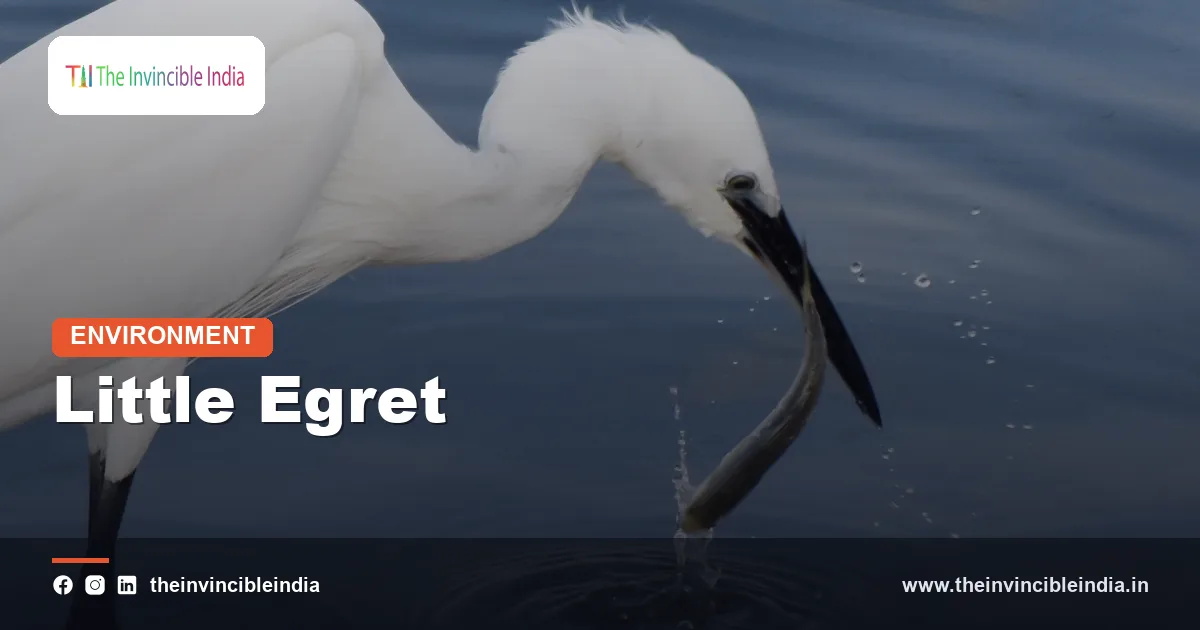
The little egret (Egretta garzetta) is a small, slender, snow-white heron with a thin black bill, black legs and bright yellow feet that actively chases fish and frogs in shallow water, and it is one of the most common and widespread egrets in India. It is a resident across much of the country, seen on ponds, rivers, paddy fields, tidal creeks and coastal mudflats.
The little egret is easy to confuse with other white herons, so this explainer shows how to identify it, how it hunts, when it breeds and why it was once hunted almost to local extinction for its feathers. It also covers how the little egret differs from the cattle egret, the intermediate egret and the great egret. Numbers are given only in general terms because counts vary by year and site.
| Attribute | Detail |
|---|---|
| Scientific name | Egretta garzetta |
| Family and order | Ardeidae (herons, egrets and bitterns); order Pelecaniformes |
| Typical length | About 55 to 65 cm, with a wingspan of roughly 88 to 106 cm |
| Typical weight | Roughly 350 to 550 g |
| Key field marks | All-white plumage, slim black bill, black legs, yellow feet |
| Breeding plumes | Two long nape plumes plus lacy plumes on the back and breast |
| Status in India | Common and widespread resident, with local movements |
| Nesting | Colonial stick nests in trees, mangroves or reeds; usually 3 to 5 pale blue-green eggs |
| Global conservation status | Least Concern on the IUCN Red List |
Key Takeaways
- The little egret (Egretta garzetta) is a small white heron, about 55 to 65 cm long, with a black bill, black legs and yellow feet.
- Little egrets hunt actively, stirring the mud with a foot, running through shallows and flicking their wings to flush fish and frogs.
- Breeding little egrets grow two long plumes on the nape and delicate lacy plumes on the back and breast, which were once heavily sought for the millinery trade.
- The plume trade of the late nineteenth and early twentieth centuries pushed several egret species to the brink and helped spur early bird-protection laws and conservation movements.
- Little egrets nest in mixed colonies called heronries, building stick platforms in trees, mangroves or reeds, often with other herons, cormorants and ibises.
- The IUCN classes the little egret as Least Concern, and it remains a common sight across India, though wetland loss threatens local populations.
What does a little egret look like?
A little egret looks like a small, graceful, entirely white heron with a long thin black bill, slim black legs and conspicuous yellow feet. The yellow feet, often described as golden slippers, are the most reliable feature for separating it from other white herons.
The bare skin between the bill and the eye, known as the lores, is greyish or yellowish for most of the year. In the breeding season, the lores can turn pinkish or reddish, and adults grow a pair of long, thin plumes at the back of the head, with long lacy plumes on the back and a spray on the breast. After breeding, the plumes are shed and the bird looks plainer.
Juveniles lack plumes and show duller yellowish-green legs and a paler base to the bill. The sexes look alike. The neck is slender and is usually held in an S-curve, and the overall build is lighter and more delicate than that of the great egret.
The species is small compared with most herons, but it has a long, agile, energetic look. In bright sunlight, the white plumage can appear dazzling against dark water.
Where is the little egret found in India?
The little egret is found throughout India, in nearly every kind of shallow wetland, from village ponds and paddy fields to rivers, lakes, marshes, estuaries, mangroves and mudflats. It is common at both inland and coastal sites and adapts easily to human-modified habitats.
Typical Indian habitats include:
- Village tanks, irrigation canals and flooded paddy fields
- Freshwater lakes, reservoirs and slow rivers
- Tidal creeks, saltpans, estuaries and mudflats
- Mangroves, including those of the Sundarbans and the peninsular coasts
- Urban lakes and water bodies that still hold fish
Globally, the little egret breeds across parts of Europe, Africa, Asia and Australasia, and it has been extending its range northwards in Europe in recent decades. Within India it is largely resident, but numbers at individual sites rise and fall with water levels and with the arrival of winter visitors from further north.
How does the little egret hunt?
The little egret hunts by actively pursuing prey in shallow water, using techniques that include foot-stirring, running, wing-flicking and standing still. This active style differs from the patient waiting of larger herons such as the grey heron.
- Foot-stirring: the bird vibrates one yellow foot in the mud or water to disturb prey, which it then grabs.
- Running and dashing: the egret sprints through the shallows, sometimes with wings half open, to chase small fish.
- Wing-flicking: the bird flicks its wings or shades the water to attract prey or reduce glare.
- Standing and waiting: it sometimes freezes at the edge of a pool and strikes when a fish passes.
- Following animals: little egrets occasionally forage near buffalo, cattle or other birds that stir up prey.
Some researchers suggest that the bright yellow feet may act as a lure, attracting small fish to the stirred area, although this idea is not firmly established. What is clear is that the egret uses its feet deliberately and that the technique works.
What does the little egret eat?
The little egret eats mainly small fish, frogs, tadpoles, aquatic insects, crustaceans, molluscs and worms. It generally takes prey smaller than that taken by larger herons, so it is able to feed in shallow puddles and thin water where bigger birds would not.
In paddy fields the egret catches insects, frogs and fish fry. On coastal mudflats it takes small crabs, shrimps and gobies. Because it eats many insects and small invertebrates, it is often seen as helpful in agricultural landscapes, although its diet is not limited to pests.
Predators of adult little egrets include large raptors and, occasionally, mammals such as jackals or mongooses. Eggs and chicks are taken by crows, snakes, monitor lizards and other nest predators.
When do little egrets breed?
Little egrets breed in colonies, and in India the nesting season is generally tied to the monsoon, often from around June to September, though timing differs by region and local rainfall. Breeding is easy to notice because the adult plumes and the coloured bare parts appear at this time.
| Stage | Typical detail |
|---|---|
| Courtship | Display at the nest site with plumes raised, neck stretched and lores brightly coloured |
| Nest | Platform of sticks and twigs in trees, mangroves or reeds, built by both parents |
| Eggs | Usually 3 to 5, pale blue-green |
| Incubation | Roughly three weeks, shared by both parents |
| Chick period | Chicks are fed by regurgitation and leave the nest after around a month |
| Colony type | Mixed heronry with other egrets, herons, cormorants, spoonbills or ibises |
Little egret heronries are often placed in trees near villages, in mangroves, or in waterside groves. In many parts of India, communities have traditionally protected these trees, and the colony brings noise and droppings but also fertile soil and a sense of local pride.
Why were egrets once hunted for their feathers?
Egrets were hunted because their breeding plumes, known as aigrettes, were highly fashionable in women’s hats in the late nineteenth and early twentieth centuries, and plume hunters shot nesting birds, leaving chicks to starve. The trade devastated colonies of several egret species around the world.
The outcry against this slaughter became one of the early drivers of the bird-conservation movement. In the United Kingdom and the United States, campaigns by bird societies helped lead to laws restricting the plume trade, and organisations such as the Audubon societies were built partly around the cause. India also had a large feather trade during colonial times, with plumes exported from the subcontinent.
Today, wild birds in India are protected from hunting and trade under the Wildlife (Protection) Act, 1972, whose schedules have been modified by later amendments. Anyone needing the precise legal listing of a specific species should check the current schedules. The recovery of egret numbers shows how legal protection and habitat conservation can restore a species.
How is the little egret different from other white herons?
The little egret differs from other white herons mainly in its small size, black bill, black legs and yellow feet. Other white herons that look similar in India include the cattle egret, the intermediate egret, the great egret and the western reef egret.
| Bird | Size | Bill | Legs and feet |
|---|---|---|---|
| Little egret | Small, about 55 to 65 cm | Slim and black | Black legs, yellow feet |
| Cattle egret | Small and stocky | Short, thick, yellow | Dark to yellowish legs; buff plumes when breeding |
| Intermediate egret | Medium | Short, yellow, with a gape line ending below the eye | Mostly black legs and feet |
| Great egret | Large, about 80 to 104 cm | Long, yellow; black when breeding | Black legs and feet |
| Western reef egret | Similar to the little egret | Heavier, often yellowish-brown | Thick, dark legs, often yellowish feet; also has a dark grey form |
The western reef egret mainly occupies coastal habitats and has a dark grey morph, so a coastal white egret needs careful checking. The black bill and fine build usually favour the little egret.
Is the little egret a migratory bird?
The little egret is mostly a resident in India, but it makes local movements and is joined by migrants from colder regions in winter. Water levels, breeding needs and food supply drive these movements, so numbers at any one wetland change through the year.
Elsewhere in the world, some populations migrate, such as birds breeding in northern and central parts of the range, which move south in autumn. Indian birds are best regarded as partial or local migrants, often dispersing after breeding and returning to colonies in the next season.
Because the species is common and adaptable, it is often one of the first waterbirds to colonise new ponds, reservoirs and restored wetlands.
Is the little egret under threat?
The little egret is not threatened globally, since the IUCN rates it Least Concern, but in India it faces pressure from wetland loss, pollution, tree felling at heronries and disturbance. A healthy national population does not remove the need to protect nesting trees and shallow wetlands.
- Filling of ponds and marshes for housing and roads
- Pollution of water by sewage, plastics and chemicals
- Felling and lopping of nesting trees during the breeding season
- Entanglement in fishing line and nets
- Pesticide contamination of prey
- Collision with wires and structures
Conservation of heronries often succeeds when local people are involved. Protecting a few large trees can safeguard hundreds of nests.
How can you watch little egrets?
The best way to watch little egrets is to visit a shallow wetland in the morning, stand back from the water’s edge with binoculars and observe the bird’s feeding style. Look for the yellow feet and listen for the soft croaks and rattles from heronries.
- Choose paddy fields, pond edges, creeks or lagoons with shallow water.
- Watch for foot-stirring, quick dashes and wing-flicking.
- Check the bill and feet colour to separate it from other egrets.
- Keep well away from nesting colonies and avoid flash photography there.
- Take litter home, especially fishing line and plastic bags.
Bottom Line
The little egret is a small, white, active heron with black legs and yellow feet that is common across India’s shallow wetlands. Its history, from the plume trade to modern legal protection, shows that conservation can work. Protecting village ponds, mangroves and nesting trees is the simplest way to keep little egrets common.
Frequently Asked Questions
How can I identify a little egret?
A little egret is a small white heron with a thin black bill, black legs and bright yellow feet. The yellow feet are the best clue for separating it from other white herons. Breeding birds also have long nape plumes and lacy back plumes.
What is the difference between a little egret and a cattle egret?
The little egret has a thin black bill, black legs and yellow feet, while the cattle egret has a short, thick yellow bill and a stockier body. The cattle egret often follows grazing animals in dry fields. In the breeding season, the cattle egret develops buff-orange plumes on the head, chest and back.
Is a little egret the same as a great egret?
No, the little egret and the great egret are different species. The great egret is much larger, with a long yellow bill and black feet, while the little egret is small with a black bill and yellow feet. Both are in the family Ardeidae.
What does a little egret eat?
A little egret eats small fish, frogs, tadpoles, insects, crustaceans, molluscs and worms. It hunts actively by stirring mud with its feet, running in shallows and flicking its wings. It can feed in very shallow water where larger herons cannot.
Why were egrets hunted for their feathers?
Egrets were hunted because their breeding plumes, called aigrettes, were prized as hat decorations in the late nineteenth and early twentieth centuries. Hunters killed adults at their nests, leaving chicks to starve. The resulting outcry helped create bird-protection laws and conservation societies.
Is the little egret protected in India?
Yes, wild birds in India are protected under the Wildlife (Protection) Act, 1972, which prohibits hunting, capture and trade. Schedule placements have been revised by amendments, so the current schedules should be checked for exact details. Globally, the little egret is rated Least Concern by the IUCN.
{“@context”:”https://schema.org”,”@graph”:[{“@type”:”FAQPage”,”mainEntity”:[{“@type”:”Question”,”name”:”How can I identify a little egret?”,”acceptedAnswer”:{“@type”:”Answer”,”text”:”A little egret is a small white heron with a thin black bill, black legs and bright yellow feet. The yellow feet are the best clue for separating it from other white herons. Breeding birds also have long nape plumes and lacy back plumes.”}},{“@type”:”Question”,”name”:”What is the difference between a little egret and a cattle egret?”,”acceptedAnswer”:{“@type”:”Answer”,”text”:”The little egret has a thin black bill, black legs and yellow feet, while the cattle egret has a short, thick yellow bill and a stockier body. The cattle egret often follows grazing animals in dry fields. In the breeding season, the cattle egret develops buff-orange plumes on the head, chest and back.”}},{“@type”:”Question”,”name”:”Is a little egret the same as a great egret?”,”acceptedAnswer”:{“@type”:”Answer”,”text”:”No, the little egret and the great egret are different species. The great egret is much larger, with a long yellow bill and black feet, while the little egret is small with a black bill and yellow feet. Both are in the family Ardeidae.”}},{“@type”:”Question”,”name”:”What does a little egret eat?”,”acceptedAnswer”:{“@type”:”Answer”,”text”:”A little egret eats small fish, frogs, tadpoles, insects, crustaceans, molluscs and worms. It hunts actively by stirring mud with its feet, running in shallows and flicking its wings. It can feed in very shallow water where larger herons cannot.”}},{“@type”:”Question”,”name”:”Why were egrets hunted for their feathers?”,”acceptedAnswer”:{“@type”:”Answer”,”text”:”Egrets were hunted because their breeding plumes, called aigrettes, were prized as hat decorations in the late nineteenth and early twentieth centuries. Hunters killed adults at their nests, leaving chicks to starve. The resulting outcry helped create bird-protection laws and conservation societies.”}},{“@type”:”Question”,”name”:”Is the little egret protected in India?”,”acceptedAnswer”:{“@type”:”Answer”,”text”:”Yes, wild birds in India are protected under the Wildlife (Protection) Act, 1972, which prohibits hunting, capture and trade. Schedule placements have been revised by amendments, so the current schedules should be checked for exact details. Globally, the little egret is rated Least Concern by the IUCN.”}}]}]}


