

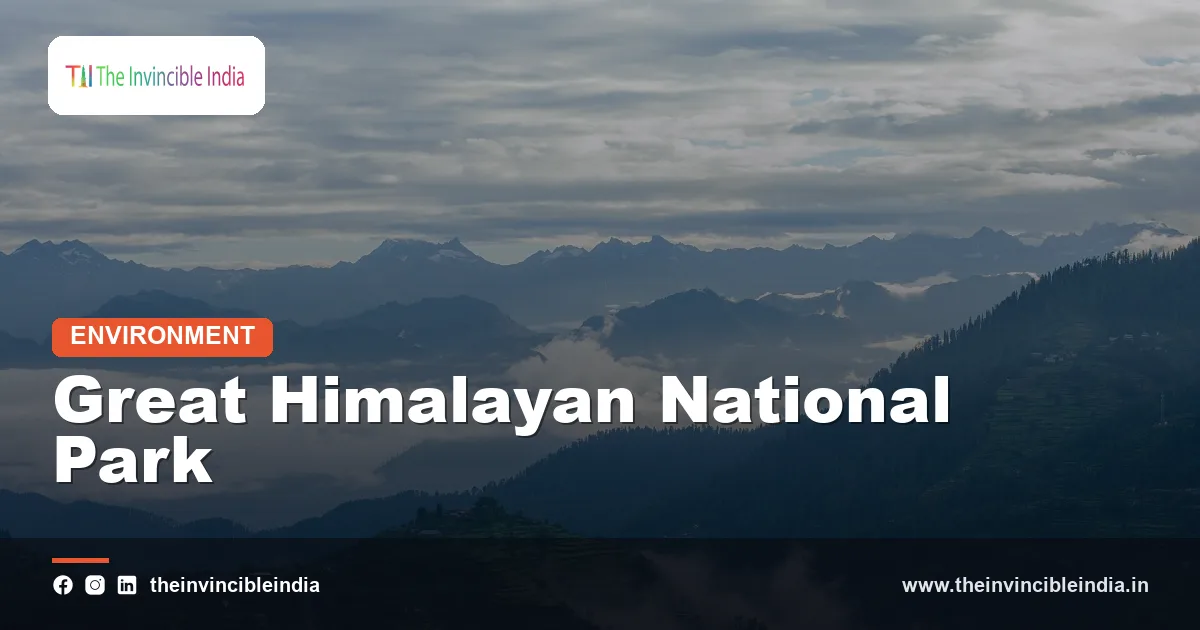
The Great Himalayan National Park is a protected area in the Kullu district of Himachal Pradesh that safeguards a rugged stretch of western Himalayan forest, alpine meadow, glacier and snow peak, and it was inscribed as a UNESCO World Heritage Site in 2014 for its outstanding biodiversity. Rising from mid-elevation forest to summits above 5,000 metres, it is one of the last large, intact blocks of high-altitude habitat in the western Himalaya and a refuge for species that have vanished from much of their former range.
This explainer covers the park from an ecological and conservation point of view: where it lies, how its glacial valleys and life zones are arranged, which animals and plants it protects, why UNESCO recognised it, how local villagers were brought into its management, and what threatens it today. It was last reviewed on 2 November 2026.
| Attribute | Detail |
|---|---|
| Location | Kullu district, Himachal Pradesh, in the Western Himalaya |
| Protection status | National park notified in 1999; UNESCO World Heritage Site since 2014 |
| Core area | Roughly 750 sq km of national park, with adjoining Tirthan and Sainj wildlife sanctuaries |
| World Heritage property | About 1,170 sq km including the core and a surrounding buffer zone |
| Altitude range | From roughly 1,500 metres to above 6,000 metres |
| Main river systems | Tirthan, Sainj, Jiwa Nal and Parvati, all tributaries of the Beas |
| Flagship species | Western tragopan, Himalayan brown bear, snow leopard, Himalayan musk deer, Himalayan tahr, bharal |
| UNESCO criterion | Criterion (x), significant habitats for in-situ conservation of biodiversity |
| Management | Himachal Pradesh Forest Department, with community participation through ecodevelopment |
Key Takeaways
- The Great Himalayan National Park lies in the Kullu district of Himachal Pradesh and protects headwater valleys of the Beas river basin.
- It became a UNESCO World Heritage Site in 2014 under criterion (x), recognising its value as habitat for threatened Himalayan wildlife.
- Its altitude range of several thousand metres packs temperate forest, subalpine forest, alpine meadow and glaciers into one landscape.
- Flagship species include the western tragopan, a threatened pheasant, along with the Himalayan brown bear, snow leopard and musk deer.
- A long ecodevelopment programme replaced traditional grazing and collection rights with alternative livelihoods, and it remains central to how the park is managed.
- Main pressures include grazing, collection of medicinal herbs, hydropower and road construction around the edges, and climate change.
Where Is the Great Himalayan National Park and How Big Is It?
The Great Himalayan National Park sits in the Seraj and Banjar regions of the Kullu district in Himachal Pradesh, on the western flank of the Greater Himalaya where the main range bends towards the outer hills. The national park proper covers roughly 750 square kilometres, and it is managed together with the neighbouring Tirthan and Sainj wildlife sanctuaries and a surrounding ecozone.
When the World Heritage property was defined, it included the national park and a buffer, giving a total of about 1,170 square kilometres. The wildlife sanctuaries and the ecozone act as a cushion between fully protected habitat and the villages, orchards and roads of the lower valleys.
The park does not stand alone. To its north and east it connects with other high-altitude protected areas of Himachal Pradesh, including the Pin Valley National Park and the Rupi Bhaba, Kais and Manali sanctuaries. Together they form a broad belt of protected land across the western Himalaya, which matters because large mammals such as snow leopards and bears need space far larger than any single reserve.
What Makes the Landscape of the Great Himalayan National Park Unique?
The landscape is unique because it combines steep glacial valleys, permanent ice and an unusually wide vertical range of habitat in a place that people have altered only lightly. The terrain is a maze of deep gorges, knife-edged ridges, hanging valleys and high cirques carved by glaciers over many thousands of years.
Most of the park’s rivers begin as glacial melt and snowmelt on its upper slopes. The Tirthan, the Sainj and the Jiwa Nal each drain their own valley before joining the Beas system, while the Parvati drains the northern margin. Because they start high and drop fast, these streams run cold, clear and oxygen-rich, which supports aquatic life such as trout and many insect larvae. Pressed between steep ridges, the valleys are narrow, and the slopes above them are often too precipitous for grazing or farming, which has left large areas almost untouched.
The result is a landscape that scientists value as a reference ecosystem. When researchers want to know what a western Himalayan forest or meadow looks like with limited human disturbance, they can compare degraded areas elsewhere with places such as these.
What Habitats and Life Zones Does the Park Contain?
The park contains a sequence of habitats stacked on the mountainside by altitude, from broadleaf and conifer forest at the base to alpine meadows, rock and permanent ice at the top. Each zone has its own plants, animals and seasonal rhythm.
The lower slopes carry temperate forests of oak, particularly ban oak and kharsu oak, mixed with maple, horse chestnut and other broadleaf trees. Higher up, coniferous forest of deodar, blue pine, spruce and fir takes over. Above this, stunted birch and rhododendron mark the treeline, where the forest thins into subalpine scrub. At still higher elevations lie alpine meadows, locally called thach, which burst into flower during the short summer and carry a rich cover of herbs, grasses and dwarf shrubs. Beyond the meadows, bare rock, scree and glaciers form the nival zone.
The park holds hundreds of plant species, including many used in traditional medicine. The mix of forest types makes a patchwork of habitats close together, so animals can move up and down with the seasons, following food and escaping snow. This altitudinal movement is one of the most important ecological processes in the park, and protecting a continuous altitude gradient is a key reason the area was chosen for World Heritage status.
| Zone | Approximate elevation | Typical vegetation | Typical wildlife |
|---|---|---|---|
| Temperate forest | About 1,500 to 2,500 m | Oak, maple, horse chestnut, mixed broadleaf | Leopard, Himalayan black bear, serow, goral, cheer pheasant |
| Coniferous forest | About 2,500 to 3,200 m | Deodar, blue pine, spruce, fir | Western tragopan, Himalayan monal, koklass pheasant, musk deer |
| Subalpine forest and scrub | About 3,200 to 3,600 m | Birch, rhododendron, juniper | Himalayan brown bear, Himalayan tahr, musk deer |
| Alpine meadows | About 3,600 to 4,500 m | Grasses, herbs, dwarf shrubs | Bharal, snow leopard, marmot, Himalayan snowcock |
| Nival zone | Above about 4,500 m | Rock, scree, lichens, glaciers | Occasional snow leopard and high-altitude birds |
Which Wildlife Lives in the Great Himalayan National Park?
The Great Himalayan National Park shelters dozens of mammal species, well over a hundred bird species and a large number of insects, reptiles and amphibians, including several that are globally threatened. It is better known for the quality of its habitat than for easy sightings, because most large animals are shy and live in remote, steep terrain.
The mammals include the snow leopard, the Himalayan brown bear, the Himalayan black bear, the common leopard, the Himalayan musk deer, the Himalayan tahr, the bharal or blue sheep, the goral, the serow and the Himalayan marmot. Predators such as the leopard and the snow leopard sit at the top of the food chain, and their presence signals a functioning ecosystem with enough prey.
Bird life is especially rich. Pheasants form a group of particular interest, and the park holds the western tragopan, the Himalayan monal, the koklass pheasant, the cheer pheasant and the Himalayan snowcock. Other residents include the lammergeier and other raptors, and several species that migrate up and down the mountain. Insects, including a diverse butterfly fauna, and small amphibians contribute to a food web that is still poorly documented, so new records can still turn up.
Why Is the Western Tragopan Important to the Park?
The western tragopan is important because it is one of the rarest pheasants in the world, it is classified as Vulnerable by the IUCN, and the Great Himalayan National Park holds one of its few remaining strongholds. The male is a striking bird with a red and black body spotted with white, and a bright blue throat patch that it inflates during display.
The species lives only in a narrow band of the western Himalaya, from northern Pakistan through Kashmir to Himachal Pradesh and Uttarakhand, and it favours dense, old forest with a thick understorey of rhododendron and bamboo between roughly 2,000 and 3,500 metres. This is exactly the belt where forests have been cut and fragmented elsewhere, so the bird has declined across its range.
Conservationists use the western tragopan as an indicator species. When its numbers hold steady, it suggests that mid-altitude forest, one of the most heavily pressured habitats in the Himalaya, is in good condition. Wildlife monitoring in the park has tracked its calls in spring, when males advertise from the forest, to estimate numbers. Protecting the bird means protecting its whole habitat, from the forest floor where it nests to the shrub layer where it feeds on leaves, buds and berries.
What Large Mammals and Predators Live at High Altitude?
The high-altitude zone supports the snow leopard, the Himalayan brown bear, the Himalayan tahr, the bharal and the musk deer, forming a classic Himalayan food chain from grazers to carnivores. These animals depend on alpine meadows and steep rocky ground that offers both food and escape terrain.
The snow leopard is a solitary hunter of cliffs and ridgelines that preys mostly on bharal, tahr and smaller animals such as marmots. It is classified as Vulnerable globally and is rarely seen, so its presence is usually confirmed through camera traps, pugmarks and scrapes. The Himalayan brown bear is another elusive resident. It spends the winter in hibernation and, in summer, forages on roots, grasses and carrion in alpine meadows. Livestock killing by bears and leopards causes conflict in the neighbouring villages, which is one reason local support matters.
The Himalayan musk deer is a small, antlerless deer of forest and scrub. Its males carry a musk pod that has long been prized in perfumery and traditional medicine, which made the species a target of poaching, and it is now protected under Indian law and listed as Endangered. The Himalayan tahr, a wild goat, and the bharal, often called blue sheep, are the main prey of snow leopards. Healthy numbers of these grazers depend on meadows that are not overgrazed by domestic sheep and goats.
Why Did UNESCO Make It a World Heritage Site?
UNESCO inscribed the Great Himalayan National Park as a World Heritage Site in June 2014 because it protects outstanding examples of habitat for the conservation of biodiversity, meeting natural criterion (x). The decision recognised the park as a rare intact sample of western Himalayan ecosystems, with an unusually wide range of altitude and species in a compact area.
The World Heritage Committee noted that the property sits in a region that is a recognised global biodiversity hotspot, the Himalaya, and that it holds high numbers of threatened species, including several found only in this part of the world. The inscription was also based on the strength of its legal protection and management, and the fact that local communities no longer exercise traditional rights inside the core area.
World Heritage status does not change who owns or administers the land. The park continues to be managed by the Himachal Pradesh Forest Department under Indian wildlife law. What the status adds is international recognition, a duty to report on the condition of the site, and a stronger case for funding, scientific attention and careful review of any large project nearby.
How Were Local Communities Involved in Conservation?
Local communities were brought into conservation through an ecodevelopment programme that offered alternative livelihoods in exchange for giving up grazing, herb collection and hunting inside the protected core. This approach is one of the most studied examples in India of balancing strict protection with the needs of mountain villages.
Before the park was notified, villagers in the surrounding valleys used the high pastures for summer grazing of sheep and goats, collected medicinal plants and wild mushrooms, and sometimes hunted. As protection tightened in the 1990s, these rights were reviewed and later ended inside the core. Because these activities were an important source of income, an ecodevelopment project supported by international funding was designed to cushion the loss.
Its elements included village-level planning, new income from sources such as handicrafts, small enterprises, improved agriculture and nature-based work, and village committees to help manage the surrounding ecozone. The programme met with mixed reactions. Some villagers gained from new opportunities, while others felt the loss of traditional access to the high forests and pastures was not fully compensated. Researchers continue to study how well it worked, and the lessons are widely discussed in debates about people and protected areas across the Himalaya.
What Threatens the Great Himalayan National Park?
The main threats to the Great Himalayan National Park are pressure from livestock grazing and plant collection along its boundaries, infrastructure such as hydropower and roads in the valleys around it, and the slow effects of climate change on snow, glaciers and forests. Fragile mountain ecosystems recover slowly from any disturbance.
Grazing by domestic animals in the buffer areas and the unregulated harvest of high-value medicinal herbs and fungi can reduce food for wild herbivores and damage meadow vegetation. Hydropower projects on the Beas, Parvati and Sainj rivers, together with the roads, tunnels and transmission lines that serve them, bring blasting, debris and workers into landscapes that were once remote. Their effect on river ecology, slope stability and wildlife movement is an ongoing concern, and heritage reviews have asked for careful monitoring of the surrounding area.
Climate change is a slower but wider threat. Glaciers across the western Himalaya are retreating, snow cover is changing and the treeline may shift upward over time. Species adapted to cold, high ground, including the snow leopard and the tragopan, have little room to move if their habitat is squeezed. Natural hazards such as landslides and flash floods are also a risk, and the monsoon season in the region has seen damaging events in recent years.
How Is the Park Protected and Managed Today?
The park is protected under the Wildlife (Protection) Act, 1972, which prohibits hunting, grazing, collection and other extractive use inside a national park. The Himachal Pradesh Forest Department runs patrols, wildlife monitoring and ecodevelopment work, supported by scientific partners and local committees.
Management combines enforcement with research. Field teams survey birds and mammals through calls, camera traps and transects, and these records allow managers to track whether populations are stable. The zoning of the area into a strictly protected core, sanctuaries and an ecozone allows a gradient of use, with the strictest rules where wildlife is most sensitive.
Conservation here is also shaped by wider policy. The park is part of the national network of Himalayan protected areas, and it falls within the framework of India’s wildlife and forest laws and the World Heritage Convention. Success depends on keeping rivers free-flowing, avoiding fragmented habitat, and maintaining the goodwill of the surrounding villages that live with the park every day.
Bottom Line
The Great Himalayan National Park is a World Heritage landscape in Himachal Pradesh whose value lies in intact altitude gradients, headwater rivers and threatened species such as the western tragopan and snow leopard. It also stands as a long-running test of how strict protection can be combined with village livelihoods, and its future depends on managing the pressures that gather around its edges.
Frequently Asked Questions
Where is the Great Himalayan National Park located?
The Great Himalayan National Park is located in the Kullu district of Himachal Pradesh, in the western Himalaya. It covers the upper valleys of the Tirthan, Sainj, Jiwa Nal and Parvati rivers, all feeding the Beas basin. Altitudes range from roughly 1,500 metres to above 6,000 metres.
When did the Great Himalayan National Park become a UNESCO World Heritage Site?
The park was inscribed as a UNESCO World Heritage Site in June 2014. It was listed under natural criterion (x) for its significant habitats for conserving biodiversity, including threatened species. The listed property includes the national park and a surrounding buffer zone.
Which animals are found in the Great Himalayan National Park?
The park shelters the snow leopard, Himalayan brown bear, Himalayan black bear, leopard, musk deer, Himalayan tahr, bharal, goral and serow. Its pheasants include the western tragopan, Himalayan monal, koklass and cheer pheasant. Many are shy and live in remote, steep terrain, so they are seldom seen.
Why is the western tragopan important?
The western tragopan is one of the world’s rarest pheasants and is classified as Vulnerable by the IUCN. It lives only in dense mid-altitude forests of the western Himalaya, a habitat that has been heavily cut elsewhere. The park holds one of its key strongholds, so the bird is used as an indicator of forest health.
What is the ecodevelopment programme at the park?
Ecodevelopment is a programme that gave villagers alternative livelihoods in return for ending grazing, hunting and herb collection inside the protected core. It included village planning, small enterprises, improved agriculture and local committees. Its results were mixed, and it is still studied as an example of balancing conservation and community needs.
What are the biggest threats to the park?
The main threats are grazing and plant collection near the boundaries, hydropower and road building in the surrounding valleys, and climate change affecting snow, glaciers and forests. Landslides and flash floods add natural hazards. Careful monitoring and strong protection of the buffer areas are needed to keep the ecosystem intact.
{“@context”:”https://schema.org”,”@graph”:[{“@type”:”FAQPage”,”mainEntity”:[{“@type”:”Question”,”name”:”Where is the Great Himalayan National Park located?”,”acceptedAnswer”:{“@type”:”Answer”,”text”:”The Great Himalayan National Park is located in the Kullu district of Himachal Pradesh, in the western Himalaya. It covers the upper valleys of the Tirthan, Sainj, Jiwa Nal and Parvati rivers, all feeding the Beas basin. Altitudes range from roughly 1,500 metres to above 6,000 metres.”}},{“@type”:”Question”,”name”:”When did the Great Himalayan National Park become a UNESCO World Heritage Site?”,”acceptedAnswer”:{“@type”:”Answer”,”text”:”The park was inscribed as a UNESCO World Heritage Site in June 2014. It was listed under natural criterion (x) for its significant habitats for conserving biodiversity, including threatened species. The listed property includes the national park and a surrounding buffer zone.”}},{“@type”:”Question”,”name”:”Which animals are found in the Great Himalayan National Park?”,”acceptedAnswer”:{“@type”:”Answer”,”text”:”The park shelters the snow leopard, Himalayan brown bear, Himalayan black bear, leopard, musk deer, Himalayan tahr, bharal, goral and serow. Its pheasants include the western tragopan, Himalayan monal, koklass and cheer pheasant. Many are shy and live in remote, steep terrain, so they are seldom seen.”}},{“@type”:”Question”,”name”:”Why is the western tragopan important?”,”acceptedAnswer”:{“@type”:”Answer”,”text”:”The western tragopan is one of the world’s rarest pheasants and is classified as Vulnerable by the IUCN. It lives only in dense mid-altitude forests of the western Himalaya, a habitat that has been heavily cut elsewhere. The park holds one of its key strongholds, so the bird is used as an indicator of forest health.”}},{“@type”:”Question”,”name”:”What is the ecodevelopment programme at the park?”,”acceptedAnswer”:{“@type”:”Answer”,”text”:”Ecodevelopment is a programme that gave villagers alternative livelihoods in return for ending grazing, hunting and herb collection inside the protected core. It included village planning, small enterprises, improved agriculture and local committees. Its results were mixed, and it is still studied as an example of balancing conservation and community needs.”}},{“@type”:”Question”,”name”:”What are the biggest threats to the park?”,”acceptedAnswer”:{“@type”:”Answer”,”text”:”The main threats are grazing and plant collection near the boundaries, hydropower and road building in the surrounding valleys, and climate change affecting snow, glaciers and forests. Landslides and flash floods add natural hazards. Careful monitoring and strong protection of the buffer areas are needed to keep the ecosystem intact.”}}]}]}


