

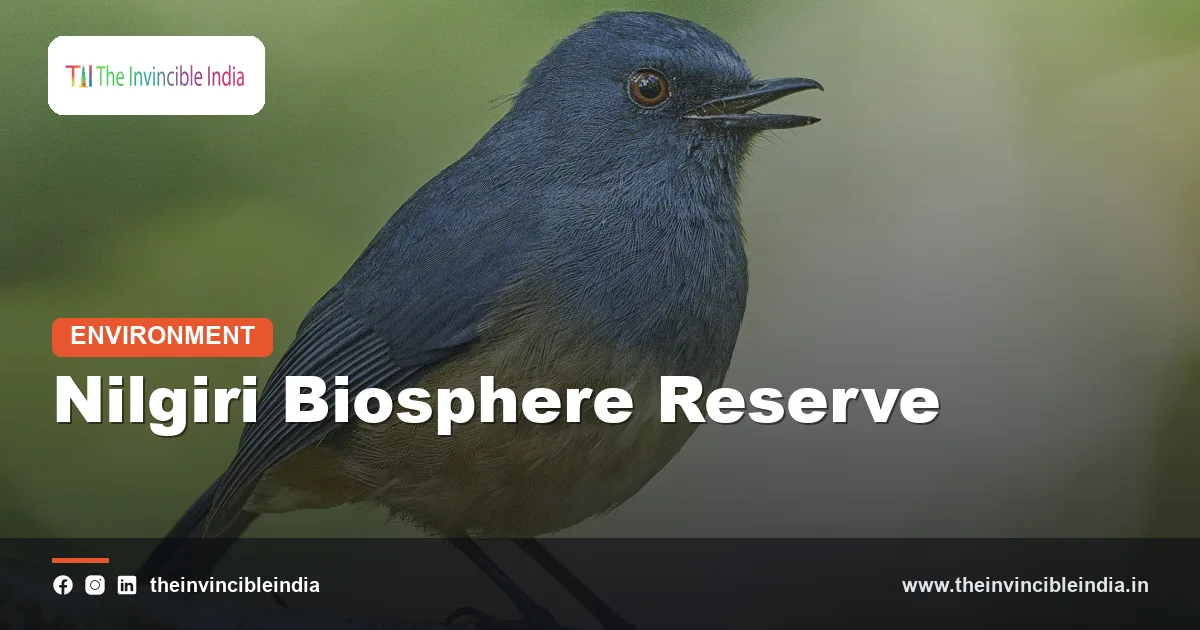
The Nilgiri Biosphere Reserve was the first biosphere reserve to be established in India, in 1986, and it is a vast mosaic of forests, grasslands and plantations spread across the Western Ghats in Tamil Nadu, Kerala and Karnataka. It was set up to conserve one of the richest living landscapes on the Indian subcontinent, and it joins several well-known wildlife areas into a single connected conservation unit of more than 5,000 square kilometres.
This explainer covers the reserve from an ecological and conservation standpoint: what a biosphere reserve is, where the Nilgiri reserve lies, how its habitats are arranged, which animals and plants it protects, how its elephant and tiger populations are linked, who lives inside it, and what challenges it faces. It was last reviewed on 2 November 2026.
| Attribute | Detail |
|---|---|
| Established | September 1986, India’s first biosphere reserve |
| UNESCO network | Part of the UNESCO Man and the Biosphere World Network of Biosphere Reserves since 2000 |
| States | Tamil Nadu, Kerala and Karnataka |
| Area | About 5,500 sq km |
| Altitude range | From roughly 250 metres to about 2,600 metres |
| Protected areas inside | Mudumalai, Bandipur, Nagarhole, Wayanad, Silent Valley, Mukurthi and Nilambur forest areas |
| Key habitats | Tropical evergreen forest, moist and dry deciduous forest, thorn scrub, shola forest and montane grassland |
| Flagship species | Asian elephant, tiger, Nilgiri tahr, lion-tailed macaque, Nilgiri langur |
| Local communities | Toda, Kota, Irula, Kurumba, Paniya, Kattunayakan and others |
Key Takeaways
- The Nilgiri Biosphere Reserve was India’s first biosphere reserve, notified in 1986, and it spans three southern states.
- It links several national parks and sanctuaries, including Mudumalai, Bandipur, Nagarhole, Wayanad, Silent Valley and Mukurthi, into one large conservation landscape.
- Its altitude range, from dry plains to cool, misty peaks, creates habitats from thorn scrub to evergreen forest and shola-grassland.
- Flagship species include the Asian elephant, the tiger, the Nilgiri tahr and the lion-tailed macaque, several of them endemic to the Western Ghats.
- Like all biosphere reserves, it is organised into core, buffer and transition zones so that people can live and work alongside conservation.
- Main concerns are habitat fragmentation, invasive plants, plantations, human-elephant conflict and climate change in the high shola grasslands.
What Is a Biosphere Reserve?
A biosphere reserve is a protected landscape designated under the UNESCO Man and the Biosphere Programme to conserve biodiversity while allowing sustainable human use and scientific research in the surrounding area. Unlike a national park, which is meant mainly to exclude human activity, a biosphere reserve is planned around the idea that people are part of the landscape.
Each biosphere reserve is divided into three connected zones. The core zone is strictly protected and is usually an existing national park or sanctuary. The buffer zone surrounds the core and allows activities that are compatible with conservation, such as research, education and some traditional use. The transition zone is the outermost belt, where farms, plantations, villages and towns operate under sustainable practices.
In India, biosphere reserves are designated by the central government and later may be nominated to the UNESCO network. The designation is a planning and cooperation framework rather than a separate piece of legislation, so the protection of the core areas comes from the Wildlife (Protection) Act, 1972 and other forest laws.
Where Is the Nilgiri Biosphere Reserve and What Does It Cover?
The Nilgiri Biosphere Reserve lies where the Western Ghats meet the Eastern Ghats around the Nilgiri hills, and it takes in forest across the Nilgiri, Wayanad, Malappuram, Palakkad and Chamarajanagar regions of three states. It covers about 5,500 square kilometres, making it one of the largest protected landscapes in southern India.
Its core areas include Mudumalai National Park and the Mukurthi National Park in Tamil Nadu, Silent Valley National Park and parts of the Nilambur and Wayanad forests in Kerala, and Bandipur and Nagarhole in Karnataka. Joining these units under one framework means wildlife can be studied and managed across state lines, which is important for animals that wander across borders.
The reserve also reaches into the Attappadi area and the Siruvani hills, and it surrounds the Nilgiri plateau, home to the hill towns of Ooty and Coonoor. The plateau itself is a high, rolling highland that has been heavily altered by tea, vegetable farming and settlement, while the slopes around it keep much more natural cover.
What Habitats Make the Nilgiri Biosphere Reserve So Diverse?
The Nilgiri Biosphere Reserve is diverse because it spans a steep climate gradient: heavy rainfall and evergreen forest on the western, Arabian Sea-facing slopes, and drier, rain-shadow forest and scrub on the eastern side. Altitude then adds another layer of variety, from warm lowlands to cool, windswept uplands.
On the western flank, moist evergreen and semi-evergreen forests grow tall and dense in places such as the Silent Valley. Further east, rainfall falls sharply, and moist deciduous forest gives way to dry deciduous forest and thorn scrub in areas such as Mudumalai and Bandipur. Rainfall differences within a short distance can be dramatic, which explains why such different forests lie so close together.
At higher elevations, the signature habitat is the shola-grassland mosaic. Shola forests are small pockets of dense, stunted evergreen forest that fill sheltered folds in the hills, and rolling montane grasslands lie between them. Together they form a distinctive ecosystem found only on the higher hills of southern India, and they act as sponges, soaking up monsoon rain and releasing it gradually into streams.
| Habitat | Where it is found | Notable species |
|---|---|---|
| Tropical wet evergreen forest | Western slopes, including Silent Valley | Lion-tailed macaque, Nilgiri langur, Malabar giant squirrel |
| Moist deciduous forest | Mid-elevation slopes of Wayanad and Mudumalai | Elephant, gaur, sambar, tiger |
| Dry deciduous forest and thorn scrub | Eastern rain-shadow areas of Mudumalai and Bandipur | Elephant, chital, leopard, dhole |
| Shola forest | Sheltered folds above about 1,800 m | Nilgiri marten, Nilgiri laughingthrush, Nilgiri flycatcher |
| Montane grassland | Open high plateaus such as Mukurthi | Nilgiri tahr, Nilgiri pipit |
Which Animals Are Protected in the Nilgiri Biosphere Reserve?
The reserve protects some of the largest populations of Asian elephants and tigers in India, along with many Western Ghats endemics such as the Nilgiri tahr, the lion-tailed macaque and the Nilgiri langur. Its connected habitat makes it a stronghold for wide-ranging mammals.
The Nilgiri landscape is considered to hold one of the largest surviving populations of Asian elephants in the world, forming part of a greater elephant landscape that stretches into the Eastern Ghats. Tigers, leopards, dholes, gaur, sloth bears, sambar and chital are also present, and the large herbivores support a healthy set of carnivores. The tiger reserves in and around the area, including Bandipur, Nagarhole, Mudumalai and Wayanad, are among the best known in the country.
The Nilgiri tahr is a stocky mountain goat that lives on steep grassy cliffs and is found only in the Western Ghats. It is classified as Endangered, and Mukurthi National Park was established mainly to protect it. The lion-tailed macaque is an arboreal monkey of rainforest canopy, found only in the Western Ghats, and Silent Valley holds one of its important populations. The Nilgiri langur and the Nilgiri marten are other species with restricted ranges, and the Nilgiri laughingthrush and the Nilgiri wood pigeon are among the endemic birds of the high forests.
What Plants and Forest Types Grow in the Reserve?
The reserve holds thousands of plant species, including many endemic flowering plants, orchids, medicinal herbs and wild relatives of crops such as pepper, cardamom and banana. This richness reflects the long isolation of the Western Ghats and the variety of climates inside the reserve.
The wet evergreen forests hold tall trees, thick lianas, epiphytes and ferns, while the high shola forests contain small, gnarled trees with leathery leaves adapted to wind, cold and mist. The grasslands between shola patches hold tussock grasses, herbs and flowering shrubs, including species of Strobilanthes, a group that famously flowers in synchronised mass blooms across southern hills at long intervals.
Plant diversity also includes species of direct human use. Many local communities collect honey, fruits, fibres and medicinal plants from the forests, and the genetic diversity of wild crop relatives is valuable for future plant breeding. The Silent Valley forest, in particular, is regarded as one of the least disturbed tropical evergreen forests in the Western Ghats.
How Does the Reserve Connect Elephant and Tiger Habitats?
The reserve connects elephant and tiger habitats by linking several large protected areas through forest corridors, so animals can move between Mudumalai, Bandipur, Wayanad and Nagarhole and onward into the Eastern Ghats. Large mammals travel long distances in search of water, food and mates, and cut-off patches cannot support healthy populations over time.
A corridor is a strip of habitat that links larger blocks of forest. In the Nilgiris, important corridors cross areas shared with villages, resorts, roads and plantations. One well-known example is the Sigur plateau corridor, where elephant movement between the Western Ghats and Eastern Ghats passes through a mix of forest and settlements. Court orders and state action have in recent years addressed construction and resort pressure in such corridors.
Maintaining connectivity is as important as protecting each park, because the biggest risk to a large animal population is isolation. Roads, railway lines and night traffic on highways that cut through forest, such as those crossing Bandipur and Mudumalai, increase the chance of collisions, and fences or barriers can block movement. Management therefore focuses on keeping corridors open, regulating traffic and reducing conflict where elephants enter fields.
Who Lives Inside the Nilgiri Biosphere Reserve?
The Nilgiri Biosphere Reserve is home to several indigenous communities, including the Toda, Kota, Irula, Kurumba, Paniya and Kattunayakan, whose traditional knowledge and livelihoods have long been tied to the forests and grasslands. This is what separates a biosphere reserve from a strict wilderness reserve.
The Toda are a pastoral people of the high Nilgiri plateau, known for their buffalo herds and distinctive barrel-vaulted huts, and their culture is closely tied to the shola-grassland landscape. The Kota were traditionally craftspeople, while the Irula, Kurumba and Kattunayakan have long relied on forest produce, honey collection and tracking skills. Many of these groups are recognised as scheduled tribes, and some are classed as particularly vulnerable tribal groups.
Alongside indigenous communities live plantation workers, farmers and townspeople who arrived in the colonial era and after. Tea, coffee, cardamom and vegetable farming transformed much of the landscape. Balancing the rights of forest-dwelling communities with wildlife protection, and the demands of agriculture and tourism with ecological limits, is a continuing task for managers.
What Threatens the Nilgiri Biosphere Reserve?
The main threats are habitat fragmentation, invasive plants, conversion of land to plantations and construction, human-elephant conflict and climate change. Each of these reduces the quality of habitat or the ability of animals to move between patches.
Invasive species are a major problem on the plateau. Plantations of exotic trees such as wattle, eucalyptus and pine, together with invasive shrubs such as Lantana and Scotch broom, have spread into native grasslands and degraded shola edges. Removing exotic trees and restoring native grassland and shola cover is now a stated goal in several protected areas.
Human-wildlife conflict is another daily reality. Elephants raid crops, and leopards and tigers sometimes take livestock, which can lead to retaliation, injury and loss of life. Rising temperatures and shifting rainfall may squeeze high-altitude species such as the Nilgiri tahr and the shola birds into smaller areas, because they cannot move higher than the summit. Illegal construction, sand mining, and unregulated resorts on corridor land add further pressure.
How Is the Reserve Managed and Conserved Today?
The reserve is managed through the forest departments of the three states, with the core protected areas governed by the Wildlife (Protection) Act, 1972 and several of them functioning as tiger reserves under Project Tiger. A coordination framework links the states and research institutions, because wildlife does not respect state boundaries.
Conservation work includes anti-poaching patrols, habitat restoration, monitoring of tigers and elephants through camera traps and counts, and programmes to manage conflict, such as early warning systems and compensation for losses. Many projects also focus on restoring native grassland by removing exotic trees, and on involving local communities in monitoring and eco-development.
The wider setting also matters. The reserve forms part of the larger Western Ghats, which are recognised internationally as a global biodiversity hotspot and include several UNESCO World Heritage components. The headwaters of important rivers, including the Bhavani, Moyar and Kabini, rise in these hills, so protecting the forest also protects the water supply of millions of people downstream.
Bottom Line
The Nilgiri Biosphere Reserve shows how a connected network of parks, corridors and community lands can protect large animals, endemic species and high-altitude ecosystems at once. As India’s first biosphere reserve, it remains a benchmark for landscape-scale conservation, and its future depends on keeping corridors open, controlling invasive species and sharing the landscape fairly with the people who live there.
Frequently Asked Questions
When was the Nilgiri Biosphere Reserve established?
The Nilgiri Biosphere Reserve was established in September 1986 and was the first biosphere reserve in India. It joined the UNESCO World Network of Biosphere Reserves in 2000. It covers about 5,500 square kilometres across Tamil Nadu, Kerala and Karnataka.
Which states does the Nilgiri Biosphere Reserve cover?
It covers parts of Tamil Nadu, Kerala and Karnataka. Protected areas inside it include Mudumalai and Mukurthi in Tamil Nadu, Silent Valley and Wayanad in Kerala, and Bandipur and Nagarhole in Karnataka. This joint arrangement lets wildlife be managed across state borders.
What animals live in the Nilgiri Biosphere Reserve?
The reserve is home to Asian elephants, tigers, leopards, gaur, dholes, sloth bears and many deer, along with Western Ghats endemics such as the Nilgiri tahr, lion-tailed macaque and Nilgiri langur. It also supports a rich bird life, including endemic birds of the high shola forests.
What is a shola-grassland ecosystem?
A shola-grassland ecosystem is a mosaic of small patches of dense evergreen forest, called sholas, set within rolling montane grassland on the higher hills of southern India. The sholas fill sheltered valleys while grasses cover the open slopes. The system stores rainwater and releases it slowly into streams.
What is the difference between a biosphere reserve and a national park?
A national park is a strictly protected area in which human activity is largely prohibited. A biosphere reserve is a larger landscape that includes protected core areas, a buffer zone and a transition zone where people live and work sustainably. National parks often form the core of a biosphere reserve.
What are the main threats to the Nilgiri Biosphere Reserve?
The main threats are habitat fragmentation, invasive plants and exotic plantations, construction on elephant corridors, human-wildlife conflict and climate change. High-altitude species such as the Nilgiri tahr are especially vulnerable to warming. Restoring native vegetation and keeping corridors open are key responses.
{“@context”:”https://schema.org”,”@graph”:[{“@type”:”FAQPage”,”mainEntity”:[{“@type”:”Question”,”name”:”When was the Nilgiri Biosphere Reserve established?”,”acceptedAnswer”:{“@type”:”Answer”,”text”:”The Nilgiri Biosphere Reserve was established in September 1986 and was the first biosphere reserve in India. It joined the UNESCO World Network of Biosphere Reserves in 2000. It covers about 5,500 square kilometres across Tamil Nadu, Kerala and Karnataka.”}},{“@type”:”Question”,”name”:”Which states does the Nilgiri Biosphere Reserve cover?”,”acceptedAnswer”:{“@type”:”Answer”,”text”:”It covers parts of Tamil Nadu, Kerala and Karnataka. Protected areas inside it include Mudumalai and Mukurthi in Tamil Nadu, Silent Valley and Wayanad in Kerala, and Bandipur and Nagarhole in Karnataka. This joint arrangement lets wildlife be managed across state borders.”}},{“@type”:”Question”,”name”:”What animals live in the Nilgiri Biosphere Reserve?”,”acceptedAnswer”:{“@type”:”Answer”,”text”:”The reserve is home to Asian elephants, tigers, leopards, gaur, dholes, sloth bears and many deer, along with Western Ghats endemics such as the Nilgiri tahr, lion-tailed macaque and Nilgiri langur. It also supports a rich bird life, including endemic birds of the high shola forests.”}},{“@type”:”Question”,”name”:”What is a shola-grassland ecosystem?”,”acceptedAnswer”:{“@type”:”Answer”,”text”:”A shola-grassland ecosystem is a mosaic of small patches of dense evergreen forest, called sholas, set within rolling montane grassland on the higher hills of southern India. The sholas fill sheltered valleys while grasses cover the open slopes. The system stores rainwater and releases it slowly into streams.”}},{“@type”:”Question”,”name”:”What is the difference between a biosphere reserve and a national park?”,”acceptedAnswer”:{“@type”:”Answer”,”text”:”A national park is a strictly protected area in which human activity is largely prohibited. A biosphere reserve is a larger landscape that includes protected core areas, a buffer zone and a transition zone where people live and work sustainably. National parks often form the core of a biosphere reserve.”}},{“@type”:”Question”,”name”:”What are the main threats to the Nilgiri Biosphere Reserve?”,”acceptedAnswer”:{“@type”:”Answer”,”text”:”The main threats are habitat fragmentation, invasive plants and exotic plantations, construction on elephant corridors, human-wildlife conflict and climate change. High-altitude species such as the Nilgiri tahr are especially vulnerable to warming. Restoring native vegetation and keeping corridors open are key responses.”}}]}]}


