

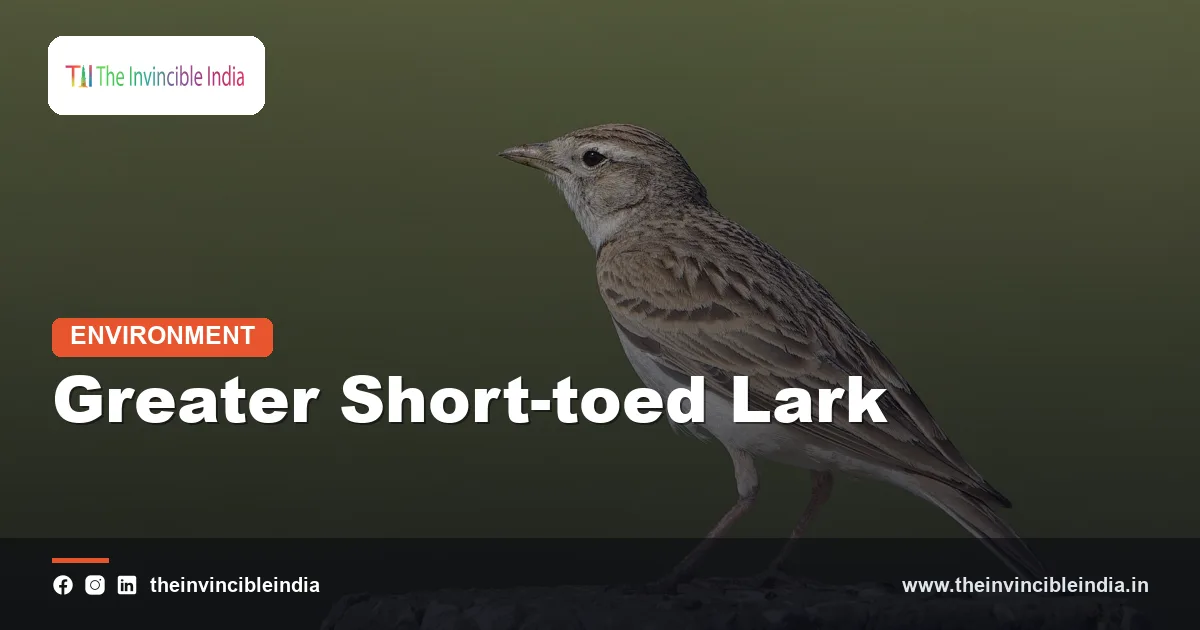
The greater short-toed lark (Calandrella brachydactyla) is a small, sandy-brown songbird that breeds across southern Europe, North Africa and central Asia and spends the winter in large flocks on the dry plains, fallow fields and stubble of north-western, central and peninsular India. It is one of the most numerous winter-visiting larks of the subcontinent, yet most people never notice it because its pale, streaked plumage blends perfectly into bare soil and dry grass.
This guide explains how to identify the greater short-toed lark, where and when it appears in India, what it eats, how it differs from the other small larks it is often confused with, and what its presence says about the health of India’s open, semi-arid landscapes. Last updated: 30 October 2026.
| Attribute | Detail |
|---|---|
| Common name | Greater short-toed lark |
| Scientific name | Calandrella brachydactyla |
| Family | Alaudidae (larks) |
| Approximate length | About 13 to 15 cm, roughly sparrow-sized |
| Status in India | Winter visitor, locally common in open dry country |
| Typical habitat in India | Dry plains, short grassland, fallow and harvested fields, dry lake margins |
| Diet | Seeds mainly in winter, small insects and other invertebrates |
| IUCN Red List category | Least Concern (global assessment) |
Key Takeaways
- The greater short-toed lark is a small, pale, sparrow-sized lark that winters in India after breeding in southern Europe, North Africa and central Asia.
- Adult greater short-toed larks have a plain, whitish to buff underside, a streaked sandy back, a rufous crown and usually a dark smudge on each side of the upper breast.
- The greater short-toed lark feeds almost entirely on the ground, eating mostly seeds in winter and picking up insects when they are available.
- Winter flocks of greater short-toed larks favour bare, open habitats such as stubble, fallow land, dry plains and the dried edges of village tanks.
- The greater short-toed lark is globally assessed as Least Concern, but its dependence on open farmland and dry grassland links its numbers to land-use change.
- Telling the greater short-toed lark from the sand lark and Hume’s short-toed lark depends on bill shape, breast markings and overall colour tone.
What is the greater short-toed lark?
The greater short-toed lark is a small ground-dwelling songbird in the lark family, Alaudidae, that is placed in the genus Calandrella. The name “short-toed” refers to the relatively short hind claw and toes compared with some larger larks, and “greater” distinguishes it from smaller, similar species in the same group.
Larks are a mostly Old World family of birds that live on the ground in open country. Almost all of them have streaked, earth-coloured plumage, a long hind claw in many species, and a habit of singing in flight. The greater short-toed lark follows this pattern, but it is notable for its migratory behaviour. Many larks are resident, while populations of the greater short-toed lark that breed in the northern and eastern parts of the range move south in the cold season.
Several regional forms are recognised across its wide breeding range. Taxonomists have repeatedly revised how these forms, along with similar short-toed larks of Central and East Asia, should be grouped into species. For this reason, field guides published at different times may describe the group a little differently, and some Asian birds once lumped into this species are now treated separately. For the observer in India, the practical point is that several look-alike short-toed larks occur, and careful attention to plumage detail is needed.
How can you identify the greater short-toed lark?
The greater short-toed lark is identified by its small size, pale sandy upperparts with dark streaks, a rufous-tinged crown, a plain whitish underside and a dark patch at the side of the upper breast. The bill is short and fairly thick and conical, suited to cracking small seeds rather than probing.
Several features, taken together, make field identification reliable:
- Underparts: The throat, breast and belly are largely unstreaked and buffy-white, which separates the species from larks with heavily streaked breasts.
- Breast patches: Many birds show a dusky smudge or small dark patch on each side of the upper breast, though this can be faint in worn or young birds.
- Crown: The crown often has a warm rufous or chestnut tone, sometimes raised slightly into a short crest when the bird is alert.
- Face: A pale supercilium (eyebrow stripe) gives the face an open, pale-eyed look.
- Tail: The dark tail has pale outer feathers that flash in flight.
- Bill: The bill is short, stout and conical, with a pale base.
In flight, the greater short-toed lark shows relatively long wings for its size and a rapid, bounding flight that dips and rises. Its call is a short, dry, trilled or chirruping note, often given in flight, and flocks produce a soft twittering as they move over a field.
Juvenile birds in autumn are scalier on the back and may show more spotting on the breast, which can complicate identification. Wear through winter makes plumage progressively duller and paler.
Where does the greater short-toed lark live in India?
The greater short-toed lark winters mainly across the open dry country of north-western and central India and extends south through the Deccan plateau, being much less frequent in humid or densely forested regions. It avoids dense woodland and wetter zones, and it is typically found in places where the ground is bare or covered by short, sparse vegetation.
Within India, the birds are associated with several habitat types:
- Harvested and fallow fields: Stubble in wheat and millet country provides spilt grain and weed seeds.
- Dry grassland and scrub plains: Short, grazed grassland in semi-arid zones is a core habitat.
- Dry lake and tank margins: Exposed mud and cracked soil at the edges of seasonal water bodies are often used.
- Salt flats and coastal plains: Open, sparsely vegetated flats in drier regions attract flocks.
- Wasteland and ploughed ground: Fresh-turned soil and rough ground with little cover are readily used.
The birds avoid tall crops and thick grass. They prefer to see predators from a distance, so open ground with a clear view is essential. Regions of Rajasthan, Gujarat, Punjab, Haryana, Maharashtra and Karnataka are among those where large wintering flocks are most commonly reported, and the species also reaches the drier parts of Tamil Nadu and Andhra Pradesh.
When does the greater short-toed lark visit India?
The greater short-toed lark arrives in India as a winter visitor, with birds appearing from roughly October and most departing by around March to April as they return north to their breeding grounds. Exact dates vary with the year, the weather in the breeding region and the location within India.
The journey is part of a broader pattern of Palearctic migration, in which birds that breed in the temperate or semi-arid north shift south when food becomes scarce. Larks that breed in the more continental parts of Central Asia face cold winters in which snow covers the ground and the seeds on which they depend, so moving south is essential for survival. India’s dry plains offer a mild winter and abundant seed.
Migration is typically undertaken at night and in loose flocks, with birds stopping to feed in open fields on the way. Spring departure is gradual, and flocks tend to grow in size before departure as birds fatten up on seeds and insects.
| Season | Typical activity of the greater short-toed lark in India |
|---|---|
| Autumn (October to November) | Arrival of migrant flocks, birds spreading across open plains |
| Winter (December to February) | Settled foraging in flocks on stubble, fallow land and dry grassland |
| Early spring (March to April) | Fattening, increased song and restlessness before departure |
| Summer (May to September) | Species is absent from most of India and is on its breeding grounds |
What does the greater short-toed lark eat?
The greater short-toed lark eats mainly small seeds during the winter and supplements them with insects and other small invertebrates, all picked up directly from the ground. The short, conical bill is well adapted for dealing with small hard seeds, including those of grasses and weeds that grow in agricultural fields.
In India, winter flocks often forage in places where grain has been spilt after harvest, where weeds have set seed or where short grass has dried and dropped its seeds. They walk or run in short bursts, pausing to peck, rather than hopping. When insects such as beetles, small grasshoppers or ant pupae are available, the larks take them readily, and the proportion of animal food in the diet rises in the breeding season when chicks need protein.
Like many seed-eating birds, greater short-toed larks swallow tiny grit particles that help grind the seeds in the gizzard. This is one reason they are often seen at the edges of dirt tracks and bare patches. They also need water, and flocks may visit shallow pools, tanks or damp ground in the early morning or afternoon.
How does the greater short-toed lark behave?
The greater short-toed lark is a gregarious, ground-hugging bird that forages in flocks, relies on camouflage to avoid predators and flies up in a body when disturbed. A flock may contain a few birds or several hundred, and it can be hard to see until it moves.
Key behaviours include:
- Crouching to hide: When a predator approaches, the birds often freeze and flatten against the ground, relying on their colour to avoid detection.
- Collective flight: When flushed, the flock lifts, wheels together and often lands again a short distance away.
- Dust bathing: Larks bathe in dry soil to clean their feathers and remove parasites.
- Song flight: On the breeding grounds, males sing while hovering or circling high above the ground, producing a varied series of twittering and trilling notes. Some singing may also be heard from birds in India before they depart.
- Mixed flocks: Greater short-toed larks sometimes associate with other small larks, pipits and wagtails in the same fields.
Predators of larks in open country include raptors such as the shikra, kestrels, harriers and falcons, as well as foxes, cats and other ground predators. Flocking provides many eyes for spotting danger, and the sudden explosion of birds from the ground can confuse an attacking predator.
How is the greater short-toed lark different from similar larks?
The greater short-toed lark differs from similar small larks mainly in its largely unstreaked underparts, its dark breast-side patches, its rufous crown and its stouter conical bill. Several short-toed larks and sand larks occur in India, and they can be genuinely difficult to separate, especially in worn plumage or poor light.
| Bird | Key points compared with the greater short-toed lark |
|---|---|
| Sand lark (Indian sand lark) | Often resident or locally migratory near rivers and sandy ground; looks very pale and streaked on the breast; bill appears longer and more slender |
| Hume’s short-toed lark | Winters in parts of north-west India; greyer toned with a thinner pointed bill and typically a more uniform grey-buff look |
| Ashy-crowned sparrow-lark | Smaller and stockier; males have black underparts and a pale crown; females are brown and streaked |
| Crested lark and similar larks | Larger, with a distinct pointed crest and heavy breast streaking |
For birdwatchers, the best approach is to look at the bill shape and the breast pattern first, then check for the crown colour and the presence of a smudge on the side of the breast. Photographs taken from several angles are useful for later checking against reliable references, as individual birds vary.
Where does the greater short-toed lark breed?
The greater short-toed lark breeds across a broad belt of dry, open country that runs from the Mediterranean region and North Africa eastward through the Middle East and Central Asia. It does not breed on the plains of mainland India, so Indian birds are visitors that raise their young elsewhere.
The nest is a shallow cup of grass, rootlets and plant down placed on the ground, usually sheltered beside a small tuft, a stone or a clod of earth. The female typically lays a small clutch of speckled eggs, and the chicks are fed insects by both parents. Young birds leave the nest before they can fly strongly and remain hidden on the ground nearby. Some populations raise more than one brood in a season.
Populations in the western part of the range, such as those in southern Europe and North Africa, include many resident and partially migratory birds. Those in the continental interior are more strictly migratory. The birds seen in India are thought to come mainly from breeding populations in Central Asia and neighbouring regions, though ringing recoveries and detailed studies are limited.
Is the greater short-toed lark threatened?
The greater short-toed lark is not globally threatened and is classified as Least Concern by the International Union for Conservation of Nature (IUCN), thanks to its very large range and large population. However, local declines have been reported in parts of its European breeding range, and the species depends on habitats that are changing.
Several pressures are relevant to birds wintering in India:
- Agricultural change: Shifts in crops, intensified farming and increased pesticide use can reduce the weed seeds and insects the larks need.
- Loss of open grassland: Conversion of grazing land and dry grassland to plantations, irrigated crops or built-up areas removes habitat.
- Afforestation of open land: Planting trees on natural grassland and scrub, though well-intentioned, can eliminate the open ground that larks require.
- Infrastructure and land development: Roads, industrial sites and solar and wind installations may alter or fragment open habitats.
- Hunting and trapping: Small songbirds are sometimes trapped, though this is illegal for protected species under Indian law.
Because the species is widespread and adaptable, conservation action for it is usually part of broader efforts to protect India’s open natural ecosystems, including dry grasslands, scrub and wetlands. These habitats are often undervalued and classified as “wasteland” despite supporting a large variety of specialist birds.
Why does the greater short-toed lark matter for India’s grasslands?
The greater short-toed lark matters because its winter presence is an indicator of healthy open, semi-arid habitats and because it forms part of the food web linking seeds, insects and birds of prey. Grassland and dry-plains birds are among the least studied and least protected groups in India.
India’s open natural ecosystems cover a large area but have historically received less attention than forests. Species such as larks, pipits, buntings and wheatears are well adapted to these landscapes and depend on them for winter food. Monitoring their numbers helps scientists understand how land-use change affects migratory birds. Citizen-science platforms and bird-count programmes in India now collect many records of winter larks, which gradually builds a picture of their distribution and trends.
Protecting grazing commons, village grasslands and traditional low-intensity farming benefits not only larks but also the endangered great Indian bustard, the lesser florican, the Indian courser and many other open-country species.
How can you watch the greater short-toed lark in India?
The best way to watch the greater short-toed lark in India is to visit open dry fields or short grassland between November and February, scan bare ground patiently with binoculars and look for small flocks that move in short bursts. Early morning and late afternoon are the most productive times, when the birds are actively feeding.
These practical tips help:
- Stay in a vehicle or move slowly, since flocks are wary and fly off when approached on foot.
- Look along the edges of tracks, fallow fields and the dry margins of tanks.
- Use binoculars to check the breast patch, bill shape and crown colour.
- Listen for dry trilling calls from a flock flying overhead.
- Take photographs and note the location, date and habitat, and upload records to a citizen-science platform so they contribute to national datasets.
- Avoid disturbing the birds repeatedly; give them space to feed.
Well-known birding areas in dry parts of Rajasthan, Gujarat, Maharashtra and Karnataka are good places to practise, because several lark species can be compared in a single morning.
Bottom Line
The greater short-toed lark is an unobtrusive but numerous winter visitor to India’s dry plains, valued by birdwatchers as a test of careful identification. Its wellbeing depends on open grassland and low-intensity farmland, which makes it a useful reminder that India’s so-called wastelands are living habitats.
Frequently Asked Questions
Is the greater short-toed lark a resident or migratory bird in India?
The greater short-toed lark is mainly a winter visitor to India. It breeds in southern Europe, North Africa and central Asia and arrives in India from about October, leaving by around March or April.
What does a greater short-toed lark look like?
The greater short-toed lark is a small, sandy-brown lark with a streaked back, a rufous crown, a plain whitish underside and a short conical bill. Many birds show a dark smudge on each side of the upper breast.
What does the greater short-toed lark eat in India?
The greater short-toed lark eats mostly small seeds of grasses and weeds in winter. It also takes insects and other small invertebrates from the ground when they are available.
Where can I see the greater short-toed lark in India?
The greater short-toed lark can be seen on open dry plains, harvested fields, short grassland and dry lake margins, especially in north-western and central India. Rajasthan, Gujarat, Punjab, Maharashtra and Karnataka are among the regions where winter flocks are often reported.
Is the greater short-toed lark endangered?
No, the greater short-toed lark is classified as Least Concern by the IUCN because its global range and population are large. It does face local pressures from agricultural intensification and the loss of open grassland.
How can I tell the greater short-toed lark from the sand lark?
The greater short-toed lark has a stouter conical bill, a rufous crown and a largely unstreaked underside with dark breast-side patches. The sand lark usually looks paler, with finer streaking on the breast and a slimmer bill.
{“@context”:”https://schema.org”,”@graph”:[{“@type”:”FAQPage”,”mainEntity”:[{“@type”:”Question”,”name”:”Is the greater short-toed lark a resident or migratory bird in India?”,”acceptedAnswer”:{“@type”:”Answer”,”text”:”The greater short-toed lark is mainly a winter visitor to India. It breeds in southern Europe, North Africa and central Asia and arrives in India from about October, leaving by around March or April.”}},{“@type”:”Question”,”name”:”What does a greater short-toed lark look like?”,”acceptedAnswer”:{“@type”:”Answer”,”text”:”The greater short-toed lark is a small, sandy-brown lark with a streaked back, a rufous crown, a plain whitish underside and a short conical bill. Many birds show a dark smudge on each side of the upper breast.”}},{“@type”:”Question”,”name”:”What does the greater short-toed lark eat in India?”,”acceptedAnswer”:{“@type”:”Answer”,”text”:”The greater short-toed lark eats mostly small seeds of grasses and weeds in winter. It also takes insects and other small invertebrates from the ground when they are available.”}},{“@type”:”Question”,”name”:”Where can I see the greater short-toed lark in India?”,”acceptedAnswer”:{“@type”:”Answer”,”text”:”The greater short-toed lark can be seen on open dry plains, harvested fields, short grassland and dry lake margins, especially in north-western and central India. Rajasthan, Gujarat, Punjab, Maharashtra and Karnataka are among the regions where winter flocks are often reported.”}},{“@type”:”Question”,”name”:”Is the greater short-toed lark endangered?”,”acceptedAnswer”:{“@type”:”Answer”,”text”:”No, the greater short-toed lark is classified as Least Concern by the IUCN because its global range and population are large. It does face local pressures from agricultural intensification and the loss of open grassland.”}},{“@type”:”Question”,”name”:”How can I tell the greater short-toed lark from the sand lark?”,”acceptedAnswer”:{“@type”:”Answer”,”text”:”The greater short-toed lark has a stouter conical bill, a rufous crown and a largely unstreaked underside with dark breast-side patches. The sand lark usually looks paler, with finer streaking on the breast and a slimmer bill.”}}]}]}


