

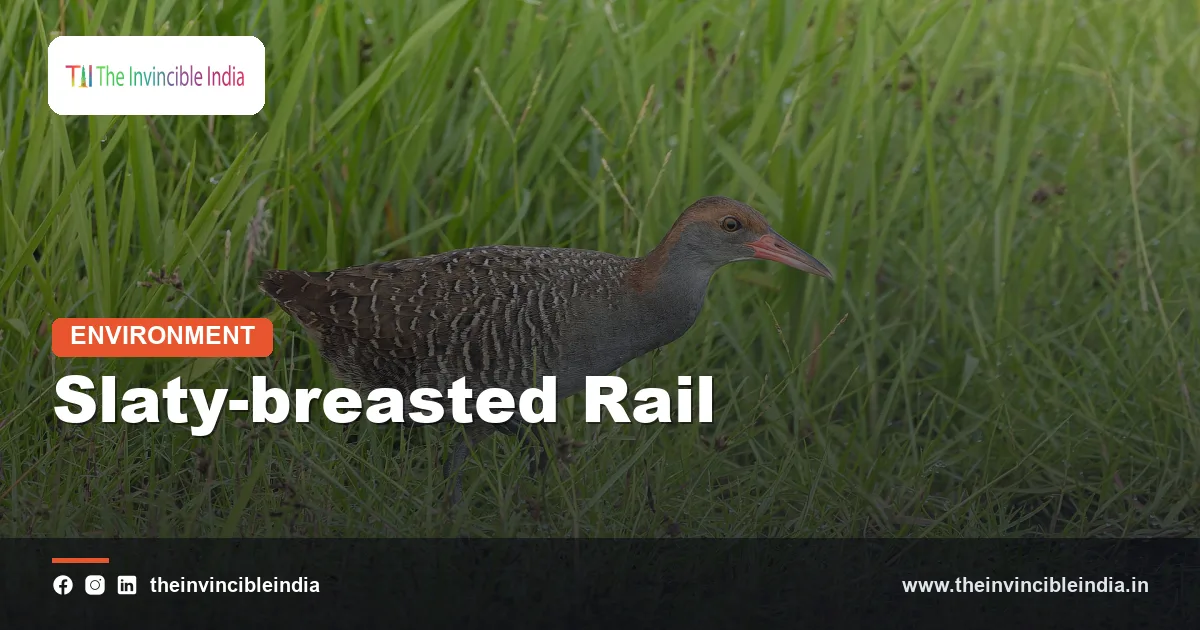
The slaty-breasted rail (Lewinia striata) is a secretive, medium-sized marsh bird of South and Southeast Asia, recognised by its slate-grey breast, chestnut crown, black-and-white barred flanks and a long, slightly curved reddish bill. In India the slaty-breasted rail is a resident of reedbeds, wet paddy fields, ponds and mangroves, but it is shy and more often heard than seen, because it slips quietly through dense vegetation and rarely flies far.
The slaty-breasted rail feeds on insects, snails, worms and seeds, which it picks up in shallow water and wet mud, and it is most active at dawn, at dusk and sometimes at night. This explainer covers how to identify the slaty-breasted rail, where it lives in India, how it feeds and breeds, how to tell it apart from similar wetland birds and what its conservation status is.
| Quick Facts: Slaty-breasted Rail | |
|---|---|
| Common name | Slaty-breasted rail (also called the blue-breasted banded rail in some older lists) |
| Scientific name | Lewinia striata (earlier classified as Gallirallus striatus) |
| Family and order | Rallidae (rails, crakes and coots), order Gruiformes |
| Size | Roughly 25-29 cm long, a little smaller than a domestic hen |
| Key field marks | Slate-grey breast and face, chestnut crown and nape, barred black-and-white belly and flanks, long reddish bill, white-spotted brown back |
| Status in India | Resident, with local movements; found in suitable wetlands across much of the country |
| Habitat | Marshes, reedbeds, flooded paddy fields, pond edges and mangroves |
| Diet | Insects, snails, worms, small crustaceans and seeds |
| IUCN status | Least Concern |
Key Takeaways
- The slaty-breasted rail (Lewinia striata) is a skulking marsh bird with a slate-grey breast, a chestnut crown, barred flanks and a long reddish bill.
- The slaty-breasted rail lives in reedbeds, wet paddy fields, ponds and mangroves across India, the Indian subcontinent and parts of Southeast Asia and southern China.
- The slaty-breasted rail is shy and mostly crepuscular, so it is usually detected by its call, which is a series of sharp, repeated notes given at dusk and at night.
- The slaty-breasted rail feeds in shallow water and mud on insects, snails, worms and seeds, probing with its long bill.
- The slaty-breasted rail builds a hidden nest of grass and reeds near the water and breeds mainly during the monsoon, when water levels and food are high.
- The IUCN lists the slaty-breasted rail as Least Concern, though the loss and drainage of wetlands are the main threats to its habitat.
What is the slaty-breasted rail?
The slaty-breasted rail is a species of rail, a family of mostly secretive wetland birds, that is found from the Indian subcontinent through Southeast Asia to southern China, the Philippines and parts of Indonesia. The family Rallidae also includes crakes, waterhens, moorhens and coots, and the slaty-breasted rail is one of the larger and more strikingly marked rails of Asian marshes.
The bird was long placed in the genus Gallirallus, but it is now usually assigned to the genus Lewinia, which includes a few other rails of the Asia-Pacific region, such as the Lewin’s rail of Australia. Older books may therefore list it as Gallirallus striatus, which is the same bird.
The name “slaty-breasted” describes the dull blue-grey colour of the throat and breast, which stands out against the barred belly and the chestnut cap. A rail is built to move through dense reeds: it has a laterally compressed body, long toes and strong legs, which allow it to slip sideways between stems. This build explains the phrase “thin as a rail”.
How can you identify a slaty-breasted rail?
You can identify a slaty-breasted rail by its slate-grey face and breast, chestnut crown and nape, black-and-white barred belly and flanks, and a long, slightly down-curved bill that is reddish at the base. The upperparts are olive-brown and finely streaked and spotted with white, which gives a speckled look on the back and wings.
Males and females look much alike, though females may be slightly duller. Juveniles are paler and browner, with less distinct grey on the breast. The eyes are red or reddish-brown, and the legs are greenish or olive-grey. In flight, which is usually brief, the bird looks short-winged and weak, with its legs dangling.
What to look for in the field
- A bird that walks slowly along reed edges, flicking its short tail up and down.
- A strong contrast between the grey breast, the barred belly and the chestnut crown.
- A long bill that is noticeably longer than that of a crake or a waterhen.
- A very quick retreat into cover when disturbed, often in a crouching run rather than in flight.
Where does the slaty-breasted rail live in India?
The slaty-breasted rail lives in freshwater and brackish wetlands across much of India, including reedbeds, marshes, flooded fields, village ponds, canals and mangrove edges, with records from the plains of the north to the peninsula and the north-east. It is rarer in dry regions and at higher altitudes, though birds may occur in the lower foothills.
The rail is a bird of dense, wet vegetation. It is regularly found in rice fields during the growing season, where tall plants give cover and the shallow water supports insects and snails. Coastal marshes, tidal creeks and mangrove margins are also used, and the species can tolerate a certain amount of salinity.
The overall range of the species is wide. Beyond India, the slaty-breasted rail occurs in Sri Lanka, Bangladesh, Nepal, Myanmar, Thailand, Vietnam, southern China, Taiwan and the Philippines, and some island populations differ slightly in plumage and are treated as separate subspecies. Birds in the Indian subcontinent are generally resident, but they may move locally in response to rainfall and the drying of marshes.
What does the slaty-breasted rail eat?
The slaty-breasted rail eats a mixed diet of insects, snails, worms and small crustaceans, along with seeds and shoots of marsh plants, which it finds by probing mud and shallow water with its long bill. It is an opportunist, taking whatever is plentiful, and its diet shifts with the seasons.
Foods commonly reported for rails of this kind include aquatic beetles, dragonfly nymphs, grasshoppers, tadpoles, small molluscs and rice seeds. Birds forage mostly at dawn and dusk, and also on cloudy days, walking carefully at the edge of the water with the head low. They are generally solitary or in pairs rather than in groups.
In paddy fields the rail may eat both pests and a small amount of grain, but it is not regarded as a serious problem for farmers. In fact, by taking snails and insects, the slaty-breasted rail may provide a modest benefit to rice cultivation.
What does the slaty-breasted rail sound like?
The slaty-breasted rail has a loud, sharp call made up of a rapid series of harsh, repeated notes, often heard at dusk, at night and before rain, and it is far more likely to be heard than seen. The calls carry a long way across a marsh and usually come from dense cover.
Rails often answer one another, so a single call from a reedbed may trigger a chorus of birds. The call is sometimes described as a trilling, creaking or tapping series that speeds up and then stops suddenly. Individual observers describe it differently, and recordings are the best guide.
The habit of calling mainly at low light is one reason the species is under-recorded. Many birdwatchers who survey wetlands in daylight miss rails altogether, while evening or early-morning visits, or night surveys, can reveal that the birds are quite common.
How does the slaty-breasted rail breed?
The slaty-breasted rail breeds by building a small, well-hidden cup or pad of grass, reeds and rice stalks on the ground or just above the water in dense vegetation, and the female lays a clutch of roughly three to six eggs. The eggs are pale, with reddish-brown spots and blotches, and the nest is often arched over by growing vegetation.
Breeding in India is mainly associated with the monsoon and the post-monsoon months, from about June to September, when water levels are high and food is abundant, although the season varies by region. Both parents are generally believed to take part in incubating the eggs and caring for the young.
Rail chicks are precocial. They hatch covered in black down, leave the nest within a day or so and follow their parents through the reeds, where they are fed until they can feed themselves. The black fluffy chicks are very hard to see, and a pair of rails with chicks is among the most secretive sights in a marsh.
How does the slaty-breasted rail differ from similar Indian wetland birds?
The slaty-breasted rail differs from similar Indian wetland birds mainly in its long reddish bill, grey breast and barred belly, which no common crake or waterhen shares. Because many marsh birds are small, brown and shy, a short comparison makes it easier to tell them apart.
| Species | Size | Key distinguishing features |
|---|---|---|
| Slaty-breasted rail | 25-29 cm | Grey breast, chestnut crown, barred belly, long reddish bill |
| White-breasted waterhen | About 32 cm | Slate-grey upperparts, white face and breast, chestnut under the tail, bobbing tail |
| Ruddy-breasted crake | About 22 cm | Rich chestnut underparts, short greenish bill, red legs |
| Slaty-legged crake | About 25 cm | Chestnut head and breast, olive-brown back, barred belly; a skulking bird of damp forest and scrub |
| Water rail | About 25 cm | Grey face and breast with barred flanks and a long red bill; a scarce winter visitor mainly to the north |
The water rail (Rallus aquaticus) is the closest lookalike, but it has a streaked brown crown with no chestnut cap, and it is a much less common bird in most of India. The presence of the chestnut crown and the spotted back is a reliable mark for the slaty-breasted rail.
Is the slaty-breasted rail threatened?
No, the slaty-breasted rail is not globally threatened, and the International Union for Conservation of Nature (IUCN) lists it as Least Concern because it has a wide range and a stable population overall. However, it depends on wetlands, which are among the most degraded habitats in India.
- Wetland drainage and reclamation: marshes, ponds and reedbeds are drained for housing, roads, industry and agriculture.
- Pollution: sewage, plastic waste and chemical runoff degrade the water and reduce the invertebrates the bird eats.
- Changes in rice farming: early drying of fields and heavy pesticide use can reduce suitable habitat.
- Invasive plants: dense mats of water hyacinth and similar species can choke open water and feeding areas.
- Hunting and trapping: in parts of its range rails are snared or shot for food, though this is less documented in India.
In India, wild birds are protected under the Wild Life (Protection) Act, 1972, and many wetlands are conserved as sanctuaries, Ramsar sites or national parks. Protecting wetlands as a whole, rather than one species at a time, is the best way to support the slaty-breasted rail and the many other birds that share its habitat.
Where and when can you watch the slaty-breasted rail in India?
The best time to look for the slaty-breasted rail in India is at dawn or dusk, near the edges of reedbeds, paddy fields and marshy ponds, and the best season is the monsoon and the months after it, when the birds are calling and breeding. Patience and quiet are more important than equipment.
Tips for finding a slaty-breasted rail
- Visit wetlands in the first hour after sunrise or the last hour before sunset.
- Stand still near a gap in the reeds or on a bund and watch the water margin for several minutes.
- Listen for the sharp, repeated calls from dense cover before scanning with binoculars.
- Check muddy openings and rice-field edges, where the bird sometimes steps out briefly to feed.
- Keep a respectful distance, do not trample reeds and avoid playing recorded calls, which can disturb breeding birds.
Large wetlands such as those in eastern and north-eastern India, and many village tanks and paddy-growing regions, support the species. Bird sanctuaries with reedbeds and mangrove-fringed lagoons are especially rewarding, and local guides often know where rails regularly appear.
Why does the slaty-breasted rail matter?
The slaty-breasted rail matters because it is an indicator of healthy, vegetated wetlands, and because it helps control insects and snails while serving as prey for larger predators. Rails need dense cover, clean shallow water and plentiful invertebrates, so their presence suggests that a marsh is still functioning as a living ecosystem.
The bird also shows the value of ordinary working landscapes. Many slaty-breasted rails live in rice fields and village ponds rather than in protected reserves. Farmers and communities who keep field edges, ponds and reeds in place, and who avoid overuse of chemicals, indirectly support this and many other secretive birds. Because the species is hard to see, community and citizen-science surveys of calling birds are especially useful in understanding where it still lives.
Bottom Line
The slaty-breasted rail is a handsome and elusive marsh bird that is more often heard than seen. It is not globally threatened, but it relies on the reeds, ponds and paddy fields that are steadily being drained or polluted across India. Quiet dawn and dusk visits, careful listening and the protection of small wetlands are the best ways to know and keep this bird.
Frequently Asked Questions
What is a slaty-breasted rail?
The slaty-breasted rail (Lewinia striata) is a secretive marsh bird with a slate-grey breast, chestnut crown, barred belly and a long reddish bill. It lives in reedbeds, paddy fields and mangroves across India and much of Asia.
Where is the slaty-breasted rail found in India?
The slaty-breasted rail is found in freshwater and brackish wetlands across much of India, including marshes, reedbeds, flooded paddy fields, village ponds and mangrove edges. It is a resident bird that may move locally with rainfall.
What does the slaty-breasted rail eat?
The slaty-breasted rail eats insects, snails, worms and small crustaceans, along with seeds and marsh plant shoots. It probes shallow water and wet mud with its long bill, mostly at dawn and dusk.
Why is the slaty-breasted rail so hard to see?
The slaty-breasted rail is hard to see because it is shy, active mainly at dawn, dusk and night, and moves through dense reeds with a narrow, laterally flattened body. It prefers to run into cover instead of flying, and is often detected by its call.
When does the slaty-breasted rail breed?
The slaty-breasted rail breeds mainly during the monsoon and post-monsoon months, from about June to September in much of India. It lays roughly three to six eggs in a hidden nest of grass and reeds near water.
Is the slaty-breasted rail endangered?
No, the slaty-breasted rail is listed as Least Concern by the IUCN because it has a wide range and a stable population overall. Its main threat is the drainage, pollution and reclamation of wetlands.
{“@context”:”https://schema.org”,”@graph”:[{“@type”:”FAQPage”,”mainEntity”:[{“@type”:”Question”,”name”:”What is a slaty-breasted rail?”,”acceptedAnswer”:{“@type”:”Answer”,”text”:”The slaty-breasted rail (Lewinia striata) is a secretive marsh bird with a slate-grey breast, chestnut crown, barred belly and a long reddish bill. It lives in reedbeds, paddy fields and mangroves across India and much of Asia.”}},{“@type”:”Question”,”name”:”Where is the slaty-breasted rail found in India?”,”acceptedAnswer”:{“@type”:”Answer”,”text”:”The slaty-breasted rail is found in freshwater and brackish wetlands across much of India, including marshes, reedbeds, flooded paddy fields, village ponds and mangrove edges. It is a resident bird that may move locally with rainfall.”}},{“@type”:”Question”,”name”:”What does the slaty-breasted rail eat?”,”acceptedAnswer”:{“@type”:”Answer”,”text”:”The slaty-breasted rail eats insects, snails, worms and small crustaceans, along with seeds and marsh plant shoots. It probes shallow water and wet mud with its long bill, mostly at dawn and dusk.”}},{“@type”:”Question”,”name”:”Why is the slaty-breasted rail so hard to see?”,”acceptedAnswer”:{“@type”:”Answer”,”text”:”The slaty-breasted rail is hard to see because it is shy, active mainly at dawn, dusk and night, and moves through dense reeds with a narrow, laterally flattened body. It prefers to run into cover instead of flying, and is often detected by its call.”}},{“@type”:”Question”,”name”:”When does the slaty-breasted rail breed?”,”acceptedAnswer”:{“@type”:”Answer”,”text”:”The slaty-breasted rail breeds mainly during the monsoon and post-monsoon months, from about June to September in much of India. It lays roughly three to six eggs in a hidden nest of grass and reeds near water.”}},{“@type”:”Question”,”name”:”Is the slaty-breasted rail endangered?”,”acceptedAnswer”:{“@type”:”Answer”,”text”:”No, the slaty-breasted rail is listed as Least Concern by the IUCN because it has a wide range and a stable population overall. Its main threat is the drainage, pollution and reclamation of wetlands.”}}]}]}


