

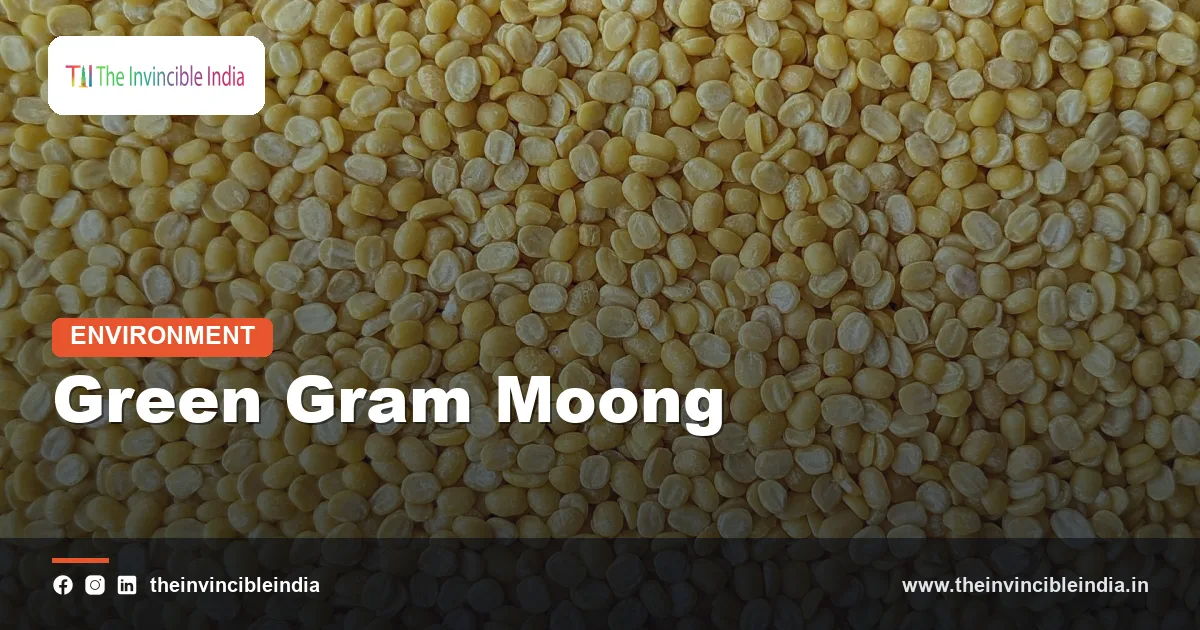
Moong, known in English as green gram, is a fast-growing pulse crop (Vigna radiata) of the legume family, valued across India for its small green seeds that are eaten as dal, cooked whole or sprouted. The plant is a slender, bushy annual that matures in only about 60 to 70 days, which makes it one of the quickest-ripening pulses in Indian agriculture.
Green gram is also called mung bean or golden gram, and it is among the lightest and most easily digested pulses in the Indian diet. This explainer covers what the plant is, where and when it grows, how it is cultivated and processed, and why moong holds such an important place on farms and in kitchens.
| Attribute | Detail |
|---|---|
| Common names | Green gram, moong, mung bean, golden gram (Hindi: moong; Tamil: pasi payaru; Telugu: pesalu; Kannada: hesaru kaalu) |
| Scientific name | Vigna radiata (L.) R. Wilczek |
| Plant family | Fabaceae (the legume or pea family) |
| Where grown in India | Rajasthan, Madhya Pradesh, Maharashtra, Karnataka, Gujarat, Andhra Pradesh, Odisha, Bihar and Uttar Pradesh, among others |
| Growing season | Grown in kharif (monsoon), rabi (winter, mainly in the south) and summer (zaid) seasons |
| Crop duration | About 60 to 70 days in most conditions |
| Part used | Dry seeds (whole, split, or sprouted); green pods eaten as a vegetable in some regions; haulm used as fodder |
| Main products and uses | Moong dal, whole green moong, sprouts, khichdi, cheela, halwa, payasam, flour and noodles |
| Importance | Major short-duration pulse; nitrogen-fixing rotation crop; one of India’s principal pulses |
Key Takeaways
- Green gram (Vigna radiata), known as moong in Hindi, is a legume domesticated in the Indian subcontinent and cultivated in India for thousands of years.
- Green gram matures in roughly 60 to 70 days, so it can be grown as a summer crop between a winter harvest and the next monsoon.
- Green gram seeds contain roughly a quarter of their dry weight as protein and are regarded as one of the easiest pulses to digest.
- Green gram plants fix atmospheric nitrogen through root nodules, which enriches the soil for the cereal crops that follow in rotation.
- Moong is eaten in several forms in India, including whole green seeds, split yellow dal, soaked and sprouted seeds, and flour.
- Yellow mosaic disease, spread by whiteflies, is the most serious threat to green gram crops, and resistant varieties are the main defence.
What Is Green Gram?
Green gram is a pulse, meaning the dry edible seed of a legume, and it is the seed of the plant Vigna radiata. It belongs to the same genus as black gram (urad), cowpea and moth bean, and it is known around the world as the mung bean.
The seeds are small, round to oval and usually olive green, with a thin skin and a pale yellow interior. When the green skin is removed, the seed splits into the familiar yellow moong dal sold in shops, while the unhusked seed is cooked whole as sabut moong.
Where did green gram originate?
Green gram is believed to have been domesticated in the Indian subcontinent, where wild relatives of the crop still grow, and archaeological finds point to cultivation in India thousands of years ago. From India it travelled to China, Southeast Asia and Africa, and it is now widely grown in countries such as Myanmar, China, Thailand and Indonesia.
In ancient Indian texts a pulse called mudga is generally identified with green gram, and Ayurvedic writing has long recommended it as a light food for the sick and the convalescent. That tradition explains why moong khichdi is still a common first meal after illness.
What Does the Green Gram Plant Look Like?
The green gram plant is a small, erect or semi-erect annual herb, usually 30 to 100 centimetres tall, with hairy stems, three-part leaves and slim pods that hang in clusters. It resembles black gram, but green gram pods are generally narrower and the seeds are green rather than black.
- Roots: a branching taproot with small nodules that house nitrogen-fixing Rhizobium bacteria.
- Leaves: trifoliate, with three oval leaflets on each long stalk.
- Flowers: small, pale yellow, in clusters at the leaf joints; the plant is mostly self-pollinating.
- Pods: slender, cylindrical and 5 to 10 centimetres long, turning black or brown when ripe and holding about 10 to 15 seeds.
- Seeds: small and green, with a tiny white hilum scar on one edge.
Modern varieties have been bred so that pods ripen close together, which allows a single harvest. Older types ripen over a longer period and need several pickings.
Where Is Green Gram Grown in India?
Green gram is grown across much of India, with Rajasthan, Madhya Pradesh, Maharashtra, Karnataka, Gujarat and Andhra Pradesh among the leading producing states. Rankings shift from year to year with rainfall and prices, so national figures should always be read with the reference year in mind.
Because the crop matures quickly, it is grown in three seasons.
- Kharif: sown with the monsoon in June or July, mainly in rainfed areas of Rajasthan, Madhya Pradesh and Maharashtra.
- Rabi: sown in October or November in parts of southern and eastern India, using residual soil moisture.
- Summer (zaid): sown in March or April on irrigated land in the Indo-Gangetic plain after the wheat or potato harvest.
India is among the world’s largest producers and consumers of green gram, and the crop is mostly raised by small and marginal farmers.
What Conditions Does Green Gram Need to Grow?
Green gram grows best in warm weather with temperatures of about 25 to 35 degrees Celsius, moderate rainfall and well-drained soil. The crop does not tolerate waterlogging or frost, and it prefers a sunny, relatively dry spell during the ripening stage.
| Requirement | Typical Range or Preference |
|---|---|
| Temperature | About 25 to 35 degrees Celsius for good growth |
| Rainfall | Moderate; roughly 600 to 900 millimetres in rainfed areas |
| Soil | Well-drained loam or sandy loam with near-neutral pH |
| Seed rate | Often around 15 to 25 kilograms per hectare, higher in summer sowing |
| Row spacing | About 30 centimetres between rows |
| Crop duration | About 60 to 70 days |
Heavy rain at flowering and pod filling lowers yield, and saline or waterlogged soils are unsuitable. Light soils that drain quickly generally suit green gram better than heavy clays.
How Is Green Gram Cultivated?
Green gram is cultivated by sowing treated seed in rows in a fine, weed-free seedbed and then managing weeds, moisture and pests for about two months. The crop needs few inputs, which suits farmers with limited resources.
Preparing the field and sowing
The field is ploughed and harrowed to a fine tilth, and seed is sown by seed drill or by hand a few centimetres deep. Timely sowing is important, because late sowing exposes the crop to heavy rain at maturity or to heat stress.
Seed treatment and nutrients
Seed is commonly treated with a fungicide and then coated with Rhizobium culture, which helps nodules form and fix more nitrogen. Farmers usually add a small starter dose of nitrogen and some phosphorus, and the legume then supplies most of its own nitrogen.
Weeding and water
The first three to four weeks are the critical period for weed control, so one or two weedings or an inter-row hoeing are standard. Summer green gram usually receives light irrigations at the branching, flowering and pod-filling stages.
Harvest and threshing
Farmers harvest when most pods have turned brown or black and dried, and varieties with uneven ripening are picked two or three times. The pods are dried in the sun, threshed to free the seed, and the straw is kept as fodder.
Why Is Green Gram Good for the Soil?
Green gram is good for the soil because its root nodules host Rhizobium bacteria that turn nitrogen from the air into a form plants can absorb. After the crop is harvested, leftover roots and leaf litter release this nitrogen and organic matter, so the next crop needs less fertiliser.
The short duration of moong also makes it an unusually flexible crop in rotations.
- It can be squeezed between a rabi harvest and the kharif sowing as a summer crop.
- It can be intercropped with sugarcane, maize, cotton or pigeon pea.
- It can be grown as a green manure, where the whole plant is ploughed in before it matures.
- It covers the soil quickly, which limits erosion and weed growth.
In regions where rice or wheat are grown year after year, adding a summer green gram crop is a widely promoted way to restore soil health while earning extra income.
What Diseases and Pests Affect Green Gram?
Yellow mosaic disease is the most damaging problem of green gram in India, caused by a virus that is spread by the whitefly (Bemisia tabaci) and shows up as bright yellow patches on the leaves. Infected plants produce fewer pods, so farmers rely on tolerant varieties, early sowing and whitefly control.
Other common problems include the following.
- Cercospora leaf spot: circular brown spots with darker margins on leaves.
- Powdery mildew: white fungal growth that thrives in cool, humid conditions.
- Leaf curl and other viruses: twisted, stunted leaves and poor flowering.
- Pod borers, aphids, thrips and jassids: insects that feed on leaves, flowers and pods.
- Bruchid beetles: storage pests that bore into dry seeds and reduce quality.
Integrated pest management, which combines resistant seed, clean cultivation and need-based spraying, is the standard recommendation from agricultural universities and extension agencies.
In What Forms Is Green Gram Eaten?
Green gram is eaten in India as whole green seeds, as split green dal with the skin, as peeled yellow moong dal and as sprouts. Each form has a different cooking time and flavour, and each is used in distinctive dishes.
| Form | Description | Typical Dishes |
|---|---|---|
| Whole moong (sabut moong) | Intact green seed with skin | Curries, soups, sprouts, salads |
| Split with skin (chilka moong) | Green-skinned halves | Everyday dal, khichdi, tadka dal |
| Split and peeled (dhuli moong dal) | Yellow halves with skin removed | Khichdi, halwa, payasam, cheela, pakora |
| Sprouted moong | Seeds germinated for a day or two | Salads, chaat, usal, stir-fries |
| Moong flour | Ground dal | Cheela, ladoo, snacks, face packs and noodles |
Dal milling removes the green husk with abrasive rollers and then splits the seed, and the husk is kept as cattle feed.
How Are Moong Sprouts Made?
Moong sprouts are made by soaking whole green gram seeds in water for several hours, draining them and keeping them in a warm, damp, dark place until small white shoots emerge, usually in one to two days. Green gram is the most popular sprouting seed in India because it germinates quickly and produces tender, mild-tasting shoots.
Sprouting changes the seed in useful ways. It softens the seed, raises the availability of some vitamins such as vitamin C, and reduces compounds that interfere with digestion. Because sprouts grow in warm, moist conditions that also favour bacteria, they should be rinsed well and cooked lightly or eaten fresh with care, especially by children and the elderly.
Well-known moong dishes from different regions include:
- Moong dal cheela: a savoury pancake of ground dal batter.
- Moong dal khichdi: rice and dal cooked together, a staple comfort food.
- Moong dal halwa: a rich sweet made by roasting dal in ghee, popular in Rajasthan and the north.
- Pesarattu: a green moong dosa from Andhra Pradesh.
- Payasam: a milk and jaggery pudding made with roasted moong dal in the south.
Is Green Gram Nutritious?
Green gram is nutritious because it supplies protein, dietary fibre, iron, folate, potassium and magnesium with very little fat. Dry seeds typically contain around 23 to 26 per cent protein by weight, and the cooked dal is among the gentlest of pulses on the stomach.
Like other pulses, green gram is rich in the amino acid lysine and lower in methionine, so eating it with rice, wheat or millets gives a more balanced protein. This is the reasoning behind classic combinations such as khichdi and dal with roti.
Moong is often the first pulse recommended in traditional diets for people recovering from illness, because it cooks soft and is relatively easy to digest. These practices are cultural and traditional, and individual dietary needs should be guided by a qualified health professional.
What Is the Economic Importance of Green Gram?
Green gram is economically important because it is a cash pulse that farmers can grow quickly with low inputs, and it supplies a large domestic market for dal, sprouts and processed snacks. India is among the largest producers of green gram in the world, and small imports are sometimes used to meet demand.
The government announces a Minimum Support Price (MSP) for moong every year, and public agencies purchase pulses when market prices fall below it. Summer moong cultivation has been promoted in several states as a way to diversify cropping, raise farm income and improve soil fertility.
Moong also contributes to rural livelihoods through the dal-milling sector, local trading and the processing of papad, namkeen and sweets.
Bottom Line
Green gram is a quick, light and versatile pulse that serves both farmers and cooks. Its short growing period, nitrogen-fixing roots and many culinary forms explain why moong remains a dependable crop in Indian fields and a trusted food in Indian homes.
Frequently Asked Questions
Is green gram the same as moong?
Yes, green gram and moong are the same crop, Vigna radiata. It is also called mung bean in international usage, and the split, peeled form is sold as yellow moong dal.
How long does green gram take to grow?
Green gram usually matures in about 60 to 70 days after sowing. This short duration is why it can be grown as a summer crop between two main crops.
Which states grow the most green gram in India?
Rajasthan, Madhya Pradesh, Maharashtra, Karnataka, Gujarat and Andhra Pradesh are among the leading green gram producing states. The exact order changes from year to year with rainfall and the area sown.
Why is green gram called a nitrogen-fixing crop?
Green gram is called a nitrogen-fixing crop because bacteria in its root nodules convert nitrogen from the air into usable plant nutrients. This enriches the soil and lowers the fertiliser needed by the next crop in rotation.
What is the difference between moong dal and urad dal?
Moong dal comes from green gram (Vigna radiata) and urad dal comes from black gram (Vigna mungo). Moong dal cooks quickly and tastes light, while urad dal is stickier and heavier and is used for fermented batters.
Are moong sprouts healthy?
Moong sprouts are a nutritious source of protein, fibre and vitamins, and sprouting makes the seeds softer and easier to digest. Because raw sprouts can carry bacteria from warm, damp growing conditions, they should be washed well and lightly cooked for children, older people and anyone with a weak immune system.
{“@context”:”https://schema.org”,”@graph”:[{“@type”:”FAQPage”,”mainEntity”:[{“@type”:”Question”,”name”:”Is green gram the same as moong?”,”acceptedAnswer”:{“@type”:”Answer”,”text”:”Yes, green gram and moong are the same crop, Vigna radiata. It is also called mung bean in international usage, and the split, peeled form is sold as yellow moong dal.”}},{“@type”:”Question”,”name”:”How long does green gram take to grow?”,”acceptedAnswer”:{“@type”:”Answer”,”text”:”Green gram usually matures in about 60 to 70 days after sowing. This short duration is why it can be grown as a summer crop between two main crops.”}},{“@type”:”Question”,”name”:”Which states grow the most green gram in India?”,”acceptedAnswer”:{“@type”:”Answer”,”text”:”Rajasthan, Madhya Pradesh, Maharashtra, Karnataka, Gujarat and Andhra Pradesh are among the leading green gram producing states. The exact order changes from year to year with rainfall and the area sown.”}},{“@type”:”Question”,”name”:”Why is green gram called a nitrogen-fixing crop?”,”acceptedAnswer”:{“@type”:”Answer”,”text”:”Green gram is called a nitrogen-fixing crop because bacteria in its root nodules convert nitrogen from the air into usable plant nutrients. This enriches the soil and lowers the fertiliser needed by the next crop in rotation.”}},{“@type”:”Question”,”name”:”What is the difference between moong dal and urad dal?”,”acceptedAnswer”:{“@type”:”Answer”,”text”:”Moong dal comes from green gram (Vigna radiata) and urad dal comes from black gram (Vigna mungo). Moong dal cooks quickly and tastes light, while urad dal is stickier and heavier and is used for fermented batters.”}},{“@type”:”Question”,”name”:”Are moong sprouts healthy?”,”acceptedAnswer”:{“@type”:”Answer”,”text”:”Moong sprouts are a nutritious source of protein, fibre and vitamins, and sprouting makes the seeds softer and easier to digest. Because raw sprouts can carry bacteria from warm, damp growing conditions, they should be washed well and lightly cooked for children, older people and anyone with a weak immune system.”}}]}]}


