

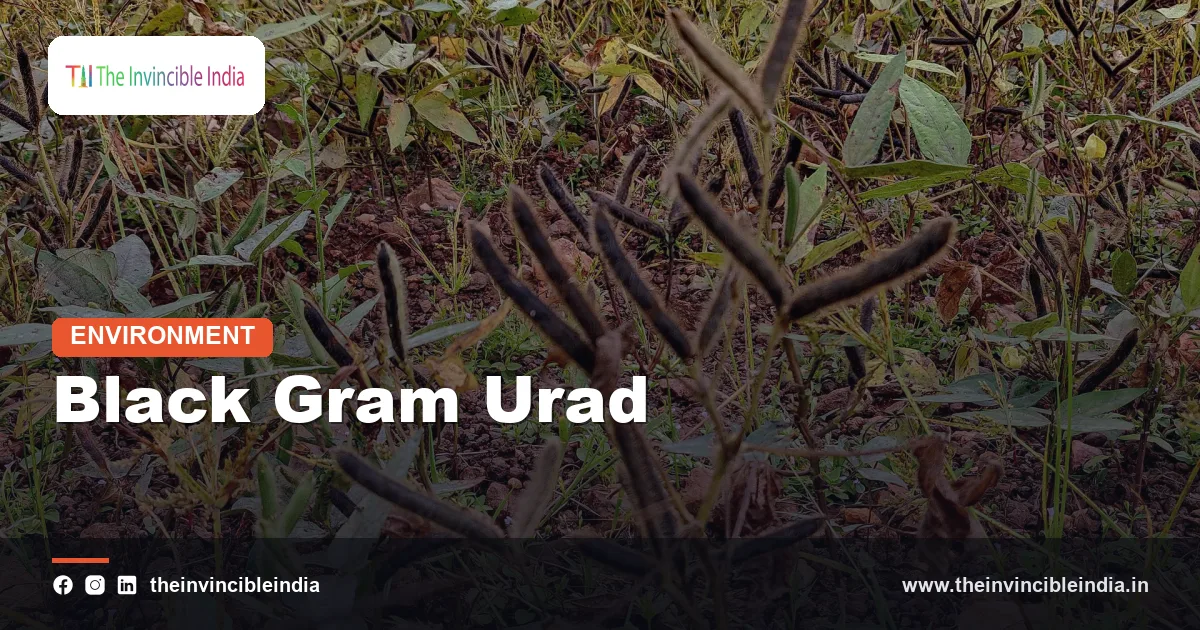
Urad, known in English as black gram, is a short-duration pulse crop (Vigna mungo) of the legume family that is grown across India for its small black-skinned seeds, which are eaten whole, split into dal or ground into batter. The plant is a bushy, hairy annual that finishes its life in roughly two to three months and leaves the soil richer in nitrogen than it found it.
Black gram is one of the most widely eaten pulses in the country, and it is the quiet engine behind idli, dosa, vada, papad and the slow-cooked dal makhani. This explainer describes the plant, the places and seasons in which it is raised, how it is grown and processed, and why it matters to Indian kitchens and farms.
| Attribute | Detail |
|---|---|
| Common names | Black gram, urad, urd bean, black lentil (Hindi: urad or mash; Tamil: ulundu; Telugu: minumulu; Kannada: uddu) |
| Scientific name | Vigna mungo (L.) Hepper |
| Plant family | Fabaceae (the legume or pea family) |
| Where grown in India | Madhya Pradesh, Uttar Pradesh, Andhra Pradesh, Tamil Nadu, Maharashtra, Rajasthan, Odisha and several other states |
| Growing season | Mainly kharif (monsoon) crop; also grown as a rabi crop in parts of the south and as a summer crop under irrigation |
| Crop duration | Roughly 60 to 90 days from sowing to harvest, depending on variety and season |
| Part used | Dry seeds (whole, split with husk, or split and polished); haulm and husk as cattle feed |
| Main products and uses | Dal, idli and dosa batter, vada, papad, dal makhani, kali dal, flour, animal feed |
| Importance | Major source of vegetarian protein; nitrogen-fixing rotation crop; one of India’s principal pulses |
Key Takeaways
- Black gram (Vigna mungo), called urad in Hindi, is a legume native to the Indian subcontinent and is among the oldest pulses cultivated in India.
- Black gram seeds contain roughly a quarter of their dry weight as protein, which makes urad dal an important protein source in vegetarian Indian diets.
- Black gram is a short-duration crop that matures in about two to three months, so it fits easily between or alongside other crops in Indian farming systems.
- The roots of the black gram plant host Rhizobium bacteria that fix atmospheric nitrogen, which improves soil fertility for the crops that follow.
- Urad dal batter ferments naturally because of its sticky, mucilaginous quality, and this property is the reason urad is central to idli, dosa and vada.
- India is among the largest producers and consumers of black gram in the world, and domestic production is supplemented by imports in some years.
What Is Black Gram?
Black gram is a pulse, meaning the dry edible seed of a legume plant, and it belongs to the genus Vigna, the same genus that includes green gram (moong), cowpea and moth bean. The scientific name is Vigna mungo, and the crop is often called urad or urd bean in Indian languages and trade.
The seeds are small, oval and usually black or very dark green on the outside, with a creamy white interior. When the black husk is removed and the seed is split, the result is the white urad dal sold in shops, while dal sold with the husk on is called chilka urad or kali dal.
The plant is an erect to semi-spreading annual herb, normally 30 to 90 centimetres tall, covered in fine hairs. It bears trifoliate leaves, small yellow flowers and slim, cylindrical pods that hold several seeds each.
Where Did Black Gram Originate?
Black gram is generally believed to have originated in the Indian subcontinent, where its wild ancestor, a form of Vigna mungo, still grows. Botanists treat India as the primary centre of domestication of the crop, and cultivation here is thought to be several thousand years old.
From India, black gram spread to other parts of South and Southeast Asia, East Africa and the Caribbean, often carried by migrating communities. Today the crop is also grown in Myanmar, Pakistan, Thailand and Bangladesh, and Myanmar has long been a major supplier to the Indian market.
Ancient Sanskrit and later Ayurvedic texts refer to a pulse called masha, which is generally identified with black gram. That long record in food and traditional medicine shows how deeply the crop is embedded in Indian culture.
What Does the Black Gram Plant Look Like?
The black gram plant is a compact, bushy legume with hairy stems, three-part leaves and clusters of pale yellow flowers that give way to short, hairy pods. It looks somewhat similar to green gram, but the plant is usually more spreading and the pods are held more upright and are covered in denser hairs.
Key features include the following.
- Roots: a taproot with many lateral roots and small pinkish nodules where nitrogen-fixing bacteria live.
- Leaves: trifoliate, with three broad, slightly pointed leaflets on a long stalk.
- Flowers: small, yellow, pea-shaped flowers that are largely self-pollinated.
- Pods: cylindrical, roughly 4 to 7 centimetres long, turning black when ripe, each holding about 4 to 10 seeds.
- Seeds: small, oblong, with a flat white scar called the hilum on one side.
Where Is Black Gram Grown in India?
Black gram is grown in almost every part of India, but the largest areas lie in Madhya Pradesh, Uttar Pradesh, Andhra Pradesh, Tamil Nadu, Maharashtra and Rajasthan. These states account for most of the national acreage, although the exact ranking changes from year to year with the monsoon and market prices.
Production patterns differ by region.
- Central and northern India: mostly a rainfed kharif crop sown with the onset of the monsoon.
- Peninsular India: grown in both kharif and rabi seasons, and often as a rice-fallow crop sown on residual moisture after the rice harvest.
- Irrigated plains: raised as a short summer crop between the rabi harvest and the monsoon in some areas.
Black gram is mostly a smallholder crop, and it is frequently intercropped with maize, sorghum, pigeon pea or cotton. India ranks among the top producers and consumers of black gram globally, and published national figures should always be read with the year of reference in mind.
What Conditions Does Black Gram Need to Grow?
Black gram grows best in warm, humid weather with temperatures of roughly 25 to 35 degrees Celsius and moderate rainfall. The crop is sensitive to frost and to prolonged waterlogging, but it tolerates short dry spells better than many other pulses.
The ideal soil is a well-drained loam or clay loam with a neutral pH. Heavy, saline or alkaline soils reduce yields, and standing water at flowering can cause flower drop and root diseases.
| Requirement | Typical Range or Preference |
|---|---|
| Temperature | About 25 to 35 degrees Celsius during growth |
| Rainfall | Moderate; roughly 600 to 1000 millimetres in rainfed areas |
| Soil | Well-drained loam to clay loam, near-neutral pH |
| Sowing time (kharif) | June to July, with the first effective monsoon rains |
| Sowing time (summer) | February to March in irrigated areas |
| Seed rate | Often around 15 to 20 kilograms per hectare, depending on the season and sowing method |
| Crop duration | About 60 to 90 days |
How Is Black Gram Cultivated?
Black gram is cultivated by sowing seed into a finely prepared, weed-free field and managing it lightly for two to three months. Because the crop is short and hardy, it needs far fewer inputs than cereals, which is one reason it is popular with small farmers.
Land preparation and sowing
Farmers plough the field once or twice and level it so that excess water can drain away. Seeds are usually sown in rows spaced about 30 centimetres apart, either by seed drill or by hand, to a depth of a few centimetres.
Seed treatment and nutrition
Seed is often treated with a fungicide and then inoculated with Rhizobium culture, which helps the root nodules form and fix nitrogen more effectively. Black gram needs only a small starter dose of nitrogen, and farmers commonly apply phosphorus because it supports root and nodule development.
Weeding and irrigation
The first month is the critical period for weed control, so one or two weedings are normally done within about 30 days of sowing. Irrigation is needed mainly in the summer crop, where light watering at flowering and pod filling helps the yield.
Harvesting
Pods ripen unevenly, so farmers harvest when most pods have turned black and dry, often in two or three pickings or by cutting the whole plant. The plants are dried on a threshing floor, the seeds are beaten out and cleaned, and the leftover haulm is kept as fodder.
Why Is Black Gram Good for the Soil?
Black gram improves soil fertility because its roots live in partnership with Rhizobium bacteria that convert nitrogen from the air into a form plants can use. After harvest, the roots and fallen leaves leave behind nitrogen and organic matter that benefit the next crop, such as wheat, rice or maize.
This is why pulses like urad are built into traditional rotations. Farmers also value the crop because it:
- covers the ground quickly and reduces soil erosion during heavy rain,
- uses relatively little irrigation water compared with many cereals,
- fits into short windows between main crops, and
- provides a protein-rich haulm that cattle eat readily.
A short-duration pulse in the rotation can therefore raise farm income and cut fertiliser needs, although the benefit depends on soil, variety and management.
What Diseases and Pests Affect Black Gram?
The most serious problem of black gram in India is yellow mosaic disease, a viral infection spread by the whitefly (Bemisia tabaci) that causes yellow patches on leaves and can sharply reduce yield. Farmers manage it by sowing resistant varieties, controlling whitefly and removing infected plants early.
Other common problems include the following.
- Powdery mildew: a white fungal coating on leaves, common in cool, humid weather.
- Cercospora leaf spot: brown spots on leaves that reduce the photosynthetic area.
- Leaf crinkle virus: causes wrinkled, curled leaves and poor pod set.
- Pod borers, aphids and leaf-eating caterpillars: insects that feed on leaves and pods.
- Bruchids (storage beetles): pests that attack the dry seed in storage.
Integrated pest management, which combines resistant varieties, timely sowing, clean fields and careful use of pesticides, is the standard approach recommended by agricultural extension services.
How Is Black Gram Processed Into Dal?
Black gram is processed into dal by cleaning the harvested seed, loosening the black husk, and splitting the seed into two halves in a dal mill. The result is one of three common market forms, which differ in how much of the husk remains.
| Form | Description | Typical Use |
|---|---|---|
| Whole black urad | Unsplit seed with black husk | Dal makhani, kali dal, slow-cooked curries |
| Split with husk (chilka urad) | Halved seed with black-green husk still on | Everyday dal, tempered curries |
| Split and polished (dhuli urad) | Husk removed; white halves | Idli, dosa, vada and papad batter |
Traditional dal milling involves oil-and-water conditioning of the seed, sun-drying, and dehusking between abrasive rollers. Because dal milling is a small-scale industry spread across the country, it is a significant source of rural employment.
Why Is Black Gram Used in Idli and Dosa?
Black gram is used in idli and dosa because its ground paste is naturally sticky and traps air, which lets the batter ferment and rise without added yeast. This property comes from the mucilage, a gummy mix of complex carbohydrates and proteins found in the seed.
In the classic South Indian method, soaked urad dal and rice are ground separately, mixed and left to ferment overnight in a warm place. Wild bacteria and yeasts present on the grains produce gas, which makes idlis soft and dosas crisp and slightly sour.
Beyond the batter, black gram appears across Indian cuisine in many forms.
- Dal makhani: whole urad and a little rajma simmered for hours with butter and cream, a staple of Punjabi cuisine.
- Papad: thin, sun-dried discs made from urad flour and spices.
- Vada and medu vada: fried savoury doughnuts of ground urad.
- Imarti and other sweets: urad batter fried and soaked in sugar syrup.
- Kali dal and urad khichdi: comforting everyday dishes in many northern homes.
Is Black Gram Nutritious?
Black gram is nutritious because it provides protein, dietary fibre, iron, folate, magnesium and potassium in a plant-based food. Dry seeds typically contain around 24 to 26 per cent protein, along with a large share of complex carbohydrates and very little fat.
Like most pulses, black gram is low in the amino acid methionine but rich in lysine, so eating it with cereals such as rice or wheat gives a more complete protein. This pairing, seen in idli with sambar or dal with roti, is part of the logic of traditional Indian meals.
Black gram can cause gas in some people, and soaking, sprouting or fermenting the seed makes it easier to digest. Traditional Ayurvedic writing treats urad as a heavy, strength-giving food, but these descriptions are cultural rather than clinical, and anyone with a medical condition should follow professional dietary advice.
What Is the Economic Importance of Black Gram?
Black gram is economically important because it is one of the main pulses produced and consumed in India, supporting millions of small farmers and a large dal-milling and trading sector. India typically grows most of the black gram it eats, but imports, especially from Myanmar, are used to bridge shortfalls.
The government announces a Minimum Support Price (MSP) for urad each year before the kharif season, and public agencies procure pulses when market prices fall below that level. Pulse prices tend to move sharply with the monsoon, so policy often balances imports, stock limits and procurement.
Black gram also has a place in rural food security because the dry seed stores well and the haulm feeds livestock. Together, these roles make the crop valuable even where its profit per acre is modest.
Bottom Line
Black gram is a small seed with outsized importance in Indian food and farming. As a quick-maturing, nitrogen-fixing pulse and the essential ingredient of fermented batters and slow-cooked dals, urad connects farm fields, rural mills and kitchens across the country.
Frequently Asked Questions
Is black gram the same as urad dal?
Yes, black gram and urad are the same crop, Vigna mungo. Urad dal is the split form of the seed, sold either with the black husk (chilka urad) or without it (white dhuli urad).
What is the difference between black gram and green gram?
Black gram (urad) and green gram (moong) are two different species of the genus Vigna. Black gram has black seeds, a sticky paste and a heavier, earthy flavour, while green gram has green seeds and is lighter, quicker to cook and often eaten sprouted.
Which Indian states grow the most black gram?
Madhya Pradesh, Uttar Pradesh, Andhra Pradesh, Tamil Nadu, Maharashtra and Rajasthan are among the leading black gram producing states. The exact ranking varies each year with rainfall and the area sown.
How long does black gram take to grow?
Black gram usually takes about 60 to 90 days to mature from sowing to harvest. The exact period depends on the variety, the season and the weather during growth.
Why is urad dal used in idli and dosa batter?
Urad dal is used in idli and dosa batter because its ground paste is sticky and holds air, which supports natural fermentation. This gives idlis their soft, spongy texture and dosas their crisp, lightly sour character.
Is black gram good for the soil?
Yes, black gram improves soil because its root nodules host bacteria that fix nitrogen from the air. Growing urad in rotation with cereals can reduce fertiliser needs for the following crop.
{“@context”:”https://schema.org”,”@graph”:[{“@type”:”FAQPage”,”mainEntity”:[{“@type”:”Question”,”name”:”Is black gram the same as urad dal?”,”acceptedAnswer”:{“@type”:”Answer”,”text”:”Yes, black gram and urad are the same crop, Vigna mungo. Urad dal is the split form of the seed, sold either with the black husk (chilka urad) or without it (white dhuli urad).”}},{“@type”:”Question”,”name”:”What is the difference between black gram and green gram?”,”acceptedAnswer”:{“@type”:”Answer”,”text”:”Black gram (urad) and green gram (moong) are two different species of the genus Vigna. Black gram has black seeds, a sticky paste and a heavier, earthy flavour, while green gram has green seeds and is lighter, quicker to cook and often eaten sprouted.”}},{“@type”:”Question”,”name”:”Which Indian states grow the most black gram?”,”acceptedAnswer”:{“@type”:”Answer”,”text”:”Madhya Pradesh, Uttar Pradesh, Andhra Pradesh, Tamil Nadu, Maharashtra and Rajasthan are among the leading black gram producing states. The exact ranking varies each year with rainfall and the area sown.”}},{“@type”:”Question”,”name”:”How long does black gram take to grow?”,”acceptedAnswer”:{“@type”:”Answer”,”text”:”Black gram usually takes about 60 to 90 days to mature from sowing to harvest. The exact period depends on the variety, the season and the weather during growth.”}},{“@type”:”Question”,”name”:”Why is urad dal used in idli and dosa batter?”,”acceptedAnswer”:{“@type”:”Answer”,”text”:”Urad dal is used in idli and dosa batter because its ground paste is sticky and holds air, which supports natural fermentation. This gives idlis their soft, spongy texture and dosas their crisp, lightly sour character.”}},{“@type”:”Question”,”name”:”Is black gram good for the soil?”,”acceptedAnswer”:{“@type”:”Answer”,”text”:”Yes, black gram improves soil because its root nodules host bacteria that fix nitrogen from the air. Growing urad in rotation with cereals can reduce fertiliser needs for the following crop.”}}]}]}


