

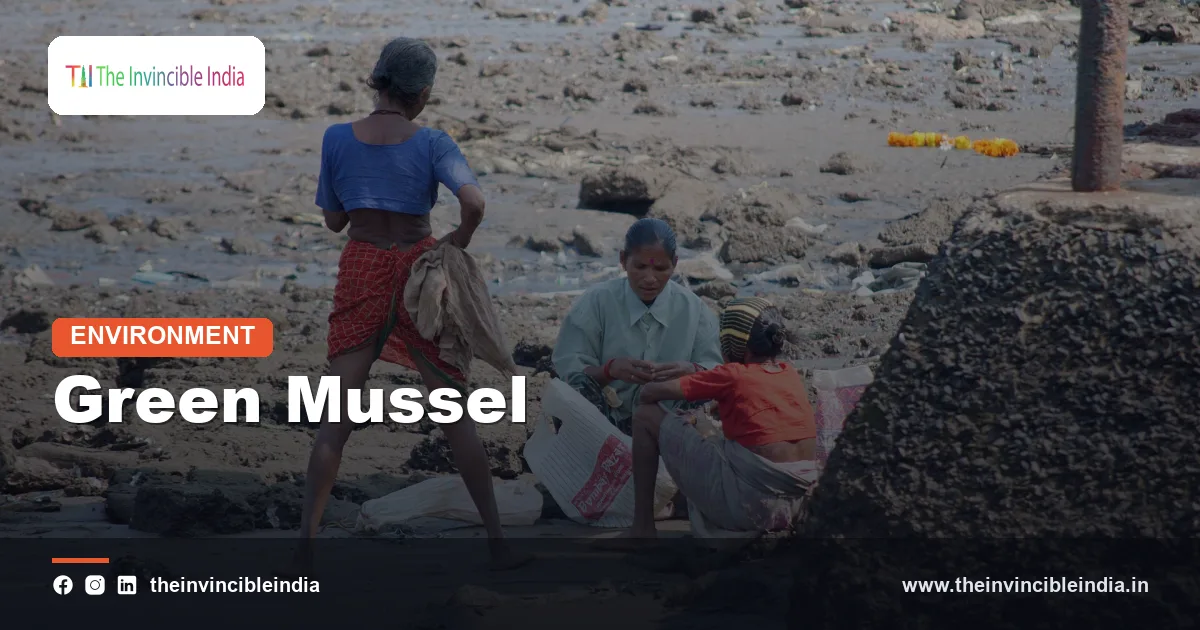
The green mussel (Perna viridis), known in Malayalam as kallummakkaya, is a green-shelled marine bivalve that attaches to rocks, jetties and ropes along the Indian coast and is both gathered from natural beds and farmed in estuaries as a popular seafood. A filter feeder native to the Indo-Pacific, the green mussel supports a growing coastal aquaculture sector, especially in Kerala, where it provides income to thousands of fishing families.
The green mussel is also called the Asian green mussel, and its fast growth, low-cost farming and high protein content make it one of the most important shellfish of the Indian coast. This article explains what the green mussel is, how it lives and feeds, how it is farmed, how it differs from the brown mussel, what risks it carries and why it matters to coastal ecosystems and livelihoods.
| Attribute | Detail |
|---|---|
| Common names | Green mussel, Asian green mussel; kallummakkaya and kadukka in Malayalam-speaking regions |
| Scientific name | Perna viridis |
| Family and class | Mytilidae, class Bivalvia (phylum Mollusca) |
| Typical adult length | About 8 to 10 cm at market size; can reach about 15 cm or more |
| Shell | Smooth, elongate, triangular shell, bright green when young, turning brown-green with age |
| Habitat | Coastal waters, estuaries, backwaters, rocky shores, jetties and submerged structures |
| Feeding | Filter feeder on phytoplankton, detritus and fine particles |
| Main Indian farming region | Kerala, with farming also in Karnataka, Tamil Nadu and other coastal states |
| Research body | ICAR-Central Marine Fisheries Research Institute (CMFRI), Kochi, which developed farming methods |
Key Takeaways
- The green mussel, Perna viridis, is a marine bivalve of the family Mytilidae that anchors itself to hard surfaces with strong threads called the byssus.
- Kerala produces the majority of India’s farmed green mussels, using ropes hung from racks, rafts and longlines in backwaters and estuaries.
- A farmed green mussel typically reaches market size within roughly five to seven months, without any added feed or fertiliser, because it filters food from the water.
- Green mussels can accumulate harmful algal toxins and bacteria, so they should be harvested from monitored waters, cooked thoroughly and eaten fresh.
- Mussel farming has given many coastal women, particularly in self-help groups in Kerala, a regular income and a role in the shellfish value chain.
- The green mussel is a fouling organism and an invasive species in parts of the Americas, where it has spread through ship ballast water and hulls.
What is the green mussel?
The green mussel is a bivalve mollusc, Perna viridis, whose two hinged shells enclose a soft body and which lives attached to hard surfaces in warm coastal waters. Its elongated, slightly curved shell has a pointed front end and a rounded back end, and the outer layer is vivid green in young animals and darker olive or brown in older ones.
The shell is smooth with fine growth lines, and its inside is pearly. A bundle of strong protein threads called the byssus emerges from the foot and glues the mussel to rocks, ropes, pillars and other mussels. This attachment allows green mussels to live in dense clusters in places swept by tides and currents.
The green mussel is native to the Indo-Pacific region, from the Persian Gulf and India through Southeast Asia. In India, it occurs along both the west and east coasts, with the richest natural beds and farms along the Malabar coast of Kerala and neighbouring Karnataka.
How does the green mussel live and feed?
The green mussel lives fixed in place and feeds by filtering tiny plants and particles from the water that flows through its body. It draws seawater in through an opening called the inhalant siphon, traps food on mucus-coated gills and expels the filtered water through the exhalant siphon.
The main food of the green mussel is phytoplankton, the microscopic algae floating in the sea, along with bacteria and fine organic matter. A single adult can filter a large volume of water in an hour, so a bed of mussels can clear water of suspended particles. Because the mussel needs no feed from farmers, the species is considered a low-input, environmentally gentle form of aquaculture.
The green mussel tolerates the changing salinity of estuaries better than many shellfish, though it grows best in moderately saline, nutrient-rich waters. It is vulnerable to very low salinity during heavy monsoon floods, to high temperatures and to oxygen depletion. Its lifespan is a few years, and it grows quickly in the first year.
How does the green mussel reproduce?
The green mussel reproduces by spawning eggs and sperm into the water, where fertilisation takes place, and the fertilised eggs develop into free-swimming larvae. Males and females are separate, and spawning often peaks around the monsoon and post-monsoon months along the Indian coast.
The development of a green mussel follows several stages.
- Fertilised egg: The egg develops into a trochophore larva in the water within hours.
- Veliger larva: The larva grows a tiny shell and swims using a ciliated structure, feeding on phytoplankton.
- Pediveliger: The larva develops a foot and searches for a hard surface on which to settle.
- Spat: The young mussel attaches by byssus threads and metamorphoses into a miniature adult.
- Juvenile and adult: The mussel grows rapidly, reaches maturity within months and joins the breeding population.
Farmers take advantage of this cycle by collecting the settled young, called spat or seed, from natural beds or by providing ropes and other surfaces on which the larvae settle. When cooked, the female mussel’s flesh is often orange to reddish, and the male’s flesh is creamy white, which reflects the colour of the reproductive tissue.
How is the green mussel farmed in India?
The green mussel is farmed in India mainly by attaching seed mussels to ropes and suspending the ropes from racks, rafts or longlines in calm estuaries and backwaters, where the mussels feed on natural plankton until harvest. The method was developed and promoted by ICAR-Central Marine Fisheries Research Institute (CMFRI) through pilot trials from the 1970s, and it spread widely among Kerala’s farmers in the following decades.
| Culture method | How it works | Typical setting |
|---|---|---|
| Rack culture | Wooden or bamboo frames are fixed in shallow water, and seeded ropes hang from them | Sheltered estuaries and backwaters with shallow depth |
| Raft culture | Floating rafts made of bamboo, wood or plastic drums carry ropes suspended in the water | Calm bays and deeper backwaters |
| Longline culture | A long rope anchored at both ends is held by floats, with seeded ropes hanging beneath | Open or semi-sheltered coastal waters |
| Bottom or stake culture | Seed mussels are placed on poles or on the bottom in shallow areas | Intertidal and shallow lagoon areas |
The sequence of farming is straightforward. Farmers collect or buy seed mussels about two to three centimetres long, wrap them around ropes with biodegradable cotton netting, and hang the ropes in the water. The mussels attach themselves to the rope as the netting dissolves. After roughly five to seven months, the animals reach a market size of about eight to ten centimetres, and the ropes are lifted and cleaned.
Because mussels feed on natural plankton, farming does not need added feed, fertiliser or antibiotics. This is one reason mussel farming is promoted as sustainable. Success depends on good water quality, the right salinity, sufficient seed and protection from heavy fouling and storms.
Where is the green mussel found and farmed in India?
The green mussel is found along most of the Indian coast, but it is farmed most intensively in Kerala, especially in the backwaters and estuaries of the Malabar and central regions, with additional farming in Karnataka, Tamil Nadu and other states. Kerala has the largest share of India’s mussel production by a wide margin.
In Kerala, important farming districts include Kozhikode, Kannur and Kasaragod in the north, as well as parts of Kollam, Alappuzha and Ernakulam in the south and centre. Coastal self-help groups, many of them led by women, have taken up mussel farming as a cooperative livelihood supported by government agencies and research institutions. Wild mussels are also gathered by divers and shore collectors from natural beds and rocky stretches.
Natural beds occur on submerged rocks, jetties, harbour walls and estuarine mouths. Because wild collection can damage beds, farming has helped reduce pressure on natural stocks while supplying markets with a steadier and cleaner product.
What is the difference between the green mussel and the brown mussel?
The green mussel (Perna viridis) differs from the brown mussel (Perna indica) mainly in shell colour, habitat and distribution: the green mussel prefers sheltered, estuarine and moderately saline waters, whereas the brown mussel grows on exposed, wave-washed rocky shores in the southern part of the west coast.
| Feature | Green mussel (Perna viridis) | Brown mussel (Perna indica) |
|---|---|---|
| Shell colour | Bright green when young, darker with age | Brown to dark brown |
| Preferred habitat | Estuaries, backwaters, sheltered coasts and structures | Exposed rocky shores with strong wave action |
| Main Indian distribution | Both coasts, with major farming in Kerala | Southern parts of the Indian west coast, such as the Kerala and Tamil Nadu coast near Vizhinjam |
| Culture suitability | Widely farmed in estuarine waters | Studied for farming in open coastal waters |
Both are members of the genus Perna, and both are eaten, but only the green mussel supports a large farming industry in India. The brown mussel is mainly collected from natural rocky shores.
Is the green mussel good to eat?
Yes, the green mussel is a nutritious and widely eaten shellfish that provides high-quality protein, minerals such as iron, zinc and iodine, vitamin B12 and healthy fats. It has a mild, slightly sweet taste and a tender texture when cooked properly.
In coastal Kerala and Karnataka, mussels are cooked in many traditional ways. Popular preparations include mussels steamed in their shells, mussel fry with coconut and spices, mussels stuffed into their shells with rice flour paste and fried, and mussel curries. The stuffed and fried form is a well-known Malabar speciality.
Food safety needs attention. Mussels should be bought alive from reliable sources, kept cool, and cooked thoroughly. A mussel that has an open shell and does not close when tapped before cooking should be discarded, and shells that remain tightly shut after cooking are usually discarded as well. Raw or undercooked mussels can carry bacteria and viruses.
What are the health and environmental risks of the green mussel?
The main risks of the green mussel are food poisoning from harmful algal toxins and bacteria, accumulation of pollutants from contaminated waters, and ecological harm when the species spreads outside its native range. These risks are manageable with monitoring and good practices.
- Harmful algal blooms: Mussels that filter toxic algae can accumulate toxins that cause paralytic shellfish poisoning, and cooking does not destroy these toxins. Monitoring agencies sometimes advise people to avoid shellfish during blooms.
- Bacteria and viruses: Mussels grown near sewage outfalls may carry pathogens, so farms should be sited in clean waters.
- Heavy metals and pollutants: Because mussels filter large volumes of water, they can concentrate metals and chemicals, which makes them useful for pollution monitoring but unsuitable to eat if grown in polluted areas.
- Fouling: Mussels settle on boat hulls, pipes and cooling-water intakes, causing blockages and extra maintenance costs for ports, ships and coastal industries.
- Invasive spread: Outside Asia, the green mussel has established itself in the Caribbean, parts of the Gulf of Mexico and other regions, probably carried by ships.
Public bodies such as the CMFRI and the Marine Products Export Development Authority (MPEDA) support water-quality monitoring and quality standards, particularly for shellfish that are exported.
Why does the green mussel matter for coastal livelihoods and ecosystems?
The green mussel matters because it provides a low-cost source of income and protein for coastal communities and also helps keep estuarine water clear by filtering particles. Mussel farming needs relatively small investment, produces food without feed, and can be managed by families and groups.
For women in coastal Kerala, mussel farming and processing have become a regular source of income. Self-help groups run farms, shuck mussels and sell them fresh, frozen or as meat. This has broadened livelihood options beyond marine fishing, which is affected by fuel costs and changing catches.
Ecologically, mussel beds provide hard surfaces and shelter for small animals such as crabs, worms and young fish. Farm structures can act as artificial habitats. At the same time, planners need to avoid overcrowding, which can deplete plankton and oxygen in enclosed waters, and need to protect estuaries from sewage and industrial discharge.
Bottom Line
The green mussel, Perna viridis, is a hardy, fast-growing filter feeder that has turned India’s backwaters into productive, low-input farms. With clean waters, careful monitoring and safe cooking, the kallummakkaya can remain a nutritious seafood and a source of coastal livelihoods.
Frequently Asked Questions
What is a green mussel?
A green mussel is a marine bivalve, Perna viridis, with a green shell that attaches to hard surfaces in coastal waters. It is called kallummakkaya in Malayalam and is farmed and eaten widely in Kerala.
What does kallummakkaya mean?
Kallummakkaya is the Malayalam name for the green mussel. It is also known as kadukka in parts of northern Kerala.
How long does it take to farm green mussels?
Farmed green mussels usually reach market size in about five to seven months. The time varies with water temperature, salinity and the availability of plankton.
What do green mussels eat?
Green mussels eat phytoplankton, bacteria and fine organic particles that they filter from seawater. Farmers do not need to give them any feed.
Is it safe to eat green mussels?
Green mussels are safe to eat when harvested from clean, monitored waters, kept cool and cooked thoroughly. They can accumulate algal toxins and bacteria, so people should avoid mussels from polluted areas or from places with reported algal blooms.
Which Indian state produces the most green mussels?
Kerala produces the largest share of India’s green mussels, mostly through farming in backwaters and estuaries. Karnataka and Tamil Nadu also have farms, and wild mussels are gathered along both coasts.
{“@context”:”https://schema.org”,”@graph”:[{“@type”:”FAQPage”,”mainEntity”:[{“@type”:”Question”,”name”:”What is a green mussel?”,”acceptedAnswer”:{“@type”:”Answer”,”text”:”A green mussel is a marine bivalve, Perna viridis, with a green shell that attaches to hard surfaces in coastal waters. It is called kallummakkaya in Malayalam and is farmed and eaten widely in Kerala.”}},{“@type”:”Question”,”name”:”What does kallummakkaya mean?”,”acceptedAnswer”:{“@type”:”Answer”,”text”:”Kallummakkaya is the Malayalam name for the green mussel. It is also known as kadukka in parts of northern Kerala.”}},{“@type”:”Question”,”name”:”How long does it take to farm green mussels?”,”acceptedAnswer”:{“@type”:”Answer”,”text”:”Farmed green mussels usually reach market size in about five to seven months. The time varies with water temperature, salinity and the availability of plankton.”}},{“@type”:”Question”,”name”:”What do green mussels eat?”,”acceptedAnswer”:{“@type”:”Answer”,”text”:”Green mussels eat phytoplankton, bacteria and fine organic particles that they filter from seawater. Farmers do not need to give them any feed.”}},{“@type”:”Question”,”name”:”Is it safe to eat green mussels?”,”acceptedAnswer”:{“@type”:”Answer”,”text”:”Green mussels are safe to eat when harvested from clean, monitored waters, kept cool and cooked thoroughly. They can accumulate algal toxins and bacteria, so people should avoid mussels from polluted areas or from places with reported algal blooms.”}},{“@type”:”Question”,”name”:”Which Indian state produces the most green mussels?”,”acceptedAnswer”:{“@type”:”Answer”,”text”:”Kerala produces the largest share of India’s green mussels, mostly through farming in backwaters and estuaries. Karnataka and Tamil Nadu also have farms, and wild mussels are gathered along both coasts.”}}]}]}


