

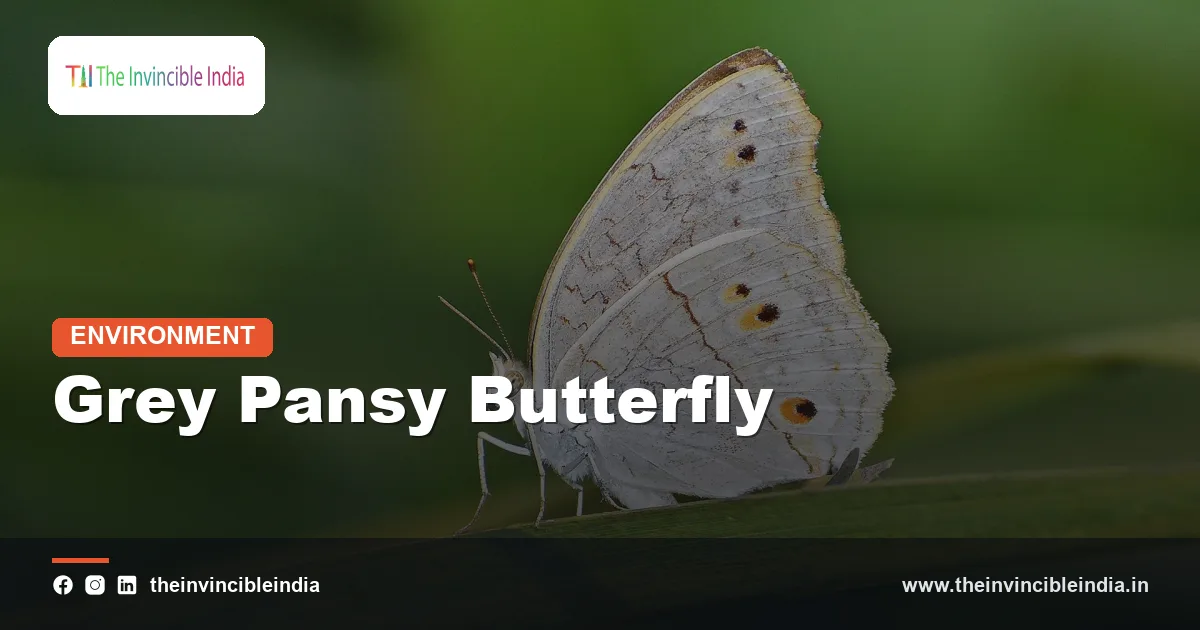
The grey pansy (Junonia atlites) is a medium-sized brush-footed butterfly of the family Nymphalidae, recognised by its pale grey-brown wings crossed by fine wavy dark lines and dotted with small eyespots. It is a familiar sight across India, where it flies low over open ground, scrubby wasteland, garden edges and the bunds of paddy fields, often settling on bare soil with its wings spread flat.
The grey pansy is one of several closely related pansies in the genus Junonia that share Indian gardens and countryside. Its subdued colour, quick low flight and habit of basking on paths make it easy to overlook, yet it is a useful species for beginners to learn because it shows seasonal forms, eyespot defence and a clear host-plant relationship in one small butterfly.
| Quick Facts | Details |
|---|---|
| Common name | Grey pansy (also written gray pansy) |
| Scientific name | Junonia atlites (Linnaeus, 1763) |
| Family | Nymphalidae (brush-footed butterflies), subfamily Nymphalinae |
| Wingspan | Roughly 5 to 6 cm |
| Host plants | Mainly plants of the acanthus family (Acanthaceae), such as Hygrophila and Barleria, plus a few other low herbs |
| Range and habitat in India | Widespread across the plains and low hills; open scrub, dry grassland, field edges, wasteland and gardens |
| Flight season and broods | On the wing for much of the year, commonest during and after the monsoon; several broods a year |
| Notable features | Grey-brown upperside with wavy lines, eyespots on both wings, distinct wet-season and dry-season forms |
Key Takeaways
- The grey pansy (Junonia atlites) is a Nymphalid butterfly with pale grey-brown wings marked by fine, wavy dark lines.
- Grey pansy caterpillars feed on low herbs, chiefly members of the acanthus family, which are common weeds in Indian fields and gardens.
- The grey pansy often basks on bare ground with open wings and flies low and fast when disturbed.
- Eyespots on the grey pansy’s wings help divert the attacks of predators away from the butterfly’s body.
- The grey pansy occurs in a wet-season form and a dry-season form, which differ in shade and in how sharply the markings stand out.
- The grey pansy is widespread and adaptable in India, and it is not regarded as a rare or threatened butterfly.
What is the grey pansy butterfly?
The grey pansy butterfly is a small to medium Indian butterfly, scientifically named Junonia atlites, that belongs to the pansy group of the brush-footed family Nymphalidae. The family name refers to the reduced front legs of adults, which are tiny and brush-like and are not used for walking, so these butterflies appear to stand on four legs rather than six.
The species was described by Carl Linnaeus in 1763 under the name Papilio atlites, and it was later moved to the genus Junonia, which holds the pansies and buckeyes of the world. In India the genus is well represented. The grey pansy sits beside the blue pansy, chocolate pansy, lemon pansy, peacock pansy and yellow pansy, and these species are often seen in the same landscapes.
The English word “pansy” in the butterfly’s name comes from the flower-like look of the large eyespots, which resemble the dark blotches on a garden pansy petal. The word “grey” refers to the overall ashy tone of the wings, which is paler and cooler than the brown of its relatives.
How can you identify a grey pansy?
A grey pansy can be identified by its pale ash-grey to greyish-brown upperside, the fine wavy dark lines running across both wings, and a scattering of small eyespots that stand out against the plain background. The butterfly is only moderately sized, with a wingspan of around 5 to 6 cm, so it looks neat and slightly delicate compared with larger nymphalids.
Upperside and underside
When the grey pansy basks with its wings open, the upperside shows a pale, almost sandy ground colour crossed by wavy transverse lines. The eyespots are usually small and ringed, and they are more noticeable on the hindwing and near the tip of the forewing. The edges of the wings are slightly scalloped rather than smooth.
When the wings are closed, the underside shows a similar but quieter pattern. It is mottled in grey and brown and helps the butterfly blend with dry soil, gravel and dead grass. A grey pansy resting on a dusty track with closed wings can be genuinely hard to spot.
Features to check in the field
- A pale grey-brown base colour rather than a rich chocolate brown or a bright blue.
- Fine wavy lines across the wings instead of broad solid bands.
- Small, neat eyespots on both the forewing and hindwing.
- A low, quick flight that ends with the butterfly settling on bare ground.
Males and females look very much alike. Females tend to be slightly larger and a little more rounded in the wing, but the difference is subtle, and most observers do not try to separate the sexes in the field.
Where does the grey pansy live in India?
The grey pansy lives across most of peninsular and northern India, mainly in open, sunny habitats such as scrub, dry grassland, roadsides, field margins and village gardens. It is much more typical of disturbed or semi-open country than of deep forest, and it readily colonises wasteland where its host plants grow as weeds.
Beyond India, the grey pansy occurs through South Asia and into South-East Asia and southern China. This broad range reflects its tolerance of warm, open conditions and the wide distribution of its larval food plants. Within India it is recorded from the plains up to modest elevations in the hills, and it is common in both dry and moist regions.
The butterfly tends to follow the availability of fresh growth. In dry tracts, activity picks up after the first monsoon showers when weedy herbs sprout, and populations may build steadily through the rainy season. In perennially moist areas, the grey pansy can be seen in most months. City gardens, school grounds and railway embankments all support it, provided that a few low herbs are allowed to grow.
What does the grey pansy eat?
Grey pansy caterpillars eat the leaves of low herbs, chiefly plants of the acanthus family (Acanthaceae), while adult butterflies drink nectar from small flowers and take moisture and minerals from damp soil. Acanthaceae herbs such as Hygrophila, Barleria and related species are common in marshy edges, field bunds and waste ground across India, which explains the butterfly’s wide occurrence.
Caterpillar food plants
The female grey pansy lays her eggs singly on the leaves or tender shoots of a suitable host plant. The caterpillars that hatch eat the foliage and grow through several stages, called instars. Because host plants are mostly modest weeds, the grey pansy rarely becomes a pest, and its feeding seldom damages a garden in any serious way.
Adult feeding
Adults visit small, low flowers and occasionally rotting fruit. They are also frequently seen on damp ground, where they sip water and dissolved salts in a habit known as mud-puddling. This behaviour is more common in males, which need minerals that help in reproduction.
How does the grey pansy behave?
The grey pansy is a ground-loving, sun-seeking butterfly that spends much of the day basking, patrolling a small territory and darting low over the soil. Its flight is quick and direct for a short distance, after which the butterfly drops back to the ground and often opens its wings flat to absorb the warmth of the sun.
Males set up small territories on patches of open ground and chase away rivals and other passing insects. They return repeatedly to the same favoured spot, which can make the species a rewarding subject for patient observers. A butterfly that rises from a path, circles briefly and returns to nearly the same place is typical grey pansy behaviour.
The butterfly is not strongly migratory, although local numbers rise and fall with rainfall and plant growth. It is active mainly in bright sunshine and takes shelter in low vegetation in cloudy or very hot weather. At night and in poor weather it roosts on grass stems or low shrubs with the wings closed.
What is the life cycle of the grey pansy?
The grey pansy goes through complete metamorphosis in four stages: egg, caterpillar, pupa and adult. Under warm Indian conditions one generation can be completed in roughly a month, which allows several broods in a year, although exact timing depends on temperature and the quality of the host plants.
| Stage | What happens |
|---|---|
| Egg | Laid singly on a host-plant leaf or shoot; small, green and ribbed or domed in shape |
| Caterpillar | Feeds on host-plant leaves and grows through several instars; spiny, dark-bodied larva typical of the genus |
| Pupa | Chrysalis hangs head-down from a stem or twig, with a shape and colour that resemble a dried leaf or twig |
| Adult | Emerges, dries its wings, feeds on nectar and moisture, and mates; the cycle then repeats |
Like other nymphalids, the grey pansy pupa is a suspended chrysalis, attached to a plant by a silken pad and a few hooks at its tail. Adults emerge by splitting the chrysalis and then hang motionless while their wings expand and harden. The whole process of drying takes a few hours.
The species is multi-brooded, so successive generations overlap through the warm months. Because the larvae feed on common weeds and the adults are mobile, populations recover quickly after a poor spell.
Why does the grey pansy have eyespots?
The grey pansy has eyespots mainly as a defence against predators, because circular, eye-like marks attract the attention of birds, lizards and other attackers to the wing edges instead of the vulnerable body. A bird that pecks at an eyespot may tear a small notch in the wing, while the butterfly escapes with its body intact.
This is a widespread trick among butterflies and moths. The effect works best when the eyespots are on the outer parts of the wings, as they are in the pansies, because a damaged wing margin does little harm to flight. In some species, eyespots may also startle a predator when the wings are suddenly opened. Many field naturalists have found grey pansies with symmetrical bites out of the hindwings, which is evidence of this strategy in action.
The eyespots are only part of the grey pansy’s protection. The cryptic underside, the habit of freezing on bare ground, and a fast, erratic takeoff all work together. Together these traits show how a small, undefended insect avoids the many predators of open Indian habitats.
How does the grey pansy differ from other pansies?
The grey pansy differs from other Indian pansies mainly in colour and pattern: it is a pale, wavy-lined grey-brown butterfly, whereas relatives are blue, chocolate brown, yellow or orange. Comparing them side by side is the easiest way to learn the genus, since all share the pansy build and the habit of basking.
| Pansy | Main colour | Typical habitat in India |
|---|---|---|
| Grey pansy (Junonia atlites) | Pale grey-brown with wavy lines | Open scrub, field edges, wasteland |
| Blue pansy (Junonia orithya) | Dark upperside with bright blue patches | Open ground, gardens, dry fields |
| Chocolate pansy (Junonia iphita) | Rich brown with a pale band | Forest edges, shaded paths, gardens |
| Lemon pansy (Junonia lemonias) | Brown to tawny with lemon-yellow marks | Grassy ground, scrub, light forest |
| Peacock pansy (Junonia almana) | Orange with large peacock-like eyespots | Wet places, gardens, paddy margins |
The grey pansy is the palest of these, and the lack of strong orange, blue or yellow is a good first clue. The wavy lines also separate it from the smoother-looking chocolate pansy. For a beginner, noticing the overall tone and then checking for lines and eyespots is usually enough.
Why does the grey pansy matter to gardens and ecosystems?
The grey pansy matters because it is a pollinator, a link in the food chain and an easy indicator of whether a patch of land still supports weedy native plants. Adults carry pollen between small flowers as they feed, and the caterpillars, eggs and adults provide food for birds, spiders, lizards, mantises and wasps.
In a garden, the butterfly is a sign that a little untidiness is useful. Acanthaceae herbs, which a gardener might pull out as weeds, are exactly what grey pansy larvae need. Leaving a small corner with such plants, along with bare, sunny soil for basking and a damp patch for mud-puddling, makes the space more attractive to the species.
Pesticides are the greatest threat in cultivated areas. Spraying field margins and roadsides removes host plants and kills caterpillars, so gentler weed control helps butterflies without any cost to crops. The grey pansy is adaptable and widespread, so it is not considered a species of conservation concern, but its presence reflects the general health of open habitats.
How can you watch and photograph the grey pansy?
The best way to watch a grey pansy is to visit open, sunny ground on a warm morning, approach slowly and let the butterfly settle, because it returns to the same basking spots again and again. Patience works far better than chasing, and a soft, slow approach from the side rather than from above avoids casting a threatening shadow.
- Visit between mid-morning and early afternoon when the butterfly is active and basking.
- Look along bare tracks, dry stream edges, bunds and the margins of scrub.
- Keep a low profile and avoid sudden movements.
- Photograph from a low angle to capture the eyespots and wavy lines.
- Do not handle the butterfly, since the scales on the wings are delicate.
Recording sightings on community platforms helps scientists track the seasonal pattern of Indian butterflies. Noting the date, place and whether the butterfly showed the paler or darker seasonal form adds useful information without any harm to the insect.
Bottom Line
The grey pansy is a modest but instructive Indian butterfly: a pale, wavy-lined pansy that basks on open ground, defends itself with eyespots and breeds on common weeds. Learning to recognise it opens the door to the wider pansy group and to the pleasures of everyday butterfly watching in gardens and fields.
Frequently Asked Questions
What is a grey pansy butterfly?
A grey pansy is a medium-sized Indian butterfly, Junonia atlites, in the family Nymphalidae. It has pale grey-brown wings with fine wavy lines and small eyespots. It is common in open scrub, field edges and gardens.
What does the grey pansy caterpillar eat?
The grey pansy caterpillar eats the leaves of low herbs, mainly plants of the acanthus family such as Hygrophila and Barleria. These plants grow as weeds on field bunds, marshy margins and waste ground. A few other herbs are also used occasionally.
How is the grey pansy different from the chocolate pansy?
The grey pansy is pale grey-brown with fine wavy lines, whereas the chocolate pansy is a deeper brown with a paler band and prefers forest edges. The grey pansy favours open, sunny ground. Their habitats overlap only in some gardens and scrubby areas.
Why does the grey pansy have eyespots on its wings?
The eyespots of the grey pansy divert predators to the wing edges instead of the body. A bird or lizard that strikes an eyespot often takes only a bite of wing. This lets the butterfly escape and continue flying.
Where can you see a grey pansy in India?
You can see the grey pansy across most of India in open, sunny habitats such as scrub, dry grassland, roadsides and village gardens. It is especially visible on bare paths where it basks with open wings. Numbers usually peak during and after the monsoon.
Is the grey pansy butterfly rare or protected?
No, the grey pansy is not regarded as a rare or threatened butterfly in India. It is widespread and adaptable and breeds on common weeds. Pesticide use and the loss of weedy herbs are the main local pressures on its numbers.
{“@context”:”https://schema.org”,”@graph”:[{“@type”:”FAQPage”,”mainEntity”:[{“@type”:”Question”,”name”:”What is a grey pansy butterfly?”,”acceptedAnswer”:{“@type”:”Answer”,”text”:”A grey pansy is a medium-sized Indian butterfly, Junonia atlites, in the family Nymphalidae. It has pale grey-brown wings with fine wavy lines and small eyespots. It is common in open scrub, field edges and gardens.”}},{“@type”:”Question”,”name”:”What does the grey pansy caterpillar eat?”,”acceptedAnswer”:{“@type”:”Answer”,”text”:”The grey pansy caterpillar eats the leaves of low herbs, mainly plants of the acanthus family such as Hygrophila and Barleria. These plants grow as weeds on field bunds, marshy margins and waste ground. A few other herbs are also used occasionally.”}},{“@type”:”Question”,”name”:”How is the grey pansy different from the chocolate pansy?”,”acceptedAnswer”:{“@type”:”Answer”,”text”:”The grey pansy is pale grey-brown with fine wavy lines, whereas the chocolate pansy is a deeper brown with a paler band and prefers forest edges. The grey pansy favours open, sunny ground. Their habitats overlap only in some gardens and scrubby areas.”}},{“@type”:”Question”,”name”:”Why does the grey pansy have eyespots on its wings?”,”acceptedAnswer”:{“@type”:”Answer”,”text”:”The eyespots of the grey pansy divert predators to the wing edges instead of the body. A bird or lizard that strikes an eyespot often takes only a bite of wing. This lets the butterfly escape and continue flying.”}},{“@type”:”Question”,”name”:”Where can you see a grey pansy in India?”,”acceptedAnswer”:{“@type”:”Answer”,”text”:”You can see the grey pansy across most of India in open, sunny habitats such as scrub, dry grassland, roadsides and village gardens. It is especially visible on bare paths where it basks with open wings. Numbers usually peak during and after the monsoon.”}},{“@type”:”Question”,”name”:”Is the grey pansy butterfly rare or protected?”,”acceptedAnswer”:{“@type”:”Answer”,”text”:”No, the grey pansy is not regarded as a rare or threatened butterfly in India. It is widespread and adaptable and breeds on common weeds. Pesticide use and the loss of weedy herbs are the main local pressures on its numbers.”}}]}]}


