

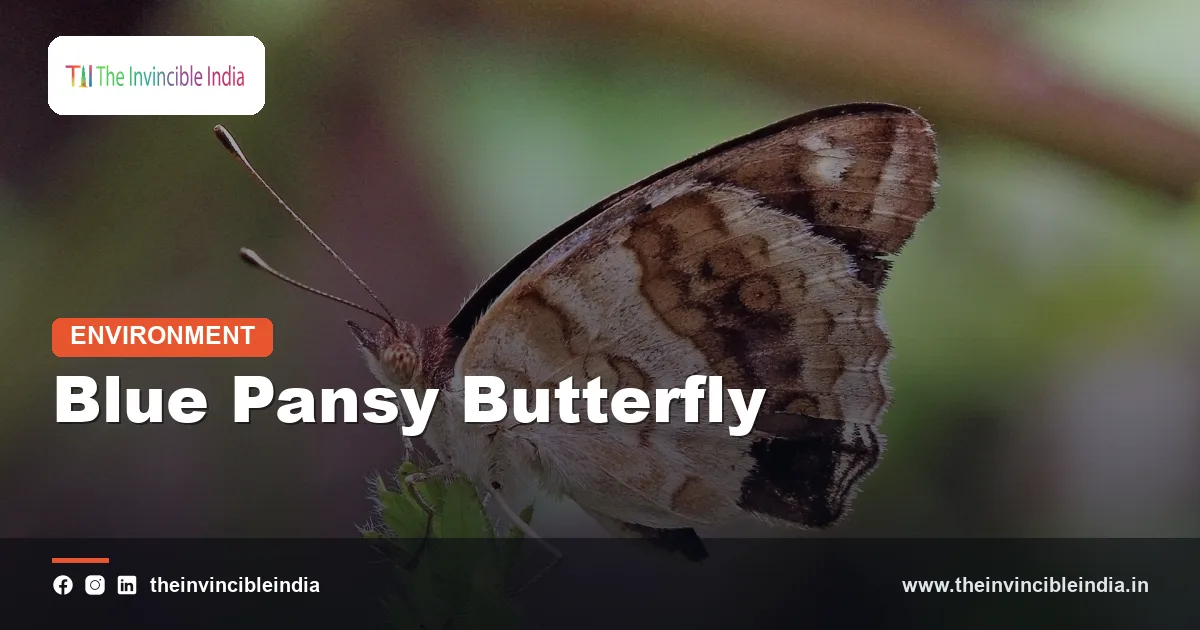
The blue pansy (Junonia orithya) is a small, strikingly coloured butterfly of the brush-footed family Nymphalidae, found across India in gardens, scrub and open sunny ground, and recognised by its blue hindwings and large eyespots. The male has a vivid cobalt-blue patch on each hindwing, while the female is a duller brown with only a hint of blue.
The blue pansy is one of the commonest garden and roadside butterflies of the Indian plains, and it is often seen basking on bare ground with its wings flat. This explainer covers how to identify the blue pansy, where it lives, what it eats, how its life cycle works and how to attract it to a garden.
| Attribute | Details |
|---|---|
| Common name | Blue pansy (also called the eyed pansy in some books) |
| Scientific name | Junonia orithya |
| Family | Nymphalidae (brush-footed butterflies), subfamily Nymphalinae |
| Wingspan | Roughly 4 to 6 centimetres, with some variation between individuals and seasons |
| Larval host plants | Low herbs such as species in the acanthus family (for example Asystasia and Hygrophila), the verbena family (Phyla) and the figwort and plantain families |
| Range in India | Widespread across the plains and lower hills, in gardens, scrub, grassland, farmland edges and roadsides |
| Wider range | Africa, South and Southeast Asia, and Australia |
| Broods | Several broods a year, with breeding possible nearly year-round in warm regions |
| Conservation status | Common and widespread; not considered threatened |
Key Takeaways
- The blue pansy, Junonia orithya, is a small brush-footed butterfly of the family Nymphalidae that is common across most of India.
- Male blue pansies show bright blue hindwings with black borders and orange markings, while females are brownish with smaller blue patches and larger orange bands.
- Blue pansy larvae feed on low-growing herbs, including members of the acanthus and verbena families, which often grow as weeds in gardens.
- The blue pansy has large eyespots on the wings, which are thought to draw predators away from the butterfly’s vital body parts.
- Blue pansies bask with open wings on bare ground, fly low and fast, and breed in several broods a year in warm parts of India.
- The blue pansy is common and adaptable, and it is easily attracted to gardens that keep weedy host plants and avoid pesticides.
What is the blue pansy butterfly?
The blue pansy butterfly is a small to medium-sized member of the genus Junonia, a group of brush-footed butterflies known as pansies, buckeyes and commodores. It is called a pansy because its rounded wings carry eyespots and colour patches that people have likened to the face of the pansy flower.
Brush-footed butterflies are named for their front pair of legs, which are tiny and covered in hair, so the butterfly appears to walk on only four legs. This feature is shared by many familiar species, including the common crow, the painted lady and the plain tiger’s relatives. The blue pansy was described scientifically by Linnaeus in the eighteenth century and has been recorded in many parts of the Old World.
Among Indian butterfly watchers, the blue pansy is a favourite beginner’s species. It is easy to approach when basking, appears in large numbers after the rains and shows strong colour contrast, so identification is rarely difficult.
How can you identify a blue pansy butterfly?
A blue pansy can be identified by its vivid blue hindwings in males, the prominent eyespots on both pairs of wings and a broad orange bar on the forewing. Females are brownish and less blue, but they share the same wing shape and eyespot pattern.
Male
The upper side of the male is dark, with a bright, almost electric blue on the hindwing and a smaller bluish sheen near the base of the forewing. Orange and white bands cross the forewing, and a large black eyespot with a coloured ring sits on each wing. The edges are scalloped and bordered with dark lines.
Female
The female is mostly brown, with a duller bluish area on the hindwing and wider orange or buff markings. Her eyespots are as large as the male’s, and in some seasonal forms the overall tone is paler.
Underside
The underside is pale greyish or buff-brown with faint eyespots and fine lines. When the butterfly folds its wings, the colour blends well with soil, dry leaves and stones, making it harder to see.
- Size: small, with a wingspan of roughly 4 to 6 centimetres.
- Flight: quick, low and darting, with short glides.
- Posture: wings open flat when basking in the sun.
- Markings: two sets of eyespots, one on each wing, and strong sexual difference in colour.
Where is the blue pansy found in India?
The blue pansy is found throughout most of India, from the plains and coastal belts to lower hill regions, wherever there is open, sunny ground with low vegetation. It is one of the most widely distributed pansies in the country.
Typical habitats include the following.
- Garden lawns, flower beds and neglected corners.
- Roadsides, railway embankments and waste ground.
- Scrub, dry grassland and fallow farmland.
- River banks, canal edges and the margins of ponds where damp soil is available.
- Forest clearings and open paths in lower hills.
Beyond India, the species ranges across Africa, South Asia, Southeast Asia and parts of Australia, which makes it one of the more cosmopolitan butterflies of the Old World tropics. In India, it tends to be most noticeable in the monsoon and post-monsoon months when host plants are lush, though adults can be seen in many months of the year in warm regions.
The butterfly generally avoids dense, shaded forest and prefers sun-warmed open spaces. Because of this preference, it thrives in human-modified landscapes, including towns and suburbs.
What does the blue pansy eat?
Adult blue pansies feed on flower nectar, while the caterpillars eat the leaves of specific low-growing host plants. The two stages need different foods, which is why a good butterfly habitat must include both flowering plants and caterpillar food plants.
Adults
Adults visit small flowers with accessible nectar, including many roadside weeds and garden plants. They also come down to damp soil, a behaviour called mud-puddling, to take up salts and minerals that help their reproduction. Males in particular gather at wet ground in the cooler hours of the day.
Caterpillars
Blue pansy caterpillars feed on herbs and creepers that often grow as weeds. Commonly recorded host plants include members of the acanthus family, such as Asystasia and Hygrophila, along with Phyla (frog-fruit or lippia) in the verbena family and certain figwort and plantain relatives. Exact host plants vary with locality, so different regions of India report different species.
Because many of these host plants are considered weeds and are cleared from lawns and fields, tidy gardening can reduce the local butterfly population even when nectar plants are present.
What is the life cycle of the blue pansy?
The blue pansy goes through complete metamorphosis in four stages: egg, caterpillar, pupa and adult. In warm weather the whole cycle can be finished in a few weeks, which allows several broods in a year.
| Stage | What happens |
|---|---|
| Egg | The female lays single eggs on the leaves or tender shoots of a host plant; the eggs are small and pale green |
| Caterpillar (larva) | The dark, spiny caterpillar eats leaves and grows through several moults, called instars |
| Pupa (chrysalis) | The caterpillar hangs head-down from a stem or twig and forms a brownish, angular chrysalis |
| Adult | The butterfly emerges, dries its wings and begins feeding on nectar, mating and egg-laying |
The time taken at each stage depends on temperature and food. In hot, humid weather the cycle is faster, and in cooler months it slows down. Adults live for a few weeks, and the species may overwinter as adults or continue breeding slowly in the warmer south.
Blue pansies show seasonal forms in many areas, which means individuals emerging in the wet season may look slightly different from those emerging in the dry season. These differences are mostly in the paleness of the underside and the strength of the markings, and they are an adaptation to the changing background of vegetation and soil.
How does the blue pansy behave?
The blue pansy is a sun-loving, territorial butterfly that basks on the ground with open wings, flies low and fast when disturbed and returns to the same patch again and again. It is most active in the warmer hours of the morning and afternoon.
- Basking: The butterfly rests on bare earth, stones or short grass with wings flat to absorb heat, which raises its body temperature for flight.
- Territorial flights: Males perch on a favoured patch and chase away rivals or other butterflies that pass by, then settle back near the same spot.
- Low flight: The butterfly flies close to the ground in short bursts, which makes it hard to follow with the eye.
- Mud-puddling: Individuals gather at damp soil to take up minerals.
- Rest posture: At night or in cool weather, the wings are folded and the butterfly sits motionless among vegetation.
Mating usually occurs near the host plants, and the female then lays eggs one at a time, moving between plants rather than depositing a cluster.
Why does the blue pansy have eyespots?
The blue pansy has eyespots because the large, circular markings are thought to confuse or startle predators and direct their attacks away from the butterfly’s head and body. Eyespots are common in the butterfly family Nymphalidae, and they are one of the best-studied examples of defensive wing patterns.
The idea has two parts. First, a sudden flash of large “eyes” may startle a small bird or lizard for a moment, giving the butterfly time to escape. Second, a predator that strikes at the eyespot, which is placed near the wing edge, may catch only a piece of wing rather than the vital body, so the butterfly can fly away damaged. Butterfly watchers often see blue pansies with notched or torn wing margins that show survival after such an attack.
The colour of the underside also helps. When the wings are folded, the pale brown surface looks like dry soil or leaf litter, and when they are opened the eyespots appear suddenly. This combination of camouflage and display is an efficient survival strategy for a small, ground-dwelling insect.
How is the blue pansy different from other pansies?
The blue pansy differs from other Indian pansies mainly in its blue hindwings and wing pattern, while related species show different dominant colours. Several Junonia species share Indian habitats, and beginners often mix them up.
| Species | Main identification feature |
|---|---|
| Blue pansy (Junonia orithya) | Bright blue hindwings in males; two large eyespots; orange bar on forewing |
| Peacock pansy (Junonia almana) | Orange-brown wings with large peacock-like eyespots; seasonal forms differ in shape |
| Lemon pansy (Junonia lemonias) | Brown with lemon-yellow patches and dark eyespots |
| Grey pansy (Junonia atlites) | Pale grey with fine wavy lines and small eyespots |
| Chocolate pansy (Junonia iphita) | Chocolate brown with a wavy pattern and a more forest-edge habitat |
The easiest field clue for the blue pansy is the blue colour on the hindwing of the male. Females can be confused with the peacock pansy or lemon pansy, so butterfly watchers look at the shape of the wing margin, the arrangement of eyespots and the colour of the bar on the forewing.
What role does the blue pansy play in nature?
The blue pansy plays a role as a pollinator of small flowers, as food for insect-eating animals and as a living indicator of open-habitat health. Although each butterfly carries only a little pollen, thousands of visits across a season add up to real benefit for weedy and wild flowering plants.
The eggs, caterpillars and chrysalises are eaten by ants, spiders, wasps, lizards and small birds, so the species links plant growth to the wider food web. Adult butterflies are in turn preyed on by birds, dragonflies, praying mantises and geckos near lights. Some caterpillars are also attacked by parasitic wasps and flies, which lay their eggs inside the young stages.
Because blue pansies depend on weedy plants and warm open ground, their presence says something about the condition of a place. A garden or field edge with many pansies, skippers and other small butterflies usually has diverse low vegetation and little chemical use, while an area with almost none may be heavily sprayed or paved.
Is the blue pansy threatened?
The blue pansy is not considered threatened, because it is common, widespread and tolerant of disturbed habitats. Its ability to breed on weedy plants in gardens and fields makes it more resilient than butterflies that depend on rare forest plants.
Even so, local populations can be affected by the following pressures.
- Use of insecticides and herbicides in farms and urban gardens.
- Clearing of weedy patches, road verges and vacant plots that provide caterpillar food.
- Paving and construction that replace bare soil and low vegetation.
- Changes in rainfall pattern that disrupt the timing of host-plant growth.
Butterflies in general act as indicators of environmental health, and the abundance of a common species like the blue pansy gives a rough measure of how friendly an area is to small insects. Citizen-science projects in India, including butterfly counts and online sightings platforms, regularly record the species.
How can you attract blue pansies to a garden?
You can attract blue pansies to a garden by keeping a sunny, open patch with bare soil, growing small nectar-rich flowers and leaving some host-plant weeds uncut for the caterpillars. Avoiding pesticides is the single most important step.
- Leave a corner of the garden unmown and allow low herbs like frog-fruit (Phyla) or wild acanthus-family plants to grow.
- Plant small, open flowers that give easy access to nectar, such as lantana, zinnia, marigold and Tridax in moderation.
- Keep some bare, sun-warmed soil or flat stones so the butterflies can bask.
- Provide a shallow, damp patch of sand or soil for mud-puddling.
- Avoid chemical sprays, which kill eggs and caterpillars.
Patience helps, since caterpillars and chrysalises are small and well camouflaged. Watching a single host plant over a few weeks often reveals the whole life cycle in a small space.
Bottom Line
The blue pansy is a bold little butterfly of Indian open ground, easy to spot and rewarding to watch through every stage of its life. Its success shows how weedy corners and pesticide-free gardens can support wildlife in towns and villages alike. Information on this page was last reviewed on 23 October 2026.
Frequently Asked Questions
What is a blue pansy butterfly?
The blue pansy is a small brush-footed butterfly, Junonia orithya, found across India. Males have bright blue hindwings and both sexes have large eyespots. It is common in gardens, scrub and open sunny ground.
Where does the blue pansy live in India?
The blue pansy lives in most parts of India, from the plains to the lower hills. It prefers open, sunny places such as gardens, roadsides, grassland and farmland edges. It generally avoids dense, shaded forest.
What do blue pansy caterpillars eat?
Blue pansy caterpillars eat the leaves of low herbs, including plants in the acanthus family such as Asystasia and Hygrophila, and Phyla in the verbena family. Host plants vary by region. Many of these plants grow as common weeds.
How can you tell a male blue pansy from a female?
A male blue pansy has bright blue hindwings, while the female is mostly brown with smaller, duller blue patches and wider orange markings. Both have large eyespots. The difference in colour is the easiest way to separate the sexes in the field.
Why does the blue pansy have eyespots on its wings?
The eyespots are thought to startle predators and draw attacks away from the butterfly’s head and body. A bird that strikes the wing edge may take only a bit of wing. Many blue pansies are seen with torn wing margins after such encounters.
Is the blue pansy butterfly rare?
No, the blue pansy is common and widespread across India. It adapts well to gardens and disturbed land, and it can breed on weedy plants. Local numbers can fall where pesticides are used heavily or weedy patches are cleared.
{“@context”:”https://schema.org”,”@graph”:[{“@type”:”FAQPage”,”mainEntity”:[{“@type”:”Question”,”name”:”What is a blue pansy butterfly?”,”acceptedAnswer”:{“@type”:”Answer”,”text”:”The blue pansy is a small brush-footed butterfly, Junonia orithya, found across India. Males have bright blue hindwings and both sexes have large eyespots. It is common in gardens, scrub and open sunny ground.”}},{“@type”:”Question”,”name”:”Where does the blue pansy live in India?”,”acceptedAnswer”:{“@type”:”Answer”,”text”:”The blue pansy lives in most parts of India, from the plains to the lower hills. It prefers open, sunny places such as gardens, roadsides, grassland and farmland edges. It generally avoids dense, shaded forest.”}},{“@type”:”Question”,”name”:”What do blue pansy caterpillars eat?”,”acceptedAnswer”:{“@type”:”Answer”,”text”:”Blue pansy caterpillars eat the leaves of low herbs, including plants in the acanthus family such as Asystasia and Hygrophila, and Phyla in the verbena family. Host plants vary by region. Many of these plants grow as common weeds.”}},{“@type”:”Question”,”name”:”How can you tell a male blue pansy from a female?”,”acceptedAnswer”:{“@type”:”Answer”,”text”:”A male blue pansy has bright blue hindwings, while the female is mostly brown with smaller, duller blue patches and wider orange markings. Both have large eyespots. The difference in colour is the easiest way to separate the sexes in the field.”}},{“@type”:”Question”,”name”:”Why does the blue pansy have eyespots on its wings?”,”acceptedAnswer”:{“@type”:”Answer”,”text”:”The eyespots are thought to startle predators and draw attacks away from the butterfly’s head and body. A bird that strikes the wing edge may take only a bit of wing. Many blue pansies are seen with torn wing margins after such encounters.”}},{“@type”:”Question”,”name”:”Is the blue pansy butterfly rare?”,”acceptedAnswer”:{“@type”:”Answer”,”text”:”No, the blue pansy is common and widespread across India. It adapts well to gardens and disturbed land, and it can breed on weedy plants. Local numbers can fall where pesticides are used heavily or weedy patches are cleared.”}}]}]}


