

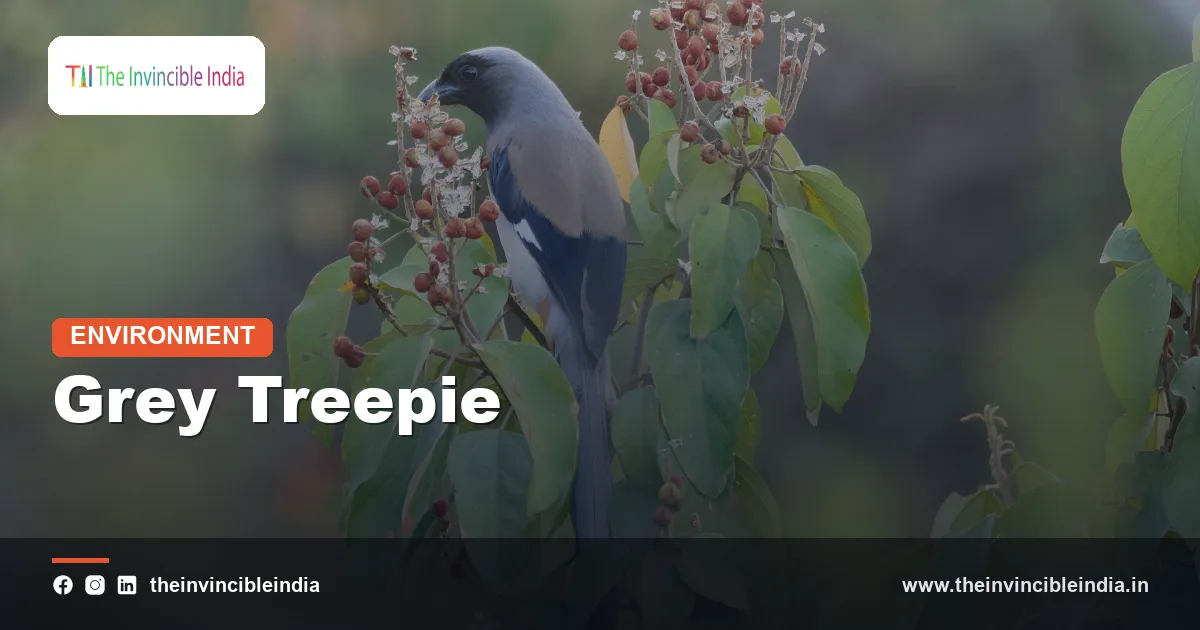
The grey treepie (Dendrocitta formosae) is a long-tailed, grey-bodied member of the crow family that lives in the broadleaved hill forests of the Himalayan foothills and north-eastern India. It is a noisy, active and highly social canopy bird, usually seen in small parties that move through the treetops with a harsh, rattling call. Although it is related to crows, jays and magpies, the grey treepie is slimmer, more arboreal and far more colourful than the common crow.
For anyone walking through the hill forests of Uttarakhand, Sikkim, Darjeeling or Arunachal Pradesh, the grey treepie is among the most frequently heard birds. This article explains what the grey treepie looks like, where it lives in India, what it eats, how it breeds and how it differs from the other treepies found in the country.
Quick Facts
| Common name | Grey treepie |
|---|---|
| Scientific name | Dendrocitta formosae |
| Family | Corvidae (crows, jays, magpies and treepies) |
| Size | About 38 cm in length, with a long graduated tail forming much of that length |
| Range | Himalayan foothills and hills from the western Himalaya eastward through Nepal, Bhutan and north-eastern India to Myanmar, South-East Asia, southern China and Taiwan |
| Habitat | Broadleaved and mixed forest, forest edges, scrub and wooded gardens, mostly from the foothills to about 2,000 m |
| Diet | Omnivorous: fruits, berries, insects, nectar, small vertebrates, eggs and nestlings |
| Breeding | Cup nest of twigs in a tree; usually 3 to 5 eggs; spring and early summer |
| Conservation status | Least Concern on the IUCN Red List |
Key Takeaways
- The grey treepie (Dendrocitta formosae) is a member of the crow family, Corvidae, and is native to the Himalayan foothills and hills of South and South-East Asia.
- An adult grey treepie is about 38 cm long, with a grey back, a black face, a white patch on a dark wing and a long grey tail tipped with black.
- The grey treepie is omnivorous, feeding on fruits, insects, eggs, nestlings and sometimes nectar, which makes it adaptable across hill forests and wooded gardens.
- The grey treepie builds a shallow cup nest of twigs in a tree and usually lays 3 to 5 eggs in spring or early summer.
- India has several treepie species, and the grey treepie is the one most associated with the Himalayan foothills and the hills of the north-east.
- The IUCN lists the grey treepie as a species of Least Concern because it has a wide range and is not known to be declining sharply.
What is the grey treepie?
The grey treepie is a medium-sized songbird of the family Corvidae, the same family that includes crows, rooks, jays, magpies and choughs. Its scientific name, Dendrocitta formosae, combines a Greek-derived genus name meaning roughly “tree jay” or “tree magpie” with a species name that refers to Formosa, the old European name for Taiwan, where the first specimens were described in the nineteenth century.
The word “treepie” captures the bird’s lifestyle. Treepies are magpie-like birds with long tails and loud voices, but unlike the black-and-white magpies of open country they spend most of their time in the branches of trees. They hop, climb and glide from tree to tree rather than foraging mainly on the ground.
Within the genus Dendrocitta, the grey treepie belongs to a group of Asian species found from the Indian subcontinent through South-East Asia and southern China. In India the genus is represented by a few species that occupy different parts of the country, and the grey treepie holds the northern and north-eastern hill belt.
What does the grey treepie look like?
The grey treepie has a mostly grey body, a blackish face and throat, a dark wing with a conspicuous white patch, a paler rump and a long grey tail with a black tip. Its lower belly and the feathers beneath the tail are a warm buff to cinnamon, a colour contrast that is easy to notice when the bird is seen from below.
Several features help to identify the species in the field:
- A black mask around the eyes and bill that merges into a dark throat.
- A soft brownish-grey to pale grey mantle and back, which gives the bird its common name.
- Black wings with a white patch that flashes in flight.
- A long, graduated tail, grey above with a black end band, that is often held cocked or swung from side to side.
- A stout, slightly curved black bill and a dark eye.
Males and females look alike. Young birds are duller and have less contrast on the face. Several subspecies are recognised across the range, and these differ mainly in the exact shade of the body, the amount of white on the rump and the depth of the buff on the underparts.
Where is the grey treepie found in India?
The grey treepie is found along the Himalayan foothills and middle hills of India, from the western Himalaya eastward through Uttarakhand, Sikkim and West Bengal’s northern hills to Assam, Arunachal Pradesh, Nagaland, Manipur, Mizoram, Meghalaya and Tripura. It is a resident bird, meaning that it does not undertake long migrations, although some birds move up and down the slopes with the seasons.
Outside India the grey treepie occurs in Nepal, Bhutan and Bangladesh, and extends eastward through Myanmar and Indo-China to southern China, Hainan and Taiwan. This is a broad range that follows the humid, forested hill country of southern Asia.
Within India, the bird is most common in the sub-Himalayan belt, in the forested hills of the north-east and in the foothill valleys of the Terai-Duar zone where hill forest meets plains. It is rarely seen in the dry interior of the peninsula, where other treepie species take its place.
What habitat does the grey treepie prefer?
The grey treepie prefers broadleaved evergreen and moist deciduous hill forest, forest edges, secondary growth and wooded gardens, usually below about 2,000 m. It tends to stay in the middle and upper layers of the forest, though it will drop to lower branches and bushes when fruits are ripe.
The bird is quite tolerant of human presence. In hill stations and tea-garden districts it often visits orchards, gardens and the shade trees planted along roads and estates. The mixture of tall trees, fruiting shrubs and open edges suits its mixed diet and its habit of moving between trees in small groups.
Altitude matters. Birds recorded in the foothills in winter may be found at somewhat higher elevations in the breeding season, and local movement follows the availability of fruit. Dense, undisturbed forest gives nest sites and cover, but the species does not depend on pristine forest in the way that some rarer hill birds do.
What does the grey treepie eat?
The grey treepie is an omnivore that eats fruits, berries, seeds, insects, nectar, eggs and the young of other small birds. As with most members of the crow family, its diet changes with the season and with whatever is easiest to find.
The main food groups are:
- Fruits and berries: wild figs and other forest fruits are favourites, and the bird also takes cultivated fruit in orchards.
- Insects and other invertebrates: beetles, caterpillars, grasshoppers and spiders are picked from bark, leaves and moss.
- Nectar and flowers: treepies sometimes probe blossoms, especially those of large flowering trees in spring, and may help to carry pollen between flowers.
- Eggs and nestlings: like other corvids, the grey treepie raids the nests of smaller birds when it gets the chance.
- Scraps: near human settlements it may take food waste or grain.
Because it eats fruit and passes the seeds, the grey treepie plays a modest role in dispersing forest plants. Because it eats insects, it also helps to control caterpillar and beetle populations in the canopy.
How does the grey treepie breed?
The grey treepie breeds in spring and early summer, building a shallow cup nest of twigs in a tree and laying usually 3 to 5 eggs. The exact timing depends on altitude and region, with lowland birds starting a little earlier than those in the higher hills.
The nest is a loosely made but sturdy platform of sticks, lined with finer material such as rootlets, grass or fibres. It is placed in the fork of a tree, often at a moderate height, and is typically hidden among dense foliage. The eggs are pale and blotched with brown or grey, a pattern that is common in the crow family.
Both parents take part in rearing the young. They feed the chicks on insects and other animal food at first, adding fruit as the young grow. After fledging, the juveniles stay with the family party for some time, which is one reason why the species is so often seen in groups.
What does the grey treepie sound like?
The grey treepie has a loud, harsh and often metallic voice, usually described as rattling, nasal or bell-like, and it is one of the main ways in which people notice the species. Calls carry far through the forest and are given both when the birds are moving and when they are alarmed.
The vocal repertoire includes a range of whistles, rasping notes and chattering sequences. Like many corvids the species is a capable mimic, and observers have reported it imitating other birds. Calls tend to be most frequent in the morning and evening, and also whenever a predator such as a hawk or a snake is spotted.
Alarm calling is a social habit. When one member of a party spots a threat, the whole group may join in, a behaviour that can alert other forest animals as well. In this way treepies serve as sentinels in the canopy.
How is the grey treepie different from other Indian treepies?
The grey treepie is distinguished from other Indian treepies mainly by its grey body, black face and white wing patch, whereas the rufous treepie has a rufous body and a dark head and the white-bellied treepie has a white belly. Each species has its own region, and the ranges overlap only a little.
| Species | Scientific name | Key features | Main Indian range |
|---|---|---|---|
| Grey treepie | Dendrocitta formosae | Grey body, black face, white wing patch, buff belly | Himalayan foothills and north-eastern hills |
| Rufous treepie | Dendrocitta vagabunda | Rufous body, sooty-black head, long tail | Plains, dry forest and open woodland across much of India |
| White-bellied treepie | Dendrocitta leucogastra | Dark head, brown back, white belly | Western Ghats |
| Collared treepie | Dendrocitta frontalis | Black head, chestnut-brown body, grey tail | Eastern Himalaya and north-eastern India |
| Andaman treepie | Dendrocitta bayleii | Chestnut-brown body, dark head, long tail | Andaman Islands |
The comparison shows how the genus has divided up the Indian landscape. The rufous treepie is the species most people meet in towns and fields, while the grey treepie belongs to cooler, wetter forests in the hills.
Is the grey treepie threatened?
No, the grey treepie is not considered threatened, and the IUCN lists it as Least Concern because it has a very large range and a population that is believed to be stable. The species is common in many parts of the hills where forest cover remains.
That does not mean it is free of pressure. Loss and fragmentation of hill forests, shifting land use and the clearing of woodland for roads and settlements can reduce suitable habitat locally. As a generalist feeder that tolerates edges and gardens, the grey treepie copes with disturbance better than many forest specialists, but it still benefits from tree cover.
Its legal position in India is straightforward. Like most native wild birds, the grey treepie is protected under the Wild Life (Protection) Act, 1972, which prohibits hunting and capture of protected species and regulates trade.
How can you spot a grey treepie in the wild?
The best way to find a grey treepie is to listen for its harsh calls in hill forest in the morning, then look up into the middle canopy for a long grey tail and a flash of white on the wings. The birds seldom sit still for long, so patient watching along forest edges or tracks gives better results than searching deep inside dense forest.
Some practical pointers can help beginners:
- Visit well-wooded hill areas such as the Himalayan foothills, Darjeeling district, Sikkim or the forest reserves of the north-east.
- Go early in the day, when birds are active and calling.
- Watch fruiting trees, since treepies gather where figs and berries are ripe.
- Note the tail: a long, black-tipped, swinging grey tail separates the species from crows and from the smaller grey birds of the same forest.
- Carry a pair of binoculars and a field guide for confirmation.
Photographers and birdwatchers value the species because it is bold, vocal and often visible, which makes it a good introduction to the family of Indian corvids.
Bottom Line
The grey treepie is a common, adaptable and easily recognised crow-relative of the Himalayan foothills and the north-eastern hills of India. Its grey plumage, long tail and harsh voice make it one of the most noticeable birds of the hill canopy, and its Least Concern status reflects a healthy population across its wide range.
Frequently Asked Questions
What is a grey treepie?
A grey treepie is a long-tailed songbird of the crow family, Corvidae, found in the hill forests of the Himalayan foothills, north-eastern India and parts of South-East Asia. It is about 38 cm long, with a grey body, a black face, a white wing patch and a black-tipped tail. The species is noisy and social and is usually seen in small groups in the treetops.
Is the grey treepie related to the crow?
Yes, the grey treepie is related to the crow because both belong to the family Corvidae. Other family members include jays, magpies and rooks. The grey treepie is more slender and more tree-dwelling than a crow, and it has a longer tail and brighter markings.
Where can I see a grey treepie in India?
You can see a grey treepie in the Himalayan foothills and middle hills, including Uttarakhand, Sikkim, northern West Bengal and the forests of the north-eastern states. It is most often found in broadleaved hill forest and wooded gardens below about 2,000 m. Early morning is the best time to look for it.
What does the grey treepie eat?
The grey treepie eats a mixed diet of fruits, berries, insects, nectar, eggs and nestlings. It changes its food with the season and takes whatever is available in the forest canopy. Near human settlements it may also take scraps or cultivated fruit.
How is the grey treepie different from the rufous treepie?
The grey treepie is grey with a black face and a white wing patch, while the rufous treepie is warm reddish-brown with a dark head. The grey treepie lives mainly in the humid hill forests of the Himalayan foothills and the north-east. The rufous treepie is more common in the plains, dry woodland and towns across much of India.
Is the grey treepie an endangered bird?
No, the grey treepie is not endangered, and the IUCN classifies it as Least Concern. It has a large range and an apparently stable population. Local habitat loss can still affect it, so retaining tree cover in the hills remains important.
{“@context”:”https://schema.org”,”@graph”:[{“@type”:”FAQPage”,”mainEntity”:[{“@type”:”Question”,”name”:”What is a grey treepie?”,”acceptedAnswer”:{“@type”:”Answer”,”text”:”A grey treepie is a long-tailed songbird of the crow family, Corvidae, found in the hill forests of the Himalayan foothills, north-eastern India and parts of South-East Asia. It is about 38 cm long, with a grey body, a black face, a white wing patch and a black-tipped tail. The species is noisy and social and is usually seen in small groups in the treetops.”}},{“@type”:”Question”,”name”:”Is the grey treepie related to the crow?”,”acceptedAnswer”:{“@type”:”Answer”,”text”:”Yes, the grey treepie is related to the crow because both belong to the family Corvidae. Other family members include jays, magpies and rooks. The grey treepie is more slender and more tree-dwelling than a crow, and it has a longer tail and brighter markings.”}},{“@type”:”Question”,”name”:”Where can I see a grey treepie in India?”,”acceptedAnswer”:{“@type”:”Answer”,”text”:”You can see a grey treepie in the Himalayan foothills and middle hills, including Uttarakhand, Sikkim, northern West Bengal and the forests of the north-eastern states. It is most often found in broadleaved hill forest and wooded gardens below about 2,000 m. Early morning is the best time to look for it.”}},{“@type”:”Question”,”name”:”What does the grey treepie eat?”,”acceptedAnswer”:{“@type”:”Answer”,”text”:”The grey treepie eats a mixed diet of fruits, berries, insects, nectar, eggs and nestlings. It changes its food with the season and takes whatever is available in the forest canopy. Near human settlements it may also take scraps or cultivated fruit.”}},{“@type”:”Question”,”name”:”How is the grey treepie different from the rufous treepie?”,”acceptedAnswer”:{“@type”:”Answer”,”text”:”The grey treepie is grey with a black face and a white wing patch, while the rufous treepie is warm reddish-brown with a dark head. The grey treepie lives mainly in the humid hill forests of the Himalayan foothills and the north-east. The rufous treepie is more common in the plains, dry woodland and towns across much of India.”}},{“@type”:”Question”,”name”:”Is the grey treepie an endangered bird?”,”acceptedAnswer”:{“@type”:”Answer”,”text”:”No, the grey treepie is not endangered, and the IUCN classifies it as Least Concern. It has a large range and an apparently stable population. Local habitat loss can still affect it, so retaining tree cover in the hills remains important.”}}]}]}


