

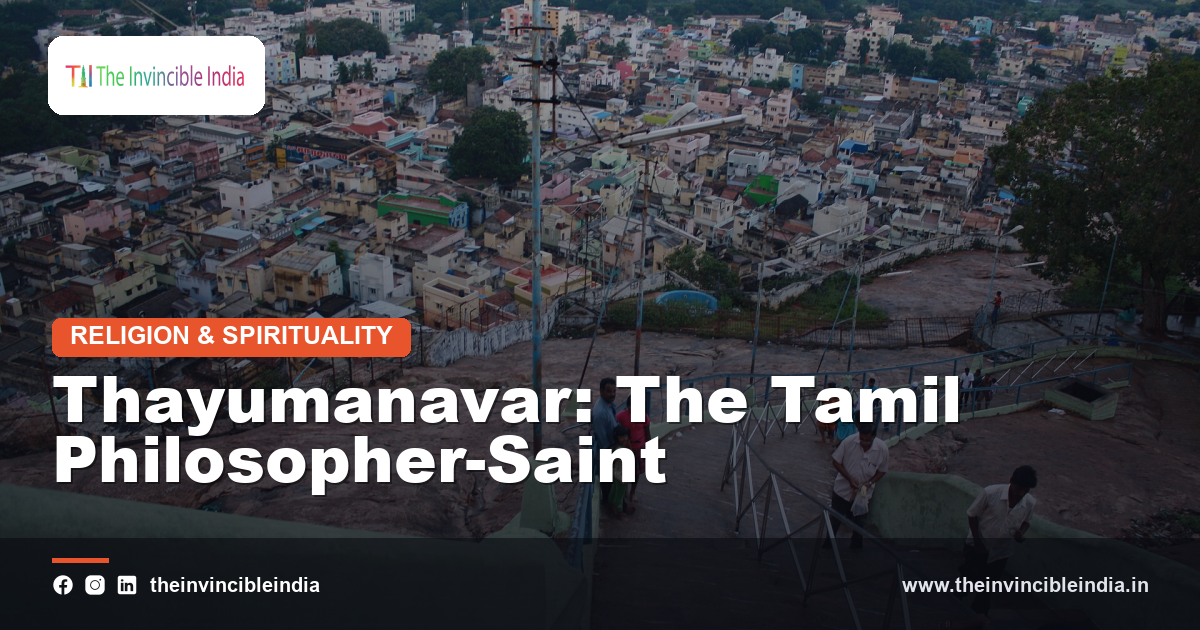
Thayumanavar, also spelled Thayumanavar Swamigal or Thayumana Swami and sometimes written Tayumanavar, is a Tamil philosopher-saint of the eighteenth century who is traditionally associated with Tiruchirappalli, the city of the Rockfort in Tamil Nadu. He is remembered as a Shaiva poet whose devotional songs bring together the thought of Vedanta and Shaiva Siddhanta, and he is said to have left royal service to follow the path of renunciation. His name is linked with the Shiva shrine on the Rockfort, where the deity is called Thayumanavar. His life belongs to the wider tradition of devotion to Shiva described in the Shaivism guide.
Quick answer: Thayumanavar is an eighteenth-century Tamil philosopher-saint and poet, traditionally associated with Tiruchirappalli, who is remembered for devotional songs that join the ideas of Vedanta and Shaiva Siddhanta. He is said to have served in a royal court before turning to renunciation, and his name is linked with Shiva as Thayumanavar on the Rockfort. His verses express the wish that all beings may be happy.
Key Takeaways
- Thayumanavar is an eighteenth-century Tamil philosopher-saint and poet devoted to Shiva.
- He is traditionally associated with Tiruchirappalli, where the Rockfort temple honours Shiva as Thayumanavar.
- Tradition says he served as an official in the court of the Nayak rulers before choosing a life of renunciation.
- His songs blend the non-dual outlook of Vedanta with the devotional theology of Shaiva Siddhanta.
- His verses are best known for their wish for the happiness of all beings.
- His memorial is honoured at Ramanathapuram in southern Tamil Nadu, according to tradition.
The sections below explain the life, works, teachings and continuing legacy in more detail.
Quick Facts
| Detail | Information |
|---|---|
| Also known as | Thayumana Swamigal, Tayumanavar |
| Role | Philosopher, poet and renunciant |
| Tradition | Tamil Shaivism, Shaiva Siddhanta and Vedanta |
| Associated deity | Shiva as Thayumanavar (Matrubhuteswarar) |
| Associated place | Tiruchirappalli, Tamil Nadu |
| Language of verse | Tamil |
| Era | Eighteenth century |
Who Was Thayumanavar?
Thayumanavar was a Tamil Shaiva poet, philosopher and renunciant of the eighteenth century who is honoured for his devotional songs. His life is usually told in two parts, a first part as a capable official of the court and a second part as a seeker who left worldly duty. He is remembered as one of the most thoughtful voices of Tamil Shaiva literature.
The accounts of his life come largely from devotional tradition and later biographical writing, and some details are not firmly documented. Respectful readers treat the stories as sacred biography that expresses the spirit of the saint. What is consistent across the accounts is the picture of a learned, gentle and inward man whose songs reached both scholars and ordinary devotees.
Why Is He Called Thayumanavar?
He is called Thayumanavar after the deity of the Rockfort temple at Tiruchirappalli, where Shiva is worshipped as Thayumanavar, meaning the one who became a mother. The name is linked with a tradition about Shiva taking the form of a mother to help a devotee. The poet took this name as a sign of his devotion to the deity of his city.
The shrine is also known by the Sanskrit name Matrubhuteswarar, which carries the same meaning. The practice of a devotee taking the name of a local deity is common in Indian tradition and shows a deep sense of belonging. The name therefore ties the saint to a particular place and to a tender image of divine care.
Where Is Tiruchirappalli and Why Is It Important?
Tiruchirappalli, also called Trichy, is a historic city on the Kaveri river in central Tamil Nadu, and it is celebrated for the Rockfort that rises over the city. The rock bears temples dedicated to Shiva as Thayumanavar and to Ganesha as Ucchi Pillaiyar at the summit. The city is also close to the great island temple of Srirangam.
In the time of Thayumanavar, Tiruchirappalli was an important political centre under the Nayak rulers of Madurai. This made it a place where state service and religious life met. The city therefore forms a fitting backdrop for the story of an official who became a saint, and it remains central to the memory of his life.
What Is the Tradition of the Mother-Form Shiva on the Rockfort?
According to tradition, Shiva came in the form of a mother to help a devotee named Ratnavati at the time of childbirth, and the deity of the Rockfort is therefore called Thayumanavar. The story is told in the sacred lore of Tiruchirappalli and is a tradition and not a documented event. It stresses the tender and protective side of the divine.
The image of God as a mother is widely loved in Tamil devotion and appears also in the worship of the goddess. In this tradition Shiva himself shows motherly care. The poet Thayumanavar, who took his name from this deity, wrote many verses addressed to the Lord in a tone of childlike trust, and the story clarifies the mood of his songs.
What Did Thayumanavar Do Before Renunciation?
Before renunciation, Thayumanavar is traditionally said to have served as an official of the court of the Nayak ruler of Tiruchirappalli, in a position of trust. He is described as capable, honest and respected for his learning. This phase of his life gave him experience of the world of governance and its pressures.
The accounts say that he felt a growing pull toward inward life even while performing his duties. This is a common pattern in the lives of Indian saints, in which public responsibility comes first and the search for the divine follows. The details of his office are known mainly through tradition, and respectful readers treat them with that in mind.
Who Was His Guru Mounaguru?
Tradition names Mounaguru, also called Mouna Guru Swami, as the teacher who guided Thayumanavar toward the spiritual path. The name means the silent teacher, and it suggests a master who taught by presence more than by words. The relationship is described as the turning point in the life of the poet.
The idea of the guru as the one who awakens the seeker is central to Indian religion. In the case of Thayumanavar, the guru’s silence is read as a sign that the highest truth lies beyond speech. Several of the poet’s songs praise the guru with great reverence. The accounts of the meeting are devotional, and details vary among tellers.
How Did He Leave Royal Service?
Thayumanavar left royal service, according to tradition, after the death of the ruler and in response to an inner call to renunciation. The accounts say that he withdrew from public office and chose a simple life of study, contemplation and song. He is described as having done so without bitterness.
Tellers add that there were pressures to remain in the world, including family responsibilities, and that he met them with calm. The details are traditional, and the stories should be read as sacred narrative. The central point is that he made a conscious choice for the spiritual life after a period of service, and that this choice shaped the depth of his later songs.
What Is Shaiva Siddhanta?
Shaiva Siddhanta is a school of Shaivism, especially strong in Tamil Nadu, that teaches the existence of three eternal realities, which are the Lord, the soul and the bondage that binds the soul. It holds that liberation comes through the grace of Shiva, supported by devotion, right conduct and knowledge. Its great texts include the Tirumurai hymns and the Meykandar Shastras.
This school gave Tamil Shaivism a clear philosophy and a rich temple practice. Thayumanavar lived within its world and respected its teaching. At the same time he was open to Vedanta, and his writings show how the two outlooks might be held together. Shaiva Siddhanta therefore forms a main background for understanding his thought.
How Does His Work Blend Vedanta and Siddhanta?
The work of Thayumanavar blends Vedanta and Shaiva Siddhanta by combining the non-dual vision of Vedanta, in which the soul and the supreme are one in essence, with the devotional language of Siddhanta. He speaks of the Lord as both the transcendent reality and a personal companion who gives grace. This synthesis is one of the marks of his thought.
Tradition uses the word samarasa, meaning harmony, to describe this outlook, in which different paths are seen as leading to the same goal. The approach appealed to many, because it offered unity without denying devotion. Scholars note that he did not write systematic treatises but expressed his thought through songs, and the harmony is therefore felt rather than argued.
What Are the Songs of Thayumanavar?
The songs of Thayumanavar are a collection of Tamil devotional poems that speak of surrender to the Lord, the nature of the soul and the joy of inner peace. They are composed in forms such as the kanni, a short verse unit, and are known for a melodic and flowing style. The collection is often called Thayumanavar Padal.
Among his best-known compositions is Paraparakkanni, a series of verses addressed to the supreme reality. The songs are sung in Tamil homes, temples and concerts, and they have been set to music by many performers. Scholars note that old devotional collections may contain later additions, but the core voice of the songs is felt to be consistent in tone.
What Is the Meaning of His Wish for the Happiness of All?
One of the most quoted ideas of Thayumanavar is the wish that all beings be happy, expressed in a verse that says the only thing he thinks of is the happiness of everyone. The line is widely recalled in Tamil Nadu as a statement of universal goodwill. It places compassion at the centre of the spiritual life.
The thought belongs to a wider Indian ideal, found in many traditions, of wishing well to all creatures. In the case of Thayumanavar, it grows from his vision of oneness. If the Lord dwells in all, then the welfare of all is the natural prayer of the devotee. This broad sympathy is a large part of why his name remains beloved.
Where Is the Samadhi of Thayumanavar?
The samadhi of Thayumanavar is traditionally located at Lakshmipuram in Ramanathapuram in southern Tamil Nadu. Tradition says that he spent his later years in that region and was honoured by the local ruler, the Sethupathi. A memorial shrine marks the place, and devotees visit it to pray and to recall the saint.
The shrine is simple and quiet, in keeping with the character of the saint. Observances held there include worship and the singing of his songs. The detail of his final years is known largely through tradition, and respectful readers treat it as sacred narrative. The memorial remains an important point of pilgrimage for admirers of Tamil Shaiva literature.
Why Is Thayumanavar Important in Indian Culture?
Thayumanavar is important in Indian culture because he gave graceful Tamil expression to the unity of Vedanta and Shaiva Siddhanta and because he voiced a universal wish for happiness. His songs are a cherished part of Tamil devotional literature and are included in the repertoire of Tamil music. He is often cited in discussions of religious harmony.
He also represents the Tamil tradition of philosopher-saints who combined learning and devotion. His life adds to the cultural history of Tiruchirappalli and Ramanathapuram by linking them with a shared memory. The legacy shows how a single poet can shape the moral and spiritual language of a region.
How Do Devotees and Scholars Honour Him?
Devotees honour Thayumanavar by singing his songs, visiting the Rockfort shrine that gave him his name and paying respects at his memorial in Ramanathapuram. Tamil scholars study his verses and the philosophical outlook behind them. Cultural groups in Tamil Nadu often hold gatherings in his memory.
The songs are also performed by musicians in concerts and devotional programmes, which keeps them alive for new audiences. Schools and societies teach his best-known lines. Through this combination of worship, scholarship and music, the memory of the philosopher-saint is passed on in several ways at once, and each strengthens the others.
What Lessons Does His Life Offer?
The life of Thayumanavar offers the lesson that service to the world and the search for the divine need not be opposed and that wisdom grows from both. He is held up as an example of one who carried responsibility with integrity and then turned toward the inner life. These qualities appeal to readers of every background, whether or not they share the Shaiva faith.
The tradition also teaches that harmony among paths is possible and that compassion for all beings is the fruit of true knowledge. His songs invite reflection and gratitude. Taken together, the story presents a calm picture of a thinker who found peace not by rejecting the world but by loving it through the Lord.
Thayumanavar Today
Thayumanavar today is remembered as one of the most gracious philosopher-poets of Tamil Nadu, honoured at the Rockfort of Tiruchirappalli and at Ramanathapuram. His songs are sung, studied and quoted, and his wish for the happiness of all is recalled as a model of goodwill. Scholars of Tamil literature and Indian philosophy continue to examine his work.
For students of Indian religion, he is an important example of how Tamil Shaivism absorbed the insights of Vedanta without losing its devotional warmth. The accounts that survive are traditional, and respectful readers treat them as sacred narrative that carries real devotional meaning. His memory lives on in the songs, the rock above the Kaveri and the simple prayer for the welfare of everyone.
Sources & Further Reading
- Ministry of Culture, Government of India (indiaculture.gov.in).
- Sahitya Akademi, India’s National Academy of Letters (sahitya-akademi.gov.in).
Frequently Asked Questions
Who was Thayumanavar?
Thayumanavar was an eighteenth-century Tamil philosopher-saint and poet, traditionally associated with Tiruchirappalli. He is remembered for devotional songs that blend Vedanta and Shaiva Siddhanta.
Why is he called Thayumanavar?
He is named after the deity of the Rockfort temple at Tiruchirappalli, where Shiva is worshipped as Thayumanavar, meaning the one who became a mother. The name is linked with a tradition of Shiva helping a devotee in the form of a mother.
Who was the guru of Thayumanavar?
Tradition names Mounaguru, also called Mouna Guru Swami, as the teacher of Thayumanavar. The accounts of the relationship are devotional and details vary among tellers.
What is Paraparakkanni?
Paraparakkanni is a well-known series of Tamil devotional verses by Thayumanavar addressed to the supreme reality. It is composed in the kanni verse form and is often sung.
Where is the samadhi of Thayumanavar?
The samadhi of Thayumanavar is traditionally located at Lakshmipuram in Ramanathapuram in southern Tamil Nadu. Devotees visit the memorial shrine to pray and sing his songs.
Why is Thayumanavar important?
Thayumanavar is important because he gave Tamil expression to the harmony of Vedanta and Shaiva Siddhanta and voiced a universal wish for the happiness of all beings. His songs remain part of Tamil devotional life.


