

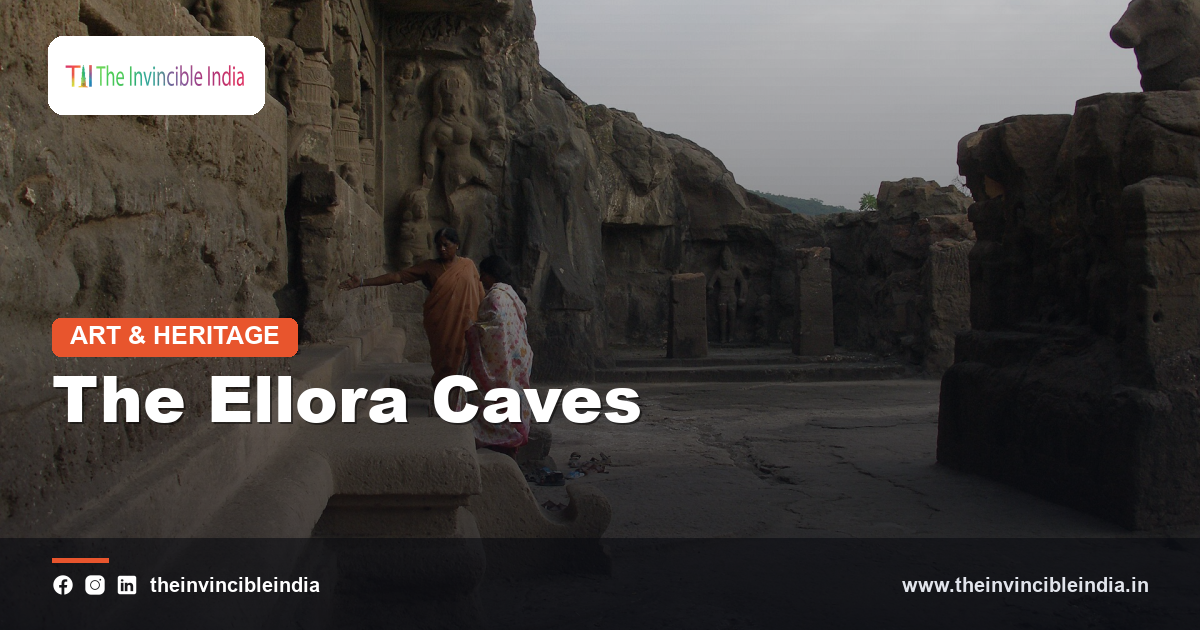
The Ellora Caves, carved into a long stretch of basalt escarpment in present-day Maharashtra, present one of the most remarkable concentrations of rock-cut architecture found anywhere in the world. Across more than thirty excavated monuments, the site brings together Buddhist, Hindu, and Jain shrines carved over successive centuries, reflecting the layered religious history of the region. Its most extraordinary achievement, the monolithic Kailasa temple, stands as a singular feat of subtractive architecture that continues to draw comparisons to other great works of Indian rock-cut architecture. Together, the caves form a continuous record of artistic and religious evolution carved directly into the living rock.
Quick Facts
| Detail | Information |
|---|---|
| Location | Aurangabad district, Maharashtra |
| Material | Basalt rock |
| Religious traditions | Buddhist, Hindu, Jain |
| Total caves | About 34 excavated monuments |
| Most famous monument | Kailasa temple (Cave 16) |
| Recognition | UNESCO World Heritage Site |
A Site of Three Faiths
What sets Ellora apart from most other rock-cut complexes is the coexistence of Buddhist, Hindu, and Jain monuments within a single continuous site. The caves are generally grouped by tradition along the escarpment, with Buddhist excavations at one end, Hindu monuments at the center, and Jain shrines toward the other end, reflecting the chronological and religious layering of the site’s development.
This arrangement offers a rare opportunity to observe how successive religious communities shared, adapted, and built upon a common landscape over an extended period. Rather than representing competing traditions in isolation, the caves illustrate a broader pattern of religious coexistence and continuity that characterized the region during the centuries of their creation.
Geological Setting
The caves are cut into a long basalt cliff formed by ancient volcanic activity, part of the Deccan Plateau’s characteristic layered rock formations. Basalt’s relatively uniform structure made it a workable medium for excavation, allowing artisans to carve deep into the hillside while maintaining structural stability across large interior spaces.
The choice of this particular escarpment was likely influenced by both the quality of the rock and the site’s position along trade and pilgrimage routes connecting the Deccan interior with the western coast. This combination of favorable geology and strategic location helped establish Ellora as a major center of rock-cut activity over several centuries.
The Buddhist Caves
The Buddhist caves at Ellora, generally regarded as the earliest phase of excavation at the site, include monasteries known as viharas and prayer halls known as chaityas. These monuments range from simple residential cells for monks to more elaborate multi-storied structures containing sculpted images of the Buddha and attendant figures.
Among the most notable of these is a large multi-level vihara whose scale and internal organization suggest it served as an important monastic center. The Buddhist caves demonstrate the evolving architectural ambitions of the community that carved them, moving from modest excavations toward increasingly complex and monumental designs over time.
The Hindu Caves
The Hindu caves at Ellora represent a later and highly ambitious phase of excavation, featuring elaborate temples dedicated primarily to Shiva, along with sculptural depictions of a wide range of deities and mythological episodes. These monuments are marked by dense figural carving and dramatic compositions that convey a sense of dynamic movement across the rock surfaces.
The Hindu group culminates in the Kailasa temple, whose scale and ambition surpass anything else at the site. Beyond this singular achievement, the surrounding Hindu caves also contain rich sculptural narratives, including celebrated depictions of cosmic and mythological themes rendered with striking dramatic intensity.
The Jain Caves
Toward one end of the escarpment lie the Jain caves, generally understood to represent the final major phase of excavation at Ellora. These monuments are comparatively smaller in scale than the Hindu and Buddhist groups but are distinguished by their intricate, delicate ornamentation and finely detailed sculptural work.
The Jain caves include shrines dedicated to Jain tirthankaras, rendered with the serene, meditative iconography characteristic of Jain religious art. Their careful detailing reflects a continuation of the region’s rock-cut tradition even as artistic emphasis shifted from monumental scale toward refined craftsmanship in the later centuries of activity at the site.
The Kailasa Temple
The Kailasa temple, designated as Cave 16, is the centerpiece of Ellora and one of the most extraordinary architectural achievements of premodern India. Rather than being built up from the ground, the entire temple was carved downward and inward from a single mass of basalt rock, a technique that required removing enormous quantities of stone to reveal the structure within.
The temple is designed to evoke Mount Kailasa, the mythological abode of Shiva, and includes a main shrine, subsidiary shrines, pillared halls, and an elaborate gateway, all carved as a unified whole from the living rock. The result is a freestanding, multi-storied temple complex that appears constructed yet was in fact entirely subtracted from solid stone.
Engineering the Monolith
Creating the Kailasa temple required a working method fundamentally different from conventional construction, since builders had to plan the finished structure in advance and then remove rock methodically from the top downward to expose it. This subtractive process left no room for structural correction once significant material had been removed, demanding exceptional planning and precision from its architects and workers.
The scale of excavation involved is estimated to have required the removal of a vast volume of rock, achieved using hand tools over an extended period of sustained labor. The technical achievement represented by the Kailasa temple is widely regarded as one of the most remarkable feats of rock-cut engineering anywhere in the ancient or medieval world.
Patronage and the Rashtrakuta Dynasty
The construction of the Kailasa temple is generally associated with the patronage of the Rashtrakuta dynasty, which ruled over much of the Deccan region during the period when the Hindu caves at Ellora were excavated. Royal patronage of this kind was central to enabling projects of such scale, as they required sustained resources, skilled labor, and long-term commitment.
The dynasty’s investment in the site reflects a broader pattern in which regional rulers used monumental religious architecture to express both piety and political authority. The Kailasa temple, in particular, stands as a lasting testament to the ambitions of its royal patrons and the skilled artisans who carried out their vision.
Sculptural Programs
Across all three religious groups, Ellora’s caves are richly adorned with sculpture depicting deities, mythological narratives, celestial beings, and decorative motifs. The Hindu caves in particular feature dramatic, large-scale panels illustrating episodes from Hindu mythology, carved with a sense of movement and emotional intensity that distinguishes Ellora’s sculptural style.
This sustained sculptural output across centuries and religious traditions makes Ellora an important site for understanding the evolution of Indian sculpture during the period of its creation. The variety and quality of carving found throughout the caves reflect the presence of highly skilled artisan communities working continuously at the site over an extended era.
Trade Routes and Regional Context
Ellora’s location placed it along routes connecting the Deccan interior with ports on India’s western coast, a position that likely facilitated the flow of resources, patronage, and religious communities to the site. Such trade connections often supported the wealth necessary for large-scale religious architecture, as merchants and rulers alike sought to gain religious merit through patronage.
This regional context helps explain why a site of such scale and ambition developed in this particular location, situated to benefit from both economic activity and the movement of pilgrims and monastic communities across the wider Deccan region during the centuries of its active use.
Interaction with Nearby Ajanta
Ellora is often discussed alongside the nearby Ajanta Caves, another major rock-cut site in the same region, though the two complexes differ in character and chronology. While Ajanta is primarily known for its Buddhist paintings and earlier excavation phases, Ellora represents a later, multi-religious continuation of the region’s rock-cut tradition.
Together, the two sites illustrate the broader trajectory of rock-cut architecture in the Deccan, moving from the more secluded monastic caves of Ajanta toward the larger, more publicly oriented temple complexes of Ellora. Their proximity has led scholars to study them as complementary chapters in the same regional artistic tradition.
Rediscovery and Documentation
Although never entirely forgotten by local communities, Ellora drew increasing attention from travelers, officials, and scholars during the colonial period, when systematic documentation of the caves began in earnest. This period saw efforts to record, sketch, and describe the site’s monuments in greater detail than had previously been undertaken.
Such documentation contributed to a growing international awareness of Ellora’s architectural and artistic significance, helping establish its reputation as one of the foremost rock-cut sites in the world. This scholarly attention laid the groundwork for the conservation efforts that continue to protect the caves today.
Conservation Challenges
Preserving Ellora presents distinct challenges, since the caves are carved directly from natural rock that remains subject to weathering, water seepage, and structural stress over time. The Kailasa temple, given its complex, freestanding form, requires particularly careful monitoring to address issues such as surface erosion and the effects of monsoon rainfall.
Conservation authorities have undertaken various measures to manage water drainage, stabilize vulnerable sections, and limit damage from visitor traffic, all while striving to preserve the site’s historical authenticity. These ongoing efforts reflect the broader challenge of maintaining ancient rock-cut monuments that cannot simply be rebuilt if damaged.
UNESCO Recognition
In recognition of its outstanding cultural and artistic value, Ellora has been designated a UNESCO World Heritage Site, joining a select group of monuments recognized for their universal significance to human heritage. This designation reflects both the technical achievement of the site’s rock-cut architecture and its role as a record of religious coexistence over an extended historical period.
World Heritage status has also supported international attention to the site’s conservation needs, encouraging collaboration between Indian authorities and global heritage organizations. This recognition affirms Ellora’s place among the most significant cultural monuments not only in India but in the broader history of world architecture.
Visiting the Caves
Visitors to Ellora typically move along the escarpment from one end to the other, progressing through the Buddhist, Hindu, and Jain groups in sequence, with the Kailasa temple as the undisputed highlight of the visit. The scale of the site means that a thorough visit requires considerable time to appreciate the range of architectural and sculptural styles on display.
The experience of walking through caves carved centuries apart by different religious communities offers a uniquely immersive encounter with India’s layered artistic and spiritual history, making Ellora one of the most rewarding destinations for those interested in rock-cut architecture and ancient craftsmanship.
Ellora Caves Today
Today the Ellora Caves stand as one of the world’s most extraordinary testaments to sustained artistic and religious activity carved directly into stone. The site continues to be studied by scholars of architecture, religion, and art history, while also drawing visitors from around the world who come to witness the scale of the Kailasa temple firsthand.
As both a UNESCO World Heritage Site and a living record of centuries of coexisting faiths, Ellora remains an unparalleled achievement in the history of rock-cut architecture, its monuments continuing to inspire awe at the scale of ambition and skill they represent.
Sources & Further Reading
- Archaeological Survey of India (asi.nic.in).
- Ministry of Culture, Government of India (indiaculture.gov.in).
Frequently Asked Questions
Where are the Ellora Caves located?
The Ellora Caves are located near Aurangabad in the state of Maharashtra, India.
What religious traditions are represented at Ellora?
The caves include Buddhist, Hindu, and Jain monuments, reflecting successive phases of religious activity at the site.
What is special about the Kailasa temple?
The Kailasa temple was carved as a single monolithic structure from a solid mass of basalt rock rather than being built up from the ground.
Who is credited with patronizing the Kailasa temple?
The temple’s construction is generally associated with patronage from the Rashtrakuta dynasty, which ruled the Deccan region at the time.
Is Ellora a UNESCO World Heritage Site?
Yes, Ellora has been designated a UNESCO World Heritage Site in recognition of its architectural and cultural significance.


