

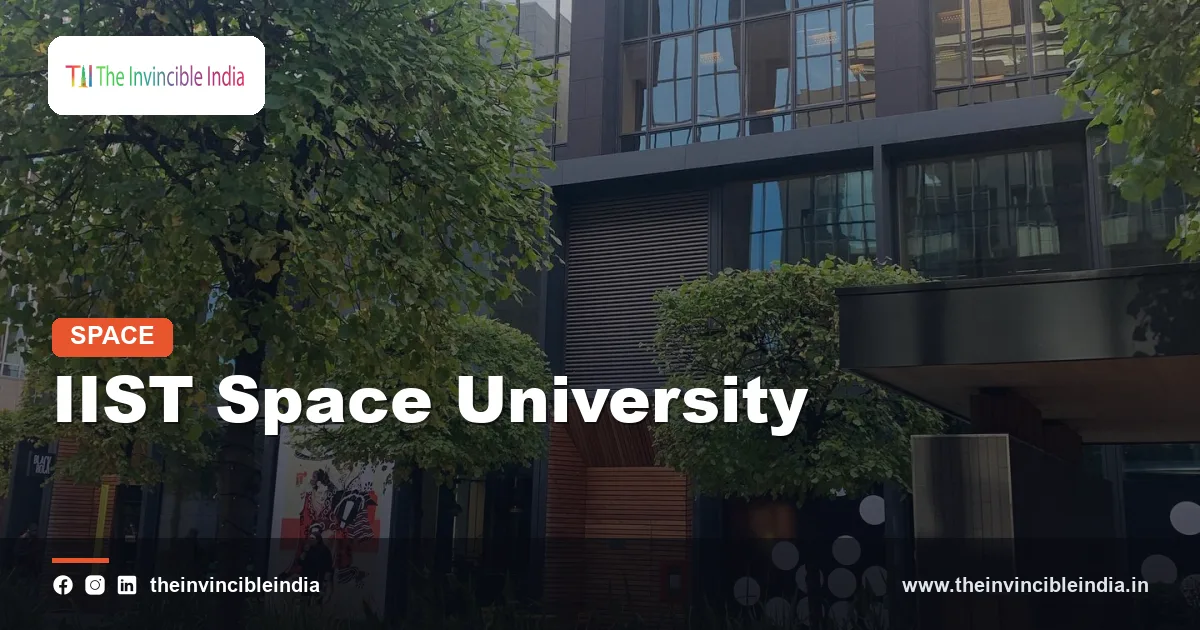
The Indian Institute of Space Science and Technology (IIST) is Asia’s first space university, established in 2007 at Thiruvananthapuram, Kerala, under the Department of Space, Government of India, to train engineers and scientists for the Indian space programme. The institution is a deemed-to-be-university that offers undergraduate, postgraduate and doctoral programmes in aerospace engineering, avionics and the physical sciences.
IIST was created to solve a practical problem: the Indian Space Research Organisation (ISRO) needed a steady supply of specially trained people for a space programme that was growing in scale. This explainer describes how IIST was founded, what it teaches, how students enter ISRO, and how the institute supports research and the wider space ecosystem. It was last reviewed on 15 October 2026.
Quick Facts
| Attribute | Detail |
|---|---|
| Full name | Indian Institute of Space Science and Technology (IIST) |
| Established | 2007 |
| Location | Valiamala, Thiruvananthapuram, Kerala |
| Administrative department | Department of Space, Government of India |
| Status | Deemed-to-be-university |
| Distinction | Described as Asia’s first space university |
| Programmes | B.Tech, dual degree (B.Tech and M.Tech), M.Tech, M.Sc and Ph.D. |
| Core branches | Aerospace engineering, avionics, and physical sciences |
| Nearby ISRO centre | Vikram Sarabhai Space Centre (VSSC), Thiruvananthapuram |
Key Takeaways
- The Indian Institute of Space Science and Technology (IIST) was established in 2007 in Thiruvananthapuram and is often described as Asia’s first space university.
- IIST functions under the Department of Space, the same department that oversees the Indian Space Research Organisation (ISRO).
- IIST is a deemed-to-be-university, which allows it to design its own courses and award its own degrees.
- IIST offers programmes in aerospace engineering, avionics and physical sciences at the bachelor’s, master’s and doctoral levels.
- Undergraduate admission to IIST is based on performance in the Joint Entrance Examination (JEE) Advanced.
- Many IIST graduates who meet the prescribed academic criteria are absorbed by ISRO and other Department of Space centres as scientists and engineers.
What is the Indian Institute of Space Science and Technology?
The Indian Institute of Space Science and Technology (IIST) is a space-focused higher education institution that prepares students for careers in the space sector. It is run by the Department of Space and sits on a campus at Valiamala in the hills near Thiruvananthapuram.
The institute combines classroom learning with exposure to real space engineering. Courses cover launch vehicles, satellites, propulsion, structures, navigation, remote sensing and the underlying mathematics and physics. IIST also supports research degrees in areas that connect directly to space applications, such as earth system science and astronomy.
Unlike general engineering colleges, IIST was designed with one national purpose in mind. Its curriculum, faculty and laboratories are tuned to the needs of the Indian space programme and of the wider aerospace industry.
Why was IIST established, and when?
IIST was established in 2007 because ISRO needed a dependable pipeline of trained manpower as India’s space activities expanded in the early 2000s. The Department of Space decided to create a dedicated institution rather than rely only on general engineering colleges.
The institute began its first academic session in 2007 in Thiruvananthapuram, a city that already hosts the Vikram Sarabhai Space Centre (VSSC), the Liquid Propulsion Systems Centre (LPSC) and other ISRO establishments. That nearness to working space centres is a deliberate feature of the design, since students can interact with scientists and use facilities for projects.
The institute was soon afterwards granted deemed-to-be-university status, which provides academic autonomy within the framework of the University Grants Commission Act, 1956. The founding years were led by a team of senior ISRO scientists, and the institute’s early growth was supported by the Department of Space.
Why is IIST called Asia’s first space university?
IIST is called Asia’s first space university because it was the first higher education institution in Asia dedicated entirely to space science and technology education. The phrase is widely used by the Department of Space and in the institute’s own description.
The label reflects focus rather than size. Other universities in India and abroad offer aerospace degrees, but IIST was built around the needs of a national space agency and offers its programmes within a single space-oriented campus. Observers sometimes note that the claim relates to dedicated space universities, as many established universities already ran aerospace departments.
What programmes does IIST offer?
IIST offers a range of degree programmes at the undergraduate, postgraduate and doctoral levels, with a focus on engineering and the physical sciences. The main categories are as follows.
- Bachelor of Technology (B.Tech): The flagship four-year programmes are aerospace engineering, and electronics and communication engineering with a focus on avionics. Engineering physics is also offered in the physical sciences stream.
- Dual degree programmes: Integrated B.Tech and M.Tech, or similar combined paths, which let students specialise early in areas such as propulsion, thermal engineering or structures.
- Master’s programmes: M.Tech in specialised areas such as control systems, signal processing and propulsion, and M.Sc in subjects like astronomy and astrophysics, chemistry, mathematics and physics.
- Doctoral programmes (Ph.D.): Research degrees in engineering, sciences and humanities, often supported by ISRO centres.
The exact list of specialisations changes from year to year, so applicants should check the current prospectus for the latest offerings.
What are the main departments at IIST?
The main departments at IIST are aerospace engineering, avionics, chemistry, earth and space sciences, humanities, mathematics and physics. Each department combines teaching with research linked to space missions.
| Department | Focus areas |
|---|---|
| Aerospace Engineering | Aerodynamics, propulsion, structures, flight dynamics, space vehicle design |
| Avionics | Electronics, communication, navigation, control and instrumentation for spacecraft |
| Physics | Engineering physics, materials, optics, astrophysics and space physics |
| Chemistry | Propellants, materials chemistry, nanomaterials and energy storage |
| Mathematics | Applied mathematics, computational methods, optimisation and statistics |
| Earth and Space Sciences | Atmospheric science, planetary science and remote sensing applications |
| Humanities | Communication skills, management, ethics and social sciences |
The inclusion of humanities and communication in the curriculum reflects the fact that space careers involve project management and teamwork, not only technical design.
How does admission to IIST work?
Admission to IIST’s undergraduate programmes is based on a student’s rank in the Joint Entrance Examination (JEE) Advanced, followed by a counselling process run for IIST seats. Students must qualify in JEE Main and then JEE Advanced before becoming eligible for the IIST counselling.
Postgraduate admission uses different routes. M.Tech candidates are normally selected on the basis of the Graduate Aptitude Test in Engineering (GATE) score, and M.Sc candidates are selected through the Joint Admission Test for Masters (JAM) or similar processes. Ph.D. admission involves a written test and an interview conducted by the institute.
Seats are limited and the process is competitive. Reservation policies of the Government of India are followed. Because the Department of Space funds the institute, tuition and hostel costs for B.Tech students have historically been kept modest, and merit-based support has been available. Candidates should verify the current rules on the official admissions notice.
How do IIST graduates enter ISRO?
IIST graduates who meet the prescribed performance criteria are offered positions at ISRO and other Department of Space centres, typically without having to compete in an external recruitment process. This route is one of the institute’s best-known features.
The arrangement works as follows. Students in the main B.Tech programmes who maintain a required minimum academic performance, usually expressed as a cumulative grade point average, become eligible for absorption as scientists or engineers at entry level. The final allocation of centres depends on vacancies, rankings and the needs of the department.
Not every graduate joins ISRO. Some pursue higher studies in India or abroad, and others take up jobs in private aerospace firms, research organisations or technology companies. As India opens its space sector to private companies, a growing share of graduates are expected to be employed in startups and the wider industry.
What does IIST contribute to space research?
IIST contributes to space research through faculty projects, doctoral work, student satellites and collaborations with ISRO centres. Research groups work on subjects such as launch vehicle aerodynamics, composite materials, satellite attitude control, atmospheric science and observational astronomy.
One visible activity has been student participation in small satellite projects. Students and faculty have taken part in building nanosatellites, which gives them hands-on experience with design, testing and mission operations. The institute also hosts workshops and outreach programmes on space technology for school students and teachers.
IIST has laboratories for areas such as propulsion, structures, avionics, materials and space instrumentation. Some of these facilities are shared with nearby ISRO units, allowing doctoral researchers to use equipment that would be difficult for an ordinary university to maintain.
How is IIST different from IITs and other engineering institutes?
IIST differs from the Indian Institutes of Technology (IITs) mainly in its narrow domain, its link with a single employer-agency and its administration under the Department of Space. IITs are broad technology institutes under the Ministry of Education, with many disciplines and a wide variety of careers.
| Feature | IIST | Typical IIT |
|---|---|---|
| Administering body | Department of Space | Ministry of Education |
| Subject range | Space-focused engineering and sciences | Wide range of engineering, science and management fields |
| Entry route (B.Tech) | JEE Advanced rank and IIST counselling | JEE Advanced rank and JoSAA counselling |
| Career link | Direct absorption route into ISRO for eligible students | Open campus placements across many sectors |
| Legal status | Deemed-to-be-university | Institution of National Importance by statute |
Both types of institution compete for similar students. Applicants who are certain about a space career often prefer IIST, while those who want broader options may choose an IIT.
What is IIST’s role in building India’s space talent in the private era?
IIST’s role in building India’s space talent is to supply engineers and scientists not only to ISRO but also to the growing private space sector. India’s space policy opened the sector to non-government companies, which created demand for trained people in rockets, satellites and data services.
IIST alumni have joined launch vehicle startups, satellite manufacturers and space data firms, in addition to government laboratories. The institute can support this shift by offering industry-oriented projects, internships and incubation-style support for student ideas.
Its main challenge is scale. The number of seats is small compared with the potential demand, so the institute works alongside other universities and technical institutions that are introducing space-related courses. The long-term outcome will depend on how well such programmes keep pace with the sector’s growth.
What is student life like at the IIST campus?
Student life at the IIST campus is residential and academically intensive, set in a green hill-side area at Valiamala away from the centre of Thiruvananthapuram. Students live in hostels on or near the campus and share laboratories, libraries and sports facilities.
The setting has a few distinctive features. The campus is close to ISRO facilities, so guest lectures by space scientists and visits to launch vehicle and satellite centres are a regular part of the learning experience. Student clubs commonly focus on astronomy, robotics, rocketry, coding and cultural activities, and these groups often compete in national technical events.
Project work is a major part of the programme. Final-year students usually complete a substantial project, and many work on problems connected with launch vehicles, satellites or ground systems, sometimes under the guidance of ISRO scientists. The practical emphasis is meant to make graduates useful from the first day at work.
What are the strengths and limitations of the IIST model?
The strengths of the IIST model are its clear purpose, its direct link with the Department of Space and its small, focused cohorts. The limitations are the small number of seats and the dependence of career outcomes on the needs of a single agency.
- Strength – focused curriculum: Every course is aligned with space applications, so students learn the specific tools and standards used in launch vehicles and satellites.
- Strength – exposure to real missions: Proximity to ISRO centres gives students access to people and projects that most campuses cannot offer.
- Strength – career clarity: The absorption route gives high-performing students a visible path into a prestigious public-sector career.
- Limitation – capacity: A small intake means the institute cannot meet the full demand for space professionals on its own.
- Limitation – dependence on one sector: Narrow specialisation may reduce flexibility if students later wish to move into unrelated fields, although the core engineering skills remain transferable.
Bottom Line
IIST turned an institutional need into an academic model: a space university that links classroom learning, ISRO facilities and a direct route into the national space programme. As the sector expands to include private players, the institute’s graduates and research are likely to remain central to India’s space talent pool.
Frequently Asked Questions
What is IIST and where is it located?
The Indian Institute of Space Science and Technology (IIST) is a space-focused deemed-to-be-university run by the Department of Space. Its campus is at Valiamala near Thiruvananthapuram in Kerala. It was established in 2007 and is described as Asia’s first space university.
Is IIST under ISRO?
IIST is administered by the Department of Space, the government department that also oversees ISRO, rather than being a unit of ISRO itself. It works closely with ISRO centres, especially the nearby Vikram Sarabhai Space Centre. Many of its faculty links, projects and graduate placements involve ISRO.
How can I get admission to IIST?
Admission to IIST’s B.Tech programmes is through a rank in JEE Advanced followed by IIST counselling. Postgraduate programmes use scores from exams such as GATE and JAM, and Ph.D. admissions use tests and interviews. Applicants should always check the latest official notice for eligibility and dates.
Do IIST graduates automatically get jobs at ISRO?
IIST graduates who meet the prescribed academic criteria are eligible for absorption into ISRO or other Department of Space centres, but the arrangement depends on performance and vacancies. It is not a blanket guarantee for every student. Graduates can also pursue higher studies or private-sector careers.
Which courses are offered at IIST?
IIST offers B.Tech programmes in aerospace engineering, avionics and engineering physics, along with dual degrees, M.Tech, M.Sc and Ph.D. programmes. The postgraduate options cover areas such as propulsion, control systems, signal processing, astronomy and applied sciences. Course lists change with time, so the current prospectus is the best reference.
Why is IIST important for India’s space programme?
IIST is important because it provides trained manpower tailored to the needs of the Indian space programme. Its graduates join ISRO, research bodies and the private space sector. The institute also contributes research and student projects that strengthen India’s space technology base.
{“@context”:”https://schema.org”,”@graph”:[{“@type”:”FAQPage”,”mainEntity”:[{“@type”:”Question”,”name”:”What is IIST and where is it located?”,”acceptedAnswer”:{“@type”:”Answer”,”text”:”The Indian Institute of Space Science and Technology (IIST) is a space-focused deemed-to-be-university run by the Department of Space. Its campus is at Valiamala near Thiruvananthapuram in Kerala. It was established in 2007 and is described as Asia’s first space university.”}},{“@type”:”Question”,”name”:”Is IIST under ISRO?”,”acceptedAnswer”:{“@type”:”Answer”,”text”:”IIST is administered by the Department of Space, the government department that also oversees ISRO, rather than being a unit of ISRO itself. It works closely with ISRO centres, especially the nearby Vikram Sarabhai Space Centre. Many of its faculty links, projects and graduate placements involve ISRO.”}},{“@type”:”Question”,”name”:”How can I get admission to IIST?”,”acceptedAnswer”:{“@type”:”Answer”,”text”:”Admission to IIST’s B.Tech programmes is through a rank in JEE Advanced followed by IIST counselling. Postgraduate programmes use scores from exams such as GATE and JAM, and Ph.D. admissions use tests and interviews. Applicants should always check the latest official notice for eligibility and dates.”}},{“@type”:”Question”,”name”:”Do IIST graduates automatically get jobs at ISRO?”,”acceptedAnswer”:{“@type”:”Answer”,”text”:”IIST graduates who meet the prescribed academic criteria are eligible for absorption into ISRO or other Department of Space centres, but the arrangement depends on performance and vacancies. It is not a blanket guarantee for every student. Graduates can also pursue higher studies or private-sector careers.”}},{“@type”:”Question”,”name”:”Which courses are offered at IIST?”,”acceptedAnswer”:{“@type”:”Answer”,”text”:”IIST offers B.Tech programmes in aerospace engineering, avionics and engineering physics, along with dual degrees, M.Tech, M.Sc and Ph.D. programmes. The postgraduate options cover areas such as propulsion, control systems, signal processing, astronomy and applied sciences. Course lists change with time, so the current prospectus is the best reference.”}},{“@type”:”Question”,”name”:”Why is IIST important for India’s space programme?”,”acceptedAnswer”:{“@type”:”Answer”,”text”:”IIST is important because it provides trained manpower tailored to the needs of the Indian space programme. Its graduates join ISRO, research bodies and the private space sector. The institute also contributes research and student projects that strengthen India’s space technology base.”}}]}]}


