

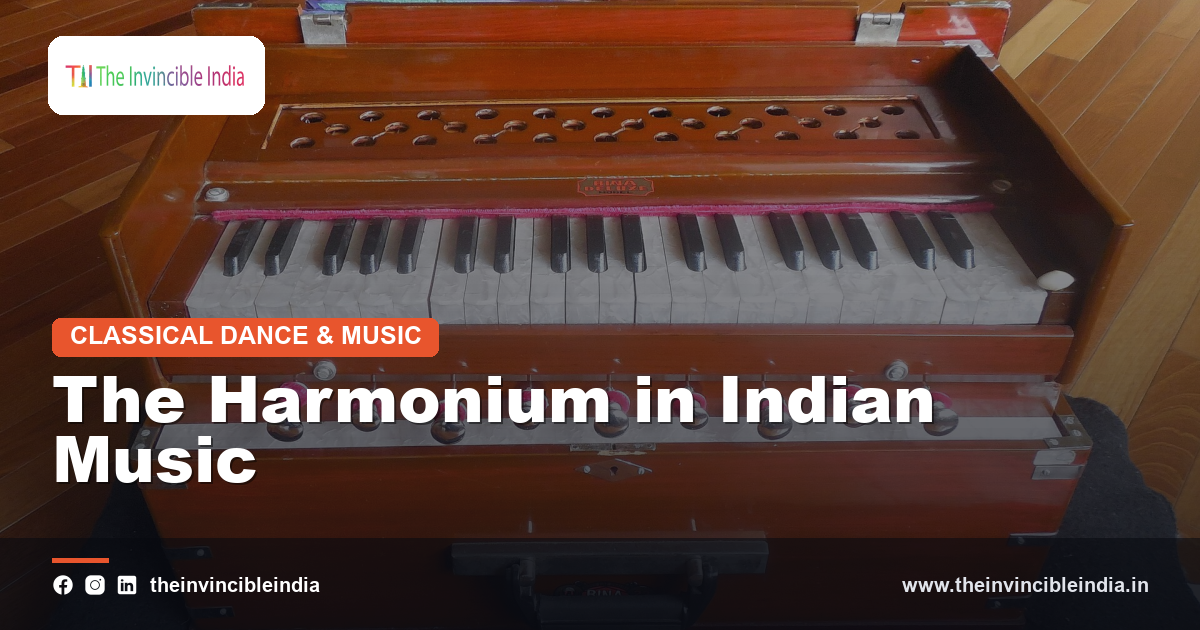
The harmonium is a hand-pumped reed instrument, played by squeezing bellows with one hand while the other presses a small keyboard, producing a sustained, organ-like tone that has become one of the most familiar sounds in Indian music. Although its origins lie in a European keyboard instrument, it was adapted and reshaped in India into a compact, portable form suited to accompanying the voice, and it went on to occupy a central place in Hindustani classical music, devotional singing and countless regional and folk traditions across the subcontinent. Despite periods of controversy over its suitability for classical performance, the harmonium’s ease of use and steady, supportive tone have secured its enduring popularity. This guide traces its history, construction, uses and continuing role in Indian musical life.
Quick Facts
| Detail | Information |
|---|---|
| Type | Free-reed keyboard instrument (aerophone) |
| Origin | Adapted in India from a nineteenth-century European instrument |
| Mechanism | Hand-pumped bellows force air across metal reeds |
| Form | Compact box with a small piano-style keyboard |
| Common uses | Vocal accompaniment, devotional and folk music |
| Status | One of the most widely used instruments in Indian music |
What Is the Harmonium
The harmonium is a free-reed keyboard instrument in which sound is generated by air, forced by a hand-operated bellows, passing across a set of thin metal reeds tuned to the notes of the keyboard. Unlike a piano, its notes can be sustained for as long as air is supplied, giving it a continuous, organ-like tone well suited to supporting a singer’s melodic line. Compact, self-contained and requiring no external power or complex tuning maintenance, the instrument proved remarkably adaptable to Indian musical needs after its introduction, and it has since become a fixture of both formal and informal musical settings across the country.
European Origins
The harmonium traces its origins to free-reed keyboard instruments developed in nineteenth-century Europe, where such instruments were used in churches, homes and small ensembles as a compact alternative to larger pipe organs. These European harmoniums arrived in India through trade and colonial contact and were initially used within similar contexts before Indian musicians and craftsmen began adapting the instrument to local musical needs. This process of adaptation transformed the harmonium considerably, reshaping its form, mechanism and playing posture into something distinct from its European ancestor while retaining its fundamental free-reed principle.
Indian Adaptation
Indian craftsmen reworked the harmonium into a smaller, portable, hand-pumped instrument that could be played while seated on the floor, a significant departure from the foot-pumped, furniture-like European originals designed for standing or seated Western use. This adaptation, refined over decades, produced the compact box harmonium now familiar across India, with an internal hand bellows operated by the player’s non-dominant hand while the other plays the keyboard. This redesign made the instrument far more suitable to Indian performance settings, including seated vocal recitals, devotional gatherings and travelling musical groups.
Construction and Mechanism
A harmonium consists of a wooden case housing a set of metal reeds, a small keyboard, and an internal bellows system operated by a hand-pumped lever at the back or side of the instrument. Pressing a key opens a valve that allows air, driven by the bellows, to pass across the corresponding reed, causing it to vibrate and produce a note. Some harmoniums include additional features such as multiple reed banks for different tonal qualities or a drone mechanism, though the essential mechanism across most models remains the same simple and robust design that has made the instrument durable and easy to maintain.
Hand-Pumped Bellows
The defining feature of the Indian harmonium is its hand-pumped bellows, operated by the player’s free hand with a steady pumping motion that maintains constant air pressure while the other hand plays the keyboard. This requires a degree of coordination, since uneven pumping can cause fluctuations in volume and tone that a skilled player learns to avoid through practice. The hand-pumped design, distinct from the foot-pumped mechanism of the original European harmonium, allows the instrument to be played comfortably while seated cross-legged on the floor, a posture common to much of Indian classical and devotional performance.
Role in Vocal Accompaniment
The harmonium’s steady, sustained tone and its ability to closely match the pitch of the human voice have made it one of the most common instruments for accompanying vocalists across many genres of Indian music. Accompanists use the instrument to echo and support the singer’s melodic phrases, providing a harmonic and melodic reference that helps both performer and audience follow the raga or composition being sung. This supportive role, requiring sensitivity to the singer’s phrasing and mood, has made skilled harmonium accompanists valued collaborators in vocal performances across classical, devotional and popular contexts alike.
The Harmonium in Hindustani Classical Music
Within Hindustani classical music, the harmonium is widely used to accompany vocal recitals, providing melodic support alongside the rhythmic accompaniment of the tabla. Accompanists follow and anticipate the vocalist’s improvisation, echoing phrases and reinforcing the raga’s melodic framework in real time. While its use in strictly classical settings has at times been debated, its practical benefits, including ease of tuning and clarity of pitch, have made it a standard fixture in most vocal concerts today, valued for the steady support it offers to singers navigating complex and demanding raga performances.
The Harmonium in Devotional Music
The harmonium occupies a particularly prominent place in Indian devotional music, accompanying bhajans, kirtans and other forms of communal religious singing across many regions and faiths. Its simple keyboard makes it accessible to amateur musicians who lead devotional gatherings, while its sustained tone supports group singing in a way well suited to communal worship. This accessibility has helped the harmonium become one of the most common instruments found in homes, temples and religious gatherings throughout India, often serving as the primary or sole instrumental accompaniment to devotional singing.
Debate over the Harmonium
The harmonium’s place in Indian classical music has not been without controversy, and for a period broadcasters and some classical musicians questioned its suitability, citing its fixed, tempered tuning as being at odds with the continuous pitch-bending central to raga performance on the voice or on fretless instruments. This debate led to periods in which the harmonium was restricted from certain classical broadcasts, prompting discussion among musicians and scholars about the balance between tradition and practical convenience. Despite this controversy, the instrument’s widespread use in practice has continued largely unabated, reflecting its deep integration into everyday musical life.
Playing Technique
Playing the harmonium well requires coordinating the pumping hand’s steady bellows action with the playing hand’s keyboard technique, all while listening closely to a vocalist or lead melody in accompaniment settings. Skilled players develop a light, controlled touch that allows for subtle dynamic shading despite the instrument’s essentially fixed reed tone, and they learn to anticipate melodic phrases so as to support rather than overshadow the main performer. As with other Indian instruments, technique is traditionally passed down through direct instruction from an experienced teacher, with considerable attention paid to musical sensitivity alongside mechanical skill.
Regional Variations
Harmoniums vary somewhat by region and maker, with differences in the number of reed banks, the presence of drone stops, and overall size and portability suited to different performance contexts, from compact travelling models to larger instruments used in fixed devotional or classical settings. Some variants include additional mechanisms intended to allow subtle pitch inflection, addressing some of the concerns raised in debates over the instrument’s suitability for classical raga performance. This regional and functional diversity reflects the harmonium’s adaptation to the wide range of musical contexts in which it is used across India.
Harmonium Makers and Craftsmanship
The construction of a quality harmonium involves careful selection and tuning of metal reeds, precise woodworking for the case and keyboard, and meticulous assembly of the bellows mechanism, work traditionally carried out by specialised instrument-making workshops in various parts of India. The tuning of each reed by hand is a particularly demanding skill, since consistency across the full keyboard is essential for the instrument to function well in accompaniment. This craftsmanship tradition has sustained a steady supply of harmoniums for musicians across the country, supporting the instrument’s widespread and continuous use.
Learning the Harmonium
The harmonium is often considered one of the more accessible Indian instruments for beginners, since its keyboard layout is intuitive and it does not require the years of embouchure or bowing technique demanded by wind or string instruments. Nonetheless, developing genuine skill in accompaniment, particularly the sensitivity required to support a vocalist in classical or devotional performance, takes considerable practice and musical understanding. Many students begin on the harmonium as a foundation for learning music theory and raga structure before or alongside study of another primary instrument or voice.
Harmonium in Folk and Popular Music
Beyond classical and devotional contexts, the harmonium has become deeply embedded in regional folk music traditions across India, valued for its portability and its ability to provide melodic and harmonic support to folk singers and small ensembles. It has also featured prominently in popular and film music, particularly in songs that draw on devotional or folk idioms, lending them a familiar, grounded texture. This broad presence across musical genres, from temple courtyards to concert halls to recording studios, underscores the harmonium’s unusual versatility among Indian instruments.
The Harmonium in Ghazal and Qawwali
The harmonium also holds a central place in the ghazal and qawwali traditions of the wider subcontinent, where its sustained, singing tone provides an ideal harmonic bed for the ornamented vocal lines characteristic of these genres. In qawwali ensembles the harmonium is typically played alongside hand-clapping and percussion, weaving supportive melodic phrases between the calls and responses of the lead and chorus singers. Its portability and reliability have made it a natural fit for performers who travel between gatherings and shrines, and its presence in these devotional and semi-classical forms has further cemented the instrument’s reputation as one of the most versatile accompanying instruments in South Asian music.
The Harmonium Today
Today the harmonium remains one of the most widely used instruments in Indian music, present in classical concerts, devotional gatherings, folk performances and music classrooms across the country and among the Indian diaspora abroad. Its practical advantages of portability, ease of learning and steady, supportive tone continue to outweigh the concerns once raised about its classical suitability, and it shows no sign of losing its central place in Indian musical accompaniment. As a bridge between Western instrument technology and Indian musical practice, the harmonium’s story reflects the broader adaptability that has long characterised Indian music.
Sources & Further Reading
- Sangeet Natak Akademi, national academy for music, dance and drama (sangeetnatak.gov.in).
- Ministry of Culture, Government of India (indiaculture.gov.in).
Frequently Asked Questions
What is a harmonium?
The harmonium is a hand-pumped, free-reed keyboard instrument that produces sustained, organ-like tones. Widely used in Indian classical, devotional and folk music, it was adapted in India from a nineteenth-century European instrument.
How does a harmonium work?
A harmonium works by using a hand-operated bellows to push air across a set of tuned metal reeds. Pressing a key opens a valve that lets air reach the corresponding reed, producing its note for as long as the key is held and air is supplied.
Why was the harmonium controversial in classical music?
Some musicians and broadcasters argued that the harmonium’s fixed, tempered tuning was unsuited to the continuous pitch-bending central to raga performance, leading to periods of restriction, though the instrument remains widely used in practice.
What is the harmonium used for in devotional music?
The harmonium is commonly used to accompany bhajans, kirtans and other forms of communal devotional singing, valued for its accessibility to amateur musicians and its sustained tone that supports group singing.
Is the harmonium easy to learn?
The harmonium is often considered relatively accessible for beginners due to its intuitive keyboard, though developing skilled, sensitive accompaniment for classical or devotional performance still requires considerable practice.


