

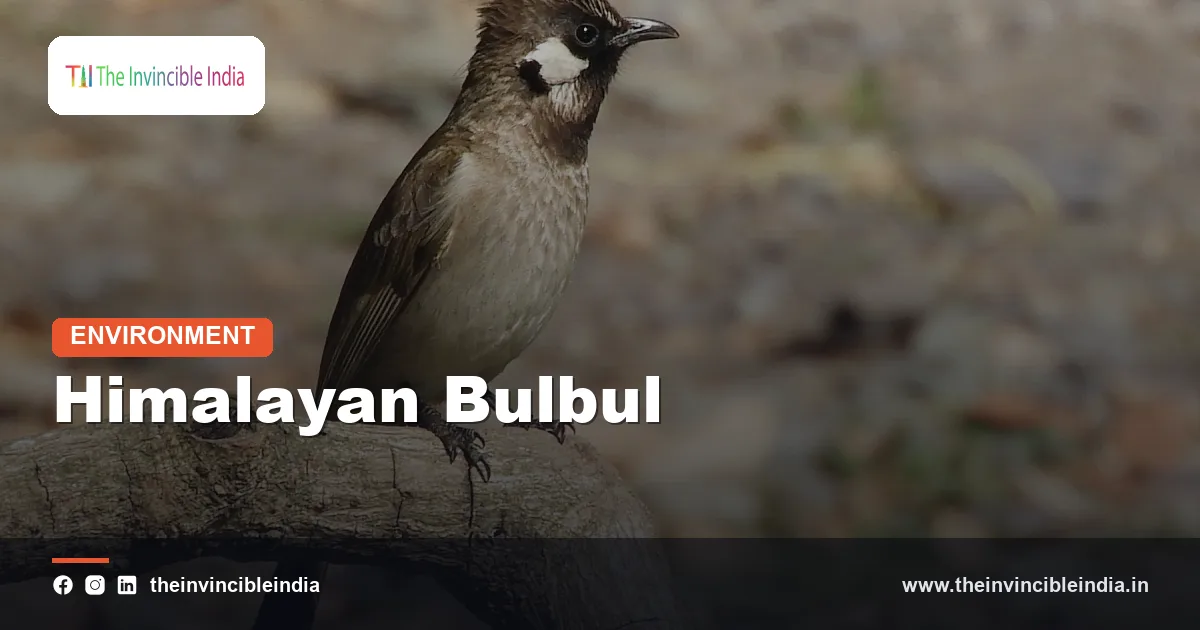
The Himalayan bulbul (Pycnonotus leucogenys), also called the white-cheeked bulbul, is a pale, crested songbird of the western Himalaya and its foothills, recognised by its black head with a short pointed crest, bold white cheek patches, brown body and bright yellow patch under the tail. It is one of the most familiar and cheerful birds of hill gardens, orchards and villages in Himachal Pradesh, Uttarakhand and Jammu and Kashmir.
The Himalayan bulbul is a bold, sociable bird that sits on open perches and sings openly, which makes it far easier to see than many hill birds. This explainer covers what the Himalayan bulbul looks like, where it lives in India, what it eats, how it sings and breeds, and how it differs from other bulbuls that share the Indian landscape.
| Attribute | Detail |
|---|---|
| Common name | Himalayan bulbul (also white-cheeked bulbul) |
| Scientific name | Pycnonotus leucogenys |
| Family | Pycnonotidae (bulbuls) |
| Size | About 20 cm long |
| Range and habitat in India | Western Himalaya and foothills; scrub, gardens, orchards, village edges and open woodland, from low hills up to moderate altitudes |
| Diet | Fruit, berries, flower buds, nectar and insects |
| Breeding | Cup nest in a bush or small tree; usually two or three pinkish eggs with spots; breeds in spring and summer |
| Conservation status | Least Concern on the IUCN Red List |
Key Takeaways
- The Himalayan bulbul is a roughly 20 cm crested bulbul with a black head, white cheek patches, a brown body and a yellow patch under the tail.
- The Himalayan bulbul is also known as the white-cheeked bulbul and is found in the western Himalaya and its foothills, extending across the mountains of the region into Pakistan and Nepal.
- The Himalayan bulbul eats fruit, berries, flower buds, nectar and insects, and it often visits fruiting shrubs and orchards.
- The Himalayan bulbul is a cheerful singer that perches in the open and delivers short, lively, whistled phrases, especially in spring.
- The Himalayan bulbul builds a cup-shaped nest in a bush or tree and usually lays two or three spotted eggs.
- The Himalayan bulbul is classed as Least Concern and thrives alongside people, particularly in gardens, orchards and village edges in the hills.
What does the Himalayan bulbul look like?
The Himalayan bulbul is a slim, long-tailed bird about 20 cm long with a glossy black head topped by a short pointed crest, bright white cheek patches, a brownish-grey body and a bold yellow patch beneath the tail. The upperparts are earthy brown, the underparts are paler, and the tail is dark with white tips on the outer feathers, which flash when the bird flies or lands.
The black head and white cheeks give the Himalayan bulbul a striking face pattern that is easy to see even at a distance, and the yellow vent adds a spot of colour beneath the tail. Males and females are very similar. Young birds are duller and have a shorter crest, and the yellow under the tail is less intense until they mature.
Key identification features
- A black head with a short, pointed crest.
- Bold white patches on the cheeks.
- A brownish body with a paler belly.
- A bright yellow patch under the tail.
- White tips on the tail feathers.
Where is the Himalayan bulbul found in India?
The Himalayan bulbul is found along the western Himalaya and its foothills in India, in states and union territories such as Jammu and Kashmir, Himachal Pradesh and Uttarakhand. It occurs more widely across the western Himalayan region, extending towards Pakistan and Nepal, and it is a typical bird of the lower and middle hills rather than of the high mountains.
In India, the Himalayan bulbul favours open and semi-open habitat with bushes and trees. It is common in scrub, village edges, orchards, parks and gardens, and also in light woodland. The bird is largely resident, but birds that breed at higher elevations may move down the slopes in winter to avoid snow and cold, and then return to higher ground when spring arrives.
Typical habitats
- Scrub and bushy slopes in the lower and middle Himalaya.
- Orchards of apple, apricot, peach and other fruit trees.
- Gardens, parks and the edges of hill towns and villages.
- Light woodland, forest clearings and roadside vegetation.
Why is the Himalayan bulbul also called the white-cheeked bulbul?
The Himalayan bulbul is also called the white-cheeked bulbul because of the conspicuous white patch on each side of its face, which is the most noticeable feature of the species. The two names refer to the same bird, and the scientific name Pycnonotus leucogenys also points to the pale cheek, since the species name combines Greek words for white and cheek.
The name “Himalayan” comes from the main region where the bird is found in India. Related bulbuls in the same group, such as the white-eared bulbul, occur further west in West Asia and the Arabian region, and the status of these relatives has been discussed by taxonomists over time. Birdwatchers in India usually use the name Himalayan bulbul for the bird of the northern hills, which keeps it distinct from the bulbuls of the plains and the peninsula.
What does the Himalayan bulbul eat?
The Himalayan bulbul eats a varied diet of fruit, berries, flower buds, nectar and insects. It is mainly a fruit eater, but it adds insects to its diet, particularly during the breeding season when growing chicks need plenty of protein.
The bird feeds on wild berries, figs and cultivated fruits, and in orchards it can take small amounts of ripening fruit. It also nips flower buds and drinks nectar from blossoming trees and shrubs. Insects such as flies, beetles and caterpillars are picked from leaves or caught in short flights from a perch. Because it eats fruit and passes seeds in its droppings, the Himalayan bulbul helps to spread the seeds of shrubs and small trees across hill slopes.
| Food type | Examples | Ecological role |
|---|---|---|
| Fruit and berries | Wild berries, figs, orchard fruit | Seed dispersal across slopes |
| Flower buds and nectar | Spring-flowering shrubs and trees | Minor pollination |
| Insects | Flies, beetles, caterpillars | Control of plant-eating insects |
How does the Himalayan bulbul sing?
The Himalayan bulbul sings a cheerful series of short, whistled, musical phrases, which it usually delivers from an open perch such as the top of a bush, a wire or a tree branch. The song is lively and melodious, and it is often heard in the morning and in spring, when the birds are establishing territories.
Alongside its song, the Himalayan bulbul uses a range of calls that include liquid, bubbling notes and sharper alarm calls. Birds often call to each other as they move between bushes, and pairs keep in touch with soft notes. The singing is so persistent in good weather that the species is among the first birds noticed by visitors to hill gardens and villages in spring and summer.
How does the Himalayan bulbul behave?
The Himalayan bulbul behaves as a bold, active and sociable bird that lives in pairs or small groups and spends much of its time in the open. It sits upright on exposed perches, flicks its crest, and flies from bush to bush with a bouncy, undulating flight.
After the breeding season, Himalayan bulbuls often gather in loose flocks, and they roost together in thick vegetation. They are tolerant of people and may nest in gardens, near houses and in orchards. In winter, birds from higher elevations commonly descend to lower areas, where they join others in feeding on fruit. The tolerance of human presence has helped the species to become one of the commonest birds around hill settlements.
- The bird often perches in the open, which makes it easy to watch.
- Pairs and small groups forage together in bushes and trees.
- Seasonal movement downhill occurs in the colder months.
- Groups roost together in dense vegetation after the breeding season.
How does the Himalayan bulbul breed?
The Himalayan bulbul breeds by building a neat cup-shaped nest of twigs, grass and fine fibres in a bush, small tree or tangle of creepers, and the female usually lays two or three pinkish eggs marked with reddish or purplish spots. The nest is often placed low or at moderate height, and it may be built in a garden hedge or beside a house.
Breeding takes place mostly in spring and summer, when insects and fruit are plentiful in the hills. Both parents help to incubate the eggs and feed the young, which leave the nest after about two weeks. In some places a pair may raise more than one brood in a season. Chicks are fed insects at first, and later fruit and berries are added to their diet.
Stages of the breeding cycle
- Males sing from perches to establish a territory.
- The pair builds a cup nest in a bush, tree or hedge.
- Two or three eggs are incubated for about two weeks.
- Both parents feed the nestlings until they fledge.
How is the Himalayan bulbul different from other bulbuls?
The Himalayan bulbul is different from other Indian bulbuls because of its black head, short crest and pure white cheek patches, combined with a brown body and yellow vent. The more familiar red-vented bulbul and red-whiskered bulbul are found over much of India, but they have different markings.
| Bulbul | Key difference from the Himalayan bulbul |
|---|---|
| Red-vented bulbul | Dark body with scaly marks, a red patch under the tail and no white cheeks |
| Red-whiskered bulbul | Taller pointed crest, red patch behind the eye and a white-cheeked look with a red whisker |
| White-browed bulbul | Olive-brown, no crest, pale eyebrow and a shy nature in peninsular scrub |
| Yellow-throated bulbul | Bright yellow on head and throat, found in rocky scrub hills of the peninsula |
In the western Himalayan region, the combination of a black head, white cheeks and a yellow vent allows the species to be identified quickly and with confidence.
Why does the Himalayan bulbul matter for the environment?
The Himalayan bulbul matters because it spreads seeds, eats insects and brings song and life to hill gardens and orchards. By eating fruit and later depositing the seeds elsewhere, the bird helps native shrubs and small trees to regenerate on slopes where they may otherwise struggle.
The bulbul also takes many insects, including pests of garden plants, though it may sometimes eat small amounts of ripening fruit in orchards. Overall, its role in seed dispersal and insect control is more valuable than the occasional loss of fruit. Its presence near villages and towns also gives residents and visitors a regular, accessible connection to wild birds.
What is the conservation status of the Himalayan bulbul?
The Himalayan bulbul is classed as Least Concern on the IUCN Red List, because it has a large range and is common in suitable habitat across the western Himalaya. The species copes well with human-modified landscapes such as orchards, gardens and village edges.
Even so, the Himalayan bulbul benefits from the protection of native scrub and fruiting shrubs on hill slopes. Intensive clearing of bushes, heavy pesticide use in orchards and uncontrolled construction on slopes can reduce nesting cover and food. Leaving hedges and patches of native vegetation in gardens and orchards is a simple step that supports the species and many other hill birds.
How can you watch the Himalayan bulbul?
The best way to watch the Himalayan bulbul is to visit a hill garden, orchard or village edge in the early morning and look for a crested, black-headed bird sitting on an open perch. The bird is bold and confiding, so it usually allows a close approach if you move slowly.
- Look on top of bushes, fences, wires and low tree branches.
- Listen for the cheerful, whistled song, especially in spring.
- Use binoculars to see the white cheeks and the yellow patch under the tail.
- Watch fruiting shrubs, where small groups often gather to feed.
- Keep a respectful distance from nests, which may be in hedges or low shrubs.
Bottom Line
The Himalayan bulbul is a lively, black-crested bird of the western Himalaya that is easy to see and easy to enjoy. It thrives in gardens and orchards, and it quietly supports hill ecosystems by dispersing seeds and eating insects. Protecting native shrubs and hedges helps keep this cheerful bird a regular presence in the hills.
Frequently Asked Questions
What is a Himalayan bulbul?
The Himalayan bulbul is a crested songbird of the western Himalaya with a black head, white cheek patches, a brown body and a yellow patch under the tail. It is also called the white-cheeked bulbul. It is common in hill gardens, orchards and village edges.
Where is the Himalayan bulbul found in India?
The Himalayan bulbul is found in the western Himalaya and foothills, including Jammu and Kashmir, Himachal Pradesh and Uttarakhand. It favours scrub, gardens, orchards and light woodland. Some birds move down the slopes in winter.
What does the Himalayan bulbul eat?
The Himalayan bulbul eats fruit, berries, flower buds, nectar and insects. It feeds mostly on fruit but adds insects, especially when raising chicks. By eating fruit, it helps to spread the seeds of hill shrubs and trees.
How can you identify a Himalayan bulbul?
The Himalayan bulbul is identified by its black head with a short pointed crest, bold white cheek patches and yellow patch under the tail. Its body is brownish and its tail has white tips. It often sits on open perches and sings cheerfully.
Is the Himalayan bulbul the same as the white-cheeked bulbul?
The Himalayan bulbul is the same bird as the white-cheeked bulbul, since both names refer to Pycnonotus leucogenys. The name white-cheeked describes its white face patches, while Himalayan describes the region where it is found in India. Birdwatchers use the two names interchangeably.
Is the Himalayan bulbul endangered?
The Himalayan bulbul is not endangered, and the IUCN classes it as Least Concern. It copes well with gardens, orchards and village landscapes in the hills. Keeping native shrubs and hedges helps the species stay common.
{“@context”:”https://schema.org”,”@graph”:[{“@type”:”FAQPage”,”mainEntity”:[{“@type”:”Question”,”name”:”What is a Himalayan bulbul?”,”acceptedAnswer”:{“@type”:”Answer”,”text”:”The Himalayan bulbul is a crested songbird of the western Himalaya with a black head, white cheek patches, a brown body and a yellow patch under the tail. It is also called the white-cheeked bulbul. It is common in hill gardens, orchards and village edges.”}},{“@type”:”Question”,”name”:”Where is the Himalayan bulbul found in India?”,”acceptedAnswer”:{“@type”:”Answer”,”text”:”The Himalayan bulbul is found in the western Himalaya and foothills, including Jammu and Kashmir, Himachal Pradesh and Uttarakhand. It favours scrub, gardens, orchards and light woodland. Some birds move down the slopes in winter.”}},{“@type”:”Question”,”name”:”What does the Himalayan bulbul eat?”,”acceptedAnswer”:{“@type”:”Answer”,”text”:”The Himalayan bulbul eats fruit, berries, flower buds, nectar and insects. It feeds mostly on fruit but adds insects, especially when raising chicks. By eating fruit, it helps to spread the seeds of hill shrubs and trees.”}},{“@type”:”Question”,”name”:”How can you identify a Himalayan bulbul?”,”acceptedAnswer”:{“@type”:”Answer”,”text”:”The Himalayan bulbul is identified by its black head with a short pointed crest, bold white cheek patches and yellow patch under the tail. Its body is brownish and its tail has white tips. It often sits on open perches and sings cheerfully.”}},{“@type”:”Question”,”name”:”Is the Himalayan bulbul the same as the white-cheeked bulbul?”,”acceptedAnswer”:{“@type”:”Answer”,”text”:”The Himalayan bulbul is the same bird as the white-cheeked bulbul, since both names refer to Pycnonotus leucogenys. The name white-cheeked describes its white face patches, while Himalayan describes the region where it is found in India. Birdwatchers use the two names interchangeably.”}},{“@type”:”Question”,”name”:”Is the Himalayan bulbul endangered?”,”acceptedAnswer”:{“@type”:”Answer”,”text”:”The Himalayan bulbul is not endangered, and the IUCN classes it as Least Concern. It copes well with gardens, orchards and village landscapes in the hills. Keeping native shrubs and hedges helps the species stay common.”}}]}]}


