

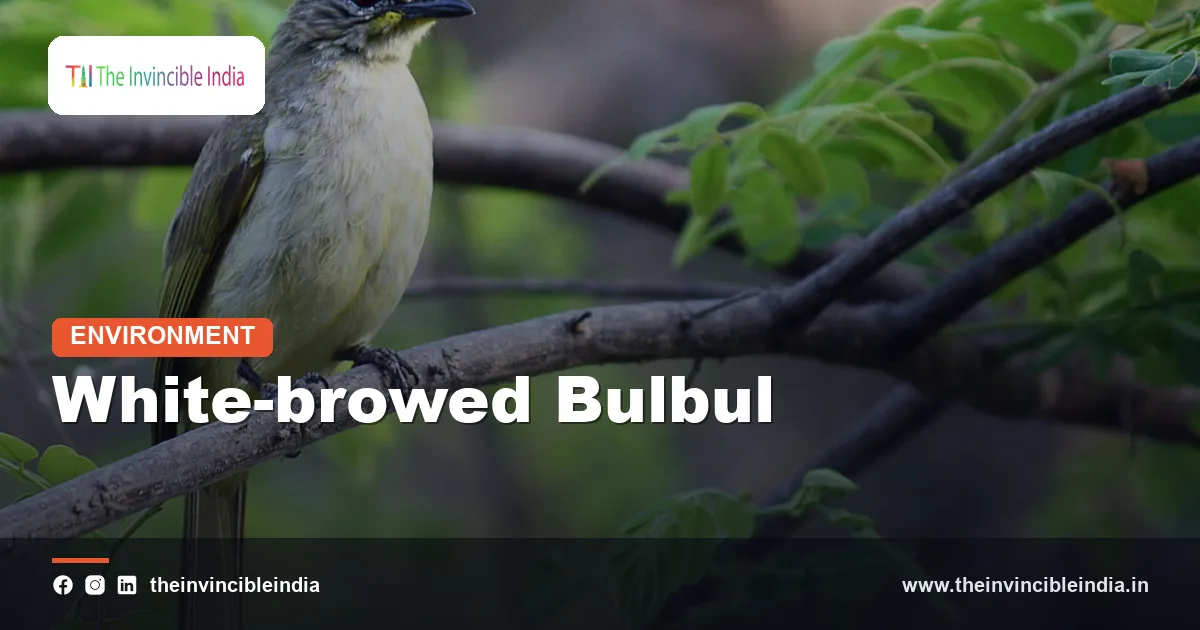
The white-browed bulbul (Pycnonotus luteolus) is a medium-sized, olive-brown bulbul of dense scrub and thickets in peninsular India and Sri Lanka, known for its pale yellowish underparts, short whitish eyebrow and a sudden, bubbling song that is heard far more often than the bird is seen. It belongs to the bulbul family, Pycnonotidae, and it is one of the shyest members of the group in India.
The white-browed bulbul spends most of its time hidden inside tangled bushes, and many people who live beside its habitat have heard it for years without ever noticing the bird itself. This explainer describes how the white-browed bulbul looks, where it lives in India, what it eats, how it sings and nests, and why this unassuming bird matters to the scrub that surrounds Indian towns and villages.
| Attribute | Detail |
|---|---|
| Common name | White-browed bulbul |
| Scientific name | Pycnonotus luteolus |
| Family | Pycnonotidae (bulbuls) |
| Size | About 20 cm long |
| Range and habitat in India | Peninsular India and Sri Lanka; dense scrub, thickets, dry deciduous woodland edges and overgrown gardens |
| Diet | Fruit, berries, nectar and insects |
| Breeding | Loose cup nest in a bush or thicket; usually two or three pinkish eggs with spots |
| Conservation status | Least Concern on the IUCN Red List |
Key Takeaways
- The white-browed bulbul is an olive-brown, roughly 20 cm bulbul with pale yellowish underparts, a short whitish eyebrow and a yellow patch beneath the tail.
- The white-browed bulbul lives in peninsular India and Sri Lanka and prefers dense scrub, thickets and overgrown edges rather than open ground.
- The white-browed bulbul is a skulking bird that is usually located by its loud, bubbling, irregular song rather than by sight.
- The white-browed bulbul eats fruit, nectar and insects, and by eating berries it helps scatter the seeds of many scrub plants.
- The white-browed bulbul builds a loose, shallow cup nest in a bush and normally lays two or three spotted eggs.
- The white-browed bulbul is classed as Least Concern, although it depends on thorny scrub and thickets that are often cleared as supposedly unproductive land.
What does the white-browed bulbul look like?
The white-browed bulbul is a plain, olive-brown bird about 20 cm long, with a short whitish streak above the eye, a pale yellowish throat and underparts, and a bright yellow patch under the tail. At first glance the bird looks drab, and its muted colouring allows it to blend into the dappled shade of bushes. A closer view shows that the upperparts are a soft olive-brown, the underparts are pale and slightly yellowish, and the face has a clearly marked pale brow.
Unlike the crested bulbuls that are common around Indian gardens, the white-browed bulbul has a smooth, rounded head with no crest. The bill is short, dark and slightly curved, and the legs are sturdy. The overall impression is of a shy, stocky bird that looks more like a small thrush or a drab warbler than a typical bulbul.
Features that help in identification
- A short white eyebrow above the eye, which is the source of the common name.
- Olive-brown upperparts with no black cap or crest.
- Yellowish underparts that are brightest around the vent.
- A loud, rich, bubbling song delivered from deep inside a bush.
Where is the white-browed bulbul found in India?
The white-browed bulbul is found across peninsular India, in dry and moist scrub, thickets and woodland edges, and it also occurs in Sri Lanka. It is largely a bird of the peninsula and is not widespread in the far north, which sets it apart from the more adaptable bulbuls that have spread into cities across the country.
Within its range, the white-browed bulbul prefers dense, tangled vegetation. It is common in scrub jungle, thorn thickets, hedgerows, abandoned plantations, overgrown gardens and the borders of forests. It also lives in the lower slopes of hills and the margins of the Western and Eastern Ghats, wherever there is enough thick cover to hide in. The species is resident, which means it stays in the same general area throughout the year.
Typical habitats
- Thorny scrub on the Deccan plateau and in drier peninsular regions.
- Tangled undergrowth at the edges of deciduous and evergreen forest.
- Thickets along streams, rocky ravines and the foot of hills.
- Old orchards, plantations and overgrown parts of large gardens.
What does the white-browed bulbul eat?
The white-browed bulbul eats a mix of fruit, berries, nectar and insects, and fruit makes up a large share of its diet. It feeds on the soft fruits of many shrubs and small trees, including wild figs, berries of scrub plants and the fruits of cultivated plants growing near thickets.
Alongside fruit, the white-browed bulbul gleans insects from leaves and twigs, and it will sometimes catch winged insects in a short sally. Nectar from flowering trees and shrubs forms an additional food source at certain times of year. This mixed diet allows the bird to survive in places where the fruit supply is seasonal, because it can fall back on insects when fruit is scarce.
| Food type | Examples | Role in the ecosystem |
|---|---|---|
| Fruit and berries | Wild figs, scrub berries, small garden fruits | Seeds are dispersed in droppings |
| Nectar | Flowers of shrubs and trees | Occasional pollination |
| Insects | Caterpillars, beetles, ants, flies | Natural control of plant-eating insects |
How does the white-browed bulbul sing?
The white-browed bulbul sings a loud, rich, bubbling song made of irregular phrases that often begin suddenly and may seem to come from nowhere. The song is not a smooth tune but a series of liquid whistles and chuckles that vary from bird to bird and from moment to moment.
Because the white-browed bulbul stays hidden inside thick cover, the song is by far the best clue to its presence. Many birdwatchers find that they hear the bird for several minutes before they get even a brief glimpse of it. The bird also gives harsher, scolding calls when disturbed, and pairs keep in touch with soft notes. Singing is most frequent in the early morning and in the breeding season, when males call from within a thicket.
Why the bird is heard more than seen
The white-browed bulbul prefers shade and cover to open perches. It tends to sing from a hidden spot and then move through the bush with quick hops, so a patient observer who waits quietly near a thicket is the most likely to be rewarded with a sighting.
How does the white-browed bulbul behave?
The white-browed bulbul behaves as a shy, skulking and fairly territorial bird that lives alone, in pairs or in small family parties. Unlike the more familiar bulbuls that perch openly on wires and walls, the white-browed bulbul rarely sits in view for long and usually keeps to the middle layers of dense bushes.
It moves by hopping and flitting between branches, often pausing to peer around before it advances. When alarmed, the bird dives deeper into the thicket or flies a short distance to the next patch of cover. Outside the breeding season, small groups may feed together in a fruiting bush, and the birds sometimes join mixed flocks of other small birds moving through scrub.
- The bird feeds mainly in the lower and middle layers of bushes.
- It flies in short, low and direct bursts between patches of cover.
- It visits fruiting shrubs regularly and may return to the same bush several times a day.
- It roosts in dense vegetation, often close to its feeding area.
How does the white-browed bulbul breed?
The white-browed bulbul breeds by building a loose, shallow, cup-shaped nest in a bush or thicket, where the female usually lays two or three pinkish eggs marked with reddish or purplish spots. The nest is made of twigs, grass and plant fibres and is placed a metre or two above the ground, hidden within dense foliage.
The timing of breeding varies across the species range and depends on local rainfall, since the chicks need plenty of insects and fruit. Both parents are generally involved in feeding the young, and the nestlings grow quickly. After leaving the nest, the young remain in dense cover for some days while the adults continue to feed them. Because the nest is hidden inside thorny or tangled vegetation, it is easily overlooked and may be destroyed by careless clearing of bushes during the breeding season.
Stages of the breeding cycle
- Males sing more often to claim a territory and attract a mate.
- The pair builds a loose cup nest within thick foliage.
- Two or three eggs are laid and incubated for about two weeks.
- Chicks are fed fruit and insects and leave the nest after roughly two more weeks.
How is the white-browed bulbul different from other bulbuls?
The white-browed bulbul is different from other Indian bulbuls because it lacks a crest and dark cap, shows a pale eyebrow, and keeps to dense cover rather than open perches. Several other bulbuls are more familiar and more visible in towns and gardens.
| Bulbul | Key difference from the white-browed bulbul |
|---|---|
| Red-vented bulbul | Black crested head, red patch under the tail, and a bold presence around houses |
| Red-whiskered bulbul | Pointed black crest, red whisker patch and white cheeks |
| Yellow-throated bulbul | Bright yellow head and throat, restricted to rocky scrub hills |
| Himalayan bulbul | Black crest and white cheeks, found in the Himalayan region rather than the peninsula |
Compared with these species, the white-browed bulbul looks plain and modest. Its pale brow, olive-brown colour and secretive habits are its best identification clues.
Why does the white-browed bulbul matter for the environment?
The white-browed bulbul matters because it disperses seeds, controls insects and indicates the presence of healthy thicket habitat. When the bird eats berries and later drops the seeds elsewhere, it helps scrub plants spread and regenerate, which supports the whole community of insects, reptiles and other birds that rely on thickets.
Thorny scrub and dense thickets are often classed as “wasteland” and cleared for plantations, quarries or construction. Yet these patches are home to many species, and they provide cover, nesting places and fruit through the year. A healthy population of white-browed bulbuls in a patch of scrub is a sign that the vegetation still has the layered structure that many animals need.
What is the conservation status of the white-browed bulbul?
The white-browed bulbul is classed as Least Concern on the IUCN Red List, because it is widespread across peninsular India and Sri Lanka and is still common in suitable habitat. As with many such species, this listing describes the species overall and does not guarantee that every local population is secure.
The main pressure on the white-browed bulbul in India is the loss of scrub and thicket to cultivation, urban expansion and mining, along with the habit of cleaning up bushes and undergrowth in gardens and farm edges. Its dependence on fruit means that removal of native fruiting shrubs can also reduce the local food supply. Retaining patches of native scrub and leaving some wild corners in gardens helps the species and many of its neighbours.
How can you watch the white-browed bulbul?
The best way to watch the white-browed bulbul is to stand quietly at the edge of a thicket early in the morning, listen for its bubbling song and wait for the bird to appear at the edge of the cover. Patience matters more than movement, because a bird that is searched for noisily will usually slip deeper into the bush.
- Visit scrub, hill foot and forest edge habitats in the cooler hours of the day.
- Use the song to locate the bird, then scan the middle layers of the nearest bush.
- Look for the pale eyebrow and yellow vent as the key identification marks.
- Stay on paths and avoid pushing into thickets, particularly in the breeding season.
- Look near fruiting shrubs, where the bird is more likely to come into view.
Bottom Line
The white-browed bulbul is a shy, olive-brown bird whose bubbling song is a regular sound of peninsular Indian scrub. It is common but easy to miss, and it plays a quiet part in dispersing seeds and controlling insects. Conserving the thickets it relies on benefits a much wider community of wildlife.
Frequently Asked Questions
What is a white-browed bulbul?
The white-browed bulbul is a medium-sized, olive-brown bulbul with pale yellowish underparts and a short whitish eyebrow. It lives in the dense scrub and thickets of peninsular India and Sri Lanka. It is shy and is usually detected by its loud, bubbling song.
Where is the white-browed bulbul found in India?
The white-browed bulbul is found mainly in peninsular India, in scrub jungle, thickets, hedgerows and forest edges. It also occurs in Sri Lanka. It prefers dense cover and is less common in open or heavily built-up places.
What does the white-browed bulbul eat?
The white-browed bulbul eats fruit, berries, nectar and insects. Fruit is a large part of its diet, so the bird helps to scatter the seeds of scrub plants. Insects supply protein, especially when the birds are feeding their young.
How can you identify a white-browed bulbul?
The white-browed bulbul can be identified by its olive-brown upperparts, pale yellowish underparts, short white eyebrow and the lack of a crest. It also has a yellow patch under the tail. Its secretive habits and bubbling song are further clues.
Does the white-browed bulbul sing?
The white-browed bulbul does sing, producing a loud, rich and irregular bubbling song from inside dense bushes. The song often starts suddenly and varies from bird to bird. It is the best way of finding the species, since the bird itself stays well hidden.
Is the white-browed bulbul endangered?
The white-browed bulbul is not endangered, and the IUCN lists it as Least Concern. Its main threat is the loss of scrub and thicket habitat to development and farming. Keeping patches of native scrub helps the species remain common.
{“@context”:”https://schema.org”,”@graph”:[{“@type”:”FAQPage”,”mainEntity”:[{“@type”:”Question”,”name”:”What is a white-browed bulbul?”,”acceptedAnswer”:{“@type”:”Answer”,”text”:”The white-browed bulbul is a medium-sized, olive-brown bulbul with pale yellowish underparts and a short whitish eyebrow. It lives in the dense scrub and thickets of peninsular India and Sri Lanka. It is shy and is usually detected by its loud, bubbling song.”}},{“@type”:”Question”,”name”:”Where is the white-browed bulbul found in India?”,”acceptedAnswer”:{“@type”:”Answer”,”text”:”The white-browed bulbul is found mainly in peninsular India, in scrub jungle, thickets, hedgerows and forest edges. It also occurs in Sri Lanka. It prefers dense cover and is less common in open or heavily built-up places.”}},{“@type”:”Question”,”name”:”What does the white-browed bulbul eat?”,”acceptedAnswer”:{“@type”:”Answer”,”text”:”The white-browed bulbul eats fruit, berries, nectar and insects. Fruit is a large part of its diet, so the bird helps to scatter the seeds of scrub plants. Insects supply protein, especially when the birds are feeding their young.”}},{“@type”:”Question”,”name”:”How can you identify a white-browed bulbul?”,”acceptedAnswer”:{“@type”:”Answer”,”text”:”The white-browed bulbul can be identified by its olive-brown upperparts, pale yellowish underparts, short white eyebrow and the lack of a crest. It also has a yellow patch under the tail. Its secretive habits and bubbling song are further clues.”}},{“@type”:”Question”,”name”:”Does the white-browed bulbul sing?”,”acceptedAnswer”:{“@type”:”Answer”,”text”:”The white-browed bulbul does sing, producing a loud, rich and irregular bubbling song from inside dense bushes. The song often starts suddenly and varies from bird to bird. It is the best way of finding the species, since the bird itself stays well hidden.”}},{“@type”:”Question”,”name”:”Is the white-browed bulbul endangered?”,”acceptedAnswer”:{“@type”:”Answer”,”text”:”The white-browed bulbul is not endangered, and the IUCN lists it as Least Concern. Its main threat is the loss of scrub and thicket habitat to development and farming. Keeping patches of native scrub helps the species remain common.”}}]}]}


