

Hindi is one of the most widely spoken languages in India and in the world, the mother tongue of hundreds of millions and a language understood by many more across the subcontinent. An Indo-Aryan language descended from ancient roots and written in the elegant Devanagari script, Hindi is one of the official languages of India and a vital link language across much of the country. It possesses a rich literary heritage, from the devotional poetry of the great saint-poets to the celebrated works of modern writers, and it flourishes in daily life, education, media, cinema and song. This guide explores the origins, script, literature, dialects, official role and living tradition of Hindi, one of the great languages of India.
Quick Facts
| Detail | Information |
|---|---|
| Type | Indo-Aryan language |
| Speakers | One of the most widely spoken languages in India and the world |
| Script | Written in Devanagari |
| Status | One of the official languages of India |
| Literature | From the Bhakti saint-poets to modern masters |
| Reach | A major link language across much of India |
A Language of Millions
Hindi is one of the most widely spoken languages in the world, the mother tongue of a vast number of people across northern and central India and understood by many more throughout the country. Its enormous number of speakers makes it one of the great languages of humanity, and within India it serves as a vital means of communication across regions and communities. Spoken in homes, streets, schools, offices and markets, and heard in film, television, radio and song, Hindi is a living, thriving language woven into the daily life of a huge population. Its vast reach and vitality make Hindi one of the most important languages of India and a major world language.
Origins and Development
Hindi is an Indo-Aryan language, part of the great family of languages descended from ancient Indo-Aryan roots and ultimately related to Sanskrit. It developed over many centuries from the ancient and medieval languages of northern India, evolving through intermediate stages into the modern language spoken today, and it draws much of its vocabulary from Sanskrit while also absorbing words from other languages over its history. The modern standard form of Hindi took shape in more recent centuries. This long development, from ancient roots through medieval stages to the modern language, connects Hindi to the deep linguistic history of northern India and to the wider heritage of the Indo-Aryan languages.
The Devanagari Script
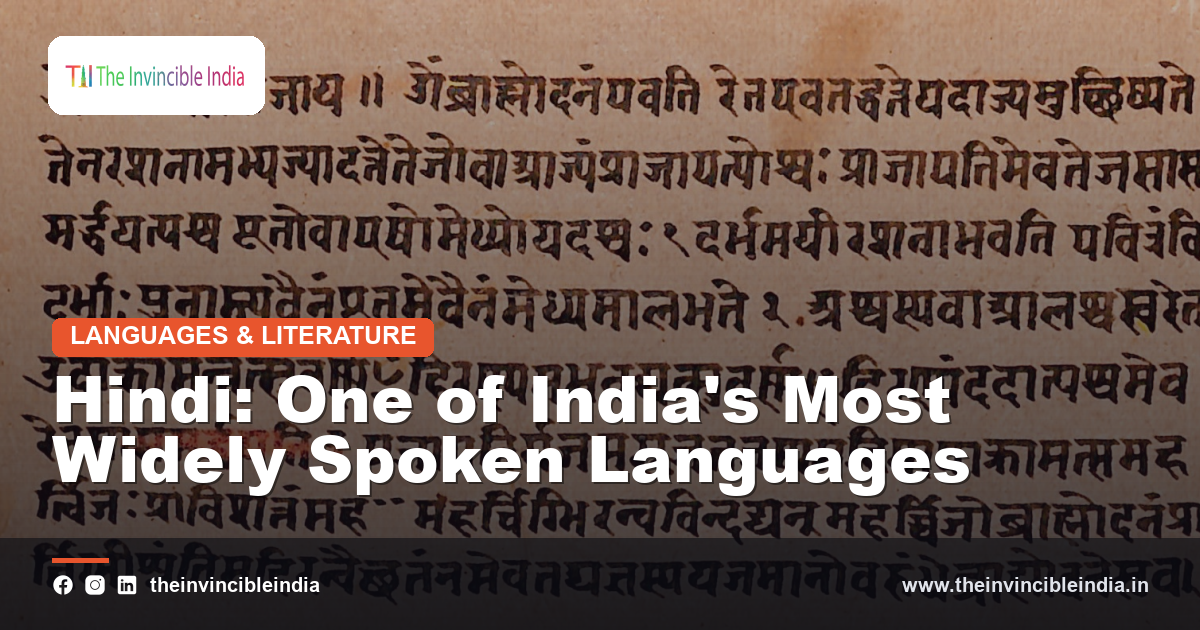
Hindi is written in the Devanagari script, an elegant and systematic writing system also used for Sanskrit, Marathi and several other languages. Recognisable by the horizontal line that runs along the top of its letters, Devanagari is a phonetic script well suited to the sounds of Hindi, in which words are generally written as they are pronounced. As a member of the great family of Indian scripts descended from the ancient Brahmi, Devanagari has a long history and a graceful form. Its use gives Hindi a clear and logical writing system and connects it to the rich tradition of Indian writing. The Devanagari script is an important part of the identity of the Hindi language.
Hindi and Its Sister Tongues
Hindi is closely related to a number of other languages and dialects of northern India, with which it shares a common ancestry and much vocabulary. It is especially closely related to Urdu, with which it shares a grammatical foundation and much everyday vocabulary, the two differing chiefly in script and in their literary and cultural vocabulary. Hindi is also connected to a range of regional languages and dialects across the Hindi-speaking area, some of which are considered dialects of Hindi and some distinct languages. This web of related tongues reflects the rich linguistic diversity of northern India, and understanding Hindi in relation to its sister languages illuminates its place in the linguistic landscape of the region.
The Dialects of Hindi
Behind the standard modern form of Hindi lies a rich diversity of dialects and regional varieties spoken across the vast Hindi-speaking region. These include a number of distinct dialects, each with its own character, vocabulary and, in several cases, its own literary tradition. Some of these dialects were the languages of great literature in earlier times, and the devotional and poetic classics of the Hindi tradition were often composed in them rather than in the modern standard language. This diversity of dialects gives the Hindi world great linguistic richness, and the dialects remain living tongues spoken in their regions. The relationship between standard Hindi and its many dialects is an important aspect of the language.
The Bhakti Poets
The literary heritage of Hindi reaches back to the glorious poetry of the Bhakti movement, composed in the older forms and dialects of Hindi by the great saint-poets. Poets such as Tulsidas, whose Ramcharitmanas is a supreme classic, and Surdas, celebrated for his devotional songs of Krishna, along with many others, created a treasury of devotional poetry that is among the greatest glories of Hindi literature. This Bhakti poetry, full of love for the divine and composed in the language of the people, laid the foundations of the Hindi literary tradition and remains beloved and revered to this day. The devotional poetry of the Bhakti poets is a cherished and foundational part of the heritage of Hindi.
Modern Hindi Literature
In the modern era, Hindi developed a rich and vibrant literature in prose and poetry, addressing the life, society and concerns of the times. Hindi produced celebrated novelists and short-story writers, foremost among them the great master who portrayed the lives of ordinary people, especially the rural poor, with realism and deep compassion, and whose works are treasured classics. Modern Hindi poetry, too, flourished in many forms and movements, giving voice to new sensibilities and ideas. This modern literature, rich in fiction, poetry, drama and essay, continues the ancient literary tradition of Hindi into the present and is a vital and celebrated part of the country’s cultural life.
An Official Language
Hindi holds the status of one of the official languages of the Union of India, a role reflecting its wide use and its importance in the life of the nation. In this capacity it is used in government, administration and official communication, alongside English and the many other languages of India, and it serves as an important language of national life. The promotion and development of Hindi, and its use in official work, are supported by the state. This official status, and Hindi’s role as a major language of government and national communication, are important aspects of its place in India, though the country’s linguistic policy recognises and respects its great linguistic diversity.
A Link Language
Beyond its official role, Hindi serves as an important link language across much of India, a common means of communication among people whose mother tongues differ. Across the vast Hindi-speaking region and beyond, Hindi is widely understood and used to communicate between speakers of different languages, aided by its presence in education, media and popular culture. This role as a link language, connecting people across linguistic boundaries in daily life and commerce, is one of the important functions of Hindi in a country of great linguistic diversity. At the same time, India’s many other languages remain vital and cherished, and the linguistic landscape of the country is richly plural.
Hindi in Cinema and Song
One of the most powerful vehicles for the spread and popularity of Hindi has been cinema, above all the vast and influential Hindi film industry, whose films and songs are beloved across India and around the world. Hindi films have carried the language to enormous audiences, and their songs, with lyrics often of great beauty drawing on the poetic traditions of Hindi and Urdu, are cherished and sung everywhere. This presence in cinema and popular music has made Hindi familiar and beloved far beyond its native region and has given it a powerful role in popular culture. The connection between Hindi and its celebrated cinema and songs is an important part of the language’s reach and appeal.
Hindi and Hindustani
Closely connected to Hindi is the idea of Hindustani, the shared, everyday spoken language of much of northern India that underlies both Hindi and Urdu. In daily speech, the common language spoken by ordinary people, drawing freely on the shared vocabulary of Hindi and Urdu, blurs the distinction between the two, and this widely understood colloquial tongue is often called Hindustani. It is this shared spoken language, rather than the more formal or literary registers, that serves as the great link language of the region and features in much popular culture. The concept of Hindustani illuminates the close relationship between Hindi and Urdu and the shared linguistic heritage of northern India.
Promoting the Language
The development and promotion of Hindi have been supported through various means, including its use in education, government and media, and efforts to enrich its vocabulary and standardise its usage. A day is observed each year to celebrate and promote the Hindi language, reflecting the importance attached to it. Institutions work to develop Hindi, produce literature and reference works, and encourage its use. These efforts have helped Hindi to grow and adapt as a modern language capable of serving every need, from literature to science and administration. The promotion of Hindi, balanced with respect for India’s linguistic diversity, is an ongoing part of the country’s cultural and linguistic life.
A Living, Growing Language
Hindi is a living, growing language, constantly evolving and adapting to the needs of the modern world while drawing on its rich heritage. It flourishes in literature, journalism, education, science, technology, cinema, music and everyday life, absorbing new words and expressions and developing to express new ideas and realities. Its vast and diverse community of speakers ensures its vitality, and its presence in every sphere of life, from the traditional to the cutting-edge, shows its adaptability. This character as a living, growing language, rooted in a deep heritage yet fully engaged with the modern world, is central to the vitality and importance of Hindi in contemporary India.
Hindi Today
Today Hindi flourishes as one of the most widely spoken languages in India and the world, a vital language of daily life, literature, media, cinema and national communication. Its rich literary heritage, from the Bhakti saint-poets to the modern masters, continues to be cherished and added to, and its presence in film and song carries it to vast audiences. As an official language and a great link language, it plays an important role in the life of the nation, within India’s rich and plural linguistic landscape. Rooted in an ancient heritage yet vibrantly modern, Hindi remains one of the great and living languages of India.
Sources & Further Reading
- Ministry of Culture and Ministry of Home Affairs, Government of India, on the official languages of India (indiaculture.gov.in).
- Sahitya Akademi, national academy of letters, on Hindi literature (sahitya-akademi.gov.in).
Frequently Asked Questions
What is the Hindi language?
Hindi is one of the most widely spoken languages in India and the world, an Indo-Aryan language written in the Devanagari script. It is one of the official languages of India, a major link language, and possesses a rich literary heritage.
What script is Hindi written in?
Hindi is written in the Devanagari script, an elegant, systematic and phonetic writing system, recognisable by the horizontal line along the top of its letters, which is also used for Sanskrit, Marathi and other languages.
What is the relationship between Hindi and Urdu?
Hindi and Urdu are closely related, sharing a grammatical foundation and much everyday vocabulary. They differ chiefly in script, Hindi using Devanagari and Urdu a Perso-Arabic script, and in their literary and cultural vocabulary. Their shared spoken form is often called Hindustani.
Who are the great writers of Hindi literature?
Hindi literature reaches from the Bhakti saint-poets, such as Tulsidas and Surdas, who composed devotional classics, to celebrated modern writers, including the great master of realist fiction who portrayed the lives of ordinary people with deep compassion.
Is Hindi an official language of India?
Yes. Hindi is one of the official languages of the Union of India, used in government and official communication alongside English and the many other languages of India, within a linguistic policy that respects the country’s great diversity.


