

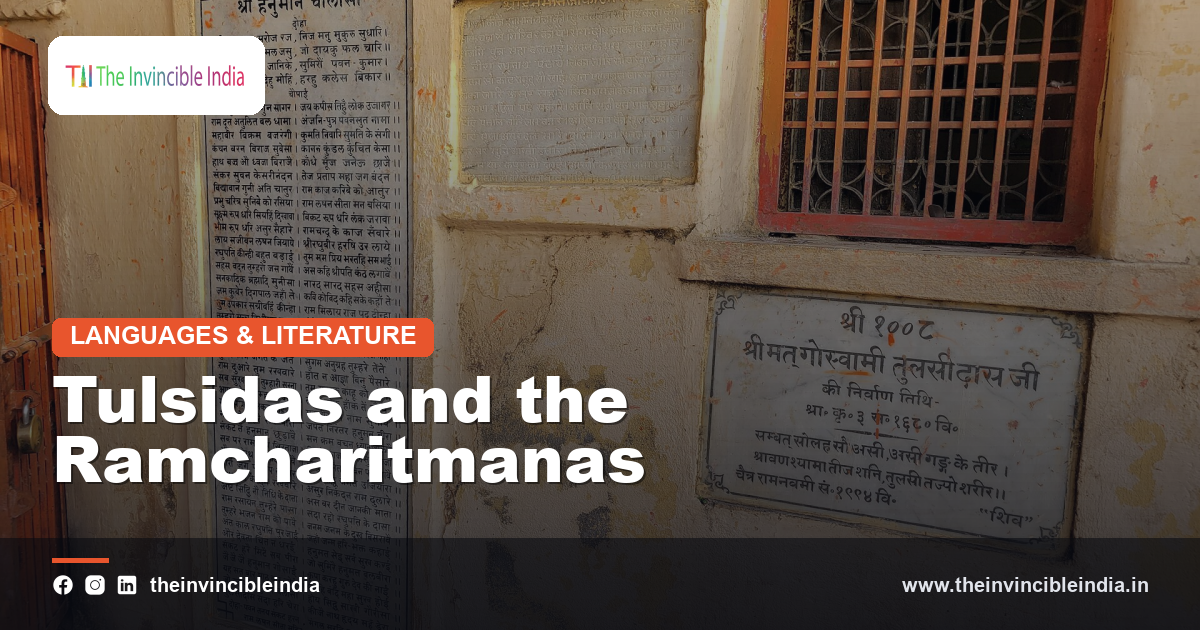
Tulsidas is one of the greatest poet-saints of India, revered above all as the author of the Ramcharitmanas, the beloved retelling of the epic Ramayana that brought the story of Rama to the people of northern India in their own language. A supreme devotee of Rama and a poet of extraordinary genius, Tulsidas transformed the ancient Sanskrit epic into a living scripture of devotion, cherished and recited in countless homes to this day. He is also honoured as the author of the ever-popular Hanuman Chalisa. Through his works, the love of Rama became the heart of religious life for millions. This guide explores the life of Tulsidas, his masterpiece the Ramcharitmanas, his other works and his profound and enduring influence.
Quick Facts
| Detail | Information |
|---|---|
| Type | Poet-saint and devotional writer |
| Masterpiece | The Ramcharitmanas, a retelling of the Ramayana |
| Language | Composed in the Awadhi vernacular |
| Devotion | A supreme devotee of Rama |
| Also wrote | The Hanuman Chalisa and other devotional works |
| Influence | Shaped the religious life of northern India |
A Supreme Devotee of Rama
Tulsidas is revered as one of the greatest poet-saints of India and a supreme devotee of Rama, whose whole life and work were an expression of his boundless love for his chosen deity. Belonging to the great tradition of Bhakti devotion, Tulsidas poured his devotion into poetry of extraordinary beauty and power, above all his retelling of the story of Rama, which became a beloved scripture of devotion. Through his genius and his faith, he made the love of Rama the centre of religious life for countless people. As a poet, a saint and a devotee, Tulsidas holds a place of the deepest reverence in the spiritual and literary heritage of India.
The Life of Tulsidas
Tulsidas lived in northern India during a great age of devotional religion, and, as with many saint-poets, his life is known partly through history and partly through cherished legend. Tradition tells of a difficult early life, a spiritual transformation, and a life devoted wholly to Rama, spent in devotion, pilgrimage and the composition of his great works, much of it associated with the holy city of Varanasi. Stories are told of his devotion, his visions and his miracles. Whatever the historical details, the figure of Tulsidas that emerges is of a man utterly devoted to Rama, whose love found expression in poetry that would transform the religious life of a whole region.
The Ramcharitmanas
The masterpiece of Tulsidas, and one of the greatest works of Indian devotional literature, is the Ramcharitmanas, his retelling of the epic story of Rama. In this great poem, Tulsidas told the beloved tale of Rama, his exile, the rescue of Sita and the triumph of good over evil, but he told it as an act of devotion, suffused with love for Rama as the supreme divine. Composed in the language of the people, the Ramcharitmanas made the sacred story directly accessible to all, and it became not merely a poem but a scripture, revered and recited as a holy text. It is the crowning achievement of Tulsidas and one of the most beloved works in all of Indian literature.
The Ramayana for the People
The great achievement of the Ramcharitmanas was to bring the story of Rama to the people in their own language, making the ancient epic, previously accessible chiefly in Sanskrit, available to ordinary men and women. By composing his retelling in the vernacular, Tulsidas placed the sacred story and its devotion within the reach of all, regardless of their learning, and the people embraced it with boundless love. The Ramcharitmanas became the Ramayana of the common people of northern India, learned, recited, sung and cherished in countless homes. This democratising of the sacred story, opening it to all through the vernacular, was of immense religious and cultural importance and is central to the legacy of Tulsidas.
Composed in the Vernacular
Tulsidas composed the Ramcharitmanas not in Sanskrit but in Awadhi, a vernacular language of northern India spoken by the people, and this choice was crucial to the work’s power and popularity. By writing in the living language of ordinary people, Tulsidas ensured that his poem could be understood, loved and recited by all, not merely by the learned. This use of the vernacular, in keeping with the spirit of the Bhakti movement, made the Ramcharitmanas a people’s scripture and greatly enriched the literary heritage of the language. The decision to compose in the vernacular was one of the keys to the extraordinary reach and influence of the work and the devotion it inspired.
A Living Scripture
The Ramcharitmanas is far more than a literary masterpiece; for millions it is a living scripture, a holy text revered and used in daily religious life. It is recited and sung in homes and temples, read aloud in devotional gatherings, and turned to for blessing, guidance and comfort, its verses cherished and often known by heart. Public recitations and dramatic enactments of the Ramcharitmanas are important religious events in northern India. This status as a living, revered scripture, woven into the daily devotion of countless people, is a remarkable testament to the work of Tulsidas, whose poem became not merely something to be admired but something to be worshipped and lived.
Devotion at Its Heart
What distinguishes the Ramcharitmanas of Tulsidas from other tellings of the story is the spirit of devotion that suffuses it from beginning to end. For Tulsidas, Rama is not merely a hero but the supreme divine, the very form of God, and the telling of his story is an act of worship and love. This devotional spirit transforms the epic into a scripture of bhakti, teaching and inspiring love for Rama and offering the path of devotion as the way to the divine. The deep, tender, all-pervading devotion of Tulsidas is the soul of the Ramcharitmanas and the source of its power to inspire love for Rama in the hearts of its countless readers and hearers.
The Ideal of Ram Rajya
Through the Ramcharitmanas, Tulsidas gave enduring expression to the ideal of Ram Rajya, the reign of Rama, held up as a vision of perfect, righteous and just rule. In his telling, the reign of Rama is a golden age of justice, prosperity, harmony and virtue, in which all live in peace and righteousness prevails. This ideal of Ram Rajya, of a perfect and righteous order, became a powerful and lasting image in Indian culture and thought, invoked as the model of ideal governance and a good society. The vision of Ram Rajya expressed in the Ramcharitmanas is one of the enduring contributions of Tulsidas to the moral and political imagination of India.
The Hanuman Chalisa
Besides the Ramcharitmanas, Tulsidas is honoured as the author of the Hanuman Chalisa, one of the most popular and beloved devotional hymns in all of India. This short hymn of praise to Hanuman, the mighty and devoted servant of Rama, is recited daily by countless people, cherished for its beauty, its devotion and the blessing and protection it is believed to bring. So beloved is the Hanuman Chalisa that it is among the most widely recited devotional texts in India, known by heart by millions. Its authorship adds further to the immense devotional legacy of Tulsidas, whose works have brought comfort and devotion to more people than almost any other in Indian religious history.
Other Works
Beyond his two most famous works, Tulsidas composed a number of other devotional writings, all expressing his love for Rama and his vision of devotion. These include collections of devotional songs and poems, works of praise and prayer, and further reflections on the story and worship of Rama, composed in the vernacular and cherished by devotees. Together with the Ramcharitmanas and the Hanuman Chalisa, these works form a rich devotional legacy that has nourished the faith of generations. This considerable body of writing, all devoted to Rama, testifies to the extraordinary devotion and poetic productivity of Tulsidas and has enriched the devotional literature and religious life of India.
A Master of the Vernacular
Tulsidas is honoured not only as a saint but as one of the supreme masters of the vernacular literature of northern India, a poet of extraordinary skill and beauty. His command of the Awadhi language, his mastery of poetic form and metre, his vivid imagery and his ability to combine profound devotion with narrative power and poetic beauty place him among the greatest poets of the Indian tradition. Through his works, he did much to shape and enrich the literary heritage of the language. This achievement as a literary master, quite apart from his religious importance, secures Tulsidas a place among the greatest of India’s poets and a foundational figure of its vernacular literature.
The Ramlila Tradition
The Ramcharitmanas of Tulsidas is closely connected to the popular tradition of the Ramlila, the dramatic enactment of the story of Rama performed especially in the autumn season across northern India. The Ramlila performances, in which the episodes of the story are acted out over many days, often draw on the text of Tulsidas, and they bring his beloved telling of the story vividly to life for whole communities. These performances are important religious and cultural events, cherished by the people and passed down through generations. The connection between the Ramcharitmanas and the living tradition of the Ramlila shows how deeply the work of Tulsidas is woven into the popular religious culture of India.
Enduring Influence
The influence of Tulsidas on the religious and cultural life of northern India has been immense and enduring, comparable to that of the greatest figures in Indian history. Through the Ramcharitmanas, he shaped the devotion, values and imagination of countless people, making the love of Rama the centre of their religious life and giving them a beloved scripture in their own tongue. His works remain among the most widely read, recited and cherished in India, and his vision continues to inspire devotion and to shape ideals of virtue and righteous rule. This profound and lasting influence makes Tulsidas one of the most important figures in the whole history of Indian religion and literature.
Tulsidas Today
Today Tulsidas remains one of the most revered and beloved figures in the religious and literary heritage of India, his works as cherished as ever. The Ramcharitmanas continues to be recited, sung and worshipped in countless homes and temples and enacted in the Ramlila each year, and the Hanuman Chalisa is recited daily by millions. His telling of the story of Rama continues to shape the devotion and imagination of northern India, and his vision of devotion and righteousness endures. As the poet-saint who gave the people the story of Rama in their own language, and who transformed an epic into a living scripture of love, Tulsidas remains an immortal figure in the heritage of India.
Sources & Further Reading
- Ministry of Culture, Government of India, on the saint-poets and devotional literature (indiaculture.gov.in).
- Sahitya Akademi, national academy of letters, on Tulsidas and the Ramcharitmanas (sahitya-akademi.gov.in).
Frequently Asked Questions
Who was Tulsidas?
Tulsidas was one of the greatest poet-saints of India, a supreme devotee of Rama, revered above all as the author of the Ramcharitmanas, the beloved retelling of the Ramayana that brought the story of Rama to the people of northern India in their own language.
What is the Ramcharitmanas?
The Ramcharitmanas is the masterpiece of Tulsidas, his devotional retelling of the epic story of Rama, composed in the Awadhi vernacular. It made the sacred story accessible to ordinary people and became a living scripture, revered and recited in countless homes to this day.
Why did Tulsidas write in the vernacular?
Tulsidas composed the Ramcharitmanas in Awadhi, a vernacular language of the people, rather than Sanskrit, so that the sacred story of Rama and its devotion could be understood, loved and recited by all, not only by the learned. This made it a people’s scripture.
Did Tulsidas write the Hanuman Chalisa?
Yes. Tulsidas is honoured as the author of the Hanuman Chalisa, one of the most popular and beloved devotional hymns in India, a short hymn of praise to Hanuman that is recited daily by countless people.
What is Ram Rajya?
Ram Rajya, the reign of Rama, is the ideal of perfect, righteous and just rule given enduring expression in the Ramcharitmanas of Tulsidas, portrayed as a golden age of justice, prosperity and harmony, and invoked in Indian culture as the model of ideal governance.


