

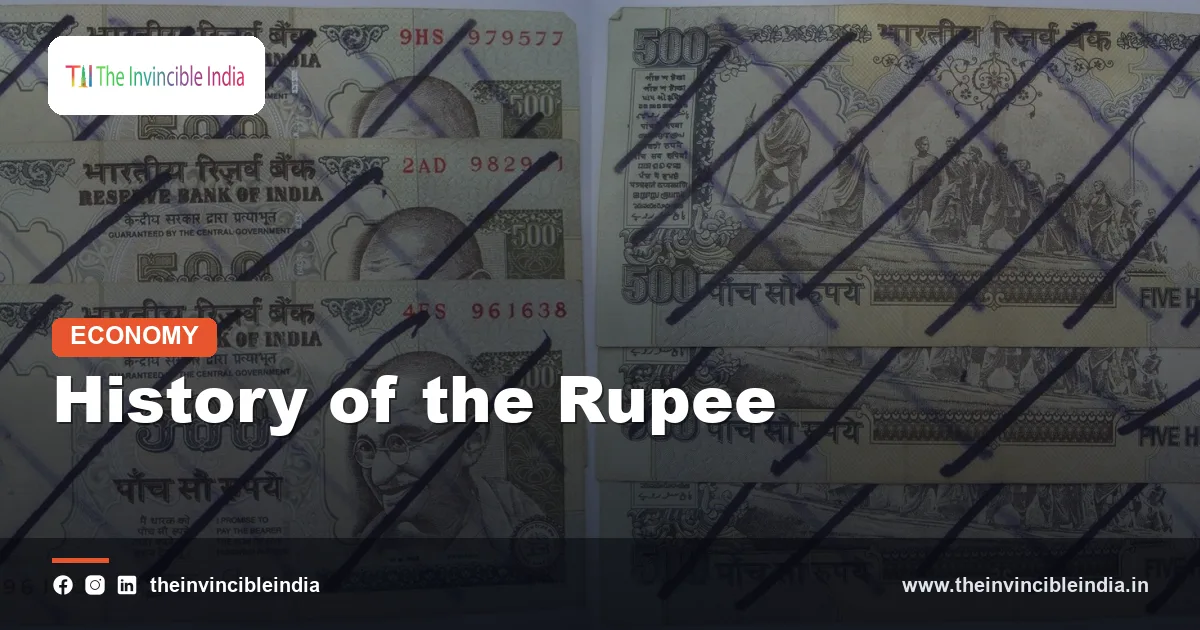
The Indian rupee is one of the oldest continuously used currency names in the world. Its story stretches from the punch-marked silver pieces of the early historic period, through the famous silver coin of Sher Shah Suri, across Mughal mints and colonial treasuries, to the smartphone screens on which millions of Indians now tap out a UPI payment. Few objects in daily life carry as much accumulated history as the coins and notes in an Indian wallet.
This explainer follows that long arc in order: where the word “rupee” comes from, how a sixteenth-century ruler set the pattern for the modern coin, how the British standardised and then managed the currency, how the Reserve Bank of India took over, how decimalisation reshaped everyday arithmetic in 1957, how the exchange-rate regime changed after the crisis of 1991, and how the rupee is now designed, printed and increasingly digitised.
| Fact | Detail |
|---|---|
| Name origin | Sanskrit “rupya” (wrought silver), linked to “rupa” (form or shape) |
| Modern silver rupiya | Introduced by Sher Shah Suri in the 1540s (about 178 grains of silver) |
| Uniform colonial rupee | Coinage Act, 1835 (East India Company) |
| First one-rupee note | 1917 |
| Central bank | Reserve Bank of India, established on 1 April 1935 |
| Decimalisation | 1 April 1957 (1 rupee = 100 naye paise) |
| Currency symbol | ₹, designed by D. Udaya Kumar and adopted in 2010 |
| Note series | Mahatma Gandhi Series (1996) and Mahatma Gandhi (New) Series (from 2016) |
| ISO code | INR |
Ancient Roots: Punch-Marked Coins and the Idea of “Rupya”
Long before the rupee had a name in its modern sense, the Indian subcontinent already had a sophisticated tradition of metal money. From roughly the sixth century BCE, the Mahajanapadas and later the Mauryan state issued punch-marked coins, mostly in silver. These pieces were made by stamping symbols such as the sun, hills, animals and geometric motifs onto a cut piece of metal with several separate punches. Historians usually call the standard silver piece of this kind a karshapana, and it circulated across large parts of northern and central India.
The word “rupya”
The word rupee traces back to the Sanskrit rupya, meaning silver that has been worked or stamped, and it is related to rupa, meaning form or shape. Early Sanskrit literature uses forms of the word for stamped silver pieces, and the Arthashastra, the classical treatise on statecraft, describes the state supervision of mints and refers to coins of silver as rupyarupa. The idea that a coin is a shaped, guaranteed piece of silver is therefore embedded in the very name.
From punch marks to dynastic coinage
Later centuries brought a wider variety of coins. Indo-Greek rulers introduced portraits and inscriptions, the Kushans issued gold coins of high quality, and the Gupta rulers produced celebrated gold dinaras. In peninsular India, dynasties such as the Cholas and Vijayanagara rulers issued their own gold and copper coins. None of these, however, created a single, long-lived silver standard that spanned the subcontinent. That step came in the sixteenth century.
Sher Shah Suri, the Silver Rupiya and Mughal Coinage
The direct ancestor of the modern rupee is the silver coin introduced by Sher Shah Suri during his brief but energetic rule in the 1540s. Having defeated the Mughal emperor Humayun, Sher Shah set about reorganising the empire’s administration, roads and revenue system, and coinage was a central part of that reform. Before him, the circulating money was a confusing mixture of coins of different weights and metal quality, which made trade and tax collection unpredictable.
What the rupiya was
Sher Shah issued a silver coin called the rupiya, weighing about 178 grains and of high purity. It was accompanied by a system of gold and copper coins, including the gold mohur and the copper dam, so that different levels of transaction had suitable denominations. The rupiya was valued in terms of copper dams, and the whole set fitted together as a coherent scheme rather than as isolated issues.
Why it mattered
- It offered a standard weight and purity that merchants could trust across regions.
- It linked land revenue, which was collected in cash, with a stable unit of account.
- It survived the fall of the Sur dynasty, because the Mughals kept the coin and its weight standard.
Sher Shah’s rule lasted only a few years, but his rupiya proved more durable than his dynasty, and its basic weight remained a reference point for centuries.
Mughal Coinage: A Silver Standard Refined
When the Mughals returned to power, they adopted and refined Sher Shah’s system. Under Akbar, the silver rupee became the standard coin of the empire, and mints in many cities produced pieces that were carefully regulated for weight and fineness. Akbar’s coinage also introduced the elegant calligraphic legends and the Ilahi dating system on some issues, and his successors, including Jahangir and Shah Jahan, continued to mint rupees with artistic variety.
Features of Mughal money
- Silver rupee as the main coin of account, with gold mohurs for high-value transactions.
- Copper dams for small change and everyday purchases.
- Coins bearing the name of the ruler, the mint town and the regnal year, which makes them valuable primary sources for historians.
- Free coinage in principle: traders could bring bullion to the mint and have it struck into coins for a fee.
Because Mughal India was a major exporter of textiles and other goods, silver flowed into the empire from abroad, and the mints turned that silver into rupees. The Mughal rupee gained a reputation for reliability, and its name and weight became familiar far beyond the borders of the empire. As Mughal authority weakened in the eighteenth century, regional rulers, princely states and European trading companies all struck their own versions of the rupee, which set the stage for the confusion the British later tried to resolve.
The East India Company and the Coinage Act of 1835
By the late eighteenth century the East India Company had become a territorial power, and it needed a workable currency for its growing domains. The result was a patchwork. The Bengal, Bombay and Madras Presidencies each issued their own coins, and various older rupees such as the sicca, the Arcot and the Surat rupee continued to circulate. Each differed slightly in weight and fineness, and moneychangers charged a discount, known as batta, to convert one into another.
Early paper money
Paper money in India also began in this period, but in a limited form. The Bank of Hindustan, founded in 1770, and the General Bank of Bengal and Bihar, established in 1773, issued early notes, and the Presidency Banks of Bengal, Bombay and Madras later issued notes of their own. These were not yet a single national currency, and their circulation was confined largely to major trading centres.
The problem of many rupees
The multiplicity of coins hampered trade and complicated the Company’s accounts. As the Company’s territories expanded and its administration became more centralised, pressure grew to create one standard silver rupee that would be accepted everywhere within its dominions.
The Coinage Act of 1835: One Rupee for British India
The turning point was the Coinage Act of 1835. It established a single uniform silver rupee for the Company’s territories, replacing the various presidency and provincial coins with one standard coin. The new rupee weighed 180 grains, of which 165 grains were pure silver, a fineness of eleven-twelfths. It carried the effigy of the reigning British monarch, beginning with William IV, and the Persian legends of earlier coins gave way to English inscriptions.
Effects of standardisation
- Domestic trade became simpler because a rupee meant the same thing in Calcutta, Bombay and Madras.
- Government accounts and taxation could be handled in one unit.
- The rupee became closely tied to the international price of silver, and therefore to global economic shifts far beyond India’s control.
The 1835 reform effectively put British India on a silver standard, and the basic weight and fineness of the rupee established then persisted, with modest changes, for well over a century.
Paper Currency, the Silver Problem and the Reserve Bank of India
Paper money became more centralised after the Paper Currency Act of 1861, which gave the government of India the right to issue notes and gradually removed the Presidency Banks from that role. Notes were initially issued in higher denominations, since a silver rupee was itself a valuable coin, and small-value notes were not yet common.
The first one-rupee note
The one-rupee note was first issued in 1917, during the First World War. The war had driven up the price of silver, which made the metal in a rupee coin worth more than its face value in some periods, and the authorities introduced a low-denomination note as a practical response. The note carried the image of King George V and marked a decisive step toward everyday use of paper money among ordinary people.
The trouble with silver
The dependence on silver had been a source of trouble for decades. After many countries moved toward the gold standard in the 1870s, silver lost value relative to gold, which caused the rupee to depreciate against the pound sterling. This raised the burden of the government’s sterling obligations in London. In 1893 the government closed the mints to the free coinage of silver, and later committees, including the Fowler Committee of 1898, recommended a gold exchange standard. In practice the rupee was fixed at a value of one shilling and four pence sterling for many years, and the following decades saw further debates over the appropriate rate, with the ratio later set at one shilling and sixpence in 1927 on the recommendation of the Hilton Young Commission.
The Reserve Bank of India and the Modern Note
The Hilton Young Commission of 1926 also recommended establishing a central bank, and after years of debate the Reserve Bank of India Act was passed in 1934. The Reserve Bank of India (RBI) began operations on 1 April 1935, with its central office initially in Calcutta before moving to Mumbai. Among its duties was the management of the currency, including the responsibility for issuing banknotes.
RBI notes
The RBI issued its first notes in 1938, beginning with a five-rupee note bearing the portrait of King George VI. Over the following years it took on the role of issuing notes of most denominations, while the one-rupee note remained an issue of the Government of India, a practice that continues in a different form to this day for one-rupee notes and coins.
The RBI’s currency functions
- Designing and issuing banknotes in consultation with the central government.
- Managing the circulation of coins and notes through its regional offices and currency chests.
- Withdrawing damaged or soiled notes and replacing them.
- Working with government-owned presses and mints, which produce the notes and coins on its behalf.
The RBI’s creation gave India a single institution responsible for monetary stability, a role it retained after nationalisation in 1949.
Independence, the Republic and Decimalisation
At Independence in 1947, the Indian rupee continued in the form it had under British rule, with the portrait of the king still appearing on notes and coins. Pakistan, too, kept the rupee as its own currency. The new Indian government gradually replaced imperial symbols with national ones. In 1949 the first independent India banknote, a one-rupee note, appeared with the Sarnath Lion Capital in place of the monarch’s portrait, and in 1950 the first coins of the Republic were issued, with the Ashoka Lion Capital on the obverse.
The pre-decimal system
Before 1957 the rupee was divided in the traditional way: one rupee was equal to 16 annas, and each anna was equal to 4 pice, so that a rupee held 64 pice. Smaller fractions such as the pie also existed in earlier times. This system was familiar but awkward for calculation, as anyone who needed to add sixteenths and sixty-fourths without a calculator would attest.
The sterling link
India remained in the sterling area, and the rupee’s value was tied to the pound sterling until the 1970s. When the pound was devalued in 1949, India followed, keeping the rupee’s relationship to sterling unchanged. Later, as sterling weakened as a global reserve currency, the rupee’s value came to be linked to a basket of major currencies.
Decimalisation on 1 April 1957
A major reform came with the Indian Coinage (Amendment) Act of 1955, which put the rupee on a decimal system from 1 April 1957. From that date, the rupee was divided into 100 units called naye paise (new paise), replacing the earlier division into 16 annas or 64 pice. The change followed the wider global movement toward decimal currencies and the metric system, which India was also adopting for weights and measures around the same time.
How the change worked
- New coins in denominations such as 1, 2, 5, 10, 20 and 50 naye paise were introduced alongside the old coins, which were gradually withdrawn.
- The word “naye” was used to help the public distinguish the new paise from the old pice, and it was dropped from the coins in 1964, leaving simply “paise”.
- Prices, accounts and school arithmetic all had to be adjusted, and many older Indians continued to speak of “annas” and “chavannis” (quarter-rupee coins) long afterwards.
Decimalisation made accounting simpler and aligned India with international practice. It also set the framework for the coins used today, with paise gradually fading from daily commerce as prices rose and lower denominations lost practical value.
Devaluations and the Move to a Market-Determined Rate
The rupee’s external value was fixed by the government for most of the first four decades after Independence, and it changed only in rare, dramatic moments. The most important were the devaluations of 1966 and 1991, each linked to pressure on the balance of payments.
The 1966 devaluation
In June 1966, following wars, droughts and a shortage of foreign exchange, India devalued the rupee substantially against the US dollar. The step was intended to improve export competitiveness and secure external aid, but it was politically contentious and was followed by a period of tighter controls on trade.
The 1991 crisis and reforms
In 1991 India faced a severe balance-of-payments crisis, with foreign exchange reserves falling to a level that could barely cover a few weeks of imports. In July 1991 the government carried out a two-step downward adjustment of the rupee as part of a wider set of economic reforms. Over the next two years the system moved from a fixed rate toward a market-determined one: a dual exchange rate arrangement was introduced in 1992, and the rates were unified in 1993, allowing the rupee’s value to be determined mainly by demand and supply in the foreign exchange market.
Managed float today
The rupee now operates under what economists call a managed float. The market sets the day-to-day rate, while the Reserve Bank of India may intervene to smooth excessive volatility rather than to defend a fixed target. Since the 1990s the rupee has generally weakened against the US dollar over the long run, reflecting differences in inflation and other factors, though it also has periods of strengthening and stability.
The Rupee Symbol: How ₹ Was Designed
For decades the rupee was written as “Rs” or “Re”, which lacked the visual identity that symbols such as the dollar sign or the pound sign enjoyed. In 2009 the Government of India invited entries for an official symbol through a public design competition, and thousands of proposals were received.
The winning design
The winning entry came from D. Udaya Kumar, then a postgraduate student at the Indian Institute of Technology Bombay. The Union Cabinet approved the design in 2010, and the symbol ₹ was formally adopted that year. It blends the Devanagari letter “र” (ra) with the Latin capital “R”, with two parallel horizontal lines across the top. The designer explained that these lines evoke the national tricolour and also suggest an equals sign, hinting at the balance and stability of the currency.
Adoption and use
- The symbol was incorporated into the Unicode standard, so that it can be typed and displayed on computers and phones worldwide.
- Keyboards, fonts and software were updated in the years after 2010 to support it.
- India joined the small group of countries whose currency has a distinct, internationally recognised symbol.
Timeline of Key Milestones
| Period or year | Milestone |
|---|---|
| Sixth century BCE onward | Punch-marked silver coins circulate in early historic India |
| 1540s | Sher Shah Suri introduces the silver rupiya of about 178 grains |
| Sixteenth to eighteenth centuries | Mughal silver rupee becomes the standard coin |
| 1835 | Coinage Act creates a uniform rupee for British India |
| 1861 | Paper Currency Act centralises note issue |
| 1917 | First one-rupee note issued |
| 1935 | Reserve Bank of India begins operations |
| 1950 | First coins of the Republic of India issued |
| 1957 | Decimalisation: 100 naye paise to the rupee |
| 1966 | Rupee devalued |
| 1991 to 1993 | Devaluation and shift to a market-determined exchange rate |
| 1996 | Mahatma Gandhi Series of banknotes introduced |
| 2010 | Rupee symbol ₹ adopted |
| 2016 | Demonetisation of Rs 500 and Rs 1,000 notes; Mahatma Gandhi (New) Series begins |
| 2022 | Pilots of the digital rupee (e-rupee) begin |
The Mahatma Gandhi Series and Security Features
For several decades after Independence, banknotes carried the Ashoka Lion Capital and various designs. In 1996 the RBI introduced the Mahatma Gandhi Series, with Gandhi’s portrait on the front of the notes, and this remained the standard design for the next two decades. Each note also carried a watermark of Gandhi, a security thread, and the value printed in numerals and words.
The Mahatma Gandhi (New) Series
From 2016 the RBI began issuing the Mahatma Gandhi (New) Series, with redesigned notes in new colours and sizes. The reverse sides feature scenes that showcase the country’s heritage and achievements, such as the Red Fort on the Rs 500 note, the Sun Temple at Konark on the Rs 10 note, and the Sanchi Stupa on the Rs 200 note. A language panel on the note shows the denomination in multiple Indian languages, reflecting the country’s linguistic diversity.
Security features
- A watermark showing Mahatma Gandhi and an electrotype denomination watermark.
- A windowed security thread that changes colour when tilted.
- Intaglio (raised) printing that can be felt by touch, especially in the portrait and identification mark.
- Micro-lettering, latent images and see-through registration devices.
- Features for the visually impaired, such as an identification mark and raised bleed lines, which vary by denomination.
Notes are printed at government and RBI-owned presses in different parts of the country, and coins are struck at the India Government Mints located in Mumbai, Kolkata, Hyderabad and Noida.
Demonetisation, UPI and the Digital Rupee
On 8 November 2016, the Government of India announced that the existing Rs 500 and Rs 1,000 banknotes would cease to be legal tender from midnight. The stated objectives included curbing counterfeit currency, reducing the circulation of unaccounted cash and encouraging a shift toward digital and formal financial channels. Citizens were allowed to deposit or exchange the old notes at banks within a specified period, and new Rs 500 notes and a new Rs 2,000 note were introduced as part of the Mahatma Gandhi (New) Series.
Aftermath
The measure withdrew a very large share of the value of currency in circulation, and it led to a period of long queues and cash shortages, followed by gradual remonetisation as new notes were printed and distributed. Economists and policymakers have offered varied assessments of its effects. In May 2023 the RBI announced that the Rs 2,000 note would be withdrawn from circulation, although it was said to remain legal tender for a period, and the Rs 500 note emerged as the highest-denomination note in regular circulation.
UPI, the Digital Rupee and the Future of Cash
The rupee has also moved onto phones. The Unified Payments Interface (UPI), launched in 2016 by the National Payments Corporation of India, allows instant bank-to-bank transfers using a mobile app, a virtual payment address or a QR code. Within a few years it became one of the most widely used retail payment systems in the country, used for everything from paying a vegetable vendor to settling a restaurant bill, and it has steadily reduced the everyday reliance on physical cash.
The digital rupee
The RBI has also developed a central bank digital currency (CBDC), known as the digital rupee or e-rupee. Pilot programmes began in late 2022, first for wholesale use among financial institutions and then for retail use by selected customers. A CBDC is not the same as UPI: it is a direct digital form of central bank money, a liability of the RBI, whereas UPI is a payments network that moves money held in bank accounts.
Cash and digital, side by side
Despite the growth of digital payments, cash has not disappeared, and the total value of currency in circulation has continued to rise over the long term. The likely future is a coexistence in which notes and coins serve those who prefer or need them, while digital rails handle a growing share of payments. Whatever the form, the unit remains the same rupee that traces its lineage to Sher Shah Suri’s silver coin.
Conclusion
The history of the Indian rupee is a story of continuity and change. The name and the idea of a standard silver coin survived from Sher Shah’s rupiya through Mughal mints and colonial reforms into the Republic. The Coinage Act of 1835 unified the currency, the Reserve Bank of India of 1935 professionalised its management, the decimal system of 1957 modernised its arithmetic, and the reforms after 1991 tied its value to the market. The ₹ symbol gave it a visual identity, while demonetisation, new note series, UPI and the digital rupee show that it continues to evolve. Understanding this journey helps make sense of the money in every Indian pocket.
Frequently Asked Questions
Who introduced the rupee in India?
The modern rupee traces back to the silver rupiya introduced by Sher Shah Suri in the 1540s. It weighed about 178 grains and was later adopted and developed by the Mughals. The British then standardised it through the Coinage Act of 1835.
What does the word “rupee” mean?
The word comes from the Sanskrit rupya, meaning wrought or stamped silver, which is connected to rupa, meaning form or shape. It originally described a coin of shaped silver and later became the name of the standard currency unit.
When did India switch to the decimal currency system?
India adopted decimal coinage on 1 April 1957. The rupee was divided into 100 naye paise, replacing the older system of 16 annas or 64 pice to the rupee. The word “naye” was dropped from coins in 1964.
Who designed the rupee symbol and when was it adopted?
The ₹ symbol was designed by D. Udaya Kumar and was adopted by the Government of India in 2010. It combines the Devanagari letter “र” with the Latin letter “R” and has two horizontal lines across the top.
When was the Reserve Bank of India established, and what is its role in currency?
The Reserve Bank of India began operations on 1 April 1935. It is responsible for issuing and managing banknotes, regulating the money supply and overseeing the country’s monetary policy, and it works with government presses and mints to supply currency.
What is the digital rupee, and how is it different from UPI?
The digital rupee is a central bank digital currency issued by the Reserve Bank of India, a digital form of legal tender. UPI, by contrast, is a payments network that transfers money between bank accounts. Pilot programmes for the digital rupee began in late 2022.


