

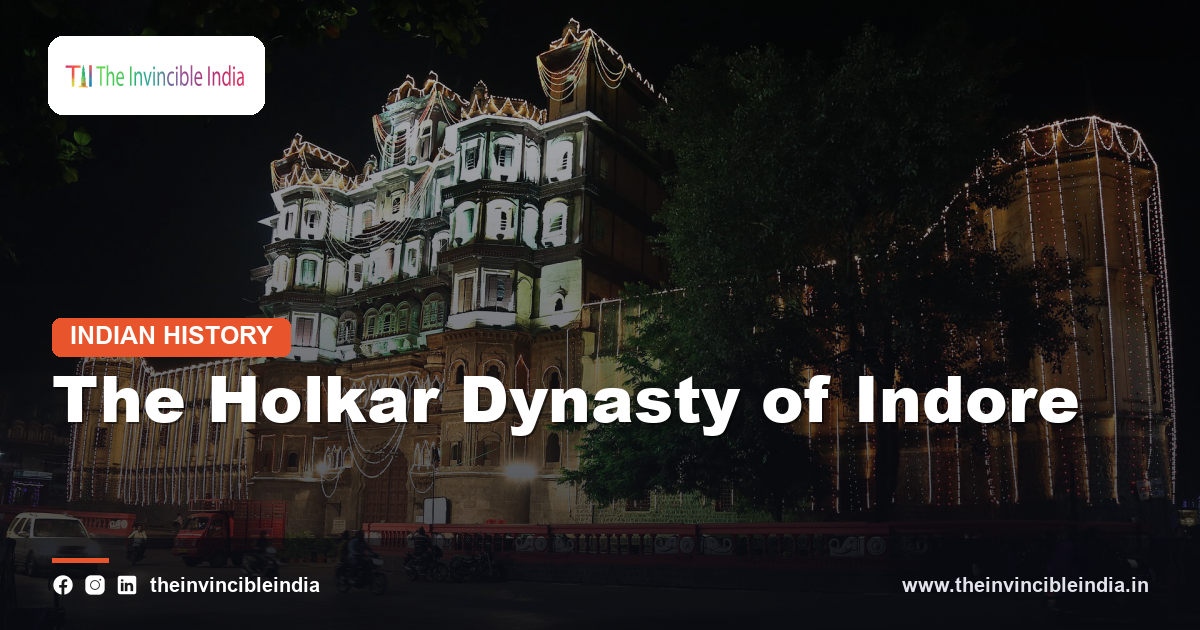
The Holkar dynasty, often called the Holkars of Indore, was a Maratha ruling house that governed the region of Malwa in central India from the eighteenth century, with its seat at Indore and, for a time, at Maheshwar on the Narmada river. Rising within the Maratha Confederacy as one of its great families, the Holkars became a major power in central and northern India, led by capable soldiers and administrators. The dynasty is remembered above all for Maharani Ahilyabai Holkar, renowned across India for her just rule and her patronage of temples and public works. The Holkars were one of the leading houses of the wider Maratha world described in the Maratha Empire. Because precise dates and figures should not be overstated, this guide keeps to broad and well-established terms.
Quick answer: The Holkar dynasty was a Maratha ruling house that governed Malwa in central India from the eighteenth century, with its capital at Indore and, for a period, at Maheshwar. Founded by the soldier Malhar Rao Holkar within the Maratha Confederacy, it is most famous for Maharani Ahilyabai Holkar, celebrated for her just administration and her patronage of temples across India. The dynasty later became the princely state of Indore and left landmarks such as the Rajwada palace.
Key Takeaways
- The Holkars were a Maratha dynasty that ruled the region of Malwa in central India from their capital at Indore.
- The dynasty was founded by Malhar Rao Holkar, a soldier who rose within the Maratha Confederacy.
- Maharani Ahilyabai Holkar is the dynasty’s most celebrated ruler, famed for her just governance and piety.
- Ahilyabai ruled from Maheshwar on the Narmada and is renowned for her patronage of temples across India.
- The Rajwada palace in Indore is a famous landmark associated with the Holkars.
- The Holkars later continued as the princely state of Indore under British paramountcy.
Read on for the history, culture, and legacy in detail.
Quick Facts
| Detail | Information |
|---|---|
| Dynasty | Holkar dynasty (Holkars of Indore) |
| Period | Eighteenth to twentieth centuries |
| Region | Malwa, in central India |
| Capital | Indore; Maheshwar under Ahilyabai |
| Founder | Malhar Rao Holkar |
| Notable Ruler | Maharani Ahilyabai Holkar |
| Patronage | Temples, ghats and public works across India |
| Legacy | Princely state of Indore; Rajwada palace |
Who Were the Holkars?
The Holkars were a Maratha ruling family who rose to become one of the great powers of eighteenth-century India, governing the rich region of Malwa in the centre of the subcontinent from their seat at Indore. They emerged within the Maratha Confederacy, the alliance of Maratha states and families that dominated much of India after the decline of Mughal central power. From origins as soldiers in Maratha service, the Holkars built a territorial power and a ruling dynasty of their own. They are counted among the principal Maratha houses, alongside families such as the Scindias, the Gaekwads and the Peshwas. Their rule combined military strength with notable achievements in administration and patronage. The Holkars therefore represent the way able commanders within the Maratha system could establish enduring dynasties, and they hold a distinguished place in the history of central India.
Where Did the Holkar Dynasty Rule?
The Holkar dynasty ruled the region of Malwa, a fertile and historically important plateau in central India, with its capital at the city of Indore. Malwa was known for its agricultural wealth, its trade routes and its strategic position linking northern and central India, which made it a valuable prize for the rising Maratha powers. Under the Holkars, Indore grew from a modest town into a thriving city and the centre of a substantial state. For a period the dynasty also made Maheshwar, a historic town on the banks of the Narmada river, an important seat, especially under Ahilyabai Holkar. The territory controlled by the Holkars extended across parts of central India and influenced affairs well beyond its core. The geography of Malwa, rich and centrally placed, therefore underpinned the prosperity and importance of the Holkar state.
How Did the Holkars Rise in the Maratha Confederacy?
The Holkars rose within the Maratha Confederacy during the eighteenth century, when the Marathas expanded their power across much of India following the weakening of the Mughal Empire. As the Marathas extended their authority into central and northern India, they assigned the collection of revenue and the governance of territories to leading commanders and families, who built regional power bases of their own. The Holkars, beginning with the soldier Malhar Rao Holkar, gained control over Malwa through service in the Maratha campaigns and were granted authority over the region. Over time this grant of military and revenue rights developed into a hereditary princely state. The Holkars thus became one of the semi-independent houses that made up the Maratha Confederacy. Their rise illustrates the way the expanding Maratha system generated powerful regional dynasties bound loosely to the central Peshwa leadership.
Who Was Malhar Rao Holkar, the Founder?
Malhar Rao Holkar is remembered as the founder of the Holkar dynasty, a soldier of humble origins who rose through ability and service to become one of the foremost Maratha commanders of his age. Through his military skill he gained the favour of the Maratha leadership and was entrusted with authority over Malwa, which became the foundation of the dynasty’s power. He is remembered as a brave and resourceful general whose campaigns carried Maratha arms across central and northern India. Under him the family established its capital at Indore and built the institutions of a state. His leadership laid the territorial and political foundations on which his successors would build. Malhar Rao Holkar therefore occupies the central place as the progenitor of the dynasty, the warrior whose career transformed a soldier’s service into a ruling house that would endure for generations.
Who Was Ahilyabai Holkar?
Ahilyabai Holkar is the most celebrated figure of the Holkar dynasty and one of the most admired rulers in Indian history, a queen renowned across the land for her just, wise and pious governance. Taking up the leadership of the Holkar state in the later eighteenth century, she ruled during a difficult period with a reputation for fairness, devotion and care for her people. She governed from Maheshwar on the Narmada and is remembered for her tireless patronage of temples, ghats and charitable works throughout India. Her administration became a byword for good government, and later generations honoured her as an ideal ruler. Her piety and public spirit earned her lasting veneration far beyond her own kingdom. Ahilyabai Holkar therefore stands as the glory of the dynasty and as a revered symbol of enlightened and devout rule in the history of India.
Why Did Ahilyabai Rule from Maheshwar?
Ahilyabai Holkar made Maheshwar, a historic town on the banks of the sacred Narmada river, her capital and the centre of her administration during her celebrated reign. Maheshwar held deep religious and cultural significance, and its position on the Narmada, one of India’s holiest rivers, suited the devout character of her rule. From this seat she governed the Holkar state, dispensed justice and directed her extensive programme of temple building and public works. The town flourished under her patronage, with the construction and adornment of ghats, temples and public buildings that still define its character. Maheshwar became closely associated with her memory and her ideals of pious and just governance. Her choice of Maheshwar as a capital reflected both practical and spiritual considerations. The town remains a lasting monument to Ahilyabai and to the devout spirit of her reign.
What Was Ahilyabai's Reputation for Administration?
Ahilyabai Holkar earned a reputation for exemplary administration that has made her name a lasting symbol of good and just government in Indian history. She is remembered for her accessibility to her subjects, her concern for justice and her careful attention to the welfare of her people during a turbulent age. Accounts of her rule praise her for maintaining order, encouraging trade and agriculture, and governing with integrity and compassion. She is said to have heard the petitions of ordinary people and to have ruled with a strong sense of duty and responsibility. Her leadership steadied the Holkar state and won the respect of allies and rivals alike. While later tradition has honoured her in idealised terms, the broad reputation for able and benevolent rule is well established. Ahilyabai’s administration therefore remains a celebrated example of enlightened governance in eighteenth-century India.
How Did Ahilyabai Patronise Temples Across India?
Ahilyabai Holkar is renowned above all for her extraordinary patronage of temples, ghats and pilgrimage centres across the length and breadth of India, a programme of religious and public works that few rulers have matched. She is traditionally credited with the building, repair and endowment of temples and sacred structures at many of the great pilgrimage sites of the subcontinent, from the Himalayas to the south. Her patronage extended to the construction of ghats, rest houses, wells and charitable institutions that served pilgrims and travellers. This vast undertaking reflected her deep personal piety and her sense of royal duty toward the religious life of the people. The specific list of her works is remembered in tradition and is extensive, so historians speak of it in general terms of its remarkable scale. Her temple patronage remains the most celebrated aspect of her legacy and a defining achievement of the Holkar dynasty.
What Is the Rajwada Palace in Indore?
The Rajwada is the historic royal palace of the Holkars in the heart of Indore, a grand multi-storeyed structure that served as the seat of the dynasty and the centre of courtly and administrative life in the city. Built over the course of the Holkar period, it combined elements of different architectural traditions and stood as a symbol of the wealth and authority of the ruling house. Its imposing wooden and stone facade and its central position made it the focal point of old Indore. The palace witnessed the ceremonies, administration and public life of the Holkar state across generations. Though it suffered damage over time, it has been preserved and restored as a heritage landmark. The Rajwada therefore remains the most famous monument of the Holkars in their capital, embodying the history and grandeur of the dynasty at the heart of Indore.
What Is Maheshwar Known For?
Maheshwar is known as the Narmada-side town that Ahilyabai Holkar made her capital, famous for its beautiful riverside ghats, its temples and its fort, as well as for its celebrated handloom weaving. Under Ahilyabai’s patronage the town was adorned with stone steps leading down to the sacred river, temples and public structures that give it a distinctive and serene character. Maheshwar is also renowned as a centre of fine handloom textiles, and the tradition of Maheshwari weaving is closely associated with the encouragement it received during Ahilyabai’s reign. The town remains a place of pilgrimage and heritage, drawing visitors to its ghats, temples and historic buildings. Its association with the revered queen gives it special significance in popular memory. Maheshwar therefore stands as one of the most important legacies of the Holkar dynasty and of Ahilyabai Holkar in particular.
How Did the Holkars Govern Malwa?
The Holkars governed Malwa as one of the princely states of the Maratha world, combining military power with an administration that managed revenue, justice and the affairs of a substantial territory. The ruler stood at the head of the state, supported by ministers, officers and military commanders who oversaw the collection of revenue from the fertile lands and trade of Malwa. The dynasty maintained a strong army, which had been the basis of its rise and remained essential to its power within the Maratha Confederacy. Under able rulers, and especially under Ahilyabai, the administration became known for order, justice and attention to public welfare. The state supported temples, trade and charitable works as part of its governance. This combination of military strength and capable administration gave the Holkar state its stability and prosperity, and underpinned its prominent role in the politics of central and northern India.
How Did the Holkars Relate to Other Maratha Houses?
The Holkars related to the other great Maratha houses through a complex web of cooperation and rivalry within the Maratha Confederacy, which bound the leading families together under the nominal leadership of the Peshwa. The Holkars, the Scindias of Gwalior, the Gaekwads of Baroda, the Bhonsles and the Peshwas themselves formed the principal powers of this confederacy, often campaigning together against common enemies. At the same time, these families competed for influence, territory and precedence, and relations among them shifted with circumstances. The Holkars and the Scindias in particular were neighbouring powers in central India whose interests sometimes aligned and sometimes clashed. This balance of alliance and rivalry was a defining feature of Maratha politics in the eighteenth century. The Holkars’ place among these houses made them a key player in the affairs of the confederacy and of India at large.
How Did the Holkars Fare in the Anglo-Maratha Wars?
The Holkars, like the other Maratha powers, were drawn into the series of conflicts with the expanding British East India Company known as the Anglo-Maratha Wars, which shaped the fate of the Maratha Confederacy in the late eighteenth and early nineteenth centuries. As the British extended their power across India, the Maratha houses, including the Holkars, resisted at various times and with varying fortunes. These wars tested the military strength of the Holkar state and ended, as for the other Maratha powers, with the acceptance of British paramountcy. The Holkars retained their dynasty and territory as a princely state under overall British authority. The details of individual campaigns are complex and are described cautiously. The outcome of the Anglo-Maratha Wars therefore marked the transition of the Holkars from an independent Maratha power to a princely state within the British-dominated order of India.
How Did Indore Develop Under the Holkars?
Indore developed under the Holkars from a modest settlement into a major city and the thriving capital of their state, growing in population, commerce and importance over the generations of their rule. As the seat of a wealthy and well-governed state, the city attracted trade, crafts and settlers, and it became an important commercial centre of central India. The Holkar rulers invested in the city’s buildings, institutions and public works, and the later maharajas of the princely state continued to modernise and expand it. The Rajwada palace stood at the heart of the old city as the symbol of the dynasty. Indore’s growth reflected the prosperity and stability that Holkar rule brought to Malwa. The city remains one of the largest and most important in central India today. Its development is therefore one of the most tangible and lasting achievements of the Holkar dynasty.
Why Is the Holkar Dynasty Significant in Indian History?
The Holkar dynasty is significant in Indian history as one of the great Maratha houses that dominated central and northern India in the eighteenth century and as the rulers who built the state and city of Indore. Their rise from military service to princely power illustrates the dynamics of the Maratha Confederacy and the political order that replaced Mughal supremacy. Above all, the dynasty is honoured for Maharani Ahilyabai Holkar, whose just governance and vast religious patronage made her one of the most revered rulers in Indian memory. The Holkars’ temples, ghats and public works across India form a remarkable cultural and religious legacy. Their state endured as the princely state of Indore into the modern era. For students of Indian history, the Holkars exemplify both the achievements of the Maratha age and the ideal of enlightened and devout rule.
The Holkar Dynasty Today
The Holkar dynasty lives on today through the city of Indore, the heritage of Maheshwar and the enduring veneration of Ahilyabai Holkar across India. The Rajwada palace in Indore and the ghats, temples and fort of Maheshwar remain cherished heritage sites that attract visitors and pilgrims. The memory of Ahilyabai is honoured throughout the country, and institutions, public works and places bear her name in recognition of her just and pious rule. The Maheshwari weaving tradition continues to flourish, carrying forward a craft linked to her patronage. Historians and conservators study and preserve the monuments and records of the dynasty. For readers of Indian history, the Holkars offer an inspiring example of able Maratha rule and of a queen remembered as a model of good governance. Their legacy endures in Indore, in Maheshwar and in the countless temples associated with Ahilyabai.
Sources & Further Reading
- Archaeological Survey of India (asi.nic.in).
- Ministry of Culture, Government of India (indiaculture.gov.in).
- Madhya Pradesh Tourism, Government of Madhya Pradesh (mptourism.com).
Frequently Asked Questions
Who were the Holkars?
The Holkars were a Maratha ruling dynasty that governed the region of Malwa in central India from the eighteenth century, with their capital at Indore. They rose within the Maratha Confederacy and became one of its great families.
Who founded the Holkar dynasty?
The Holkar dynasty was founded by Malhar Rao Holkar, a soldier who rose through ability and service to become a foremost Maratha commander. He gained authority over Malwa, which became the foundation of the dynasty’s power at Indore.
Who was Ahilyabai Holkar?
Ahilyabai Holkar was the most celebrated ruler of the Holkar dynasty, renowned across India for her just, wise and pious governance. She ruled from Maheshwar on the Narmada and is famous for her patronage of temples and public works throughout the country.
Why is Ahilyabai Holkar so revered?
Ahilyabai Holkar is revered for her exemplary administration, her devotion and her extraordinary patronage of temples, ghats and charitable works across India. Later generations have honoured her as an ideal and benevolent ruler.
What is the Rajwada palace?
The Rajwada is the historic royal palace of the Holkars in the heart of Indore, which served as the seat of the dynasty. It is a grand multi-storeyed structure and a famous heritage landmark of the city.
What happened to the Holkar state in later times?
The Holkar state continued as the princely state of Indore under British paramountcy after the Anglo-Maratha Wars. Its rulers retained their dynasty and territory and modernised the city of Indore, which remains a major center of central India.


