

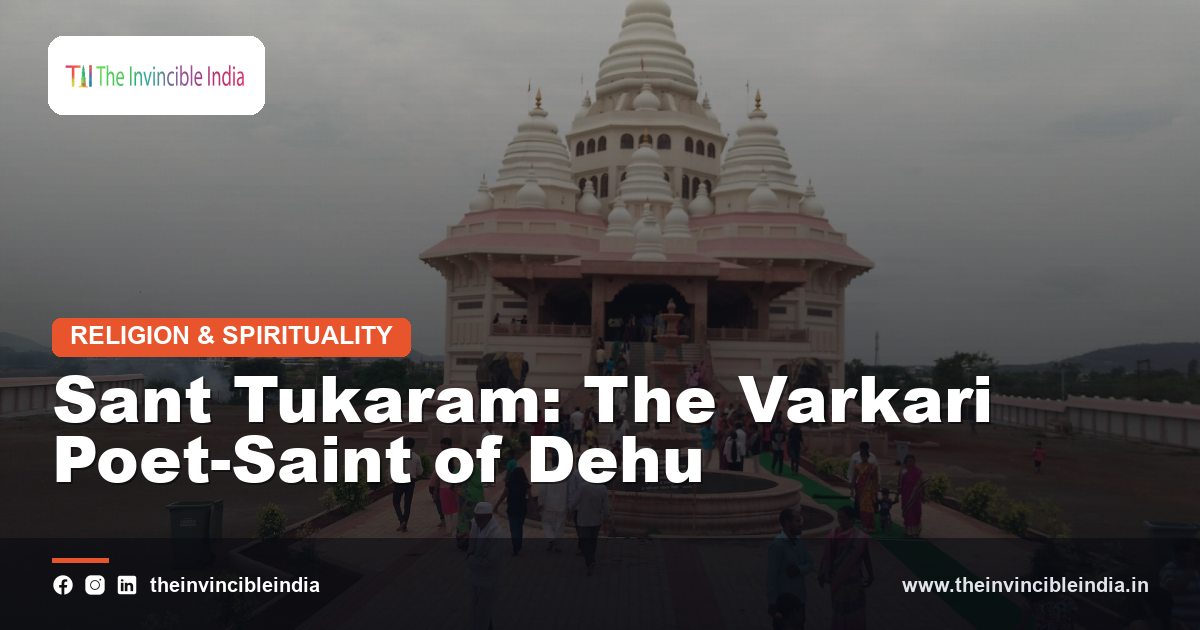
Sant Tukaram, affectionately called Tukoba, is a Varkari poet-saint of Maharashtra, generally placed in the seventeenth century and remembered as one of the greatest composers of abhangas, the devotional songs of the tradition. He belonged to the town of Dehu, near the river Indrayani, and his whole devotion centred on Vitthal, also called Vithoba, the form of Vishnu worshipped at Pandharpur. His songs, direct, honest and full of feeling, gave voice to the longing and love of the common devotee and helped carry the bhakti movement of devotion to its height in Maharashtra. Tradition makes him a contemporary of the Maratha ruler Shivaji. Many details of his life are known through tradition, yet his songs survive and reveal a saint of rare sincerity.
Quick answer: Sant Tukaram, also called Tukoba, is a Varkari poet-saint of Maharashtra, generally placed in the seventeenth century, remembered as one of the greatest composers of abhangas. He belonged to the town of Dehu and his devotion centred on Vitthal, also called Vithoba, worshipped at Pandharpur. His songs are admired for their honesty and depth of feeling, and tradition makes him a contemporary of the Maratha ruler Shivaji.
Key Takeaways
- Sant Tukaram, also called Tukoba, is a Varkari poet-saint of Maharashtra.
- He is generally placed in the seventeenth century according to tradition.
- He belonged to the town of Dehu, near the river Indrayani.
- His devotion centred on Vitthal, also called Vithoba, worshipped at Pandharpur.
- He is remembered as one of the greatest composers of abhangas, the Varkari devotional songs.
- Tradition makes him a contemporary of the Maratha ruler Shivaji.
The sections below explain his life as told by tradition, his abhangas, his devotion to Vitthal and his continuing place in the Varkari tradition of Maharashtra.
Quick Facts
| Detail | Information |
|---|---|
| Also known as | Tukoba, Tukaram Maharaj |
| Tradition | Varkari saints, Bhakti movement |
| Era | Seventeenth century, traditionally dated |
| Region | Dehu, Maharashtra |
| Language of works | Marathi |
| Principal works | Abhangas, devotional songs |
| Deity | Vitthal, also called Vithoba, of Pandharpur |
| Principal shrine | Dehu, linked with Pandharpur |
Who Was Sant Tukaram?
Sant Tukaram was a Varkari poet-saint of Maharashtra, one of the greatest composers of the devotional songs called abhangas and a central figure in the bhakti tradition of the region. He is honoured as a saint whose songs gave voice to the love and longing of the common devotee.
He belonged to the town of Dehu and is affectionately called Tukoba, a name of warmth and familiarity. His whole devotion was directed to Vitthal, the form of Vishnu worshipped at Pandharpur. Tradition remembers him as a man who passed through hardship and sorrow to find in the love of God his refuge and his joy. Although many details of his life come from tradition, his abhangas survive and reveal a saint of rare honesty, humility and depth of feeling.
What Do the Names Tukaram and Tukoba Mean?
The saint is known as Tukaram and, more affectionately, as Tukoba, names that readers will meet across devotional texts and in the living speech of Maharashtra. He is also honoured with the title Maharaj, given to revered saints.
The name Tukoba carries the warmth of familiarity, as of a beloved elder, and reflects the closeness in which the people hold him. In the Varkari tradition his name is spoken with affection and reverence, and his abhangas are often sung simply as the songs of Tuka, the signature he used in his verses. Keeping these names in mind helps a reader recognise him across sources and understand the deep love that his memory inspires among the devotees of the tradition.
When and Where Did Tukaram Live?
Tukaram is generally placed in the seventeenth century, though some details of his dates are given differently in various accounts, so it is wise to describe his era in general terms. He lived in the town of Dehu, near the river Indrayani, in the region of Maharashtra.
Tradition makes him a contemporary of the Maratha ruler Shivaji, placing him in an age of great change in the region. His life unfolded in and around Dehu, where he is said to have lived simply and devoted himself to the worship of Vitthal and the composing of songs. Because much of his life is handed down through tradition, careful writers speak of his town, his region and his age with confidence while treating particular episodes as the devotional memory of the community.
What Is the Varkari Tradition?
The Varkari tradition is a devotional movement of Maharashtra whose followers, called Varkaris, make a regular pilgrimage known as the wari to Pandharpur to worship Vitthal. It is one of the great living traditions of bhakti devotion in India.
The tradition is marked by the singing of abhangas, by a spirit of equality and simplicity, and by a chain of beloved poet-saints that includes Jnaneshwar, Namdev, Eknath and Tukaram. The Varkaris hold that the love of God is open to all, regardless of rank or learning, and that the remembrance of the divine name is a treasure for every person. Tukaram stands among the greatest of these saints, and his songs are among the most loved expressions of the Varkari spirit of devotion.
Who Is Vitthal, the Lord of Tukaram's Devotion?
Vitthal, also called Vithoba and Panduranga, is the form of Vishnu worshipped at Pandharpur and the heart of Tukaram’s devotion, as of the whole Varkari tradition. He is pictured standing on a brick, with hands on his hips, waiting for his devotees.
The worship of Vitthal draws together the devotion to Vishnu and the warmth of a God who is near and loving, and Pandharpur is honoured as his holy town. Tukaram’s abhangas are filled with love and longing for Vitthal, whom he addresses with tenderness, trust and sometimes gentle complaint. For the saint, Vitthal was not a distant deity but a close and loving presence, the refuge of his heart. This intimate devotion to Vitthal gives Tukaram’s songs their warmth and their enduring appeal.
What Are Abhangas?
Abhangas are the devotional songs of the Varkari tradition, composed in Marathi, in which the saints express their love, longing and praise for Vitthal. The word abhanga suggests something unbroken or continuous, and the form is simple, direct and well suited to singing.
Tukaram is honoured as one of the supreme composers of abhangas, and his songs are admired for their honesty, their vivid images drawn from everyday life, and their depth of feeling. They speak of the joy of devotion, the pain of separation from God, the struggles of the soul and the mercy of the Lord. Sung by pilgrims on the wari and by devotees in their homes, the abhangas of Tukaram remain among the most loved and most quoted verses in the devotional literature of Maharashtra.
What Are the Themes of Tukaram's Abhangas?
The themes of Tukaram’s abhangas are above all the love of Vitthal, the longing of the soul for God, and the honest struggle of the devotee with doubt, hardship and his own faults. His songs are marked by sincerity, humility and a fearless truthfulness.
He sings of the sweetness of the divine name, the folly of pride and greed, the emptiness of mere outward ritual and the refuge found in surrender to the Lord. His verses often draw on the ordinary experiences of life to carry a spiritual truth, making them vivid and close to the heart. For devotees these songs are both a comfort and a guide, teaching a devotion that is honest, humble and wholly centred on the love of Vitthal.
Why Is Tukaram Admired for His Honesty?
Tukaram is admired above all for the honesty of his abhangas, in which he speaks frankly of his own weakness, his doubts and his struggles, as well as of his love for God. This fearless truthfulness gives his songs a rare and moving quality.
Rather than presenting himself as a perfect saint, he lays bare the trials of the soul and the mercy that meets them, so that devotees recognise their own hearts in his words. His willingness to speak plainly of hardship and failing, and still to turn to the Lord in love, is one of the reasons his songs are so cherished. This honesty makes Tukaram a companion to all who seek God amid the difficulties of ordinary life, and it lies at the heart of his lasting appeal.
What Role Does Dehu Play in His Story?
Dehu, the town on the river Indrayani where Tukaram lived, plays a central part in his story and remains the chief place of his memory. It is honoured by devotees as the home of the saint and a centre of the Varkari tradition.
Tradition places the whole of his life and devotion in and around Dehu, where he worshipped Vitthal and composed his songs. The town is connected in a special way with the annual pilgrimage of the Varkaris, for the palanquin bearing the memory of Tukaram sets out from Dehu on the wari to Pandharpur. Pilgrims who come to Dehu honour the saint whose songs gave voice to their devotion. The town thus keeps alive the living memory of Tukaram at the heart of the tradition.
How Is Tukaram Linked With Pandharpur?
Tukaram is linked with Pandharpur, the holy town of Vitthal, as the goal of his devotion and the destination of the Varkari pilgrimage that carries his memory. Though he lived at Dehu, his heart was fixed on the Lord of Pandharpur.
Pandharpur, on the river Bhima, is the centre of the whole Varkari tradition, and the devotion of Tukaram to Vitthal binds him closely to it. His abhangas are filled with longing for the Lord of Pandharpur, and the annual wari carries his palanquin toward the holy town in the company of other saints. For devotees, the link between Tukaram and Pandharpur expresses the heart of the tradition, in which the love of the saints and the pilgrimage of the people meet at the shrine of Vitthal.
What Is the Wari Pilgrimage?
The wari is the great pilgrimage of the Varkari tradition, in which devotees travel on foot to Pandharpur to worship Vitthal, singing abhangas and carrying the palanquins that bear the memory of the saints. The palanquin of Tukaram sets out from Dehu to join the pilgrimage.
The pilgrimage takes place each year and draws great numbers of people who walk together for days, forming a moving community of faith, song and simplicity. The abhangas of Tukaram and the other saints give voice to the devotion of the pilgrims along the way. The wari keeps alive the love of Vitthal that Tukaram helped to express in song and binds the Varkari community across generations. It is both a physical journey and a shared act of worship central to the tradition.
How Is Tukaram Connected With Shivaji?
Tradition connects Tukaram with the Maratha ruler Shivaji, making the saint a contemporary of the king and placing both in the same age of Maharashtra’s history. The connection is remembered in the devotional tradition of the region.
Stories handed down tell of respect shown by the ruler toward the saint, and the memory of the two together reflects the honour in which Tukaram was held in his own time. These accounts are cherished as part of the devotional heritage of Maharashtra, even where their particulars belong to tradition rather than documented record. The link with Shivaji places Tukaram within the stirring history of the Marathas and underlines his standing as a saint whose influence reached beyond the circle of his immediate followers.
How Does Tukaram Compare With Other Varkari Saints?
Tukaram is often seen as the culmination of the great line of Varkari poet-saints, remembered for the directness and emotional power of his abhangas, where earlier saints are known for other gifts. Jnaneshwar is honoured as a philosopher-poet, Namdev for his loving songs and Eknath for his learning.
Together these saints form a chain of voices spanning several centuries, each adding to the devotional treasury of Maharashtra. Tukaram’s distinctive contribution lies in his fearless honesty and his vivid, heartfelt verse, which brought the devotion of the tradition to a kind of height. Seeing him beside the other saints helps readers appreciate how the Varkari movement produced a rich and varied literature of song, united by a common love for Vitthal.
Why Should His Life Stories Be Read as Tradition?
The miraculous and hagiographical stories of Tukaram’s life should be read as devotional tradition rather than documented history, for they belong to the sacred memory of the community and are meant to inspire love and faith. This is how the tradition itself presents them.
Treating these stories with respect means honouring their meaning for devotees while recognising that they are works of sacred biography. The surest witness to Tukaram is his abhangas, which survive and reveal his heart directly. The wonders told of his life carry a spiritual message rather than a historical claim. Careful readers can appreciate both the devotion that the stories express and the reverence with which they are held, while keeping to the general and well-established facts of the saint’s life and work.
Why Does Tukaram Still Matter Today?
Sant Tukaram still matters today because his abhangas remain among the most loved and most quoted songs of the Varkari tradition and because his honest, heartfelt devotion continues to speak to people across every walk of life. His verses are sung in Maharashtra and beyond.
His fearless truthfulness about the struggles of the soul, joined with his unwavering love for Vitthal, makes him a companion to all who seek God amid the difficulties of ordinary life. Scholars value his songs as landmarks of Marathi literature, while devotees treasure them as guides to a sincere and humble faith. Careful readers honour the context of his time and treat the sacred stories of his life as tradition, while recognising the enduring power and beauty of his abhangas.
Sant Tukaram Today
Sant Tukaram today is remembered as one of the greatest of the Varkari poet-saints of Maharashtra, honoured at Dehu and carried each year in the wari to Pandharpur, whose abhangas remain central to the devotional life of the tradition. His songs continue to be sung with deep love.
Through his verses he gave the Varkari movement a voice of rare honesty and feeling, and through his devotion he offered an example of love for Vitthal that endures. Many details of his life are tradition, yet the survival and daily use of his abhangas give a clear and constant portrait of a saint of sincerity and depth. His legacy endures as a reminder that honest love for God, expressed in song, can light the way through every hardship of life.
Sources & Further Reading
- Ministry of Culture, Government of India (indiaculture.gov.in).
- Sahitya Akademi general references on Marathi devotional literature.
Frequently Asked Questions
Who was Sant Tukaram?
Sant Tukaram, also called Tukoba, was a Varkari poet-saint of Maharashtra, generally placed in the seventeenth century, and one of the greatest composers of abhangas. He belonged to the town of Dehu and his devotion centred on Vitthal of Pandharpur.
What are abhangas?
Abhangas are the devotional songs of the Varkari tradition, composed in Marathi, in which the saints express their love and longing for Vitthal. Tukaram is honoured as one of the supreme composers of abhangas, admired for their honesty and feeling.
Who is Vitthal?
Vitthal, also called Vithoba and Panduranga, is the form of Vishnu worshipped at Pandharpur and the heart of Tukaram’s devotion. He is pictured standing on a brick, waiting for his devotees, and is the focus of the whole Varkari tradition.
How is Tukaram connected with Shivaji?
Tradition makes Tukaram a contemporary of the Maratha ruler Shivaji, placing both in the same age of Maharashtra’s history. Stories handed down tell of respect shown by the ruler toward the saint, cherished as part of the devotional heritage.
Why is Tukaram admired for his honesty?
Tukaram is admired for the honesty of his abhangas, in which he speaks frankly of his own weakness, doubts and struggles as well as of his love for God. This fearless truthfulness makes his songs a companion to all who seek God in ordinary life.
What is the Varkari tradition?
The Varkari tradition is a devotional movement of Maharashtra whose followers make a regular pilgrimage called the wari to Pandharpur to worship Vitthal. Its saints include Jnaneshwar, Namdev, Eknath and Tukaram.


