

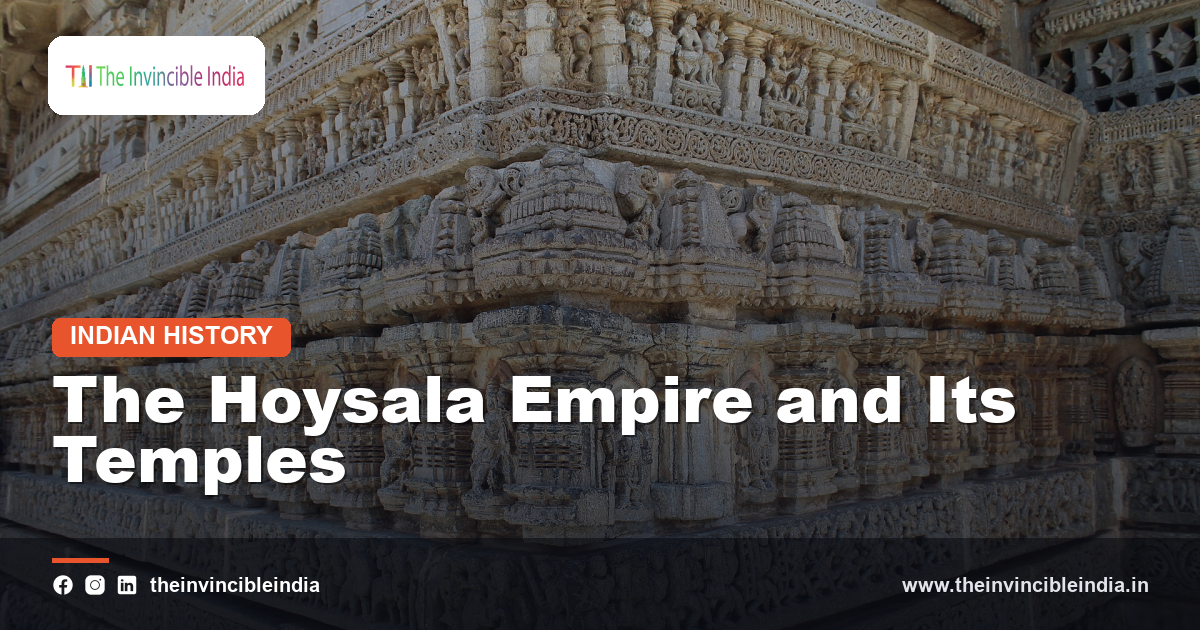
The Hoysala empire rose in the hill country of southern Karnataka and became one of the most artistically brilliant dynasties of medieval India. From their early home in the Western Ghats, the Hoysalas expanded across the southern plateau and built a kingdom that rivalled its neighbours in power and surpassed many in architectural refinement. Their temples at Belur, Halebidu and Somanathapura, carved in fine soapstone and covered with sculpture, are counted among the greatest achievements of Indian art. The dynasty inherited traditions described in our guide to the Chola dynasty and in the Deccan styles that preceded it, yet transformed them into something unmistakably their own.
Quick Facts
| Detail | Information |
|---|---|
| Dynasty | Hoysala, a medieval line of southern Karnataka |
| Heartland | The hill country of the Western Ghats and the southern plateau |
| Capitals | Belur, later Halebidu, then called Dwarasamudra |
| Famed Ruler | Vishnuvardhana, among others of the line |
| Signature Style | Star-shaped soapstone temples on raised platforms |
| Key Monuments | Belur, Halebidu and Somanathapura |
Overview of the Hoysala Empire
The Hoysalas ruled over much of what is now southern Karnataka and parts of neighbouring regions during the medieval period. Beginning as local chieftains in a hilly and forested region, they grew into an imperial power that took advantage of the weakening of larger kingdoms around them. At its height, their realm extended across the southern plateau and reached towards the eastern lowlands.
The dynasty is remembered above all for its patronage of art and architecture. The Hoysala court gathered sculptors, poets and religious teachers, and the result was a cultural flowering that left an extraordinary legacy of temples and literature. This combination of political ambition and artistic excellence defines the dynasty.
The Legend of Sala and the Tiger-Slaying Emblem
The origin of the dynasty is wrapped in a popular legend. It tells of a young man named Sala who, at the command of a Jain teacher, struck down a fierce animal that threatened the teacher. The call to strike, said to have sounded like the words strike, Sala, gave the family its name, and the scene became the royal emblem.
The dynasty’s emblem of a warrior fighting a lion or tiger appears on temples and inscriptions. Historians regard the tale as a legend that explains the name rather than a record of fact, but it reveals how the family wished to be seen, as brave protectors who rose from the forest country through valour.
Rise from Local Chieftains to Rulers
The early Hoysalas served as subordinate rulers under the Western Chalukyas, the later Chalukya line of Kalyani. As Chalukya power declined, the Hoysalas steadily increased their autonomy, gained control of strategic territory and began to issue inscriptions in their own name.
This transition from feudatory to sovereign power followed a pattern common in the medieval Deccan, where capable local rulers could take advantage of imperial weakness. By building alliances, winning battles and strengthening their administration, the Hoysalas established a durable kingdom that would shape the political map of the south.
Vishnuvardhana and the Expansion of the Kingdom
Vishnuvardhana is among the best-known rulers of the dynasty and is credited with major expansion of its territory. Under him the Hoysalas pressed against the neighbouring Chola holdings in the south and consolidated control over a wide area of the plateau. His reign marked the transition of the family from a regional force to a major power.
Tradition also associates him with important religious developments and with a large programme of temple building. Whatever the precise details, his reign laid the political and cultural foundations for the high point of Hoysala art. The ambition and confidence of the age are visible in the monuments that rose during and after his time.
Later Rulers and the Height of Power
Successive Hoysala kings continued to strengthen the kingdom, fighting rival powers such as the Yadavas of Devagiri and the Pandyas of the far south while managing internal affairs. Their reigns saw further building, the growth of towns and the spread of trade, as the dynasty reached the peak of its influence in the later twelfth and thirteenth centuries.
Court life at this time was rich and cosmopolitan, with patronage extended to scholars, artists and religious institutions of several traditions. The stability and wealth of the realm made possible the elaborate temple projects that define the Hoysala era. This period is considered the golden age of the dynasty.
Capitals: Belur and Dwarasamudra
The Hoysalas first established their seat at Belur, a town on the banks of the Yagachi river, and later moved their capital to Dwarasamudra, which is known today as Halebidu. The new capital was laid out with a great artificial lake and was admired as a prosperous and well-planned city, home to palaces, temples and markets.
The name Halebidu, meaning old city or ruined city, reflects the later decline of the place after it was attacked and abandoned. Even so, the remaining temples testify to its former grandeur. The two capitals together form the heart of the Hoysala architectural landscape and remain its most important heritage sites.
The Channakeshava Temple at Belur
The Channakeshava temple at Belur, dedicated to Vishnu, is one of the earliest great monuments of the Hoysala style and remains a functioning place of worship. Its walls are covered in sculpture, and its doorways, pillars and ceilings display a remarkable variety of ornament that rewards long and careful looking.
The temple is famous for its finely carved bracket figures, graceful female sculptures depicted as dancers, huntresses and musicians, which adorn the structure at several points. The pillars inside the hall show a particular richness of design. Belur is a living example of how art, devotion and royal patronage came together in medieval Karnataka.
The Hoysaleswara Temple at Halebidu
The Hoysaleswara temple at Halebidu is a Shaiva monument famed for the sheer abundance of its carving. It consists of twin shrines joined by a common hall, and it stands on a raised platform whose outline follows the shape of the walls. Rows of friezes run along its base, depicting elephants, horsemen, scrolls, mythical beasts and scenes from the great epics.
Above these friezes are images of gods, goddesses and attendants arranged in tiers, each executed with astonishing attention to detail. Although left unfinished in some respects, the temple is regarded as a peak of Hoysala sculpture, and its walls are often described as a stone book of Indian mythology.
The Chennakeshava Temple at Somanathapura
The Chennakeshava temple at Somanathapura, also known as Somnathpur, is one of the best preserved and most complete Hoysala monuments. It stands in the centre of a walled enclosure lined by a cloister of small shrines, and the main temple has three sanctums arranged around a shared hall, each topped by a delicately carved tower.
The star-shaped plan, with its many projecting angles, gives the exterior a lively, sculptural quality, and every surface is carved with deities, scrolls and tiny figures. The harmony of its proportions and the unity of its design make Somanathapura a model of the mature Hoysala style and a favourite among visitors and scholars.
The Star-Shaped Plan and the Raised Platform
The hallmark of Hoysala architecture is the stellate, or star-shaped, ground plan. Instead of simple square walls, the temple outline is a series of projecting and recessed angles that multiply the surfaces available for carving and create shifting patterns of light and shadow across the building.
These temples are raised on a platform, the jagati, which allows worshippers to walk around the shrine in ritual circumambulation and gives the building a graceful pedestal. The combination of star-shaped plan and platform makes a Hoysala temple appear both monumental and intimate, and it is the feature most closely associated with the dynasty in the history of Indian architecture.
Soapstone: The Material and Its Possibilities
Hoysala temples are built largely of soapstone, also called chloritic schist, a fine-grained stone that is soft when freshly quarried and hardens with exposure to the air. This property allowed sculptors to carve extremely delicate details, such as thin jewellery, tiny leaves and lacy ornament, which would have been impossible in harder rock.
The stone takes a smooth polish, and the pillars of some halls have a gleaming, almost metallic finish created on the lathe. Its use shaped the character of the whole style, encouraging an art of surface richness and fine detail. Soapstone is thus central to the visual identity of Hoysala temples.
Sculpture and the Art of the Madanikas
Hoysala sculpture is celebrated for its liveliness, its precision and its sense of movement. Figures of deities are surrounded by elaborate haloes, jewellery and decorative arches, and the carvers delighted in showing anatomical grace, expressive faces and refined gesture.
The madanikas, or celestial maidens, who appear as bracket figures beneath the eaves, are among the most admired images. They are shown in a variety of poses, dancing, playing instruments or adjusting their ornaments. Some sculptors signed their work, which is unusual in medieval India, and tradition remembers a master sculptor named Jakanachari. The sculpture demonstrates the high status of the artist in Hoysala society.
Stories from the Epics on Temple Walls
The walls of Hoysala temples are alive with narrative. Long friezes depict episodes from the Ramayana, the Mahabharata and the Bhagavata Purana, arranged in sequence so that pilgrims could follow the story as they walked around the building. Scenes of battle, hunting, courtly life and divine intervention fill the registers.
These carved narratives served as a kind of visual teaching, bringing sacred texts to a wide audience that might not read Sanskrit. The skill with which crowded scenes are composed shows the narrative imagination of the sculptors. The temple wall thus becomes a text in stone, linking art, literature and faith.
Kannada Literature and Religious Life
The Hoysala age was also a vibrant period for Kannada literature. Court poets composed works in the vernacular language, including Jain and Vaishnava texts, and writers such as Janna, Rudrabhatta and others are remembered with respect. The courts supported Sanskrit learning alongside the growth of the regional language.
Religiously the kingdom was diverse. Jainism, Shaivism and Vaishnavism all received patronage, and the great teacher Ramanuja is traditionally associated with the region during this era. The centre of Jain pilgrimage at Shravanabelagola lay within the Hoysala sphere. This pluralism enriched the cultural life of the empire and its architecture.
Administration, Economy and Society
The Hoysala state was administered through a hierarchy of officials, provincial governors and local assemblies, and inscriptions record grants of land and tax arrangements. Agriculture, supported by irrigation tanks, was the backbone of the economy, while trade in goods, including spices and timber from the hill country, brought wealth to the towns.
Merchant guilds and craft associations were active, and temples served as centres of economic life, employing large numbers of people. The prosperity created by this system provided the resources for monumental building. A stable administration and a lively economy were the practical foundations on which the brilliance of Hoysala art was built.
Decline and Absorption into Vijayanagara
In the early fourteenth century the Hoysala kingdom was shaken by invasions from the north led by the armies of the Delhi Sultanate, which attacked and weakened its capital. The last major ruler, Veera Ballala III, struggled to hold the realm together amid these pressures and the ambitions of neighbouring powers.
Over time the Hoysala territories were absorbed by the rising Vijayanagara state, which inherited much of the region and many of its traditions. The Hoysala political story ended, yet its artistic legacy influenced later architecture across the south.
The Hoysala Empire Today
Today the Hoysala temples are among the most admired monuments of India. The sacred ensembles of Belur, Halebidu and Somanathapura have been recognised internationally as World Heritage, and they draw travellers, artists and researchers from many countries. Conservation work aims to protect the delicate soapstone from weathering and the pressures of tourism.
For the people of Karnataka the temples are a source of pride and a continuing place of worship. They also inspire modern artists and students of architecture. The Hoysala empire endures as a testimony to what patient craftsmanship and inspired patronage can achieve, and its temples remain among the finest creations of medieval India.
Sources & Further Reading
- Archaeological Survey of India (asi.nic.in).
- Ministry of Culture, Government of India (indiaculture.gov.in).
Frequently Asked Questions
Who were the Hoysalas?
The Hoysalas were a medieval dynasty of southern Karnataka who rose from the hill country of the Western Ghats to build a powerful kingdom. They are best known for their intricately carved temples.
Which are the main Hoysala temples?
The principal examples are the Channakeshava temple at Belur, the Hoysaleswara temple at Halebidu and the Chennakeshava temple at Somanathapura. Together they form the core of Hoysala heritage.
What makes Hoysala architecture distinctive?
Its hallmarks are the star-shaped plan, the raised platform and the dense carving executed in fine soapstone. These features create temples of unusual richness and delicacy.
Why is soapstone important to Hoysala art?
Soapstone is soft when quarried and hardens in the air, allowing sculptors to carve extremely fine detail. It also takes a smooth polish, which suited the dynasty’s decorative style.
What happened to the Hoysala kingdom?
It was weakened by invasions from the north in the fourteenth century and was then absorbed by the rising Vijayanagara state. Its artistic traditions continued to influence later southern architecture.


