

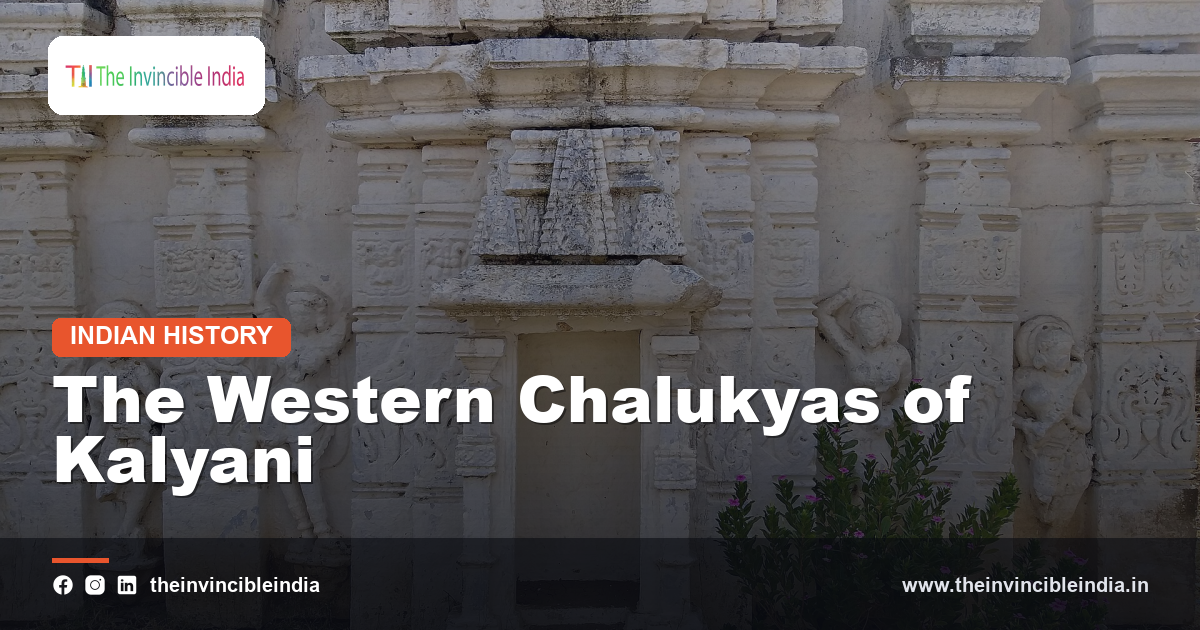
The Western Chalukyas of Kalyani ruled a large part of the Deccan plateau during the later centuries of the early medieval age, and their reign is remembered as a time of confident politics, rich literature and exceptional temple building. Emerging in the wake of the Rashtrakutas, whose story is told in our guide to the Rashtrakuta dynasty, they claimed descent from the earlier Chalukyas of Badami and made Kalyani, in present-day northern Karnataka, their royal centre. Their courts nurtured Kannada poets and Sanskrit scholars, their armies contended for supremacy with the Cholas of the south, and their artisans developed a refined regional architectural idiom that still stands in towns such as Lakkundi, Gadag and Itagi.
Quick Facts
| Detail | Information |
|---|---|
| Dynasty | Western Chalukyas, also called the Later Chalukyas or Kalyani Chalukyas |
| Capital | Kalyani, present-day Basavakalyan in Karnataka |
| Region | The Deccan plateau, centred on northern Karnataka |
| Main Rivals | The Cholas and neighbouring Deccan powers |
| Languages | Kannada and Sanskrit in inscriptions and literature |
| Heritage | Karnata Dravida temples, stepwells and inscriptions |
Overview of the Western Chalukya Empire
The Western Chalukyas were one of the principal dynasties of the Deccan in the centuries between the decline of the Rashtrakutas and the rise of the Yadavas and Hoysalas. Their kingdom stretched across much of the plateau, reaching towards the western coast and the river basins of the south, and its political weight was felt well beyond its borders. The dynasty is commonly called the Chalukyas of Kalyani after its capital, and the word Western distinguishes it from the Eastern Chalukyas who governed the Vengi region.
Taken together, their rule combined energetic statecraft with deep patronage of language, religion and art, which explains why the period is treated as a distinct and formative chapter in the cultural history of Karnataka and the wider Deccan.
Origins and the Revival of Chalukya Rule
The dynasty traced its prestige to the earlier Chalukyas of Badami, whose achievements in the Deccan had left a lasting memory. After Rashtrakuta power weakened, a Chalukya line re-established itself and presented its authority as a revival of that older royal house. Such claims of continuity were common in Indian political culture, where lineage gave legitimacy and linked a new regime to a celebrated past.
Historians generally treat the Kalyani house as a genuine successor in territory and tradition, even if the exact genealogical links were shaped by court memory. The revival gave the Deccan a stable centre of authority again, and it set the stage for a long period of consolidation and cultural activity.
Kalyani as the Royal Capital
Kalyani, known today as Basavakalyan, served as the principal seat of the dynasty and grew into a prominent political and intellectual centre. A royal capital in this age was more than a fortified residence. It drew scholars, poets, merchants, temple builders and administrators, and it became the place where the court displayed its authority through ceremony, patronage and public works.
The city held lasting importance even after the Chalukyas, and it later became closely associated with the religious and social reform movement of the twelfth century. As a capital that outlived its first dynasty in memory and meaning, Kalyani remains a significant name in the historical geography of Karnataka.
Rivalry with the Cholas and Deccan Politics
Much of the political story of the Western Chalukyas is bound up with their long contest against the Cholas of the Tamil country. The two powers competed for influence over the fertile and strategically placed lands lying between them, especially the Vengi region, where dynastic marriages and shifting loyalties kept the rivalry alive across generations.
These conflicts were not a single war but a series of campaigns, raids and diplomatic manoeuvres, in which success passed from one side to the other. The contest shaped alliances with smaller chieftains, encouraged military reform, and gave the Deccan a reputation as a theatre of ambitious and resilient kingdoms. It also shows how closely linked the political histories of the Deccan and the far south had become.
Vikramaditya VI and the Height of the Dynasty
Among the Western Chalukya rulers, Vikramaditya VI is remembered as the figure under whom the dynasty reached its cultural and political high point. His long reign is celebrated in literature as a time of order and prosperity, and he is associated with the founding of a new era reckoned from his accession, which was used in the records of his court.
Poets and scholars from different regions gathered around him, and he is portrayed in contemporary writing as a generous patron and a capable commander. While court literature naturally praises its royal subject, the breadth of learning that flourished under his rule confirms that his reign was a high-water mark for the dynasty and for the culture of Kalyani.
Administration and Society
The Western Chalukya state rested on a network of provinces, districts and villages overseen by officials, hereditary chiefs and feudatory rulers who acknowledged the king in return for local authority. Inscriptions record grants of land, remissions of taxes and the settlement of disputes, giving a picture of a government that worked through charters and local assemblies as much as through royal command.
Village bodies, merchant guilds and temple committees played an important role in everyday life, managing resources and supporting religious and educational institutions. This layered system allowed a large kingdom to function across varied landscapes, and it explains how royal policy and local custom stayed in balance throughout the period.
Economy, Agriculture and Trade
The economy of the Deccan under the Chalukyas drew on agriculture, craft production and trade. The black soils and river valleys supported farming, while artisans produced textiles, metalwork, stone carvings and other goods that circulated through regional markets. Guilds of merchants travelled between towns and ports, linking the interior plateau with the coast and with wider networks of exchange.
Temples were economic institutions as well as religious ones, receiving endowments of land and employing priests, musicians, craftsmen and labourers. Tanks, wells and stepped reservoirs supported both farming and urban life. The prosperity that resulted funded the elaborate building programmes that define the dynasty in the modern imagination.
Law, Learning and the Mitakshara
The court of Kalyani was known for its engagement with Sanskrit scholarship, including the study of law. A celebrated commentary on the ancient legal text of Yajnavalkya, known as the Mitakshara, was composed by the scholar Vijnaneshvara under royal patronage, and it became one of the most influential works on Hindu law in later centuries.
The Kashmiri poet Bilhana also found a home at the court and wrote a Sanskrit biographical poem celebrating Vikramaditya VI. The presence of scholars from distant regions shows that Kalyani was an intellectual crossroads, and the lasting influence of these works demonstrates that Chalukya patronage shaped Indian learning well beyond the Deccan.
Kannada Literature and Language
The period is a landmark in the growth of Kannada as a literary language. Poets of the age wrote narrative and devotional works that drew on epic themes and on Jain and Shaiva traditions, and they developed a polished style that later writers admired. Ranna, whose works include a retelling of the great combat of the Mahabharata, is among the most celebrated names associated with the Chalukya court.
Inscriptions in Kannada, often composed in elegant verse, appear alongside Sanskrit ones and reveal the confidence of the language in public life. The flowering of Kannada letters under the Western Chalukyas gave the region a literary identity that continued to develop in later centuries.
Religion and Pluralism
The Western Chalukya age was religiously varied. Shaivism enjoyed wide royal and popular support, and magnificent Shiva temples rose in many towns. Vaishnava shrines, Jain basadis and Buddhist traditions also received patronage, and kings, queens, officials and merchants endowed institutions of different faiths.
This plurality shaped the cultural landscape of the Deccan, where temples of several traditions stood in the same towns and often used similar artistic vocabularies. It also set the context for the devotional and reformist currents that emerged in the twelfth century. The coexistence of many faiths under the dynasty remains one of the distinctive features of its cultural record.
The Karnata Dravida Architectural Style
Western Chalukya architects developed a recognisable regional idiom, often called Karnata Dravida or the Later Chalukya style. It draws on the southern tradition of tiered pyramidal towers above the sanctum, yet it introduces its own refinements in proportion, ornament and surface treatment. Temples of the period typically feature a sanctum, a vestibule and a pillared hall with a carefully layered exterior.
The walls are divided by pilasters and miniature shrines, and the towers display a clear sense of rhythm and repetition. This language of form later fed into the work of the Hoysala builders, so the Western Chalukya style is understood as an important link in the evolution of Deccan temple architecture.
Lakkundi and Its Temples and Stepwells
The town of Lakkundi, near Gadag, is one of the finest showcases of Western Chalukya art. It holds a cluster of temples, including the well-known Kasivisvesvara temple, as well as Jain shrines and elaborately built stepped wells. The carving here is crisp and detailed, with doorways, ceilings and wall surfaces covered in intricate decoration.
Lakkundi also preserves many inscriptions, and the town has long been admired for the harmony of its stonework. Together, the monuments of Lakkundi show how religious architecture and civic engineering were treated with equal care, and they remain a rewarding destination for anyone studying the Deccan.
Gadag, Itagi and Dambal
Other towns in the Gadag region add to the dynasty’s architectural record. Gadag contains a group of temples that display the style in a lively urban setting, and Itagi is celebrated for the Mahadeva temple, which scholars and travellers have often praised for the quality of its carving and the elegance of its plan.
Dambal, with its distinctive star-shaped plan temple and its pillared halls, shows the range of experimentation that took place during the period. Each of these sites reflects the same high standard of workmanship, and together they form a regional heritage landscape that preserves the creative energy of the Chalukya masters.
Sculpture, Pillars and Craftsmanship
Craftsmanship was central to the Western Chalukya achievement. Sculptors worked with fine-grained stone to produce figures of deities, celestial beings, dancers and musicians, and they decorated ceilings with lotus motifs and layered patterns. Pillars were often given a polished, rounded finish that created a striking sense of depth and shine within the halls.
Doorframes were carved with multiple bands of ornament, and the guardian figures and flowing creepers show a mastery of both form and detail. The quality of the work suggests well-organised workshops and long traditions of training. The sculpture of the period stands as one of the finest expressions of medieval Indian craftsmanship.
The Kalachuris, Basavanna and a Changing Age
In the later decades of the dynasty, the political order of the Deccan became unsettled. Feudatories gained strength, and the Kalachuri family took control of Kalyani for a time. This was also the age of Basavanna, the statesman and saint whose teachings inspired the Lingayat movement and encouraged ideas of equality, devotion and the dignity of labour.
The vachana poems associated with this reform movement became a treasured part of Kannada literature. The events of this transition show that Kalyani remained at the heart of important historical change even as the Chalukya line lost its former dominance, and they link the city to a movement that still shapes the culture of the region.
Decline and Successors
The Western Chalukya kingdom gradually lost cohesion as powerful feudatories asserted independence and rival dynasties expanded. The Yadavas of Devagiri and the Hoysalas of the south emerged as the principal inheritors of Chalukya territory, and they drew on the administrative and artistic traditions the Chalukyas had developed.
The Hoysala temple builders in particular carried forward and transformed the architectural vocabulary of the earlier age, as seen in the Hoysala temples of the Karnataka heartland. In this sense the dynasty did not simply end but passed on a living inheritance, and its influence can be traced in the later history of the Deccan.
The Western Chalukyas Today
Today the Western Chalukyas are remembered through their monuments, inscriptions and literary works. The temples of Lakkundi, Gadag, Itagi and Dambal draw scholars, photographers and pilgrims, and conservation programmes work to protect the stonework from weather and neglect. Museums and regional institutions interpret the period for visitors, and Karnataka celebrates the dynasty as a defining chapter of its past.
The Kannada poetry, Sanskrit learning and legal scholarship of the age continue to be studied, and the town of Kalyani carries its historical weight into the present. The legacy of the Western Chalukyas endures as a model of how political strength, artistic excellence and intellectual curiosity can flourish together.
Sources & Further Reading
- Archaeological Survey of India (asi.nic.in).
- Ministry of Culture, Government of India (indiaculture.gov.in).
Frequently Asked Questions
Who were the Western Chalukyas of Kalyani?
The Western Chalukyas were a Deccan dynasty that rose after the decline of the Rashtrakutas and ruled from Kalyani in northern Karnataka. They are also called the Later Chalukyas and are remembered for their politics, literature and temples.
Why are they called Western Chalukyas?
The term distinguishes them from the Eastern Chalukyas of Vengi, a related line that ruled in the east of the peninsula. The word Kalyani refers to their capital city.
What is the Karnata Dravida style?
It is the regional temple style of the Later Chalukyas, combining the southern pyramidal tower with refined proportions and detailed surface carving. It later influenced Hoysala architecture.
Which monuments best represent the dynasty?
The temples and stepwells of Lakkundi, the Mahadeva temple at Itagi and the shrines of Gadag and Dambal are among the best-known examples. Each shows the careful craftsmanship of the period.
What was their contribution to learning?
Their courts supported Kannada poets and Sanskrit scholars, including the author of the Mitakshara legal commentary. This made Kalyani an important intellectual centre of its time.


