

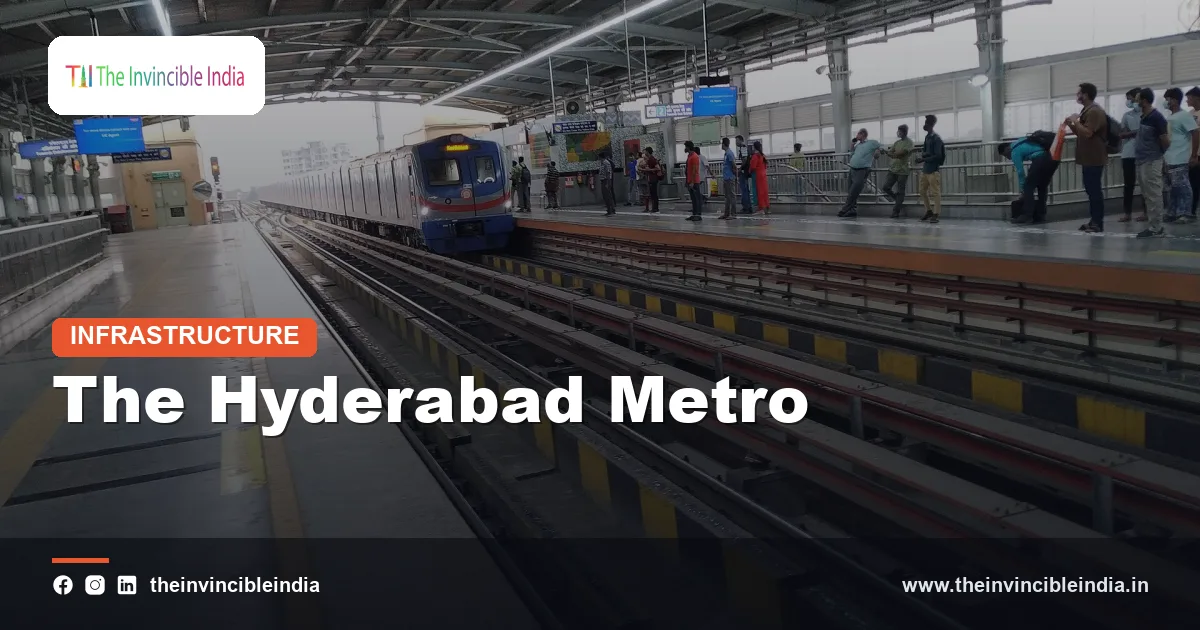
The Hyderabad Metro is the elevated rapid-transit rail network of Hyderabad, Telangana, built and operated by L&T Metro Rail (Hyderabad) Limited under a public-private partnership (PPP) with the state government, and it is widely described as one of the largest metro projects in the world to be developed on that model. It opened to passengers on 29 November 2017 and now runs on three corridors that link the old city, the commercial centre and the Hitec City technology belt.
The Hyderabad Metro was conceived to ease the road traffic of a fast-growing metropolis, and it is almost entirely elevated, which kept it clear of the dense heritage areas of the old city. This explainer sets out how the system was financed and built, which lines it has, how many people use it, how it links with the Hitec City IT corridor, and how it is planned to expand, with 17 October 2026 as the reference date.
| Attribute | Detail |
|---|---|
| System name | Hyderabad Metro Rail (HMR), commonly called the Hyderabad Metro |
| Operator | L&T Metro Rail (Hyderabad) Limited, a subsidiary of Larsen & Toubro |
| Government agency | Hyderabad Metro Rail Limited (HMRL), the state’s project company |
| Model | Public-private partnership on a design, build, finance, operate and transfer (DBFOT) basis |
| First commercial service | 29 November 2017, from Miyapur to Nagole |
| Network size | Roughly 69 km with about 57 stations on three corridors |
| Type | Almost entirely elevated metro, standard gauge, 25 kV AC overhead power |
| Corridors | Red Line, Blue Line and Green Line |
| City and state | Hyderabad, Telangana |
Key Takeaways
- The Hyderabad Metro is a public-private partnership metro operated by L&T Metro Rail (Hyderabad) Limited, with a concession period of several decades.
- The Hyderabad Metro opened for passengers on 29 November 2017 and has three corridors named the Red, Blue and Green lines.
- The Hyderabad Metro network is about 69 km long with roughly 57 stations, and it is almost entirely elevated.
- The Blue Line of the Hyderabad Metro serves Hitec City, the major IT and services district of the city.
- The Hyderabad Metro is a standard-gauge system that uses 25 kV AC overhead electric supply and air-conditioned trains.
- Expansion of the Hyderabad Metro, known as Phase 2, proposes additional corridors, including links towards the airport and the outer parts of the city.
What is the Hyderabad Metro?
The Hyderabad Metro is an urban metro railway that serves the Hyderabad metropolitan region of Telangana, running on three elevated corridors which together span roughly 69 km. It is the main mass rapid transit system of the city, alongside the older Multi-Modal Transport System (MMTS) suburban trains and the large bus network run by the state road transport corporation.
Hyderabad is one of the largest cities of southern India and a major centre of information technology, pharmaceuticals and biotechnology. The population of the metropolitan area was already above seven million at the time of the 2011 census, and it has kept growing. Roads such as the Hitec City stretch and the Secunderabad axis became heavily congested, and this made a metro a high priority.
The system is sometimes called HMR. Its trains are three-coach sets, now with the possibility of extension, and its stations are linked with the surrounding streets through skywalks and foot-overbridges in many places.
Who runs the Hyderabad Metro?
L&T Metro Rail (Hyderabad) Limited, a subsidiary of the engineering group Larsen & Toubro (L&T), runs the Hyderabad Metro under a concession agreement signed with the state government in the early 2010s. The company designed, built and financed the system and has the right to operate it and earn revenue for a long concession period, after which the system would pass to the government.
On the government side, Hyderabad Metro Rail Limited (HMRL) is the special-purpose company that coordinates the project, manages land and monitors the concessionaire. The arrangement was set up while Hyderabad was still the capital of undivided Andhra Pradesh, and it continued after Telangana was formed in 2014.
In recent years there has been public discussion about the state government taking a larger role in the operation of the system, including a possible transfer of the concessionaire’s stake. Readers should consult official announcements for the present arrangements.
How was the Hyderabad Metro financed and built?
The Hyderabad Metro was built on a DBFOT public-private partnership model in which the private concessionaire raised most of the project cost, with a financial support grant (viability gap funding) provided by the government. The project was a rare example of a large metro financed largely by private capital in India.
The concessionaire earns revenue from fares and from commercial activities, including the lease of land and space at stations, advertising and retail. Because ridership alone did not meet early projections, the concessionaire has emphasised real estate and transit-oriented development as additional income sources.
The project cost was reported in the range of several tens of thousands of crore rupees when all phases are counted, although estimates vary with the date and the inclusion of financing costs. Construction faced challenges including land acquisition and alignment disputes, and the alignment was adjusted in the old city to protect historical structures. The pre-opening phase also involved a long delay compared to the first schedule.
What are the lines of the Hyderabad Metro?
The Hyderabad Metro has three lines: the Red Line from Miyapur to LB Nagar, the Blue Line from Nagole to Raidurg, and the Green Line from Jubilee Bus Station (JBS) to MG Bus Station (MGBS). The three lines cross at interchange stations, with Ameerpet, Parade Ground and MG Bus Station among the main points of transfer.
| Line | Route | Character |
|---|---|---|
| Red Line (Corridor 1) | Miyapur to LB Nagar | East-west spine through Ameerpet and the central areas |
| Blue Line (Corridor 3) | Nagole to Raidurg | Links the eastern suburbs to the Hitec City IT belt |
| Green Line (Corridor 2) | JBS Parade Ground to MG Bus Station | North-south line through Secunderabad and the older city |
The first section opened in November 2017 from Miyapur to Nagole by a staged opening. Later sections were added in 2018 and 2019, and the Green Line followed in early 2020. The stretches have since remained as the core of the network.
How does the Hyderabad Metro serve Hitec City?
The Hyderabad Metro serves Hitec City through the Blue Line, which runs from Nagole through Ameerpet and Jubilee Hills to Raidurg, with stations at Madhapur, Hitec City, Durgam Cheruvu and Raidurg. This is the corridor that connects the main residential suburbs to the IT and business district, where a large number of software companies, global capability centres and startups are located.
Before the metro, workers travelled to Hitec City mostly by private vehicles, cabs and buses, and the stretch became known for traffic jams at peak hours. The Blue Line offered an alternative that is not affected by road conditions, and it was an important part of the policy to link jobs with transit.
The Raidurg terminal is also considered the starting point of the proposed airport link, since an express line from Raidurg to the Rajiv Gandhi International Airport at Shamshabad has been proposed to give the IT district a direct rail connection to the airport.
How many people ride the Hyderabad Metro?
The Hyderabad Metro carries several lakh passengers on an average working day, with reports in recent years of about four to five lakh daily trips and higher peaks on special occasions. Ridership has recovered from a drop during the COVID-19 pandemic in 2020 and 2021 and has been growing since.
Peak-hour crowding is common on the Blue Line and on the Red Line around Ameerpet, the busiest interchange. Exact figures change over time and depend on fare policy, and daily numbers are published by the operator and in news reports.
The system offers women-first coaches in some services, accessible features for persons with disabilities, and a smart card. Transgender persons have also been recruited by the operator for some roles in station operations.
How does the Hyderabad Metro work technically?
The Hyderabad Metro runs on a standard-gauge track with electric multiple unit trains, powered by a 25 kV AC overhead catenary supply, which is a different choice from the third rail used by some other Indian metros. Trains have three coaches, are air-conditioned and are designed for high platform loading.
Signalling is based on communication-based train control (CBTC), a moving-block system that allows closely spaced trains. The viaduct is built with precast segments, and stations are designed to be integrated with their surroundings, with entry from both sides in many cases.
Depot facilities are located at Miyapur, Uppal and Falaknuma, where trains are stabled and maintained. Automatic fare collection gates support smart cards, QR tickets and mobile applications.
What is the Phase 2 expansion of the Hyderabad Metro?
Phase 2 of the Hyderabad Metro is a proposed expansion that would add dozens of kilometres of new corridors to the existing network, extending lines towards the airport, the outer suburbs and the southern and eastern parts of the city. The scheme has been discussed for several years and has been reshaped by changes in government and in the funding model.
Proposed elements have included the extension of the Blue Line towards the airport, a link to the southern areas near the old city, and extensions in the north and east. The old city stretch from MGBS towards Falaknuma, which was part of the original plan, is one of the elements that have been taken up in the expansion planning.
Many of these proposals depend on approval from both the state and Union governments and on the financing structure, so the timelines are uncertain. Interested readers should consult the HMRL announcements for the latest information.
Expansion ideas under discussion
- An express link from Raidurg to the Rajiv Gandhi International Airport.
- Extension of the Red Line beyond its current termini.
- Connection of the old city to the core network with an alignment that protects heritage buildings.
- Linking of the metro with the regional ring road area for long-term growth.
Why is the Hyderabad Metro considered distinctive?
The Hyderabad Metro is considered distinctive because it was developed through a PPP structure at a scale unusual for metros in India, which mostly rely on public funding. Its design also pays attention to the visual and historical character of the city.
The alignment avoided major heritage buildings such as the Assembly building and parts of the old city, and the elevated construction was chosen partly to reduce disruption. Stations are generally large, and many have retail and commercial areas, reflecting the idea that rail operations and property development should work together.
Observers also note the combination of heavy IT-sector commuting, the integration with the MMTS rail network and the aspiration for a seamless card across transport modes as features of the Hyderabad context.
What are the challenges facing the Hyderabad Metro?
The main challenges of the Hyderabad Metro are financial sustainability, last-mile access to stations and the cost of expansion. The system has seen losses in some years, especially during the pandemic, and the concessionaire has asked for support from the government at various times.
Access to stations in a sprawling city, safe pedestrian paths and integration with buses are also considered important. Phase 2 will test whether the network can be extended with public funding, with PPP, or with a mix of both. A well-designed metro depends on being close to where people live and work, and on offering fares and services that are competitive with private transport.
Bottom Line
The Hyderabad Metro is a large elevated network built through a private-sector concession and serving the Hitec City belt, the central areas and the old city fringe. Its future will depend on ridership growth, financing arrangements and the delivery of Phase 2.
Frequently Asked Questions
When did the Hyderabad Metro start?
The Hyderabad Metro started passenger service on 29 November 2017, with the first stretch running from Miyapur to Nagole. Other sections and the Green Line were opened over the following two years.
Who operates the Hyderabad Metro?
The Hyderabad Metro is operated by L&T Metro Rail (Hyderabad) Limited, a subsidiary of Larsen & Toubro. The state’s project company, Hyderabad Metro Rail Limited (HMRL), oversees the concession.
How many lines does the Hyderabad Metro have?
The Hyderabad Metro has three lines, called the Red Line, the Blue Line and the Green Line. Together they cover roughly 69 km and about 57 stations.
Does the Hyderabad Metro go to Hitec City?
Yes, the Hyderabad Metro serves Hitec City through the Blue Line between Nagole and Raidurg. Stations on this line include Madhapur, Hitec City and Raidurg.
Why is the Hyderabad Metro called a PPP project?
The Hyderabad Metro is called a PPP project because a private company, L&T, was given a long-term concession to design, build, finance and operate it. The government provided land and a viability gap grant but did not fund the main construction.
Will the Hyderabad Metro be extended to the airport?
An extension of the Hyderabad Metro to the Rajiv Gandhi International Airport has been proposed, often as an express line from Raidurg. Its timeline depends on government approvals and funding, so current status should be checked with HMRL.
{“@context”:”https://schema.org”,”@graph”:[{“@type”:”FAQPage”,”mainEntity”:[{“@type”:”Question”,”name”:”When did the Hyderabad Metro start?”,”acceptedAnswer”:{“@type”:”Answer”,”text”:”The Hyderabad Metro started passenger service on 29 November 2017, with the first stretch running from Miyapur to Nagole. Other sections and the Green Line were opened over the following two years.”}},{“@type”:”Question”,”name”:”Who operates the Hyderabad Metro?”,”acceptedAnswer”:{“@type”:”Answer”,”text”:”The Hyderabad Metro is operated by L&T Metro Rail (Hyderabad) Limited, a subsidiary of Larsen & Toubro. The state’s project company, Hyderabad Metro Rail Limited (HMRL), oversees the concession.”}},{“@type”:”Question”,”name”:”How many lines does the Hyderabad Metro have?”,”acceptedAnswer”:{“@type”:”Answer”,”text”:”The Hyderabad Metro has three lines, called the Red Line, the Blue Line and the Green Line. Together they cover roughly 69 km and about 57 stations.”}},{“@type”:”Question”,”name”:”Does the Hyderabad Metro go to Hitec City?”,”acceptedAnswer”:{“@type”:”Answer”,”text”:”Yes, the Hyderabad Metro serves Hitec City through the Blue Line between Nagole and Raidurg. Stations on this line include Madhapur, Hitec City and Raidurg.”}},{“@type”:”Question”,”name”:”Why is the Hyderabad Metro called a PPP project?”,”acceptedAnswer”:{“@type”:”Answer”,”text”:”The Hyderabad Metro is called a PPP project because a private company, L&T, was given a long-term concession to design, build, finance and operate it. The government provided land and a viability gap grant but did not fund the main construction.”}},{“@type”:”Question”,”name”:”Will the Hyderabad Metro be extended to the airport?”,”acceptedAnswer”:{“@type”:”Answer”,”text”:”An extension of the Hyderabad Metro to the Rajiv Gandhi International Airport has been proposed, often as an express line from Raidurg. Its timeline depends on government approvals and funding, so current status should be checked with HMRL.”}}]}]}


