

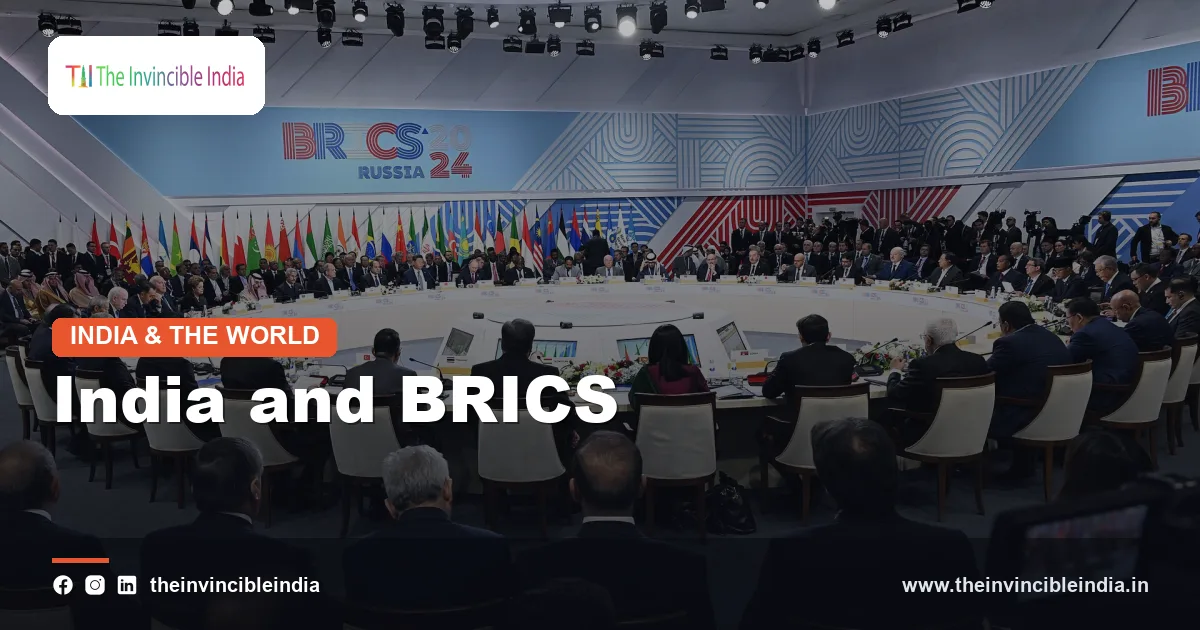
BRICS is one of the most talked-about groupings in world affairs today: a club of major emerging economies that presents itself as a voice for the Global South and a champion of a more multipolar world order. India is a founding member, and the grouping has become one of the more visible platforms through which New Delhi speaks on global governance, development finance and the concerns of developing nations.
What began as a catchy label invented by a banker has grown into an annual summit process, a development bank, a financial safety net and, since 2024, a much larger membership. This overview explains where BRICS came from, what it does, how India fits in, and where the grouping faces real tensions. Facts are dated wherever they can change; last reviewed on 30 September 2026.
| Item | Details |
|---|---|
| Full form | Brazil, Russia, India, China and South Africa (original five members) |
| Origin of the term | “BRIC” coined in 2001 by economist Jim O’Neill of Goldman Sachs |
| First leaders’ summit | 2009, Yekaterinburg, Russia (as BRIC) |
| South Africa joins | 2010, making the group “BRICS” |
| Major expansion | From 1 January 2024, with new members admitted (BRICS+) |
| Institutions | New Development Bank (agreed 2014, operational 2015) and Contingent Reserve Arrangement |
| NDB headquarters | Shanghai, China |
| India’s status | Founding member; has hosted the summit several times |
What Is BRICS?
BRICS is an informal grouping of large emerging economies. It has no founding treaty, no permanent secretariat and no binding rules, unlike the United Nations or the European Union. Decisions are taken by consensus, and the chair rotates among members each year, with the chair country hosting the annual leaders’ summit and a calendar of ministerial and expert meetings throughout the year.
Its member countries share a few broad characteristics: large populations, sizeable and fast-growing economies by the standards of the 2000s, and a shared belief that international institutions built after the Second World War do not fully reflect today’s economic weight. Together the original five accounted for roughly two-fifths of the world’s population and a substantial and rising share of global output. After expansion, the membership covers an even larger portion of humanity, though exact shares depend on the year and the measure used.
- Nature: a consultative forum and cooperation platform, not a military alliance or a trade bloc.
- Decision-making: consensus, with a rotating annual chair.
- Self-image: a voice for the Global South and for reform of global governance.
The Origin of the Term “BRIC”
The word did not come from diplomats. In 2001, Jim O’Neill, then an economist at the investment bank Goldman Sachs, published a paper that grouped Brazil, Russia, India and China under the acronym BRIC. His argument was that these four large economies would carry growing weight in the world economy over the coming decades and that global economic management should take note of them.
It was an investment and forecasting idea, not a political plan. Yet the label stuck, and the countries it described noticed. Their leaders and foreign ministers began to see value in turning a market shorthand into a diplomatic circle. It is a rare case of a financial-market acronym becoming a real international grouping.
Why the idea resonated
- The 2000s saw rapid growth in China and India and a commodity boom that helped Brazil and Russia.
- Developing economies felt underrepresented in bodies such as the International Monetary Fund and the World Bank.
- The global financial crisis of 2008 strengthened the case for a wider set of voices at the top table of economic decision-making.
From BRIC to BRICS: Building the Grouping
The political grouping took shape in stages. Foreign ministers of the four countries met on the sidelines of the United Nations General Assembly in 2006, and the first formal BRIC leaders’ summit was held in Yekaterinburg, Russia, in 2009. The timing was significant: the world was in the grip of the financial crisis, and the leaders called for a more diversified international monetary system and a greater say for emerging economies.
In 2010 South Africa was invited to join, and it took part in the 2011 summit in Sanya, China, as a full member. The addition of the “S” turned BRIC into BRICS and brought an African voice into the group. South Africa’s economy was much smaller than the others, but its inclusion reflected the desire to represent a continent as well as large national economies.
Key milestones
| Year | Milestone |
|---|---|
| 2001 | Jim O’Neill coins the term “BRIC” |
| 2006 | First ministerial-level BRIC meeting at the UN General Assembly |
| 2009 | First BRIC leaders’ summit, Yekaterinburg |
| 2010 | South Africa joins, forming BRICS |
| 2014 | Fortaleza summit agrees to set up the New Development Bank and the Contingent Reserve Arrangement |
| 2023 | Johannesburg summit agrees to a major expansion |
| 2024 | New members join from 1 January; Kazan summit introduces a “partner country” category |
The 2024 Expansion and “BRICS+”
At the Johannesburg summit in August 2023, the members agreed to invite six countries to join. From 1 January 2024, Egypt, Ethiopia, Iran and the United Arab Emirates took up membership. Saudi Arabia was also invited, and its participation has been described in different ways in official and media accounts, so it is best treated as an invitee whose status has been ambiguous. Argentina, also invited, declined after a change of government. Indonesia was later admitted as a member in early 2025.
The term “BRICS+” is used for this enlarged format and for outreach sessions that bring in non-member countries. At the 2024 Kazan summit in Russia, the group also created a “partner country” category for states that wish to work with BRICS without full membership, and a number of countries have been named partners since then. Membership lists have moved quickly in recent years, so readers should check the latest official announcements for the current line-up.
Why expand?
- Supporters see enlargement as proof of the grouping’s appeal to the Global South and a way to add weight in energy, trade and geography.
- Critics point out that adding members with diverse political systems and rivalries can make consensus harder.
- India has generally supported expansion while stressing that the grouping should work by consensus and should not turn into an anti-West bloc.
What BRICS Stands For
Three ideas run through BRICS declarations: reform of global governance, a more multipolar world, and practical economic cooperation.
Reform of global institutions
Members repeatedly call for a larger voice for developing countries in the IMF and the World Bank, whose voting shares broadly reflect the economic balance of the mid-twentieth century and later, limited adjustments. They also support reform of the United Nations, including the Security Council, so that it better reflects present-day realities. India, Brazil and South Africa have long sought permanent Security Council representation, while China and Russia already hold permanent seats, which shapes how such language is worded in joint statements.
Multipolarity
A multipolar order means many centres of influence rather than one dominant power or bloc. BRICS presents itself as one of several platforms that make this possible. Different members read the idea differently: for some it is a counterweight to Western dominance, while for India it is chiefly about giving developing countries more choices and leverage without joining any single camp.
Cooperation on development
The third strand is practical work on trade, finance, health, technology, agriculture and disaster resilience, carried out through working groups, business councils and academic forums.
Institutions: The New Development Bank and the CRA
The most concrete achievements of BRICS are the financial institutions agreed at the 2014 summit in Fortaleza, Brazil.
The New Development Bank (NDB)
The New Development Bank, often called the “BRICS Bank”, was established in 2014 and began operations in 2015. Its headquarters are in Shanghai, China. It finances infrastructure and sustainable development projects in BRICS countries and other emerging economies, including transport, clean energy, water and urban projects. The bank has admitted additional members beyond the founding five, and further countries have been in the process of joining. India has been a shareholder from the start and has been among the bank’s borrowers.
By tradition, the bank’s presidency rotates among the founding members, and India provided the first president, K. V. Kamath. The bank was designed with equal initial shareholding for the founders, in contrast to the weighted voting of the older Bretton Woods institutions.
The Contingent Reserve Arrangement (CRA)
The CRA is a framework to help members cope with short-term balance-of-payments pressures. It was set up with an initial commitment of 100 billion US dollars, made up of pledged resources rather than a cash pool sitting in an account. It is meant to work as a financial safety net alongside, not in place of, the IMF. In practice it has seen little use, and much of its value has been as a symbol of cooperation.
Areas of Cooperation
Beyond finance, BRICS runs a wide agenda, often described under three broad pillars: politics and security, economy and finance, and cultural and people-to-people exchanges.
- Trade and investment: business councils, trade promotion and efforts to reduce barriers between members.
- Energy: dialogues on energy security, given that the group includes both major producers and major consumers.
- Technology and innovation: cooperation on the digital economy, science and research networks, including recent work on the governance of artificial intelligence.
- Health: collaboration on vaccine research, traditional medicine and public health preparedness.
- Agriculture and food security: sharing of research and best practices.
- Counter-terrorism and security: a working group and periodic statements condemning terrorism.
- People-to-people ties: youth forums, sports, film and academic exchanges.
Progress is uneven. Some tracks produce regular practical outputs, while others mostly generate declarations.
Local Currencies and the De-dollarisation Debate
One of the most discussed themes around BRICS is whether member countries can reduce their reliance on the US dollar in trade and finance. This is often called de-dollarisation. It is worth being precise about what has and has not happened.
- What has happened: several members have increased the settlement of bilateral trade in local currencies, and BRICS leaders’ statements have encouraged the use of national currencies and improved cross-border payment systems.
- What has not happened: there is no agreed BRICS common currency. Official positions of several members, including India, have been that the aim is smoother local-currency settlement, not replacing the dollar.
- Why the debate exists: sanctions on some members, exchange-rate volatility and the cost of dollar funding have led many developing economies to look for alternatives.
India has described its approach as expanding options for trade settlement, including its own payment systems and rupee-based arrangements with partners, while stressing that it has no plan to undermine the dollar. Analysts continue to debate how far and how fast the global payments landscape will change, and the dollar remains dominant in global reserves and trade invoicing.
India’s Role and Interests in BRICS
India is a founding member and has been one of the grouping’s most active participants. It hosted the BRICS summit in New Delhi in 2012 and in Goa in 2016, chaired the group in 2021 with a virtual summit, and has taken on the rotating chair again in 2026. Because chair arrangements and dates are announced year by year, readers should check the official BRICS calendar for the latest schedule.
What India seeks
- A stronger Global South voice: India promotes development priorities such as climate finance, debt relief, food and energy security and access to technology.
- Institutional reform: a bigger say in the IMF, the World Bank and the UN Security Council.
- Strategic autonomy: the ability to decide its own foreign policy positions and work with many partners at once.
- Development finance: access to the NDB for infrastructure and sustainable development projects.
- Counter-terrorism language: consensus statements condemning terrorism in all forms.
Balancing act
India is also part of the Quad, has strong economic and security ties with the United States, Europe, Japan and Australia, and maintains a long-standing relationship with Russia. India’s stated approach, often described as multi-alignment, is to engage with all of them. In BRICS this shows up as support for reform and cooperation, coupled with resistance to language or institutions seen as directed against any particular country or group of countries.
Challenges and Contradictions Within BRICS
For all its visibility, BRICS faces serious questions about cohesion.
- India-China rivalry: the two largest members have an unresolved boundary dispute and a competitive relationship in Asia and beyond. Tensions after the 2020 Galwan clash strained ties, and even when relations have partly stabilised, trust remains a factor in how far India will go in cooperation inside the group.
- Diverse political systems: members include democracies, one-party states and monarchies, with very different values and priorities.
- Differing interests: some members are major energy exporters, others large importers; some are under sanctions, others are deeply integrated with Western markets.
- Unequal weight: China’s economy is much larger than any other member’s, prompting concerns about dominance in a nominally equal forum.
- Enlargement versus depth: more members can dilute consensus and slow decision-making.
- Is it anti-West? Some commentators see BRICS as a counterweight to Western-led institutions. Several members, India and Brazil in particular, say it is not against anyone and is about reform and inclusion. The question shapes debate over the language of each summit declaration.
These tensions do not necessarily mean the grouping will fade. Many international forums work despite internal disagreements, and BRICS declarations tend to reflect the lowest common denominator on which all members can agree.
BRICS Compared with Other Groupings India Belongs To
India takes part in several forums, each with a different purpose. Comparing them shows why India sees value in BRICS without treating it as its only platform.
| Grouping | Nature | Key features |
|---|---|---|
| BRICS | Emerging-economy and Global South platform | Informal, consensus-based; New Development Bank and CRA; expanded from 2024 |
| G20 | Forum of major economies | Leaders’ summits since 2008; India hosted in 2023 in New Delhi, when the African Union was admitted as a member |
| Quad | Indo-Pacific strategic dialogue | India, the United States, Japan and Australia; focus on maritime security, technology, health and infrastructure |
| SCO | Eurasian political, security and economic organisation | Founded in 2001; India became a full member in 2017; focus on regional security and connectivity |
The G20 brings together established and emerging powers, the Quad is a security-oriented partnership among democracies, and the SCO is a Eurasian body with a strong security agenda. BRICS sits between them: it has a broader development and governance agenda than the Quad and a more selective, emerging-economy focus than the G20. India’s membership across all four is often cited as an example of its multi-alignment.
Looking Ahead
The future of BRICS depends on several open questions. Can an enlarged membership keep a coherent agenda? Will the NDB and payment initiatives grow into serious alternatives to existing institutions, or remain complementary? And can members with rival interests keep working together on shared goals?
For India, the answer is likely to be pragmatic. It will continue to use the platform to push for reform, financing and Global South priorities while keeping its other partnerships intact. How BRICS evolves will matter not only for its members but also for the wider debate on how the world’s institutions adapt to a changing balance of economic power.
Conclusion
From a 2001 investment-bank acronym to a multi-continent grouping with its own bank, BRICS has travelled a long way. For India it is a useful stage: a forum to advocate for developing nations, a source of development finance and a channel of dialogue with major powers, all consistent with a policy of strategic autonomy. At the same time, the group’s diversity, the India-China relationship and the debate about its orientation mean its direction will keep being negotiated rather than fixed.
Frequently Asked Questions
What does BRICS stand for?
BRICS stands for Brazil, Russia, India, China and South Africa, the five original members. The term began as “BRIC” in 2001, coined by economist Jim O’Neill of Goldman Sachs, and South Africa joined in 2010. The grouping has expanded since 2024, so the name now covers a larger membership.
When was BRICS formed and who joined recently?
The first BRIC leaders’ summit was held in Yekaterinburg, Russia, in 2009, and South Africa joined in 2010. From 1 January 2024, Egypt, Ethiopia, Iran and the United Arab Emirates became members, with Saudi Arabia invited, and Indonesia joined in early 2025. Membership has been changing, so the latest official list should be checked.
What is the New Development Bank?
The New Development Bank, called the “BRICS Bank”, was established in 2014 and is headquartered in Shanghai. It funds infrastructure and sustainable development projects in emerging economies. It works alongside, not against, older institutions such as the World Bank.
Is there a BRICS common currency?
No common currency has been agreed. Discussions have focused on settling trade in local currencies and improving payment systems. India has said its goal is smoother local-currency trade rather than replacing the US dollar.
What is India’s role in BRICS?
India is a founding member that has hosted summits and taken part in the group’s financial and policy work. It uses the platform to push for reform of global institutions and to raise Global South concerns. It also stresses strategic autonomy and maintains strong ties with Western partners.
Is BRICS an anti-Western alliance?
BRICS is not a military alliance or a formal bloc with binding commitments. Some observers view it as a counterweight to Western-led institutions, while members such as India describe it as a forum for reform and cooperation that is not directed against anyone. Its members differ in how they see this, which is one of the grouping’s central debates.
{“@context”:”https://schema.org”,”@graph”:[{“@type”:”FAQPage”,”mainEntity”:[{“@type”:”Question”,”name”:”What does BRICS stand for?”,”acceptedAnswer”:{“@type”:”Answer”,”text”:”BRICS stands for Brazil, Russia, India, China and South Africa, the five original members. The term began as “BRIC” in 2001, coined by economist Jim O’Neill of Goldman Sachs, and South Africa joined in 2010. The grouping has expanded since 2024, so the name now covers a larger membership.”}},{“@type”:”Question”,”name”:”When was BRICS formed and who joined recently?”,”acceptedAnswer”:{“@type”:”Answer”,”text”:”The first BRIC leaders’ summit was held in Yekaterinburg, Russia, in 2009, and South Africa joined in 2010. From 1 January 2024, Egypt, Ethiopia, Iran and the United Arab Emirates became members, with Saudi Arabia invited, and Indonesia joined in early 2025. Membership has been changing, so the latest official list should be checked.”}},{“@type”:”Question”,”name”:”What is the New Development Bank?”,”acceptedAnswer”:{“@type”:”Answer”,”text”:”The New Development Bank, called the “BRICS Bank”, was established in 2014 and is headquartered in Shanghai. It funds infrastructure and sustainable development projects in emerging economies. It works alongside, not against, older institutions such as the World Bank.”}},{“@type”:”Question”,”name”:”Is there a BRICS common currency?”,”acceptedAnswer”:{“@type”:”Answer”,”text”:”No common currency has been agreed. Discussions have focused on settling trade in local currencies and improving payment systems. India has said its goal is smoother local-currency trade rather than replacing the US dollar.”}},{“@type”:”Question”,”name”:”What is India’s role in BRICS?”,”acceptedAnswer”:{“@type”:”Answer”,”text”:”India is a founding member that has hosted summits and taken part in the group’s financial and policy work. It uses the platform to push for reform of global institutions and to raise Global South concerns. It also stresses strategic autonomy and maintains strong ties with Western partners.”}},{“@type”:”Question”,”name”:”Is BRICS an anti-Western alliance?”,”acceptedAnswer”:{“@type”:”Answer”,”text”:”BRICS is not a military alliance or a formal bloc with binding commitments. Some observers view it as a counterweight to Western-led institutions, while members such as India describe it as a forum for reform and cooperation that is not directed against anyone. Its members differ in how they see this, which is one of the grouping’s central debates.”}}]}]}


