

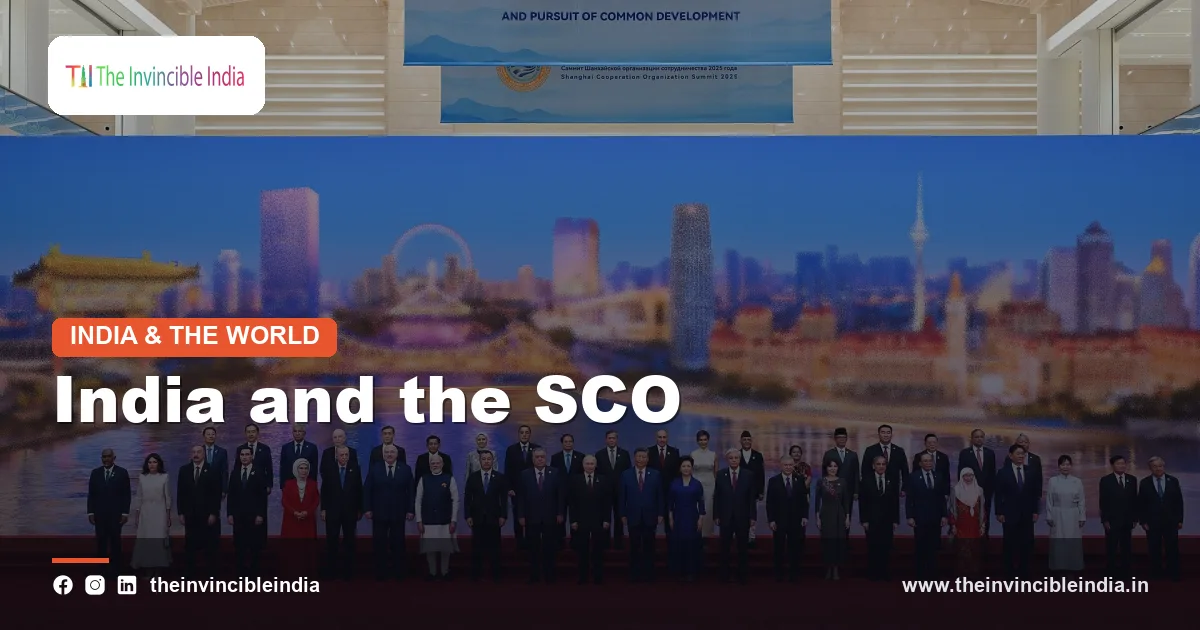
The Shanghai Cooperation Organisation (SCO) is one of the largest regional groupings in the world, spanning a vast stretch of Eurasia from the Pacific coast to the borders of Europe and the Persian Gulf. Born out of a border-confidence-building exercise in the 1990s, it has grown into a forum where its members discuss security, trade, energy, connectivity and cultural exchange. For India, which became a full member in 2017, the SCO is both an opportunity and a test of diplomatic balance.
This explainer walks through how the SCO began, how it is organised, what it does, and why India chose to join a body widely seen as shaped by China and Russia. It also looks at the contradictions India manages inside the group, its experience as chair in 2023, and the real significance and limits of the organisation in a changing world order. Last reviewed on 1 October 2026.
| Quick Facts | Details |
|---|---|
| Full name | Shanghai Cooperation Organisation (SCO) |
| Predecessor | The “Shanghai Five” (formed 1996) |
| Founded | 15 June 2001, Shanghai |
| Founding members | China, Russia, Kazakhstan, Kyrgyzstan, Tajikistan, Uzbekistan |
| India’s status | Observer from 2005; full member from 2017 (together with Pakistan) |
| Iran | Became a full member in 2023 |
| Secretariat | Beijing |
| Security body | Regional Anti-Terrorist Structure (RATS), Tashkent |
| Official languages | Chinese and Russian |
What Is the Shanghai Cooperation Organisation?
The SCO is a permanent intergovernmental organisation whose members agree to cooperate on political, economic, security and humanitarian matters. Unlike a military alliance such as NATO, it has no mutual-defence clause that obliges members to fight on behalf of one another. Unlike a customs union, it does not impose a common external tariff. It is better understood as a consultative and coordinating platform, where heads of state and ministers meet regularly and agree on declarations, joint exercises and cooperation frameworks.
Size and reach
With the entry of India, Pakistan and later Iran, the grouping covers a very large share of Eurasia’s land area and roughly 40 per cent of the world’s population, making it one of the biggest regional organisations on the planet. It brings together nuclear-armed states, major energy producers, large consumer markets and important transit corridors, which is what gives it geopolitical weight despite its loose structure.
Guiding spirit
The organisation describes its guiding approach as the “Shanghai Spirit”, built on mutual trust, mutual benefit, equality, consultation, respect for diverse civilisations and a commitment to common development. In practice, this translates into decisions by consensus and a strong emphasis on non-interference in internal affairs.
Origins: From the Shanghai Five to the SCO
The story begins with the end of the Cold War. When the Soviet Union dissolved in 1991, new states emerged along the long border that had once separated the Soviet Union from China. Questions about who controlled which stretch of frontier, and how many troops could be stationed there, needed to be settled peacefully.
In 1996, China, Russia, Kazakhstan, Kyrgyzstan and Tajikistan met in Shanghai and signed an agreement on confidence-building in the military field along their border areas. A follow-up agreement on the mutual reduction of military forces in border regions was signed in Moscow in 1997. This group came to be known informally as the “Shanghai Five”. Over the following years, its summits expanded beyond border issues to topics such as terrorism, extremism and regional economic cooperation.
Key milestones
| Year | Milestone |
|---|---|
| 1996 | Shanghai Five agreement on military confidence-building along borders |
| 1997 | Moscow agreement on reducing military forces in border areas |
| 2001 | Uzbekistan joins; the Shanghai Cooperation Organisation is formally declared on 15 June |
| 2002 | SCO Charter signed at St Petersburg |
| 2003 | Charter enters into force |
| 2004 | Secretariat begins work in Beijing; RATS starts functioning in Tashkent |
| 2005 | India, Pakistan, Iran and Mongolia receive observer status |
| 2017 | India and Pakistan become full members at the Astana summit |
| 2023 | Iran becomes a full member; India hosts the summit virtually |
How the SCO Is Organised
The SCO’s structure is relatively lean. At the top sits the Council of Heads of State, which meets annually and decides the main priorities and direction of the organisation. Below it is the Council of Heads of Government, which focuses mainly on economic and budgetary matters, and the Council of Foreign Ministers, which handles day-to-day political coordination. Various ministerial meetings, covering areas such as defence, transport, energy, culture and emergency response, add further layers of cooperation.
Permanent bodies
- Secretariat: based in Beijing, it provides administrative and organisational support and is led by a Secretary-General.
- Regional Anti-Terrorist Structure (RATS): based in Tashkent, it coordinates intelligence sharing and counter-terrorism cooperation among members.
Rotating chairmanship
The chair of the organisation rotates among members each year, and the chairing country hosts the annual summit. This rotation lets every member shape the agenda for a year, which is why India’s turn at the helm in 2023 mattered for its visibility within the group.
Observers and dialogue partners
Beyond full members, the SCO also has observer states and dialogue partners. These countries are not part of decision-making but take part in selected meetings and cooperate on specific issues. This tiered structure allows the SCO to widen its outreach without committing to full membership for every interested country.
The “Three Evils”: Security Cooperation at the Core
Security has been the SCO’s original and enduring core. Its founding documents identify three threats, often called the “three evils”: terrorism, separatism and extremism. Central Asian states, in particular, worried in the 1990s about militant networks, cross-border insurgencies and instability spilling over from Afghanistan. Cooperation against these threats was the glue that kept the group together.
RATS and information sharing
The Regional Anti-Terrorist Structure in Tashkent maintains databases, circulates information on terrorist and extremist organisations, and helps members coordinate responses. For India, this offers a rare multilateral channel to raise concerns about cross-border terrorism and to exchange threat assessments with regional partners.
Joint exercises
The SCO’s members conduct periodic joint counter-terrorism and military exercises, commonly known as “Peace Mission” drills, along with other exercises hosted by individual member states. India has taken part in several of these, which gives its armed forces exposure to the doctrines and practices of neighbouring militaries. The exercises are focused on counter-terrorism rather than preparing for a war against a third party.
Wider security agenda
Over time the agenda has grown to include drug trafficking, organised crime, cyber security, border management and the stabilisation of Afghanistan. Afghanistan has long been an observer in the SCO framework, and the situation there remains a shared concern for members.
Economic, Energy and Connectivity Cooperation
Although security defines the SCO’s public image, economic cooperation has been part of its charter from the outset. Members talk about easing trade, improving transport links, cooperating on energy and promoting investment. The region contains major oil and gas producers, large reserves of minerals and several landlocked economies that depend on neighbours for access to markets.
Energy
Central Asia and Russia are rich in hydrocarbons, while Iran holds large reserves as well. China, India and Pakistan are major energy consumers. This complementarity explains why energy cooperation is a recurring theme in SCO discussions, even though concrete multilateral energy deals have been harder to achieve than declarations suggest.
Transport and trade
Discussions on road, rail and customs facilitation aim to reduce the cost and time of moving goods across the region. Many such proposals tie into larger connectivity initiatives, and this is where the SCO becomes politically sensitive for India, as discussed below.
Other areas
- Cultural and educational exchanges, including student mobility and youth forums.
- Cooperation in agriculture, disaster management and healthcare.
- Technology, start-ups and innovation dialogues in which India has promoted its own digital public infrastructure experience.
India’s Road to SCO Membership
India’s relationship with the SCO developed in stages. When the group opened to observers in 2005, India was admitted alongside Pakistan, Iran and Mongolia. For more than a decade India participated in meetings but could not take part in the full decision-making process. Meanwhile, the case for full membership grew stronger as India’s trade, energy needs and strategic interests in Eurasia expanded.
The question of expansion was settled through a package approach. At the 2015 summit in Ufa, members agreed to begin the process of admitting India and Pakistan. Both countries signed the relevant memorandum of obligations in 2016 and became full members at the Astana summit in June 2017. Russia was widely seen as a champion of India’s entry, while China supported Pakistan’s, making the simultaneous admission a diplomatic compromise.
Why the two joined together
Admitting India without Pakistan, or the reverse, would have been hard for either side to accept. Joining together meant that neither country gained a unilateral advantage inside the organisation, although it also meant that two rivals now shared the same table, which carries its own awkwardness.
Why India Joined and What It Gains
India’s decision to join reflects a mix of strategic, economic and diplomatic motives. It was less about alignment with any bloc and more about ensuring that India has a voice in a region that directly affects its security and prosperity.
Engagement with Central Asia
Central Asia is often described as India’s “extended neighbourhood”. The region offers energy resources, minerals, markets and historical ties along old Silk Road routes. India launched its “Connect Central Asia” policy in 2012 to deepen political, economic and cultural links, and SCO membership gives that policy an institutional anchor. Because India shares no direct land border with the Central Asian republics, regular, multilateral access to their leaders is valuable.
Counter-terrorism cooperation
The SCO’s emphasis on terrorism and extremism matches India’s long-standing concerns. Through RATS and ministerial meetings, India can press for stronger language against cross-border terrorism and exchange information with Central Asian and other partners facing similar threats.
Strategic autonomy and multipolarity
India follows a policy often described as strategic autonomy: keeping decision-making independent and avoiding rigid alliances. Being part of the SCO, alongside forums such as BRICS, lets India engage non-Western platforms without giving up its ties with the West. It also supports India’s long-held preference for a multipolar world in which power is distributed across several centres rather than concentrated in one or two.
A voice on Eurasian affairs
Perhaps most simply, membership means India is in the room when Eurasian security and economic questions are debated. Staying outside would have meant that decisions affecting Afghanistan, Central Asian energy and regional connectivity would be discussed without India’s direct input.
Challenges and Contradictions for India
India’s participation is not without friction. The SCO is often perceived as a China-led organisation, given that its secretariat is in Beijing, its name refers to a Chinese city and China is its largest economy. Russia’s presence offers some balance, but India has to manage a body where its largest regional rival holds considerable influence and where its neighbour Pakistan also sits as an equal member.
The Belt and Road Initiative
China’s Belt and Road Initiative (BRI) is a major infrastructure and connectivity programme, and it is frequently referenced in SCO declarations. India does not endorse the BRI, chiefly because its flagship project, the China-Pakistan Economic Corridor, passes through territory in Jammu and Kashmir that India regards as its own, and because India has concerns about sovereignty, transparency and debt sustainability in such projects. As a result, India has generally stayed out of the paragraphs endorsing the initiative in SCO documents.
Tensions with Pakistan
Because both India and Pakistan sit inside the SCO, bilateral disputes can surface around the group’s meetings. The organisation’s charter discourages members from bringing bilateral disputes into the forum, yet differences over terrorism and Kashmir inevitably shape the atmosphere. At times, India has declined to sign joint statements that it felt did not adequately address terrorism concerns.
Consensus and its costs
Since decisions are taken by consensus, a single member can block or dilute a proposal. This keeps the SCO from taking bold collective steps, but it also means that India can prevent language it opposes from being adopted.
The Connectivity Dilemma: Chabahar, INSTC and the BRI
Connectivity is where India’s interests and the SCO’s dominant narrative diverge most sharply. India wants better access to Central Asia and Eurasia, but Pakistan does not allow transit for Indian goods over land, and India will not join China’s BRI. India has therefore sought alternative routes.
India’s alternatives
- Chabahar Port (Iran): a port on Iran’s southeastern coast that India has helped develop, offering a sea-and-land route to Afghanistan and Central Asia that bypasses Pakistan.
- International North-South Transport Corridor (INSTC): a multimodal route of ships, rail and road agreed by India, Russia and Iran in 2000, linking the Indian Ocean and Persian Gulf with the Caspian Sea and northern Europe.
- Connect Central Asia policy: a diplomatic framework to build links through institutions, commerce, education and culture in the absence of a direct land route.
Iran’s accession to the SCO in 2023 added an interesting dimension, since Iran is central to both Chabahar and the INSTC. It strengthened the argument that the SCO can be a forum in which these alternatives are discussed alongside Chinese-led projects.
Balancing the SCO with Western Partnerships
India does not treat its SCO membership as a choice against the West. It is a partner in the Quad, a dialogue among India, Australia, Japan and the United States focused on a free and open Indo-Pacific, and it maintains deep economic, defence and technology ties with the United States, Europe and others. At the same time, it retains long-standing relations with Russia and engages with China where interests overlap.
Multi-alignment in practice
This approach is sometimes called multi-alignment: building issue-based partnerships with many countries rather than joining a single camp. The SCO and BRICS are one set of platforms in this strategy, the Quad and similar groupings another. India’s view is that participation in one forum should not be read as an endorsement of the positions of another.
Reading the signals
Observers sometimes interpret India’s choice of which SCO statements to sign, and at what level it sends representatives to meetings, as signals of its priorities. Its willingness to sit alongside Beijing and Islamabad while pursuing separate coalitions reflects a calculation that being present is more useful than being absent.
India as SCO Chair and the 2023 Summit
India took over the rotating chair after the 2022 summit in Samarkand and held the presidency through 2023, the first time it led the organisation as a full member. India’s chairmanship used the theme “SECURE SCO”, an acronym built on a vision India had earlier set out for the organisation: Security, Economic development, Connectivity, Unity, Respect for sovereignty and territorial integrity, and Environmental protection.
The virtual summit
The annual heads-of-state summit in 2023 was hosted by India in virtual format in July rather than in person. It was at this meeting that Iran formally became a full member, bringing the number of full members to nine at that point. The final declaration again reflected the usual pattern, with India not joining the paragraph supporting the BRI while the other members did.
Agenda during the chairmanship
- Cooperation on traditional medicine, digital public infrastructure, start-ups and innovation.
- Efforts on food security, millet promotion and youth exchanges.
- Emphasis on civilisational and cultural ties with Central Asia.
Significance and Limits of the SCO
The SCO’s significance lies in its scale and its convening power. It is one of the few forums where leaders from China, Russia, India, Pakistan, Iran and the Central Asian republics sit together regularly. That in itself reduces the risk of misunderstanding, creates channels for communication in tense moments and gives smaller members a stage that they might not otherwise have.
Where it falls short
- Consensus-based decision-making slows action and favours lowest-common-denominator outcomes.
- Internal rivalries, particularly between India and China and between India and Pakistan, limit deep integration.
- Limited institutional capacity means that proposals such as a development bank or a common financing mechanism have progressed slowly.
- No collective-defence commitment keeps the SCO from functioning like a formal alliance.
Why it still matters for India
Despite these limits, the SCO provides India with a platform to pursue its interests in Eurasia, voice its positions on terrorism and connectivity, and project itself as an independent pole in a multipolar order. How much the organisation delivers depends on whether its members can manage their differences and turn declarations into concrete projects.
Conclusion
The Shanghai Cooperation Organisation has travelled from a border-confidence agreement among five states in 1996 to a sprawling Eurasian grouping that has continued to expand. For India, it is a space to engage Central Asia, raise counter-terrorism concerns and demonstrate that its foreign policy is not bound to any single bloc. At the same time, India must navigate a China-influenced forum, the presence of Pakistan and a connectivity agenda that it only partially shares. Understanding that balancing act is the key to understanding India’s role in the SCO.
Frequently Asked Questions
What is the Shanghai Cooperation Organisation?
The SCO is a Eurasian intergovernmental organisation founded in 2001 by China, Russia, Kazakhstan, Kyrgyzstan, Tajikistan and Uzbekistan. It focuses on regional security, counter-terrorism, and economic and cultural cooperation. It grew out of the “Shanghai Five”, formed in 1996.
When did India become a member of the SCO?
India became an observer in 2005 and a full member in June 2017 at the Astana summit, together with Pakistan. Iran later joined as a full member in 2023.
What are the “three evils” in the SCO?
The three evils are terrorism, separatism and extremism. The organisation was founded with the goal of coordinating action against these threats, and the Regional Anti-Terrorist Structure (RATS) in Tashkent supports this work.
Why does India not endorse the Belt and Road Initiative in SCO documents?
India objects chiefly because the China-Pakistan Economic Corridor, a flagship BRI project, passes through territory in Jammu and Kashmir that India claims. It also has concerns about sovereignty, transparency and debt sustainability. India has therefore stayed out of the paragraphs endorsing the initiative.
Is the SCO a military alliance like NATO?
No. The SCO does not have a mutual-defence clause that obliges members to defend each other. It conducts joint counter-terrorism exercises and security consultations, but it functions as a political, economic and security cooperation forum rather than a formal military alliance.
How is India’s SCO membership compatible with its Quad partnership?
India follows a policy of strategic autonomy and multi-alignment, building issue-based partnerships with many countries. It participates in groupings such as the SCO and BRICS as well as the Quad, treating each as serving different interests rather than as competing camps.


