

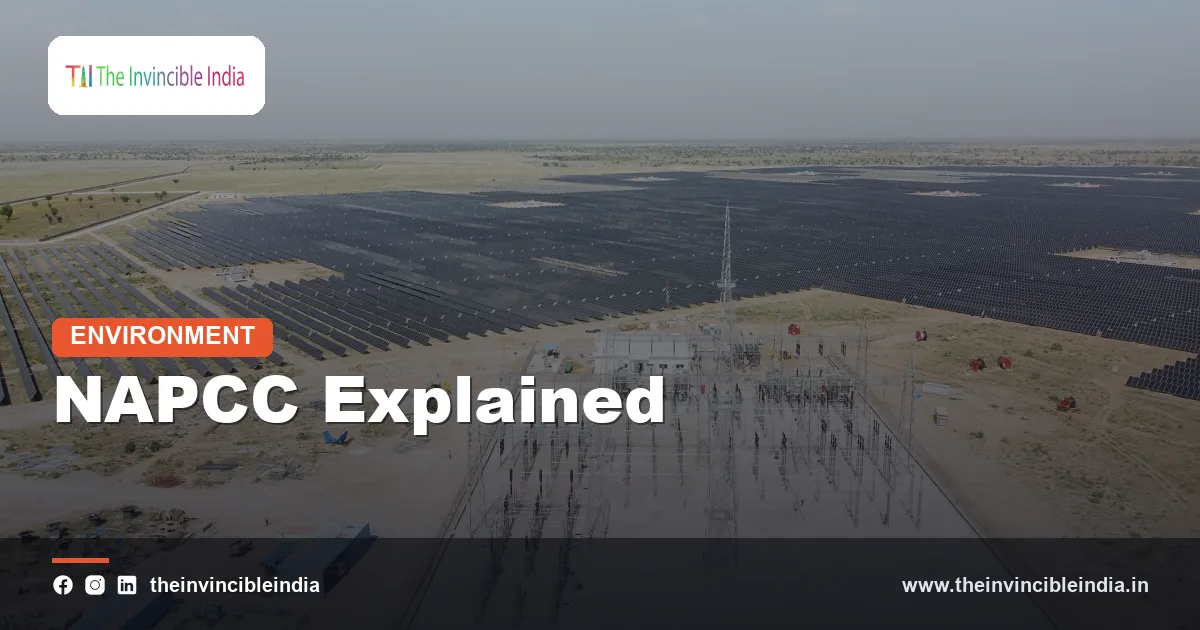
The National Action Plan on Climate Change, usually shortened to NAPCC, is the overarching policy framework through which India approaches the problem of a warming planet. Released in 2008, it brought together a set of existing and new efforts on clean energy, efficiency, water, forests, farming and research under a single umbrella, and it treats climate action as something that must go hand in hand with development rather than compete with it.
For a country with a large population, a long coastline, a vast agricultural economy and the Himalayan glaciers at its northern edge, climate change is not an abstract debate. This explainer walks through what the NAPCC is, its guiding principles, each of its eight national missions, how states and ministries put it into practice, how it links to India’s international pledges, and where it has succeeded or fallen short.
Quick Facts
| Item | Detail |
|---|---|
| Full name | National Action Plan on Climate Change (NAPCC) |
| Released | 30 June 2008 |
| Released by | Prime Minister’s Council on Climate Change, Government of India |
| Nature | Overarching national strategy covering mitigation and adaptation |
| Structure | Eight National Missions |
| Guiding idea | Inclusive, sustainable development that protects the poor and vulnerable |
| Sub-national link | State Action Plans on Climate Change (SAPCCs) |
| Nodal ministry for coordination | Ministry of Environment, Forest and Climate Change |
What Is the NAPCC? Background and Guiding Principles
The NAPCC is a policy document, not a law. It does not create penalties or a new regulator. Instead, it sets out a direction and a list of priority areas, and then asks different ministries to build detailed programmes around them. Its full title, the National Action Plan on Climate Change, signals the intention: it is a plan for action at the national level, to be translated into schemes, budgets and regulations over time.
The plan was prepared under the Prime Minister’s Council on Climate Change, an advisory body constituted in 2007 and made up of ministers, officials, scientists and other experts. Its release in June 2008 placed India among the early developing countries to publish a comprehensive national climate strategy. The plan is short compared with later documents, but it was deliberately broad, identifying the main areas where the country needed to change course or build resilience.
Mitigation and adaptation together
Climate policy has two halves. Mitigation means cutting or avoiding greenhouse gas emissions, for example by generating cleaner electricity or using fuel more efficiently. Adaptation means preparing for the changes that are already under way or unavoidable, such as shifting rainfall, heat, floods and sea-level rise. The NAPCC addresses both. The solar and energy-efficiency missions lean towards mitigation, while the water, agriculture and Himalayan missions lean towards adaptation. Several, such as the Green India and habitat missions, do a bit of both.
Background: Why India Needed a Climate Plan
By the mid-2000s, the science of climate change had become hard to ignore. The United Nations Framework Convention on Climate Change had been adopted in 1992, and the Kyoto Protocol of 1997 had set binding targets for industrialised countries only. India, like other developing nations, had no binding emission cut under that arrangement, but it faced growing pressure to show how it would manage its own emissions and vulnerabilities.
India’s circumstances were distinctive. A large share of its people depend on rain-fed agriculture, forests and fisheries, which are all sensitive to climate. Millions live in coastal areas, river floodplains or drought-prone regions. At the same time, India still needed to expand access to electricity, housing, jobs and basic services. A plan was needed that explained how the country would grow while keeping the climate cost as low as possible, and how it would protect its most exposed communities.
The international context
The NAPCC was drawn up during a period of intense global negotiation. It allowed India to say that it was already acting at home, on its own priorities, rather than waiting for an international agreement to compel it. This home-grown approach later became a recurring theme in India’s climate diplomacy.
Guiding Principles of the NAPCC
The plan rests on a few core principles that shape every mission beneath it. They are worth understanding because they explain why the NAPCC looks different from climate plans written in wealthier countries.
- Protecting the poor and vulnerable: climate action should not come at the cost of those with the least. Development and poverty reduction remain top priorities.
- Ecologically sustainable growth: economic growth should continue, but with a qualitative change in direction that improves ecological sustainability.
- Efficient, cost-effective strategies: particular attention is given to managing demand, using resources wisely and avoiding waste.
- Appropriate technology: deploying suitable technologies for both adaptation and mitigation, including new ones.
- Innovative mechanisms: using market, regulatory and voluntary tools, as well as public-private partnerships.
- International cooperation: working with other countries on research, technology and finance.
Equity and common but differentiated responsibilities
A central idea in the plan is equity. The global climate framework recognises “common but differentiated responsibilities and respective capabilities”, meaning that all countries share the duty to act, but historical emissions and levels of development differ. India has consistently argued that its per capita emissions are low and that developed countries, which contributed most of the accumulated emissions, should lead on cuts and provide finance and technology to developing ones. The NAPCC reflects this stance while also showing that India is taking its own steps.
The Eight National Missions at a Glance
The heart of the NAPCC is its set of eight national missions. Each mission has a focus area, a lead ministry or department, and a set of targets or strategies that evolved over time. The table below gives a quick overview before we look at each one in detail.
| Mission | Main focus |
|---|---|
| National Solar Mission (Jawaharlal Nehru National Solar Mission) | Scaling up solar power generation and bringing down costs |
| National Mission for Enhanced Energy Efficiency (NMEEE) | Improving energy efficiency, including the Perform, Achieve and Trade scheme |
| National Mission on Sustainable Habitat | Green buildings, urban waste management, public transport |
| National Water Mission | Conserving water and improving water-use efficiency |
| National Mission for Sustaining the Himalayan Ecosystem | Protecting fragile Himalayan glaciers, biodiversity and communities |
| National Mission for a Green India | Afforestation and improving forest and tree cover |
| National Mission for Sustainable Agriculture | Climate-resilient farming, soil and water management |
| National Mission on Strategic Knowledge for Climate Change | Research, data, modelling and capacity building |
Mission 1: The National Solar Mission
The Jawaharlal Nehru National Solar Mission was launched in 2010 with the aim of making India a global leader in solar energy. Its original stated goal was to install 20,000 megawatts of grid-connected solar power by 2022, in phases. In 2015 the government raised the ambition, setting a target of 100 gigawatts of solar capacity by 2022 as part of a larger renewable energy goal.
How it worked
- Long-term power purchase agreements and bundling of solar with conventional power in the early years.
- Competitive reverse auctions, which helped drive tariffs down sharply over the following decade.
- Support for rooftop systems, solar parks and off-grid applications such as pumps and lighting.
- Efforts to build domestic manufacturing and research capacity.
The Ministry of New and Renewable Energy leads the mission. Solar is widely regarded as the most visible success among the eight missions, with capacity growing from a very small base in 2010 to a major share of India’s renewable fleet. Questions remain about meeting the full rooftop targets and about domestic manufacturing, but the direction of travel has been clear.
Mission 2: The National Mission for Enhanced Energy Efficiency
The National Mission for Enhanced Energy Efficiency, or NMEEE, aims to reduce energy use per unit of output across the economy. It builds on the Energy Conservation Act of 2001 and is steered by the Bureau of Energy Efficiency under the Ministry of Power.
The PAT scheme
The best-known instrument under NMEEE is Perform, Achieve and Trade, or PAT. It targets large energy-intensive industries, such as power plants, cement, steel, textiles and fertiliser units, which are notified as “designated consumers”. Each is given a specific energy-consumption target. Those who exceed their target earn tradable energy-saving certificates, while those who fall short must buy certificates or pay a penalty. PAT began operating in cycles from 2012, with later cycles covering more sectors and units.
Other elements
- Market-based mechanisms to make efficient appliances more affordable, including the star-labelling programme.
- Financing platforms that help companies invest in energy-saving upgrades.
- Fiscal instruments and incentives for efficient technologies.
Later changes to energy conservation law also opened the way for a domestic carbon credit trading scheme, extending the market-based thinking that PAT introduced.
Mission 3: The National Mission on Sustainable Habitat
Cities are where much of India’s future growth, and its future emissions, will be concentrated. The National Mission on Sustainable Habitat focuses on making urban areas more efficient and resilient. It is mainly associated with the Ministry of Housing and Urban Affairs.
- Green buildings: promoting energy-efficient construction through measures such as the Energy Conservation Building Code and green building rating systems.
- Waste management: improving solid and liquid waste handling, and recovering power and resources from waste.
- Public transport: encouraging mass transit, metro systems, buses and better urban planning to reduce dependence on private vehicles.
- Resilience: planning for flooding, heat and other climate impacts in town planning.
Because urban planning is largely a state and local subject, delivery under this mission depends heavily on municipal bodies and state governments, which has made progress uneven.
Mission 4: The National Water Mission
Water is where climate change is felt most directly. Shifts in monsoon patterns, melting glaciers and more extreme floods and droughts all affect supply. The National Water Mission, under the Ministry of Jal Shakti, aims at integrated management of water resources, conserving it, minimising waste and ensuring more equitable distribution across and within states.
A widely cited objective of the mission is to improve water-use efficiency by 20 per cent. Its strategies include:
- Building a comprehensive water database and assessing the impact of climate change on resources.
- Promoting citizen and state action for conservation and groundwater recharge.
- Focusing on over-exploited areas and encouraging efficient irrigation.
- Promoting basin-level planning and better water pricing.
Since agriculture is the largest user of water in India, this mission is closely tied to farming practices and to the agriculture mission discussed below.
Mission 5: Sustaining the Himalayan Ecosystem
The Himalayas are the source of major rivers, home to rich biodiversity and a living landscape for millions of people. They are also among the regions most sensitive to a warming climate, with glaciers, snow cover and fragile slopes at risk. The National Mission for Sustaining the Himalayan Ecosystem seeks to understand and safeguard this region. It is coordinated by the Department of Science and Technology.
Key activities
- Monitoring glaciers and snow cover, and studying how they respond to warming.
- Assessing biodiversity and ecosystem health in mountain areas.
- Supporting the livelihoods and traditional knowledge of Himalayan communities.
- Strengthening cooperation among Himalayan states and with neighbouring countries on data and research.
The mission is largely research and capacity oriented. Its outcomes are therefore harder to express as simple numbers than those of the solar or efficiency missions.
Mission 6: The National Mission for a Green India
Forests act as carbon sinks, protect watersheds and sustain communities. The Green India Mission, in the portfolio of the Ministry of Environment, Forest and Climate Change, aims to protect, restore and expand forest and tree cover, and to improve the quality of degraded forests. In its original design it spoke of increasing forest or tree cover on around five million hectares and improving the quality of cover on another five million hectares.
- Community participation, with village institutions such as forest committees playing a major role.
- Restoration of degraded forests, grasslands, wetlands, mangroves and urban green spaces.
- Integration with livelihood programmes so that local people benefit from restoration.
- Monitoring of carbon stocks and ecosystem services.
The mission has often been discussed alongside compensatory afforestation funds and other forest programmes, and its rollout has been slower than many early expectations.
Mission 7: The National Mission for Sustainable Agriculture
Farming is both a victim and a contributor to climate change. Erratic weather harms yields, while some farm practices produce emissions. The National Mission for Sustainable Agriculture, led by the Ministry of Agriculture and Farmers Welfare, seeks to make Indian farming more climate-resilient, productive and sustainable, particularly in rain-fed areas.
- Soil health management and the promotion of organic and efficient nutrient use.
- Efficient on-farm water management, including micro-irrigation.
- Rain-fed area development and integrated farming systems.
- Crop diversification, climate-resilient varieties and improved weather advisories.
Many of its components were later built into broader schemes, so it is often visible through programmes for soil health, irrigation efficiency and rain-fed development rather than as a single stand-alone effort.
Mission 8: Strategic Knowledge for Climate Change
Good policy needs good evidence. The National Mission on Strategic Knowledge for Climate Change, coordinated by the Department of Science and Technology, aims to build a knowledge system to support the other seven missions. It seeks to improve climate modelling, assess regional impacts and nurture a community of researchers.
- Establishing research networks and centres of excellence on climate science.
- Improving observation, data collection and regional climate projections.
- Supporting global research partnerships and exchange of expertise.
- Building human capacity through training and fellowships.
Its value lies in being a backbone for evidence-based planning, even though it seldom makes headlines.
How the Missions Are Implemented
A distinctive feature of the NAPCC is that it has no single implementing agency. Each mission is assigned to a lead ministry or department, which prepares a detailed mission document, seeks approvals and funds, and reports progress. The Prime Minister’s Council on Climate Change reviews the overall direction, while the Ministry of Environment, Forest and Climate Change plays the central coordinating role as the nodal ministry for climate matters.
The role of states
Because water, agriculture, forests, health and urban planning are in large part state responsibilities, the plan could not succeed on central action alone. In 2010 states and union territories were asked to prepare their own State Action Plans on Climate Change, or SAPCCs, aligned with the national missions but adapted to local realities. A coastal state might stress cyclone and sea-level risks, a hill state might focus on glaciers and landslides, and a dry state on drought and water stress. Most states have drafted such plans, and many have since revised them.
Funding channels
Mission funding generally comes through existing ministry budgets and schemes, supplemented by tools such as the National Adaptation Fund for Climate Change, set up in 2015 to support adaptation projects in vulnerable states and sectors. There is no single dedicated pool of money for the whole NAPCC, which has important consequences for how progress is measured, as discussed later.
Links to International Commitments
The NAPCC has acted as the domestic foundation for India’s positions abroad. Before the Copenhagen conference of 2009, India announced a voluntary goal to reduce the emissions intensity of its GDP by 20 to 25 per cent from 2005 levels by 2020, drawing on actions in the NAPCC. After the Paris Agreement was adopted in 2015, countries were asked to submit Nationally Determined Contributions, or NDCs. India’s first NDC set targets for 2030 on emissions intensity, non-fossil electricity capacity and additional carbon sinks, and relied heavily on the missions for solar, efficiency, forests and more.
Updated pledges
- 2021, COP26 in Glasgow: India announced the five-part “Panchamrit” pledge, including a goal of 500 gigawatts of non-fossil electricity capacity by 2030, meeting half of energy requirements from renewables by 2030, reducing projected emissions by one billion tonnes by 2030, reducing the carbon intensity of the economy by 45 per cent by 2030, and reaching net-zero emissions by 2070.
- 2022: India submitted an updated NDC reflecting stronger targets for emissions intensity and non-fossil capacity, along with a long-term low-emission development strategy.
- International Solar Alliance: launched in 2015 with France, it extends the logic of the Solar Mission to cooperation with other sun-rich countries.
These targets are stated goals and commitments, and progress toward them is tracked through official reports and independent assessments.
Newer Initiatives Building on the NAPCC
The NAPCC was written in 2008, and many newer programmes now sit alongside or beyond its original eight missions.
- National Green Hydrogen Mission: approved in 2023, it aims to make India a hub for the production, use and export of green hydrogen, which can help decarbonise heavy industry and transport.
- Mission LiFE (Lifestyle for Environment): launched in 2022, it encourages individuals and communities to adopt environment-friendly habits such as saving energy and water and reducing waste.
- Electric mobility and battery programmes: schemes to encourage electric vehicles and domestic manufacturing.
- Carbon market development: building on the PAT experience to create a wider market for emission reductions.
- Cooling and clean-air efforts: including the India Cooling Action Plan and the National Clean Air Programme.
Many observers see these as natural extensions of the NAPCC’s spirit: using missions, targets and market tools to push the economy toward lower emissions.
Progress, Achievements and Criticisms
Progress and Achievements
Assessing the NAPCC is not simple, because the missions vary widely in design and ambition. Still, some clear patterns stand out.
- Solar and clean power: the Solar Mission is the standout success. Rapid growth in installed capacity, falling tariffs and a competitive auction model made solar a mainstream power source in India.
- Energy efficiency: PAT introduced a market-based approach to industrial efficiency, and appliance labelling raised consumer awareness.
- Institutional learning: the plan prompted ministries and states to treat climate as a planning concern, and it created the template for state action plans.
- Knowledge base: climate research, monitoring and modelling expanded, supporting later national assessments.
Criticisms and Challenges
The NAPCC has also drawn criticism from researchers, think tanks and civil society, and it is fair to present these alongside the achievements.
Uneven performance
Solar and energy efficiency moved ahead quickly, but missions such as Green India, Sustainable Habitat and the Himalayan mission have been seen as slower or less visible. Some missions were folded into existing schemes, making it difficult to see what the mission itself delivered.
Funding and coordination
Because there is no single dedicated budget, missions compete with other priorities within their own ministries. Coordinating across many ministries and between the Centre and states is difficult, and state action plans have sometimes been limited by weak funding and capacity.
Measurable outcomes
Critics point to the lack of clear, publicly reported indicators for several missions, which makes it hard to judge whether targets are being met. Calls have been made for better monitoring, regular public reporting and independent evaluation.
A plan that needs updating
The 2008 document predates the Paris Agreement, the steep fall in renewable energy costs and India’s net-zero pledge. Many experts argue that it should be refreshed, perhaps with new missions or revised targets, to align with the country’s present commitments and to give more weight to adaptation, climate finance and a fair transition for workers and regions that depend on fossil fuels.
Conclusion
The NAPCC remains the foundation of India’s climate response, a framework that connected energy, water, forests, farming, cities, mountains and knowledge under one strategy and tied them to the idea of equitable, sustainable development. Its eight missions have not all performed equally, and the plan itself has aged in a fast-changing policy landscape. Yet it set the template for state action plans, shaped India’s international positions and made climate a regular subject of national planning. Any future update will likely build on this base. Last reviewed: 1 October 2026.
Frequently Asked Questions
What is the National Action Plan on Climate Change?
The National Action Plan on Climate Change (NAPCC) is India’s overarching strategy to address climate change through both mitigation and adaptation. It was released in 2008 by the Prime Minister’s Council on Climate Change and is organised around eight national missions covering areas such as solar energy, energy efficiency, water, forests and agriculture.
What are the eight national missions of the NAPCC?
The eight missions are the National Solar Mission, the National Mission for Enhanced Energy Efficiency, the National Mission on Sustainable Habitat, the National Water Mission, the National Mission for Sustaining the Himalayan Ecosystem, the National Mission for a Green India, the National Mission for Sustainable Agriculture, and the National Mission on Strategic Knowledge for Climate Change.
What is the PAT scheme?
PAT stands for Perform, Achieve and Trade. It is a market-based scheme under the energy efficiency mission in which large energy-intensive industries receive energy-saving targets. Units that beat their targets earn tradable certificates, while those that fall short must buy certificates or face penalties.
How do State Action Plans on Climate Change relate to the NAPCC?
State Action Plans on Climate Change (SAPCCs) translate the national missions into state-level strategies. Since subjects like water, agriculture, forests and urban planning are largely handled by states, each state prepares a plan reflecting its own climate risks, such as floods, droughts, cyclones or glacier melt.
How does the NAPCC connect to India’s net-zero goal?
The NAPCC is the older domestic framework, while the net-zero target for 2070, announced at COP26, and the Paris Agreement NDCs are newer international commitments. The missions, especially solar and energy efficiency, contribute directly to those targets, and newer efforts such as the Green Hydrogen Mission and Mission LiFE build on the same approach.
Why do experts say the NAPCC needs to be updated?
The plan was written in 2008, before the Paris Agreement and before large changes in renewable energy costs and India’s pledges. Critics also point to funding gaps, weak coordination and limited public reporting on some missions, and they suggest a refreshed plan with clearer indicators and stronger focus on adaptation.


