

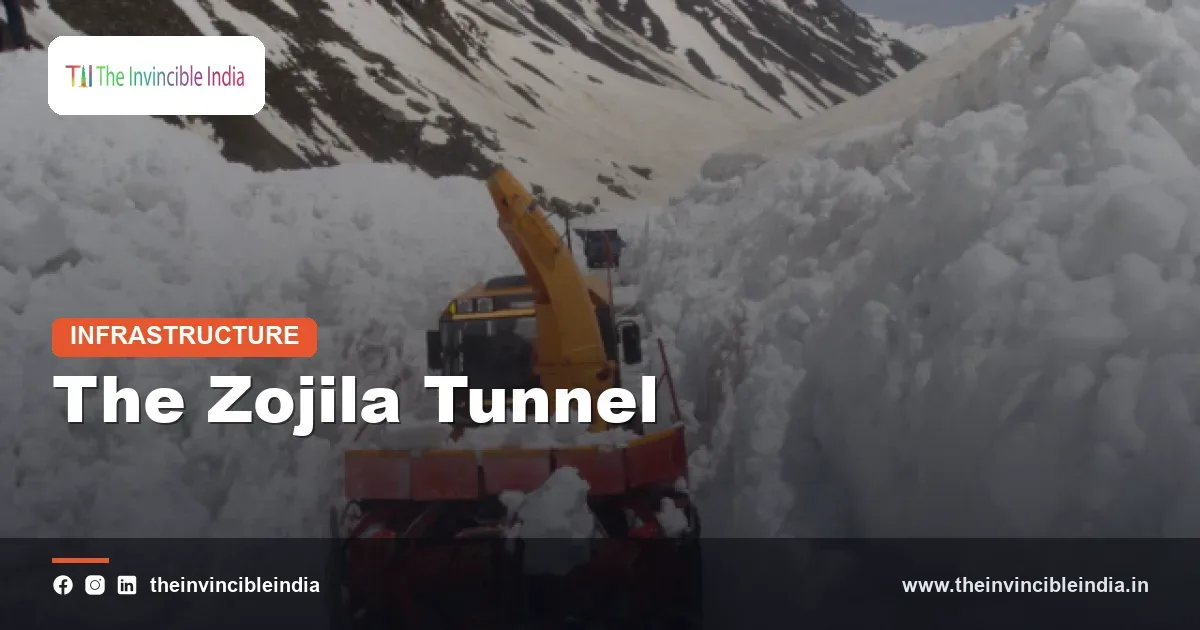
The Zojila Tunnel is an under-construction road tunnel of about 13 kilometres beneath the Zojila pass in the Himalaya, designed to give all-weather road connectivity between the Kashmir Valley and Ladakh on the Srinagar-Kargil-Leh national highway. Once completed, the Zojila Tunnel is expected to be among the longest bi-directional road tunnels in Asia and the longest road tunnel in India, replacing a hazardous mountain section that is closed by snow for several months each year.
The project is being executed by the National Highways and Infrastructure Development Corporation Limited (NHIDCL) under the Ministry of Road Transport and Highways. It is regarded both as a development project for Ladakh and as a strategic asset for defence logistics. This explainer covers what the tunnel is, why it is needed, how it is built, how it connects to the Z-Morh (Sonamarg) tunnel and what engineering and schedule challenges remain. Dates and figures are given approximately because they have been revised during construction.
| Attribute | Detail |
|---|---|
| Project | Zojila Tunnel (also written Zoji La Tunnel) |
| Location | Beneath the Zojila pass, between Sonamarg in the Kashmir Valley and Minamarg on the Drass side, Union Territories of Jammu and Kashmir and Ladakh |
| Highway | Srinagar-Kargil-Leh national highway (NH-1) |
| Length | About 13 km (with approach roads, about 14 km) |
| Type | Bi-directional road tunnel with an associated escape arrangement |
| Executing agency | NHIDCL, under the Ministry of Road Transport and Highways |
| Foundation stone | 2018 |
| Status | Under construction; completion target revised more than once, now expected in the late 2020s |
| Complementary project | Z-Morh (Sonamarg) tunnel, about 6.5 km, on the Kashmir side |
Key Takeaways
- The Zojila Tunnel is an under-construction road tunnel of about 13 kilometres beneath the Zojila pass on the Srinagar-Kargil-Leh national highway.
- The Zojila Tunnel is designed to keep the Kashmir-Ladakh road open throughout the year, replacing a pass that is closed by snow and avalanches for months in winter.
- The Zojila Tunnel is being built by the National Highways and Infrastructure Development Corporation Limited (NHIDCL) and is expected to be among the longest bi-directional road tunnels in Asia.
- The Zojila Tunnel works together with the Z-Morh (Sonamarg) tunnel, which was opened in early 2025 and secures the approach on the Kashmir side.
- The Zojila Tunnel has strategic value because it will give the Indian armed forces dependable year-round road access to Kargil, Drass and Leh.
- The Zojila Tunnel faces demanding engineering conditions, including heavy snow, avalanches, steep terrain, weak rock, low oxygen and severe winter cold, which have affected its schedule.
What is the Zojila Tunnel?
The Zojila Tunnel is a planned road tunnel through the mountain mass below the Zojila pass, intended to carry traffic between Sonamarg and Minamarg without crossing the pass itself. With a length of about 13 kilometres, it will be the longest road tunnel in India and one of the longest bi-directional road tunnels in Asia.
The tunnel forms the central part of a larger infrastructure package that includes approach roads, avalanche-protection structures, ventilation and safety systems. It is designed as a bi-directional tunnel, which means that vehicles use the same bore in both directions, with a parallel arrangement for emergency escape. The tunnel mouth on the Kashmir side is near Baltal and Sonamarg, and the exit on the Ladakh side is near Minamarg in the Drass region.
When completed, the project is expected to reduce travel time for the section from several hours in good weather to a matter of minutes, and, more significantly, to replace uncertainty with reliability. The Zojila Tunnel does not by itself create a new highway; it removes the single most vulnerable stretch from an existing one.
Where is the Zojila pass and why is it difficult?
The Zojila pass is a high mountain pass in the western Himalaya, at an elevation of about 3,500 metres, that links the Kashmir Valley with the Drass and Kargil districts of Ladakh. It is the principal road gateway to Ladakh from the Kashmir side and has long been known for its steep, narrow and exposed road.
The pass sits in a zone that receives very heavy winter snowfall. Avalanches and landslides are frequent, and the road is cut into the mountainside with sharp bends and long drops. In winter, snow accumulates to great depths, and the road is closed for months. Even when it is open, the highway often experiences delays, one-way traffic windows and accidents. Drivers and military convoys must plan their movement around weather, and the route is regarded as one of the most challenging mountain roads in the country.
The pass is also significant in military history. During the first Kashmir war in 1948, the Indian Army pushed light tanks up to Zojila in an operation that is remembered for its audacity and that helped reopen the route to Ladakh. This history is often cited to explain why the corridor has been central to defence planning.
Why is the Zojila Tunnel needed?
The Zojila Tunnel is needed because Ladakh depends on a limited number of road corridors, and the Zojila stretch is closed by snow for a large part of the year, which isolates the region from the Kashmir Valley by road. Ladakh is a high-altitude, sparsely populated territory in which supplies, health services and economic activity depend heavily on access.
- Humanitarian and economic access: residents of Kargil and Leh gain a dependable route for food, fuel, medicines and goods in winter.
- Tourism and trade: a longer open season supports tourism, horticulture and trade, which are central to the Ladakhi economy.
- Safety: the tunnel removes travellers from an avalanche-prone, accident-prone road.
- Strategic mobility: the armed forces gain a dependable supply line to forward areas along the borders with Pakistan and China.
- National integration: an all-weather link strengthens the connection between the Kashmir Valley and Ladakh, which became a separate Union Territory in 2019.
Air transport serves Ladakh but cannot match road transport for bulk cargo and is also affected by weather. Ladakh has other road links, including the Manali-Leh route through Himachal Pradesh, but those routes are also seasonal. A year-round Srinagar-Leh road would therefore add real resilience to the region’s connectivity.
Who is building the Zojila Tunnel?
The Zojila Tunnel is being built by NHIDCL, a public-sector company under the Ministry of Road Transport and Highways that specialises in highways in border, hilly and remote regions. NHIDCL acts as the executing agency, which means it plans, awards contracts, supervises construction and oversees quality and safety.
The construction contract was awarded to a private infrastructure company under an engineering, procurement and construction arrangement. NHIDCL has the responsibility for land acquisition, environmental and forest clearances and coordination with the Border Roads Organisation (BRO) and the Indian Army, which operate in the same corridor. The foundation stone of the project was laid in 2018, and work began after the finalisation of design and contracts.
The financing comes from the central government through the national highways programme. The cost of the Zojila tunnel and its approach roads runs to several thousand crore rupees, which makes it one of the most expensive road projects in the Himalaya. Estimates of cost and completion date have changed over time, which is common for tunnels in difficult terrain.
How is the Zojila Tunnel being built?
The Zojila Tunnel is being built mainly by drilling and blasting combined with the New Austrian Tunnelling Method (NATM), which excavates the rock in stages and supports it as work proceeds. This method is widely used in the Himalaya because it can adapt to varying rock conditions.
The design includes the following main elements:
- Main bore: a horseshoe-shaped bi-directional tunnel with space for two lanes of traffic.
- Escape tunnel: a parallel passage that serves as an emergency exit and also assists construction.
- Cross-passages: connectors between the main bore and the escape route at intervals.
- Ventilation: a transverse ventilation system to maintain air quality over the long length.
- Safety systems: fire detection, lighting, communication, monitoring and emergency response facilities.
- Approach roads and galleries: avalanche-protection structures and realigned approach sections at both ends.
The excavation proceeds from both portals and, in some designs, through intermediate access points, so that more headings can be worked at the same time. The tunnel is constructed at high altitude, which affects equipment performance and worker health, and the construction season outside the tunnel is short because the approaches are snow-bound for long periods.
What is the Z-Morh tunnel and how does it relate?
The Z-Morh tunnel, also called the Sonamarg tunnel, is a road tunnel of about 6.5 kilometres between Gagangir and Sonamarg on the Srinagar-Sonamarg road, built to bypass an avalanche-prone stretch known as Z-Morh. It complements the Zojila Tunnel by securing the approach to the pass from the Kashmir side.
Before the Z-Morh tunnel, the road to Sonamarg could be blocked by snow and avalanches even before reaching Zojila. By providing a tunnel on this section, the project makes it possible to reach Sonamarg all year round, which has also benefited tourism in a popular Himalayan destination. The tunnel was opened in January 2025.
The two tunnels together form a sequence. The Z-Morh tunnel keeps the road open up to Sonamarg, and the Zojila Tunnel will carry traffic under the pass to Minamarg, after which the road continues to Drass, Kargil and Leh. Until the Zojila Tunnel is complete, the pass section remains the weak link in the corridor.
How does the Zojila Tunnel compare with other Indian tunnels?
The Zojila Tunnel is planned to be longer than every road tunnel currently in operation in India. The comparison below uses approximate lengths.
| Tunnel | Region | Approximate length | Notes |
|---|---|---|---|
| Zojila Tunnel | Jammu and Kashmir / Ladakh | About 13 km | Under construction; bi-directional |
| Chenani-Nashri Tunnel | Jammu and Kashmir | About 9 km | Opened in 2017; among India’s longest road tunnels |
| Atal Tunnel (Rohtang) | Himachal Pradesh | About 9 km | Opened in 2020; connects Manali with Lahaul |
| Z-Morh (Sonamarg) Tunnel | Jammu and Kashmir | About 6.5 km | Opened in 2025; complements Zojila |
Although the Zojila Tunnel will be longer than the others, its significance is not only length. It is being built at higher altitude and in a more severe climate than many comparable tunnels, and it serves a region with few alternatives.
Why does the Zojila Tunnel matter strategically?
The Zojila Tunnel matters strategically because it secures the main road to Ladakh through the winter, allowing the armed forces to move troops, equipment and supplies to Kargil, Drass and Leh without relying on a pass that is routinely closed. Ladakh borders both Pakistan and China, and logistics are central to deployment there.
The Kargil conflict of 1999 demonstrated how important the Srinagar-Leh road is and how exposed it can be on sections near the Line of Control. A tunnel does not remove all vulnerabilities, but it shortens the length of road exposed to weather and, depending on alignment, to observation. It also gives planners flexibility in managing seasonal build-up and reducing dependence on air transport.
The tunnel is also viewed as a development asset for border areas. By making the region easier to reach, it supports civilian infrastructure, tourism and local economies, which in turn contribute to the long-term resilience of frontier communities. Officials describe this combination of civil and military benefits as a reason for giving the project priority.
What engineering challenges does the Zojila Tunnel face?
The Zojila Tunnel faces challenges that include heavy snow and avalanches, difficult geology, extreme cold, low oxygen at altitude and the logistics of working in a remote mountain area. These conditions explain why construction is slower and more expensive than for a comparable tunnel in the plains.
Geology and terrain
The Himalaya is geologically young and active, and the rock along the alignment includes fractured, weak and water-bearing zones. Tunnellers must deal with changing rock conditions, which can cause collapses, high water inflow and the need for heavy support. The region lies in a seismically active zone, which requires careful structural design.
Weather and altitude
Winter temperatures at the site fall well below freezing and the work season is limited by snow. Low oxygen at high altitude affects the health of workers and the performance of machines. Supplies, fuel and equipment must be transported over a road that is itself affected by seasonal closure.
Safety and ventilation
A tunnel of this length needs strong ventilation to remove vehicle exhaust, and a robust system for fire safety and emergency evacuation. The designers have to plan for traffic management, breakdowns and the risk of smoke in a long bi-directional bore.
Schedule and cost
The project has seen revisions to its completion target. Delays have been attributed to the difficult terrain, weather, the time taken for design and clearances, and the effects of the pandemic. Observers note that long Himalayan tunnels often take longer than first planned.
What will change for travellers and Ladakh once it opens?
Once the Zojila Tunnel opens, travellers between Sonamarg and Minamarg will be able to use a covered road all year, and travel time on this section is expected to fall from hours to a few tens of minutes. The change is likely to be most noticeable in winter, when the road would otherwise be closed.
For Ladakh, the benefits include steadier supply of goods, easier access to hospitals and a longer tourist season. Businesses that depend on the Srinagar-Leh road, including transport, hospitality and horticulture, would gain from greater predictability. Environmentalists and local residents have also pointed out that increased access can bring pressure on fragile ecosystems and tourism infrastructure, so managing growth will be important.
Bottom Line
The Zojila Tunnel is a long-awaited effort to give Ladakh a dependable road link to the rest of India by replacing the snow-prone Zojila pass with a tunnel of about 13 kilometres. Together with the Z-Morh tunnel, it is meant to make the Srinagar-Leh corridor an all-weather road, with benefits for local communities and defence logistics, although its completion depends on overcoming demanding Himalayan conditions.
Frequently Asked Questions
How long is the Zojila Tunnel?
The Zojila Tunnel is about 13 kilometres long, and with its approach roads the project extends to roughly 14 kilometres. It is planned to be the longest road tunnel in India and one of the longest bi-directional road tunnels in Asia.
Where is the Zojila Tunnel located?
The Zojila Tunnel is located beneath the Zojila pass on the Srinagar-Kargil-Leh national highway, between Sonamarg in the Kashmir Valley and Minamarg on the Ladakh side. It connects the Union Territory of Jammu and Kashmir with the Union Territory of Ladakh.
Who is building the Zojila Tunnel?
The National Highways and Infrastructure Development Corporation Limited (NHIDCL), under the Ministry of Road Transport and Highways, is the executing agency. A private construction company was awarded the main contract, and the project coordinates with the Border Roads Organisation and the Indian Army.
Why is the Zojila Tunnel important for Ladakh?
The tunnel is important because it will keep the road between Kashmir and Ladakh open throughout the year. The Zojila pass is currently closed by snow for several months each winter, which cuts off Kargil and Leh from the Valley by road.
What is the Z-Morh tunnel?
The Z-Morh tunnel, also known as the Sonamarg tunnel, is a road tunnel of about 6.5 kilometres that bypasses an avalanche-prone stretch before Sonamarg. It was opened in early 2025 and complements the Zojila Tunnel by keeping the approach from Srinagar open in winter.
When will the Zojila Tunnel be completed?
The Zojila Tunnel is expected to be completed in the late 2020s, though the target date has been revised more than once. Delays are attributed to difficult geology, harsh weather and the high altitude of the site.
{“@context”:”https://schema.org”,”@graph”:[{“@type”:”FAQPage”,”mainEntity”:[{“@type”:”Question”,”name”:”How long is the Zojila Tunnel?”,”acceptedAnswer”:{“@type”:”Answer”,”text”:”The Zojila Tunnel is about 13 kilometres long, and with its approach roads the project extends to roughly 14 kilometres. It is planned to be the longest road tunnel in India and one of the longest bi-directional road tunnels in Asia.”}},{“@type”:”Question”,”name”:”Where is the Zojila Tunnel located?”,”acceptedAnswer”:{“@type”:”Answer”,”text”:”The Zojila Tunnel is located beneath the Zojila pass on the Srinagar-Kargil-Leh national highway, between Sonamarg in the Kashmir Valley and Minamarg on the Ladakh side. It connects the Union Territory of Jammu and Kashmir with the Union Territory of Ladakh.”}},{“@type”:”Question”,”name”:”Who is building the Zojila Tunnel?”,”acceptedAnswer”:{“@type”:”Answer”,”text”:”The National Highways and Infrastructure Development Corporation Limited (NHIDCL), under the Ministry of Road Transport and Highways, is the executing agency. A private construction company was awarded the main contract, and the project coordinates with the Border Roads Organisation and the Indian Army.”}},{“@type”:”Question”,”name”:”Why is the Zojila Tunnel important for Ladakh?”,”acceptedAnswer”:{“@type”:”Answer”,”text”:”The tunnel is important because it will keep the road between Kashmir and Ladakh open throughout the year. The Zojila pass is currently closed by snow for several months each winter, which cuts off Kargil and Leh from the Valley by road.”}},{“@type”:”Question”,”name”:”What is the Z-Morh tunnel?”,”acceptedAnswer”:{“@type”:”Answer”,”text”:”The Z-Morh tunnel, also known as the Sonamarg tunnel, is a road tunnel of about 6.5 kilometres that bypasses an avalanche-prone stretch before Sonamarg. It was opened in early 2025 and complements the Zojila Tunnel by keeping the approach from Srinagar open in winter.”}},{“@type”:”Question”,”name”:”When will the Zojila Tunnel be completed?”,”acceptedAnswer”:{“@type”:”Answer”,”text”:”The Zojila Tunnel is expected to be completed in the late 2020s, though the target date has been revised more than once. Delays are attributed to difficult geology, harsh weather and the high altitude of the site.”}}]}]}


