

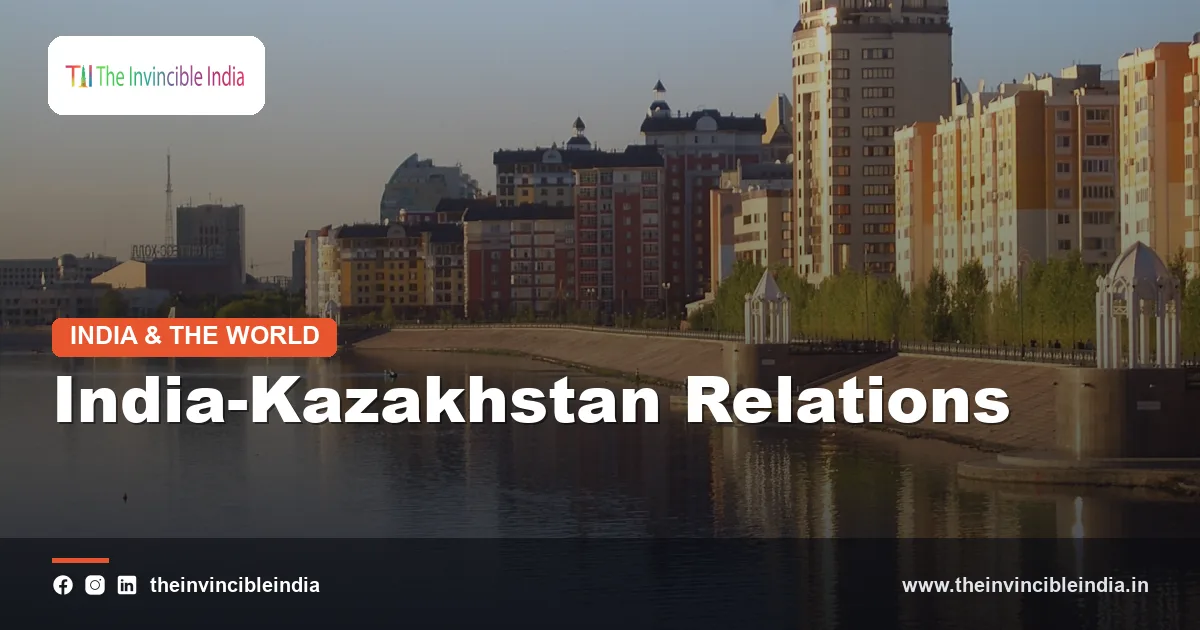
India-Kazakhstan relations are the bilateral ties between the Republic of India and the Republic of Kazakhstan, Central Asia’s largest economy and the world’s leading producer of uranium, and they rest on a strategic partnership established in 2009, cooperation in energy and civil nuclear supply, defence exercises, and growing interest in regional connectivity. Diplomatic relations began in 1992, soon after Kazakhstan became independent following the dissolution of the Soviet Union.
For India, Kazakhstan is the most significant partner in Central Asia because of its size, resources and location between Russia, China and the Caspian region. For Kazakhstan, India is a large, fast-growing market and a balancing partner in a multi-vector foreign policy. This explainer covers the history, the main pillars of cooperation, the practical obstacles that limit the relationship and the soft-power links between the two peoples, with live figures stated only in qualified terms.
Quick Facts: India-Kazakhstan Relations
| Attribute | Detail |
|---|---|
| Diplomatic relations established | 1992, after Kazakhstan’s independence from the Soviet Union (1991) |
| Level of partnership | Strategic partnership, announced in 2009 |
| Kazakhstan’s capital | Astana (known as Nur-Sultan between 2019 and 2022) |
| Key resource link | Uranium supplied by the Kazakh state company Kazatomprom for India’s civil nuclear programme |
| Policy framework | India’s Connect Central Asia policy (announced in 2012) and the India-Central Asia Summit format (first held virtually in January 2022) |
| Defence cooperation | Joint military exercise KAZIND and defence dialogues |
| Multilateral overlap | Both countries are members of the Shanghai Cooperation Organisation (SCO); India joined in 2017 |
| Connectivity routes | International North-South Transport Corridor (INSTC) and Iran’s Chabahar port |
| Soft-power links | Bollywood, yoga, Indian classical culture, students and a small Indian diaspora |
Key Takeaways
- India and Kazakhstan established diplomatic relations in 1992 and upgraded them to a strategic partnership in 2009.
- Kazakhstan is the world’s largest producer of uranium, and Indian state entities have signed multi-year purchase agreements for uranium from Kazakhstan’s Kazatomprom to fuel India’s civil nuclear reactors.
- India’s Connect Central Asia policy, announced in 2012, is the framework through which India approaches Kazakhstan and the other four Central Asian republics.
- The KAZIND military exercise is the bilateral defence engagement between the armies of India and Kazakhstan.
- India and Kazakhstan lack a direct land route, so trade and connectivity depend on corridors through Iran and Russia, including the International North-South Transport Corridor and the Chabahar port.
- Indian cinema, especially Bollywood, has long been popular in Kazakhstan and is widely cited as an instrument of India’s soft power there.
How did India-Kazakhstan relations begin?
India-Kazakhstan relations began in 1992, when the two countries established formal diplomatic ties after Kazakhstan became independent in December 1991 with the end of the Soviet Union. India had been a close friend of the Soviet Union, and its engagement with the new Central Asian republics built on that old network of familiarity.
Early contacts were modest. India opened an embassy in Almaty, then Kazakhstan’s capital, and later in Astana after the capital was moved in 1997. Kazakhstan’s first President, Nursultan Nazarbayev, visited India in the 1990s and again in later years, and he became a regular guest at Indian events, including as chief guest at the Republic Day parade in 2009.
The two countries share a history of contact that predates the modern state. The Silk Road linked India with the steppe, and Buddhist, Mughal and trading connections flowed across the region. Babur, the founder of the Mughal dynasty, came from the Fergana valley in neighbouring Uzbekistan, a reminder of the long overlapping geography of South and Central Asia.
What is the India-Kazakhstan strategic partnership?
The India-Kazakhstan strategic partnership is a framework announced in 2009 during the visit of President Nazarbayev to New Delhi, covering political dialogue, trade, energy, defence, science and culture. It signalled that both governments saw the relationship as more than routine diplomacy.
The partnership is supported by regular institutions rather than a single treaty:
- Joint Commission on Trade, Economic, Scientific and Technical Cooperation, which reviews economic cooperation.
- Joint Working Group on Counter-Terrorism, which allows information sharing on extremism and security threats.
- Foreign office consultations and summit meetings, held at various levels over the years.
Subsequent leaders have continued this track. Kazakhstan’s President Kassym-Jomart Tokayev, who took office in 2019, has continued to treat India as an important partner, and Indian leaders have visited Kazakhstan, including Prime Minister Narendra Modi’s 2015 visit to Astana, which was part of a five-country Central Asia tour.
Why is Kazakhstan important to India’s energy and nuclear programme?
Kazakhstan is important to India’s energy and nuclear programme because it is the world’s largest producer of uranium, the fuel for nuclear reactors, and India needs reliable supplies to expand its civil nuclear power. After the India-US civil nuclear agreement and the Nuclear Suppliers Group’s waiver in 2008 opened international nuclear commerce to India, Indian authorities began signing fuel contracts with several suppliers.
A civil nuclear cooperation agreement was signed with Kazakhstan around 2009, followed by supply contracts. In 2015, during the Prime Minister’s visit, Indian and Kazakh entities agreed on the supply of uranium over a multi-year period, widely reported as around five thousand tonnes, under a contract between Kazatomprom and the Department of Atomic Energy. Later extensions and further contracts have been reported, though readers should check current official sources for up-to-date quantities and terms.
Kazakhstan’s mining sector uses in-situ recovery methods, which dissolve uranium in place underground and pump the solution to the surface. India’s interest in the sector complements its domestic reserves, which are limited in grade and quantity relative to its planned expansion.
Other energy ties
Beyond uranium, India’s public-sector ONGC Videsh has had a long-standing interest in Kazakhstan’s hydrocarbon sector, including the Satpayev exploration block in the Caspian region. Oil and gas cooperation has been shaped by commercial results and by transport constraints, since Kazakhstan’s energy exports primarily travel through Russia and, more recently, through routes toward China and the Caspian.
What is India’s Connect Central Asia policy?
India’s Connect Central Asia policy is a broad diplomatic framework announced in 2012 to strengthen India’s political, economic, security and cultural links with the five Central Asian republics: Kazakhstan, Kyrgyzstan, Tajikistan, Turkmenistan and Uzbekistan. It was meant to give structure to India’s outreach in a region that Indian policy had long treated as part of an extended neighbourhood.
The policy has four main strands:
- political engagement through high-level visits and dialogues,
- economic partnership in energy, pharmaceuticals, IT and infrastructure,
- cooperation on security and counter-terrorism,
- cultural and educational exchange, including scholarships.
The format was strengthened in later years by the India-Central Asia Dialogue, a ministerial-level mechanism, and by the India-Central Asia Summit. The first summit was held virtually in January 2022 and brought the leaders of India and the five republics together, producing a framework document for continued cooperation. Kazakhstan, as the region’s largest economy, has been a central participant.
What does defence cooperation between India and Kazakhstan involve?
Defence cooperation between India and Kazakhstan involves military exercises, training exchanges, staff talks and security dialogue on terrorism and extremism. The flagship activity is KAZIND, a bilateral exercise between the two armies held in alternating locations and focused on counter-terrorism and mountain and urban operations.
Both countries are also members of the SCO, which has a regional anti-terrorism structure, and both share concerns over instability in Afghanistan and the spread of radical networks. Kazakhstan has offered training slots to Indian officers, and India has offered training to Kazakh personnel through its defence institutions and its Indian Technical and Economic Cooperation (ITEC) programme.
The relationship is not an alliance. Kazakhstan maintains a security relationship with Russia through the Collective Security Treaty Organization and has extensive economic ties with China, so defence cooperation with India is calibrated within a balanced foreign policy.
How do trade and connectivity work between India and Kazakhstan?
Trade and connectivity between India and Kazakhstan are limited by geography, since the two countries do not share a border and goods must pass through third countries, typically via Iran, Russia or the Caspian Sea. Bilateral trade has fluctuated around a modest scale, generally in the low billions of US dollars or below, and is well short of its potential given the size of both economies.
India exports pharmaceuticals, machinery, tea, textiles and agricultural products, while Kazakhstan exports uranium, minerals, metals and some energy products and grain-related goods. Several routes are central to improving connectivity:
| Route | Description | Main challenge |
|---|---|---|
| International North-South Transport Corridor (INSTC) | A multi-modal route linking India, Iran, Russia and Central Asia via sea, rail and road | Fragmented infrastructure, customs procedures and geopolitical risk |
| Chabahar port, Iran | An Indian-supported port on Iran’s Makran coast, offering access to Afghanistan and Central Asia | Sanctions concerns and uncertain investment flows |
| Caspian and trans-Caspian routes | Shipping and rail across the Caspian toward the Caucasus and Europe | Limited capacity and transhipment costs |
| Air links | Direct flights between Indian cities and Kazakh cities such as Almaty and Astana | Limited frequency and demand |
Kazakhstan has itself invested heavily in railways and dry ports to position itself as a Eurasian transit hub, and this fits with India’s desire to find an overland and multimodal route to the region that does not depend on Pakistan or China.
What soft power and people-to-people ties link the two countries?
Soft power and people-to-people ties link India and Kazakhstan chiefly through Indian cinema, yoga, Indian cuisine and education, and these ties are often described as the warmest part of the relationship. Bollywood films from the era of Raj Kapoor onward have been widely watched in Central Asia, and Hindi film songs remain familiar to many older audiences.
Several other channels support these links:
- Education: Kazakh students study in India, including under ITEC and scholarship programmes, and some Indian students study medicine in Kazakhstan.
- Yoga and culture: International Yoga Day events and Indian cultural centres promote Indian traditions in Kazakh cities.
- Diaspora: The Indian community in Kazakhstan is small, made up largely of students, professionals and traders, but it is active in cultural activities.
- Tourism: Travel between the two countries has grown slowly, helped by e-visa arrangements.
These links matter because they provide a base of public goodwill that supports government-level cooperation, even when formal trade lags behind expectations.
How do regional politics shape India-Kazakhstan relations?
Regional politics shape India-Kazakhstan relations by creating both opportunities and limits: Kazakhstan’s close ties with Russia and China, its membership in Russian-led groupings and the situation in Afghanistan all influence what the two countries can do together. Kazakhstan follows a long-standing multi-vector foreign policy, balancing relations with several major powers rather than aligning with one.
China’s Belt and Road Initiative has built extensive infrastructure in Central Asia, and India has chosen not to join it, citing sovereignty concerns about the China-Pakistan Economic Corridor. That means India competes for influence with a much larger investor while offering its own strengths, such as capacity building, pharmaceuticals, digital public infrastructure and lines of credit. Analysts differ on how far India can expand without direct land access, and both countries acknowledge that connectivity is the central constraint.
On the positive side, Kazakhstan has been a consistent supporter of dialogue, has hosted multilateral conferences such as the Conference on Interaction and Confidence Building Measures in Asia (CICA), and has welcomed India’s role in Eurasian forums.
What are the main challenges and the outlook?
The main challenges for India-Kazakhstan relations are the absence of direct overland access, a trade volume below potential, competition from larger investors and the effects of sanctions and conflict on transit routes through Russia and Iran. The outlook depends mostly on whether connectivity corridors can be made reliable and cost-effective.
Opportunities include:
- expanding long-term uranium and clean-energy cooperation,
- growth in pharmaceuticals, information technology and digital public services,
- deeper cooperation on counter-terrorism and Afghanistan-related stability,
- institutional use of the India-Central Asia Summit format.
Observers generally describe the relationship as friendly and steady but under-realised, with potential in sectors where both governments have shown continuing interest.
Bottom Line
India-Kazakhstan relations combine a strategic partnership, a uranium supply link and growing defence and cultural cooperation, held back mainly by geography and limited trade. Kazakhstan is India’s anchor partner in Central Asia, and the strength of the relationship will depend on how well connectivity and energy cooperation develop over the coming years.
Frequently Asked Questions
When did India and Kazakhstan establish diplomatic relations?
India and Kazakhstan established diplomatic relations in 1992, shortly after Kazakhstan gained independence from the Soviet Union in 1991. The relationship was upgraded to a strategic partnership in 2009. Embassies operate in New Delhi and in Astana.
Why is Kazakhstan important to India?
Kazakhstan is important to India because it is the largest producer of uranium in the world and Central Asia’s largest economy. It supplies fuel for India’s civil nuclear reactors and sits at a strategic crossroads between Russia, China and the Caspian region. It is also India’s main partner in Central Asia.
Does India buy uranium from Kazakhstan?
Yes, India buys uranium from Kazakhstan under civil nuclear supply agreements. The best-known deal was signed in 2015 and was widely reported to cover around five thousand tonnes over several years, with later contracts reported thereafter. Exact current quantities should be checked against official statements.
What is the KAZIND exercise?
KAZIND is a joint military exercise between the Indian Army and the Kazakh armed forces. It focuses on counter-terrorism, mountain operations and interoperability. The exercise is held on an alternating basis in each country.
What is India’s Connect Central Asia policy?
Connect Central Asia is India’s policy, announced in 2012, to deepen political, economic, security and cultural ties with the five Central Asian republics, including Kazakhstan. It underpins mechanisms such as the India-Central Asia Dialogue and the India-Central Asia Summit. The first summit was held virtually in January 2022.
How do goods travel between India and Kazakhstan?
Goods travel between India and Kazakhstan through third countries, since the two have no common border. Routes include the International North-South Transport Corridor through Iran and Russia, and the Chabahar port in Iran. Air cargo and trans-Caspian routes are also used on a smaller scale.
{“@context”:”https://schema.org”,”@graph”:[{“@type”:”FAQPage”,”mainEntity”:[{“@type”:”Question”,”name”:”When did India and Kazakhstan establish diplomatic relations?”,”acceptedAnswer”:{“@type”:”Answer”,”text”:”India and Kazakhstan established diplomatic relations in 1992, shortly after Kazakhstan gained independence from the Soviet Union in 1991. The relationship was upgraded to a strategic partnership in 2009. Embassies operate in New Delhi and in Astana.”}},{“@type”:”Question”,”name”:”Why is Kazakhstan important to India?”,”acceptedAnswer”:{“@type”:”Answer”,”text”:”Kazakhstan is important to India because it is the largest producer of uranium in the world and Central Asia’s largest economy. It supplies fuel for India’s civil nuclear reactors and sits at a strategic crossroads between Russia, China and the Caspian region. It is also India’s main partner in Central Asia.”}},{“@type”:”Question”,”name”:”Does India buy uranium from Kazakhstan?”,”acceptedAnswer”:{“@type”:”Answer”,”text”:”Yes, India buys uranium from Kazakhstan under civil nuclear supply agreements. The best-known deal was signed in 2015 and was widely reported to cover around five thousand tonnes over several years, with later contracts reported thereafter. Exact current quantities should be checked against official statements.”}},{“@type”:”Question”,”name”:”What is the KAZIND exercise?”,”acceptedAnswer”:{“@type”:”Answer”,”text”:”KAZIND is a joint military exercise between the Indian Army and the Kazakh armed forces. It focuses on counter-terrorism, mountain operations and interoperability. The exercise is held on an alternating basis in each country.”}},{“@type”:”Question”,”name”:”What is India’s Connect Central Asia policy?”,”acceptedAnswer”:{“@type”:”Answer”,”text”:”Connect Central Asia is India’s policy, announced in 2012, to deepen political, economic, security and cultural ties with the five Central Asian republics, including Kazakhstan. It underpins mechanisms such as the India-Central Asia Dialogue and the India-Central Asia Summit. The first summit was held virtually in January 2022.”}},{“@type”:”Question”,”name”:”How do goods travel between India and Kazakhstan?”,”acceptedAnswer”:{“@type”:”Answer”,”text”:”Goods travel between India and Kazakhstan through third countries, since the two have no common border. Routes include the International North-South Transport Corridor through Iran and Russia, and the Chabahar port in Iran. Air cargo and trans-Caspian routes are also used on a smaller scale.”}}]}]}


