

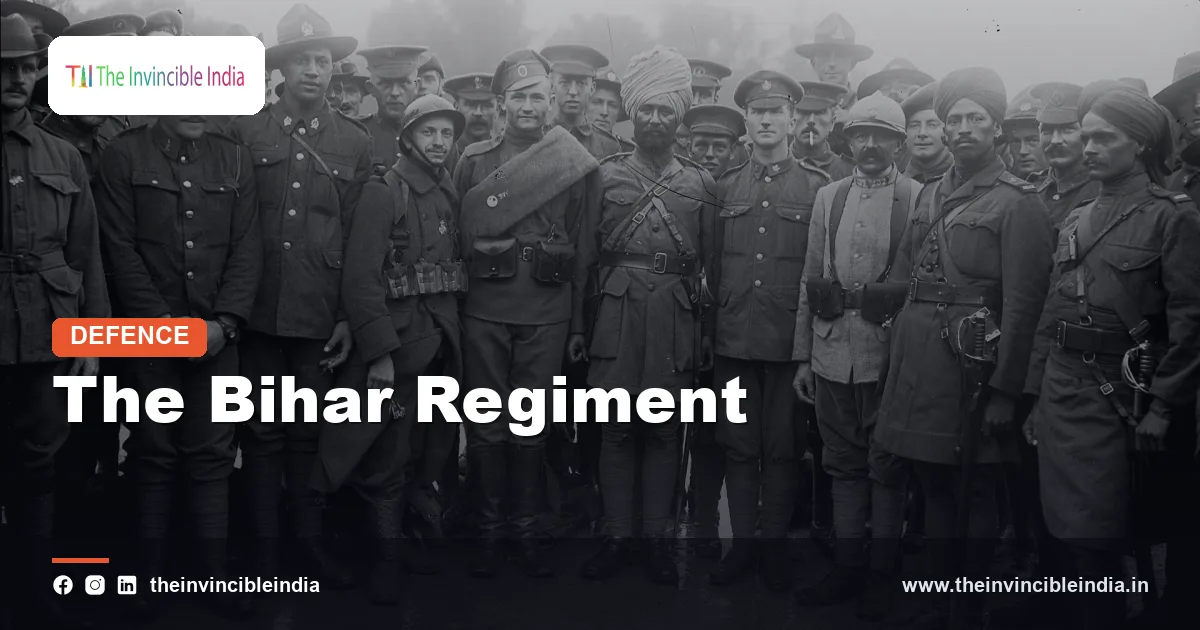
The Bihar Regiment is an infantry regiment of the Indian Army, raised in 1941 and drawing its soldiers largely from the states of Bihar and Jharkhand, with its Regimental Centre at Danapur Cantonment near Patna. The regiment fights under the motto “Karm Hi Dharm” and the war cry “Jai Bajrang Bali”, and it has served in the major conflicts and counter-insurgency campaigns of independent India.
In public memory, the Bihar Regiment is linked above all to two moments: the fighting around the Batalik sector during the Kargil conflict of 1999 and the deadly clash with Chinese troops in the Galwan Valley in June 2020. This explainer sets out how the Bihar Regiment was formed, how it is organised and trained, what its traditions are, and what the record shows, while taking care to separate verified facts from commonly repeated confusions.
Quick Facts: Bihar Regiment
| Attribute | Detail |
|---|---|
| Type | Infantry regiment of the Indian Army |
| Raised | 1941 (First Battalion, formed during the Second World War) |
| Regimental Centre | Danapur Cantonment, near Patna, Bihar |
| Principal recruiting region | Bihar and Jharkhand |
| Motto | Karm Hi Dharm (duty or action is one’s dharma) |
| War cry | Jai Bajrang Bali (a second cry, Birsa Munda Ki Jai, is also associated with the regiment) |
| Parent service | Indian Army, under the Ministry of Defence |
| Best-known recent actions | Batalik sector, Kargil conflict (1999); Galwan Valley clash (June 2020) |
| Composition | All-class infantry; numbered regular battalions plus training and administrative elements at the Centre |
Key Takeaways
- The Bihar Regiment is an Indian Army infantry regiment raised in 1941 whose Regimental Centre is located at Danapur Cantonment near Patna.
- The Bihar Regiment recruits mainly from Bihar and Jharkhand and uses the motto “Karm Hi Dharm” and the war cry “Jai Bajrang Bali”.
- During the 1999 Kargil conflict, the 1st Battalion of the Bihar Regiment fought in the Batalik sector, where it is credited with capturing a number of high-altitude positions.
- Colonel B. Santosh Babu, commanding officer of the 16th Battalion of the Bihar Regiment (16 Bihar), was killed in the Galwan Valley clash of 15 June 2020 and was posthumously awarded the Maha Vir Chakra.
- The Bihar Regiment is a different unit from regiments with similar-sounding associations; for example, Captain Manoj Kumar Pandey of Kargil fame belonged to the Gorkha Rifles, not the Bihar Regiment.
- Danapur Cantonment, home of the Bihar Regimental Centre, is among the oldest military stations in eastern India, dating to the eighteenth century.
What is the Bihar Regiment?
The Bihar Regiment is a line infantry regiment of the Indian Army, a body of foot soldiers organised into numbered battalions that share a common identity, training base, traditions and recruiting pool. Like other infantry regiments, the Bihar Regiment does not fight as one unit; its individual battalions are posted across the country and are placed under larger Army formations such as brigades and divisions.
The regiment is one of the youngest of the Army’s older regimental units, having been created during the Second World War rather than in the nineteenth century. Its battalions are identified by number followed by the word “Bihar”, so that “16 Bihar” means the 16th Battalion of the Bihar Regiment. The Indian Army has a long tradition of regimental identity, in which a soldier’s loyalty to his battalion and regiment sits alongside his loyalty to the nation, and the Bihar Regiment follows this model.
The regiment’s soldiers are infantrymen, trained to hold ground, assault positions and conduct counter-insurgency operations. Many of its battalions have served in high-altitude terrain, in the north-east, in Jammu and Kashmir and in peacekeeping and overseas deployments.
When and how was the Bihar Regiment raised?
The Bihar Regiment was raised in 1941, and its first battalion was formed by redesignating an existing battalion that had belonged to the older Hyderabad Regiment of the pre-independence Indian Army. This lineage link is widely stated in regimental accounts, although readers should treat precise details of the early reorganisation with some caution, because summaries from different sources vary slightly.
The timing mattered. In 1941 the British Indian Army was expanding rapidly to meet the demands of the Second World War, and new regiments were created to widen the recruiting base beyond the so-called martial races that had dominated recruitment in earlier decades. A regiment named after Bihar reflected the large population of the province and its manpower, which had historically been under-represented in the combat arms relative to its size.
After India became independent in 1947, the regiment continued as part of the Indian Army. Further battalions were added over the following decades, particularly during the expansion of the Army after the 1962 war with China, so the Bihar Regiment today comprises many more battalions than the single one it started with.
Where is the Bihar Regiment Centre and how does it train recruits?
The Bihar Regimental Centre is located at Danapur Cantonment, a historic military station on the Ganga about ten kilometres from the centre of Patna. A regimental centre is the home base of an infantry regiment: it receives new recruits, trains them in basic soldiering and infantry skills, holds the regiment’s records and traditions, and supports battalions in the field.
Danapur is one of the older cantonments in the region and was established by the East India Company in the later eighteenth century. The Bihar Regimental Centre is the training and administrative core of the regiment, and a recruit’s journey typically follows a standard pattern:
- Selection: candidates are chosen through recruitment rallies and written and physical tests conducted by the Army’s recruiting machinery.
- Basic training: recruits undergo several months of physical conditioning, weapon handling, drill and field craft at the Centre.
- Attestation and passing out: after training, soldiers take their oath in a formal passing-out ceremony and are posted to a battalion.
- Specialist courses: as they advance, soldiers attend courses in areas such as weapons, signals, medical aid and leadership.
The Centre also houses the regimental museum and memorials, and it serves as the focus for ceremonies on regimental anniversaries and remembrance days.
Who serves in the Bihar Regiment and where do its soldiers come from?
The Bihar Regiment recruits mainly from the states of Bihar and Jharkhand, which were a single state until Jharkhand was carved out in 2000. This is the regiment’s defining demographic feature: its soldiers come from the plains communities of Bihar and from the tribal and forest districts that now form Jharkhand.
The regiment is an all-class unit, meaning that its battalions are mixed in composition instead of being built around a single caste, community or religion, as some older regiments are. This follows the broader Indian Army policy of building mixed units, and it makes the Bihar Regiment a useful illustration of how a modern infantry regiment can reflect a regional identity without being exclusive to one group.
The association with Jharkhand explains why the regiment’s traditions include a reference to Birsa Munda, the tribal leader and freedom fighter of the late nineteenth century who is revered in the region. Regimental accounts associate the cry “Birsa Munda Ki Jai” with the regiment alongside its better-known war cry. The regiment’s strength is therefore tied to the economy and social life of eastern India: military service is a significant source of employment and prestige in many villages of the two states.
What are the motto, war cry and traditions of the Bihar Regiment?
The Bihar Regiment’s motto is “Karm Hi Dharm”, which can be rendered as “duty is dharma” or “action is one’s sacred duty”, and its principal war cry is “Jai Bajrang Bali”, an invocation of the Hindu deity Hanuman. Indian infantry regiments generally have distinct war cries, which are shouted by troops going into battle and used to reinforce unit cohesion.
Within the Army’s secular framework, regimental war cries are treated as part of the heritage of the unit. They do not imply a religious requirement for individual soldiers, and soldiers of every faith serve in mixed units. Other regiments use cries drawn from different traditions, such as the Sikh Regiment’s religious call, the Gorkha Rifles’ “Jai Mahakali, Ayo Gorkhali”, or the Rajput Regiment’s invocation of a regional deity.
The regiment also maintains the customary elements of Indian Army regimental life:
- a regimental insignia, badge and colours,
- a regimental song and band,
- annual commemorations at the Centre and in the battalions,
- a roll of honour recording gallantry awards and battle honours.
What operations has the Bihar Regiment taken part in since 1947?
The Bihar Regiment’s battalions have been deployed in many of the operations that have shaped independent India’s military history, including wars on the borders, counter-insurgency in Jammu and Kashmir and the north-east, and peacekeeping and humanitarian missions. Because individual battalion records are detailed and sometimes contested in public accounts, only the broad pattern is summarised here.
| Period | Context | Bihar Regiment’s role |
|---|---|---|
| 1941 | Second World War expansion | Regiment raised; First Battalion formed |
| 1947 onward | Partition and the first Kashmir conflict | Regiment continues in the Indian Army; battalions serve in operations in the early post-independence years |
| 1960s | War with China (1962) and Army expansion | New battalions added as the Army grows |
| 1965 and 1971 | Wars with Pakistan | Battalions deployed on western and eastern fronts, as with many infantry units |
| 1980s to 1990s | Counter-insurgency, Siachen region, peacekeeping | Battalions rotate through high-altitude, north-eastern and Jammu and Kashmir postings |
| 1999 | Kargil conflict | 1 Bihar fights in the Batalik sector |
| 2020 | Galwan Valley clash, eastern Ladakh | 16 Bihar engaged; its commanding officer killed |
The table is intended as an orientation to the regiment’s history rather than a full list of battle honours. Readers who need the exact battle and theatre honours awarded to specific battalions should consult official Army or Ministry of Defence publications.
What was the Bihar Regiment’s role in the Kargil War of 1999?
During the 1999 Kargil conflict, the 1st Battalion of the Bihar Regiment (1 Bihar) fought in the Batalik sector, one of the sub-sectors where Pakistani troops and militants had occupied heights across the Line of Control. The Batalik sector lies east of the Kargil town, along the Indus-side ridgelines, and its terrain forced Indian troops to climb steep slopes under fire to dislodge entrenched positions.
The battalion is credited with capturing several important heights in the sector, including positions near Jubar and neighbouring features, and it earned the battle honour “Batalik” and, as is commonly reported, the theatre honour “Kargil”. Among those who died in the fighting was Major M. Saravanan of 1 Bihar, who was posthumously awarded the Vir Chakra for his leadership in the Batalik sector.
It is important to separate this record from other well-known Kargil stories. Captain Manoj Kumar Pandey, who won the Param Vir Chakra at Khalubar, belonged to the 1st Battalion of the 11 Gorkha Rifles, not to the Bihar Regiment. Rifleman Sanjay Kumar, another Param Vir Chakra recipient, was from the Jammu and Kashmir Rifles. Public discussion sometimes blends these accounts, so a careful reading of each unit’s own record avoids attributing the actions of one regiment to another.
Why was Batalik difficult?
The Batalik sector was difficult because the heights were above 4,000 metres in many places, the approaches were exposed and narrow, and the defenders had the advantage of observation and fire. Indian units had to fight at night, in thin air and in freezing conditions, and logistics depended on porters and mule trains. These conditions explain why the sector became a test of infantry stamina, junior leadership and artillery coordination.
What happened in the Galwan Valley in June 2020 and how is the Bihar Regiment linked?
The Galwan Valley clash of 15 June 2020 was a violent confrontation between Indian and Chinese troops in eastern Ladakh in which twenty Indian soldiers were killed, and the Bihar Regiment is linked to it because Colonel B. Santosh Babu, the commanding officer of the 16th Battalion of the Bihar Regiment, was among those who died. The clash occurred in the Galwan River valley near the Line of Actual Control after weeks of tension, and it was fought in hand-to-hand conditions with improvised weapons rather than firearms, in line with long-standing border agreements that discourage the use of guns.
Colonel Santosh Babu was posthumously awarded the Maha Vir Chakra, India’s second-highest wartime gallantry award, in the 2021 honours list. Other soldiers who took part in the same clash were also decorated for gallantry. The exact casualty figures on the Chinese side have not been independently settled in the public record, and different governments have offered different accounts, so this explainer limits itself to the widely acknowledged Indian figures.
The Galwan clash is remembered in India as a defining event in modern border history. It brought the Bihar Regiment’s name into national attention, and the regiment’s battalions are among the units whose service in eastern Ladakh has been recognised in the years since.
How is an infantry regiment like the Bihar Regiment organised?
An infantry regiment like the Bihar Regiment is organised into a regimental centre and a number of numbered battalions, with each battalion commanded by a colonel and made up of several companies. The battalion is the real fighting unit; the regiment is an administrative and traditional umbrella.
- Soldier and section: the smallest building blocks are sections of about ten soldiers.
- Platoon and company: several sections form a platoon, and several platoons form a company, commanded by a major.
- Battalion: a battalion of roughly eight hundred to a thousand personnel, led by a colonel as commanding officer.
- Brigade and division: battalions from different regiments are grouped into brigades, which sit within divisions and corps.
This is why a brigade in Ladakh may contain a Bihar battalion alongside units from other regiments. Regimental affiliation shapes training and identity, while operational command follows the formation structure.
Why does the Bihar Regiment matter?
The Bihar Regiment matters because it is a regionally rooted but nationally deployed fighting force, because its battalions have been central to two of the most widely remembered Indian military episodes since 1999, and because it shows how Army regiments connect villages in eastern India to the frontier. The regiment has helped to broaden the Army’s recruiting profile and to give an institutional home to soldiers from a populous but historically less represented region.
Its history also illustrates a wider point about the Indian Army: units built in the colonial period have been adapted to the demands of a republic with a very different political culture, and new regiments created in the 1940s have since matured into battle-tested organisations with their own honours. Care is needed, however, with popular storytelling. Gallantry awards, battle honours and individual accounts should always be checked against official records, because stories in the media sometimes merge units, dates and ranks.
Bottom Line
The Bihar Regiment is an Indian Army infantry regiment raised in 1941, based at Danapur and drawing recruits mainly from Bihar and Jharkhand. Its record includes the Batalik sector in Kargil in 1999 and the Galwan Valley clash in 2020, where Colonel B. Santosh Babu of 16 Bihar was killed. Accurate attribution of gallantry awards and battle honours matters, and the regiment should not be confused with other units that served in the same campaigns.
Frequently Asked Questions
When was the Bihar Regiment raised?
The Bihar Regiment was raised in 1941, during the Second World War. Its first battalion was formed by redesignating an existing battalion from an older regiment of the pre-independence Indian Army. The regiment then grew with additional battalions after independence.
Where is the Bihar Regiment Centre located?
The Bihar Regimental Centre is located at Danapur Cantonment, close to Patna in Bihar. It trains recruits, preserves regimental records and traditions, and supports the regiment’s battalions. Danapur is one of the older military stations in eastern India.
What is the war cry of the Bihar Regiment?
The war cry of the Bihar Regiment is “Jai Bajrang Bali”, an invocation of Hanuman. The regiment’s motto is “Karm Hi Dharm”, meaning duty is dharma. The cry “Birsa Munda Ki Jai” is also associated with the regiment because of its links to Jharkhand.
What did the Bihar Regiment do in the Kargil War?
The 1st Battalion of the Bihar Regiment fought in the Batalik sector during the 1999 Kargil conflict. It is credited with capturing high-altitude positions and is reported to have earned the Batalik battle honour. Major M. Saravanan of 1 Bihar was posthumously awarded the Vir Chakra.
Which Bihar Regiment officer died in the Galwan Valley clash?
Colonel B. Santosh Babu, commanding officer of the 16th Battalion of the Bihar Regiment, died in the Galwan Valley clash of 15 June 2020. He was posthumously awarded the Maha Vir Chakra. Twenty Indian soldiers were killed in the same confrontation.
Was Captain Manoj Kumar Pandey from the Bihar Regiment?
No, Captain Manoj Kumar Pandey was not from the Bihar Regiment. He belonged to the 1st Battalion of the 11 Gorkha Rifles and received the Param Vir Chakra for his actions in the Kargil conflict. The confusion arises because several regiments fought in the same campaign.
{“@context”:”https://schema.org”,”@graph”:[{“@type”:”FAQPage”,”mainEntity”:[{“@type”:”Question”,”name”:”When was the Bihar Regiment raised?”,”acceptedAnswer”:{“@type”:”Answer”,”text”:”The Bihar Regiment was raised in 1941, during the Second World War. Its first battalion was formed by redesignating an existing battalion from an older regiment of the pre-independence Indian Army. The regiment then grew with additional battalions after independence.”}},{“@type”:”Question”,”name”:”Where is the Bihar Regiment Centre located?”,”acceptedAnswer”:{“@type”:”Answer”,”text”:”The Bihar Regimental Centre is located at Danapur Cantonment, close to Patna in Bihar. It trains recruits, preserves regimental records and traditions, and supports the regiment’s battalions. Danapur is one of the older military stations in eastern India.”}},{“@type”:”Question”,”name”:”What is the war cry of the Bihar Regiment?”,”acceptedAnswer”:{“@type”:”Answer”,”text”:”The war cry of the Bihar Regiment is “Jai Bajrang Bali”, an invocation of Hanuman. The regiment’s motto is “Karm Hi Dharm”, meaning duty is dharma. The cry “Birsa Munda Ki Jai” is also associated with the regiment because of its links to Jharkhand.”}},{“@type”:”Question”,”name”:”What did the Bihar Regiment do in the Kargil War?”,”acceptedAnswer”:{“@type”:”Answer”,”text”:”The 1st Battalion of the Bihar Regiment fought in the Batalik sector during the 1999 Kargil conflict. It is credited with capturing high-altitude positions and is reported to have earned the Batalik battle honour. Major M. Saravanan of 1 Bihar was posthumously awarded the Vir Chakra.”}},{“@type”:”Question”,”name”:”Which Bihar Regiment officer died in the Galwan Valley clash?”,”acceptedAnswer”:{“@type”:”Answer”,”text”:”Colonel B. Santosh Babu, commanding officer of the 16th Battalion of the Bihar Regiment, died in the Galwan Valley clash of 15 June 2020. He was posthumously awarded the Maha Vir Chakra. Twenty Indian soldiers were killed in the same confrontation.”}},{“@type”:”Question”,”name”:”Was Captain Manoj Kumar Pandey from the Bihar Regiment?”,”acceptedAnswer”:{“@type”:”Answer”,”text”:”No, Captain Manoj Kumar Pandey was not from the Bihar Regiment. He belonged to the 1st Battalion of the 11 Gorkha Rifles and received the Param Vir Chakra for his actions in the Kargil conflict. The confusion arises because several regiments fought in the same campaign.”}}]}]}


