

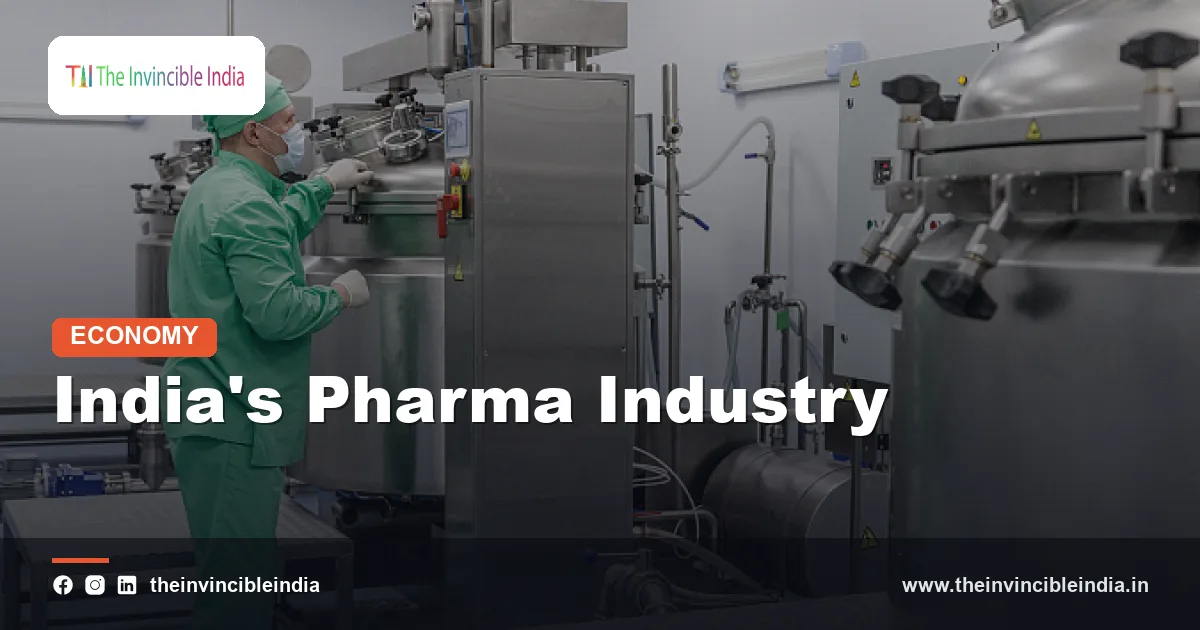
The India pharmaceutical industry is one of the quiet success stories of the country’s modern economy. From a landscape dominated by imported branded drugs in the 1960s, India has grown into one of the world’s largest producers of medicines by volume, earning the nickname “pharmacy of the world”. Tablets, capsules, injections, syrups and vaccines made in factories from Hyderabad to Ahmedabad and from Baddi to Bengaluru reach patients in well over two hundred countries.
What makes the story remarkable is not just scale but purpose. Indian manufacturers built their reputation on affordable generic medicines – copies of off-patent drugs sold at a fraction of the originator’s price. That approach transformed the treatment of HIV/AIDS in the developing world, put life-saving vaccines within reach of poor countries, and now fills a large share of prescriptions even in the United States. This explainer walks through how the industry began, the law that shaped it, its main segments and companies, and the challenges it must now solve.
Quick Facts
| Aspect | Details |
|---|---|
| Popular nickname | “Pharmacy of the world” |
| Core strength | Affordable generic medicines and vaccines |
| Landmark law | Patents Act, 1970 (in force from 1972) – process patents only for drugs |
| Return of product patents | Patents (Amendment) Act, 2005, following the TRIPS Agreement of the WTO |
| Key safeguard | Section 3(d) of the Patents Act, upheld in the Novartis-Glivec case (2013) |
| Drug regulator | Central Drugs Standard Control Organisation (CDSCO), headed by the Drugs Controller General of India |
| Price regulator | National Pharmaceutical Pricing Authority (NPPA), set up in 1997 |
| World’s largest vaccine maker (by doses) | Serum Institute of India, Pune, founded 1966 |
| Biggest vulnerability | Heavy import dependence on China for active pharmaceutical ingredients (APIs) |
Why India Is Called the Pharmacy of the World
The phrase is not just a slogan. India is generally ranked among the top three or four countries in the world by volume of pharmaceutical production, even though it ranks lower when measured by the value of sales. The gap exists because Indian companies sell low-priced generics in enormous quantities rather than expensive patented innovator drugs.
What the numbers broadly show
- India supplies a large share of the world’s generic medicines by volume – commonly estimated at around one-fifth of global generic exports.
- India is among the biggest suppliers of vaccines, with international agencies often citing a majority of the world’s childhood vaccine doses as originating from Indian factories.
- Indian firms supply a substantial portion of generic prescriptions filled in the United States, one of the world’s most tightly regulated drug markets.
- Exports go to Africa, Latin America, South-East Asia, Europe and North America, and form one of India’s most consistent export earners.
Why generics matter
A generic drug contains the same active ingredient, dose and form as a branded drug whose patent has expired. Because makers do not need to repeat expensive clinical trials, they can charge far less. For health systems and families that pay for medicines out of pocket, this price gap often decides whether a treatment is affordable at all.
The Early Years: Industry Before 1970
At Independence in 1947, India’s drug market was dominated by multinational companies that imported finished medicines or carried out limited local packaging. Domestic production was small, and most active ingredients came from abroad. A few Indian pioneers existed, including Bengal Chemical and Pharmaceutical Works, founded by Acharya Prafulla Chandra Ray in 1901, and Cipla, established by K. A. Hamied in 1935.
The public sector push
The new government recognised that a poor country could not rely entirely on imports for medicines. In the 1950s and 1960s it set up public sector units, notably Hindustan Antibiotics Limited at Pimpri (1954) with assistance from the World Health Organization and UNICEF, and Indian Drugs and Pharmaceuticals Limited (1961). These companies produced penicillin and other essential drugs and trained a generation of Indian chemists and process engineers.
A market that was expensive
Despite this, prices of medicines in India were among the highest in the world in the 1960s. Foreign patent holders controlled much of the market, and local firms had little room to manufacture the same drugs. This frustration set the stage for a major change in the law.
The Patents Act, 1970: Process Patents and the Generic Boom
The turning point came with the Patents Act, 1970, which replaced an older colonial-era law and came into force in 1972. Its most consequential feature was how it treated medicines. For food, drugs and chemicals, the Act allowed patents only on the process of making a substance – not on the product itself – and for a short period of about five to seven years.
Why that mattered
Under a product patent, nobody else may make the molecule at all. Under a process patent, a rival may make exactly the same molecule as long as it uses a different method. Indian chemists therefore began to reverse-engineer foreign drugs, devising their own routes of synthesis. This skill, built up over decades, is the technical foundation of the industry today.
Supporting policies
- The Drugs Price Control Order and later price rules kept essential medicines within reach.
- Foreign-exchange and licensing rules encouraged domestic production over imports.
- Public research bodies such as the Council of Scientific and Industrial Research (CSIR) laboratories, including the National Chemical Laboratory in Pune and the Indian Institute of Chemical Technology in Hyderabad, shared process know-how with industry.
By the 1990s Indian companies had overtaken multinationals in domestic market share, and many had begun exporting to markets where drugs were already off patent.
HIV/AIDS Drugs and Global Health
If one episode defines India’s global reputation in medicine, it is the fight over HIV/AIDS treatment. In the late 1990s, patented antiretroviral therapy cost thousands of dollars per patient each year, putting it out of reach in most of Africa and Asia. Millions of people were dying while effective drugs existed.
The turning point
In 2001, Cipla’s chairman Yusuf Hamied offered a triple-drug antiretroviral combination to humanitarian groups at a price of under a dollar a day. The offer shocked the global industry and showed that generic competition could cut costs drastically. Other Indian manufacturers soon followed, and prices fell sharply over the next few years.
Lasting impact
- Indian generic antiretrovirals became the backbone of large international treatment programmes, including those funded by the United States’ PEPFAR initiative and the Global Fund.
- Fixed-dose combinations, which combine several drugs in a single pill, made treatment simpler for patients in poor settings.
- The episode strengthened the argument made at the WTO that public health must be balanced against patent rights, reflected in the Doha Declaration of 2001 on TRIPS and public health.
India’s role in treating diseases such as tuberculosis, malaria and hepatitis C, using affordable generics, followed the same pattern.
TRIPS and 2005: The Return of Product Patents
When India became a founding member of the World Trade Organization in 1995, it agreed to the Agreement on Trade-Related Aspects of Intellectual Property Rights (TRIPS). The agreement required member countries to grant product patents on pharmaceuticals, normally for twenty years. India used its transition period and finally amended its law through the Patents (Amendment) Act, 2005, restoring product patents for drugs from 1 January 2005.
Safeguards written into the law
- Section 3(d): A new form of a known substance is not patentable unless it shows significantly enhanced therapeutic efficacy. This is meant to block “evergreening”, where a company obtains fresh patents on minor tweaks to extend its monopoly.
- Compulsory licensing: The government can authorise a third party to make a patented drug if it is not available at a reasonably affordable price or in adequate quantity. The first compulsory licence was granted in 2012 to Natco Pharma for a cancer drug.
- Pre-grant and post-grant opposition: Patients’ groups and competitors can challenge a patent application before or after it is granted.
The Novartis-Glivec case
In 2013, the Supreme Court of India rejected Novartis’s application to patent the beta-crystalline form of imatinib mesylate, sold as Glivec. The Court held that the claimed form did not show the enhanced efficacy required by Section 3(d). The verdict was closely watched around the world and is regarded as a landmark in balancing innovation incentives with access to medicines.
Segments of the Industry
The industry is not one block. It is a chain of linked activities, from basic chemicals to finished tablets, and from routine generics to advanced biologics. The table below summarises the major segments.
| Segment | What it covers | Position of India |
|---|---|---|
| Generic formulations | Finished tablets, capsules, injectables and syrups sold under generic or brand-generic names | The core of the industry and the largest export earner |
| Bulk drugs / APIs | Active pharmaceutical ingredients, the chemicals that make a medicine work | Large producer, but dependent on imports of key intermediates, especially from China |
| Biosimilars | Near-copies of complex biological medicines made from living cells, such as insulin and cancer antibodies | Growing strongly, led by firms such as Biocon and Dr Reddy’s |
| Vaccines | Immunisation products for children and adults, including COVID-19 vaccines | Among the world’s largest suppliers by volume |
| Contract research and manufacturing (CRAMS / CDMO) | Research, development and manufacturing services for foreign pharmaceutical companies | An expanding area where cost and chemistry skills are an advantage |
| OTC and Ayurvedic products | Over-the-counter medicines, herbal and traditional formulations | Large domestic market with growing exports |
Formulations are the most visible segment, because they are what patients actually buy. APIs sit upstream and decide how self-reliant the whole chain really is.
APIs and the Dependence on China
There is an irony at the centre of the Indian pharmaceutical story. A country called the pharmacy of the world has relied heavily on imports for the basic chemicals that go into its own medicines. In the 1990s India produced most of the APIs it needed. As Chinese manufacturers scaled up with cheap power, large fermentation plants and strong chemical clusters, Indian firms found imports cheaper than making the material themselves, and many domestic API lines were shut down.
Why it became a concern
The dependence became a national worry during the COVID-19 pandemic, when lockdowns and trade disruptions in China threatened supply chains of key ingredients, including antibiotics such as penicillin-group intermediates and vitamins. A single country supplying a large share of critical inputs is a strategic vulnerability for both India’s health system and its exports.
Policy response
- Production Linked Incentive (PLI) schemes: Launched around 2020-21, the PLI scheme for bulk drugs offers financial incentives for domestic manufacture of critical starting materials and APIs. A separate PLI scheme supports pharmaceutical formulations and high-value products.
- Bulk drug parks: The government approved the development of dedicated bulk drug parks with shared infrastructure, such as common effluent treatment, to lower costs.
- Focus on key starting materials: Policy attention has shifted to the earliest chemical building blocks, where dependence is highest.
Rebuilding capacity will take years, since API manufacturing is capital-intensive and faces strict environmental rules.
Vaccines: Serum Institute, Covishield and Vaccine Maitri
India’s vaccine industry is a global heavyweight. The Serum Institute of India, founded in Pune in 1966 by Cyrus Poonawalla, is recognised as the world’s largest vaccine manufacturer by number of doses produced. Its vaccines against diseases such as measles, polio, diphtheria, tetanus and pertussis are supplied to many countries, often through UNICEF and other international agencies. Other major players include Bharat Biotech in Hyderabad, Biological E and Zydus.
The COVID-19 effort
- Covishield: The Oxford-AstraZeneca vaccine, manufactured at scale by the Serum Institute under licence.
- Covaxin: An indigenous inactivated-virus vaccine developed by Bharat Biotech in collaboration with the Indian Council of Medical Research (ICMR) and the National Institute of Virology.
- India’s national vaccination drive, which began in January 2021, relied overwhelmingly on these two vaccines.
Vaccine Maitri
In January 2021 India launched the “Vaccine Maitri” (vaccine friendship) initiative, supplying doses to dozens of countries through a mix of grants, commercial sales and the COVAX facility. The effort showcased India’s capacity to act as a supplier to the developing world, although a domestic surge in cases in 2021 forced a temporary pause in exports. It remains a significant example of pharmaceutical capacity doubling as a tool of diplomacy.
The Big Companies
The industry combines a handful of large multinational-scale firms with thousands of small and medium units, many clustered in Gujarat, Maharashtra, Telangana, Himachal Pradesh and Andhra Pradesh.
- Sun Pharmaceutical Industries: Founded by Dilip Shanghvi in 1983, it is among India’s largest drug makers and acquired Ranbaxy in 2014.
- Dr. Reddy’s Laboratories: Founded in Hyderabad in 1984 by K. Anji Reddy, with strengths in generics, APIs and biosimilars.
- Cipla: Established in 1935 and famous for its role in affordable HIV treatment and respiratory medicines.
- Lupin: Founded in 1968, known for its anti-tuberculosis drugs and large US generic portfolio.
- Zydus Lifesciences, Aurobindo Pharma, Torrent and Mankind: Large players across domestic and export markets.
- Biocon: Founded by Kiran Mazumdar-Shaw in 1978, a leader in biosimilars and insulin.
- Serum Institute of India and Bharat Biotech: The two best-known vaccine makers.
Many of these companies have built factories and acquired businesses abroad, and several of their plants have been inspected and approved by foreign regulators such as the United States Food and Drug Administration (USFDA).
Regulation, Pricing and Quality
Who regulates drugs
The legal base is the Drugs and Cosmetics Act, 1940, along with its rules. At the national level, the Central Drugs Standard Control Organisation (CDSCO), under the Union Ministry of Health and Family Welfare, approves new drugs, clinical trials and imports, and sets standards. It is headed by the Drugs Controller General of India (DCGI). State drug regulators license manufacturing and sales within their territories, which means oversight is shared between the Centre and the states.
Price control
The National Pharmaceutical Pricing Authority (NPPA), created in 1997, fixes and monitors prices of medicines listed in the National List of Essential Medicines under the Drugs (Prices Control) Order, 2013. Non-listed drugs may rise only by a limited percentage each year. Alongside, the Jan Aushadhi scheme sells low-cost generic medicines through dedicated stores.
Quality concerns
The industry’s reputation has been tested by quality lapses. Several Indian plants have received warning letters and import alerts from the USFDA over data integrity and manufacturing standards. In 2022-23, contaminated cough syrups linked to some Indian-made products were implicated in child deaths in other countries, prompting investigations and tighter export testing rules. Authorities have since stressed upgrading good manufacturing practice standards, particularly for smaller manufacturers. These episodes involve a minority of producers, but they affect the credibility of the whole sector.
Challenges and the Road Ahead
For all its strength, the industry faces a set of connected challenges.
From generics to innovation
Indian firms spend far less on research as a share of sales than global innovators. The next stage is moving up the value chain – developing new chemical entities, complex generics, biosimilars, and cell and gene therapies. A few companies have started discovery programmes, but the leap from copying to inventing is long and risky, and requires patient capital and strong academic links.
Other pressures
- API dependence: Reducing reliance on a single foreign supplier remains the top strategic priority.
- Pricing pressure: Intense competition and price controls squeeze margins, especially at the lower end of the market.
- Compliance: Tighter global inspections demand constant investment in quality systems.
- Intellectual property disputes: Pressure from trade partners to strengthen patent protection continues, creating tension with India’s access-focused approach.
- Environmental rules: Effluent and emissions norms for chemical plants are growing stricter.
Why it matters
The India pharmaceutical industry matters well beyond its balance sheets. It keeps essential medicines affordable for lakhs of Indian families, supports a skilled scientific workforce, earns foreign exchange and is a pillar of global health security. If it can pair its manufacturing strength with greater innovation and cleaner quality records, India is well placed to remain the world’s most trusted source of affordable medicines. This article was last updated on 1 October 2026.
Frequently Asked Questions
Why is India called the pharmacy of the world?
India is one of the largest producers of medicines by volume and supplies a very large share of the world’s generic drugs and vaccines. Its low-cost manufacturing has made treatment affordable in developing countries and has helped lower costs even in markets such as the United States.
What was the Patents Act, 1970, and why was it important?
The Patents Act, 1970 allowed patents only on the process of making a drug, not on the drug molecule itself. This let Indian companies develop their own methods to make existing medicines and sell them cheaply, which built the foundation of India’s generic drug industry.
What changed in 2005 and what is Section 3(d)?
To comply with the WTO’s TRIPS Agreement, India reintroduced product patents for drugs in 2005. Section 3(d) of the amended Act prevents patents on minor modifications of known drugs unless they show significantly better therapeutic efficacy, curbing the practice of evergreening. The Supreme Court upheld this in the Novartis-Glivec case in 2013.
Why does India depend on China for APIs?
Chinese manufacturers expanded large-scale, low-cost production of active pharmaceutical ingredients and their chemical starting materials, making imports cheaper than making them in India. Many Indian API plants closed as a result. The government now uses Production Linked Incentive schemes and bulk drug parks to rebuild domestic capacity.
Who regulates medicines in India?
The Central Drugs Standard Control Organisation, headed by the Drugs Controller General of India, approves new drugs and sets standards under the Drugs and Cosmetics Act, 1940. State regulators license manufacturing, while the National Pharmaceutical Pricing Authority controls the prices of essential medicines.
What role did India play in COVID-19 vaccines?
The Serum Institute of India produced Covishield, and Bharat Biotech developed Covaxin with ICMR. Together they powered India’s own vaccination drive, and under the Vaccine Maitri initiative India also supplied doses to many other countries.


