

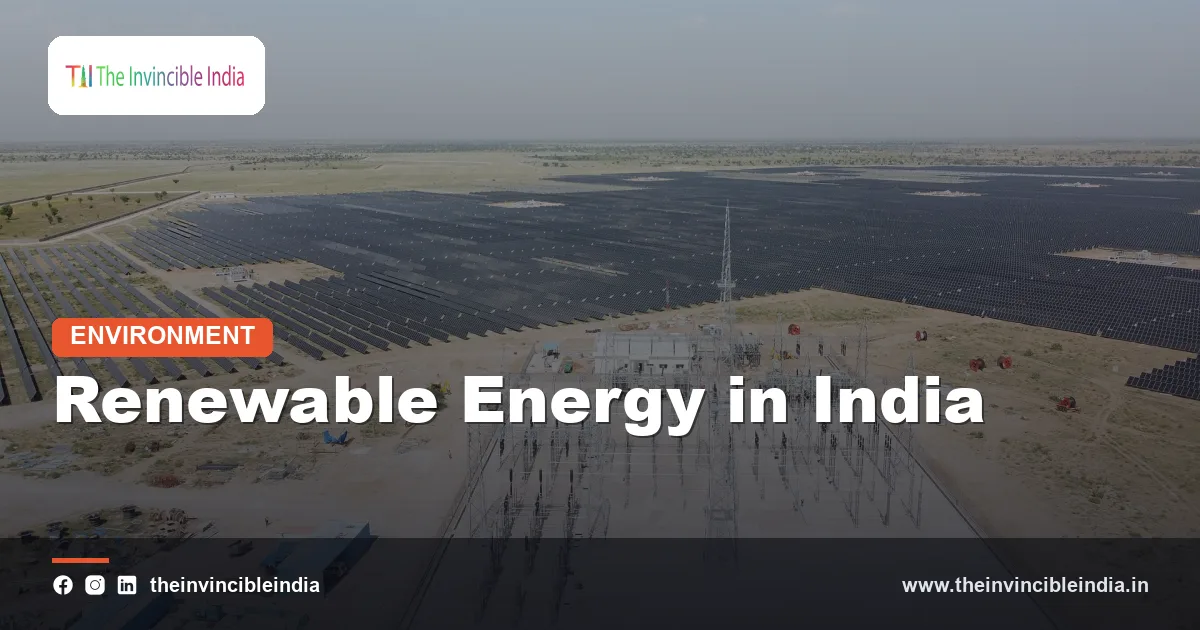
Few sectors of the Indian economy have changed as quickly in the last fifteen years as power generation. Today, renewable energy in India is no longer a niche experiment run by a few government agencies; it is a mainstream part of how the country keeps its lights on, its factories running and its farms irrigated. Vast solar parks in the deserts of Rajasthan, wind turbines along the coasts of Tamil Nadu and Gujarat, mountain hydropower stations and a new push for green hydrogen together form one of the largest clean energy programmes in the world.
This explainer traces that journey: why India chose to expand clean power, which institutions and missions drove the change, how each major source of energy has developed, what commitments the country has made on the global stage, and what challenges still lie ahead. Figures are given as approximate, dated milestones, because capacity numbers keep rising every year. Last reviewed: 29 September 2026.
Quick Facts
| Topic | Key fact |
|---|---|
| Nodal ministry | Ministry of New and Renewable Energy (MNRE), in its present name since 2006 |
| First national solar programme | Jawaharlal Nehru National Solar Mission, launched in January 2010 |
| Largest growth source | Solar power, which crossed the 100 GW mark in installed capacity in the mid-2020s |
| Wind power leaders | Tamil Nadu, Gujarat, Karnataka, Maharashtra and Rajasthan |
| Landmark solar parks | Bhadla (Rajasthan) and Pavagada (Karnataka), each among the largest in the world |
| International Solar Alliance | Co-founded by India and France in 2015; headquartered in Gurugram, Haryana |
| Climate pledge (COP26, 2021) | 500 GW of non-fossil capacity by 2030 and net zero emissions by 2070 |
| National Green Hydrogen Mission | Approved in January 2023 to build a domestic green hydrogen industry |
Why Renewable Energy Matters for India
India is the world’s most populous country and one of its fastest-growing major economies, so its appetite for electricity keeps rising. For decades, coal supplied most of that power, and the country also depends heavily on imported crude oil and gas. Renewable energy addresses several national concerns at once.
Energy security
India imports a large majority of the crude oil it consumes, which exposes households and businesses to global price shocks. Sunlight and wind, by contrast, are domestic resources. Every unit of electricity generated from them reduces pressure on imported fuels and on the foreign exchange spent on them.
Climate commitments and air quality
As a signatory to the Paris Agreement, India has promised to cut the emissions intensity of its economy and to raise the share of clean power. Cleaner generation also helps with urban air pollution, since burning coal releases particulates and sulphur and nitrogen oxides.
Jobs and rural development
Solar and wind projects create work in manufacturing, construction, installation and maintenance. Distributed systems such as rooftop panels and solar pumps bring power to places where the grid is weak, giving farmers and small businesses a more dependable supply.
- Security: less dependence on imported fuel
- Climate: lower emissions per unit of GDP
- Health: reduced pollution from fossil fuel plants
- Economy: new industries, skills and employment
The Ministry of New and Renewable Energy (MNRE)
The institutional story begins in the early 1980s, when the government set up the Commission for Additional Sources of Energy and then a Department of Non-Conventional Energy Sources to look beyond coal, oil and large dams. In 1992 the department became the Ministry of Non-Conventional Energy Sources, and in 2006 it was renamed the Ministry of New and Renewable Energy, the name it carries today.
What MNRE does
MNRE is the nodal ministry for solar, wind, small hydro, bioenergy and, more recently, green hydrogen. It frames national policy, sets capacity targets, runs subsidy and incentive programmes and supports research and testing. Specialised bodies work under or alongside it.
- Solar Energy Corporation of India (SECI): a public sector company that conducts large auctions and signs power sale agreements
- Indian Renewable Energy Development Agency (IREDA): a government financing institution for renewable projects
- National Institute of Solar Energy, National Institute of Wind Energy and National Institute of Bio-Energy: research and testing institutions
Working with states and regulators
Electricity is a concurrent subject under the Constitution, so states play a central role. State agencies allocate land, state regulators fix tariffs, and distribution companies buy the power. Policies such as renewable purchase obligations, which require utilities to source a minimum share of their electricity from renewables, and waivers of certain inter-state transmission charges have helped projects move across state lines.
Solar Power: India’s Biggest Growth Story
Solar energy is the standout performer. India receives strong sunshine across most of the year, especially in Rajasthan, Gujarat and the southern plateau, which makes photovoltaic power a natural fit. Solar capacity was tiny at the start of the 2010s, but by the mid-2020s it had crossed 100 GW, making it the fastest-expanding source in the national mix.
Falling costs
Competitive auctions drove tariffs down dramatically over the decade. In some auctions, solar power was contracted at prices lower than the cost of running many older coal plants, which changed the economics of the sector and drew in domestic and foreign developers.
Solar parks
The government promoted large solar parks, where land, transmission and clearances are prepared in advance so that developers can build quickly. Two are especially well known.
- Bhadla Solar Park, Rajasthan: located in the arid Jodhpur district, it is counted among the largest solar parks in the world, with a capacity of more than 2 GW.
- Pavagada Solar Park, Karnataka: built on drought-prone land in Tumakuru district and involving thousands of local farmers as lessors, it also has a capacity of around 2 GW.
Other notable projects include floating solar installations on reservoirs and the fully solar-powered Cochin International Airport, which drew global attention in 2015.
Wind Energy: From Coasts to Plateaus
India was an early adopter of wind power. Commercial development began in the 1980s and 1990s, and the country now has one of the largest installed wind fleets in the world, at more than 40 GW as of the mid-2020s.
Where the wind blows
The best resources lie in a few regions, and a handful of states account for most of the installed capacity.
- Tamil Nadu: the pioneer, with the Muppandal area near Kanyakumari among the best known wind clusters, driven by strong south-west monsoon winds.
- Gujarat: a rapidly growing hub along the western coast and in Kutch and Saurashtra.
- Karnataka, Maharashtra and Rajasthan: important contributors on plateaus and ridgelines.
Repowering and offshore ambitions
Older, smaller turbines are being replaced by larger, more efficient models through repowering, while wind-solar hybrid projects share transmission lines to raise usage. India has also identified offshore wind potential off the coasts of Gujarat and Tamil Nadu, and the government has moved to support early offshore development, although this segment is still at an early stage. Indian manufacturers supply a significant part of the equipment used domestically, which makes wind one of the more locally rooted clean technologies.
Hydropower: Large and Small
Hydropower is India’s oldest renewable source. The country has generated electricity from flowing water since the late nineteenth century, and the big multipurpose dams built after independence, such as Bhakra Nangal on the Sutlej, combined irrigation, flood control and power generation.
Large hydro
Plants above 25 MW are classified as large hydro. In 2019 the government declared large hydropower projects a renewable source, bringing them under renewable purchase obligations and supporting policy. The Himalayan and north-eastern rivers hold the greatest untapped potential, but projects there face steep terrain, seismic risk, resettlement concerns and environmental scrutiny, which often slow progress.
Small hydro and pumped storage
Small hydro projects, up to 25 MW, are well suited to hilly states such as Himachal Pradesh, Uttarakhand and Karnataka because they can serve remote communities with smaller ecological footprints. Meanwhile, pumped storage plants, which pump water uphill when power is cheap and release it when demand peaks, are gaining importance as a way of storing renewable electricity for later use.
Bioenergy and Biomass
Bioenergy turns agricultural and organic waste into power, heat and fuel. India produces enormous quantities of crop residue, bagasse from sugar mills, and animal and municipal waste, so the raw material is plentiful.
Main forms
- Bagasse cogeneration: sugar mills burn crushed cane residue to generate electricity for their own needs and for the grid.
- Biogas and compressed biogas: gas produced from cattle dung, farm waste and food waste can be used for cooking or purified as a vehicle fuel, an idea promoted under the SATAT initiative.
- Biofuels: ethanol blended with petrol has been a major policy focus, with the government working towards blends of around 20 per cent.
Crop residue challenge
Bioenergy also offers a possible answer to stubble burning in northern India, since paddy straw can be collected and processed into pellets or gas rather than set alight. Making this work at scale needs reliable collection, storage and buyers, and pilots continue in several states. Bioenergy will probably remain a supporting player rather than a leading one, but it helps connect farms, waste management and clean energy.
Green Hydrogen: The Emerging Frontier
Green hydrogen is produced by splitting water into hydrogen and oxygen using electricity from renewable sources. It can replace fossil fuels in industries that are hard to electrify directly, such as fertiliser and steel production, refining and long-distance shipping.
The National Green Hydrogen Mission
The government approved the National Green Hydrogen Mission in January 2023. It aims to make India a major producer and exporter of green hydrogen and its derivatives such as green ammonia, to build domestic electrolyser manufacturing, and to reduce the import bill for fossil fuels. It sets a target for annual production by 2030 in the range of several million tonnes, alongside a large addition of dedicated renewable capacity. Incentive schemes for electrolyser manufacturing and for hydrogen production support the mission.
Why India is well placed and what stands in the way
Cheap solar and wind, a large industrial base, and long coastlines with ports give India natural advantages. However, green hydrogen remains more expensive than fossil-based hydrogen, and it needs water, storage, pipelines and demand guarantees. The industry is at the demonstration stage, so its long-term contribution is a promise, not yet a settled fact.
Landmark Missions and Schemes
A series of well-designed programmes gave structure to the shift. The table below summarises the most important ones.
| Scheme or mission | Year | Purpose |
|---|---|---|
| Jawaharlal Nehru National Solar Mission | 2010 | Create large-scale grid solar capacity; original target of 20 GW by 2022, later raised to 100 GW in 2015 |
| International Solar Alliance | 2015 | Coalition of sun-rich countries led by India and France to promote solar deployment and finance |
| Ultra Mega Renewable Energy Parks and solar park scheme | 2014 onwards | Provide ready land and transmission for large projects |
| PM-KUSUM | 2019 | Solar pumps, solarisation of grid-connected pumps and small solar plants for farmers |
| Production Linked Incentive for solar modules | 2021 | Encourage domestic manufacturing of high-efficiency solar modules |
| National Green Hydrogen Mission | 2023 | Develop production, use and export of green hydrogen |
| PM Surya Ghar: Muft Bijli Yojana | 2024 | Promote rooftop solar for households with financial support |
The Jawaharlal Nehru National Solar Mission
Launched in 2010 as part of the National Action Plan on Climate Change, this mission put solar power on the national agenda. Its early auctions attracted developers and set the stage for the cost reductions that followed.
Support for farmers and households
The PM-KUSUM scheme helps farmers replace diesel pumps with solar pumps and even sell surplus power to the grid, while rooftop solar programmes let households and businesses cut their electricity bills. Domestic manufacturing incentives seek to reduce dependence on imported cells and modules.
Climate Targets: Panchamrit and the 500 GW Goal
At the COP26 climate summit in Glasgow in 2021, India announced five commitments known as the Panchamrit, a term borrowed from the five sacred ingredients used in Indian ritual offerings.
- Reach 500 GW of non-fossil electricity capacity by 2030.
- Meet half of the country’s energy requirements from renewable sources by 2030.
- Reduce projected carbon emissions by one billion tonnes between now and 2030.
- Reduce the carbon intensity of the economy by 45 per cent by 2030 from 2005 levels.
- Achieve net zero emissions by 2070.
Updated national pledges
In 2022, India formally updated its Nationally Determined Contribution under the Paris Agreement, including a target of about 50 per cent of installed electric capacity from non-fossil sources by 2030. As of the mid-2020s, installed non-fossil capacity had passed the 200 GW class and was reported to account for roughly half of the total installed capacity, though it delivers a smaller share of actual electricity generation because solar and wind run only part of the day.
Why the 2070 date is debated
Net zero by 2070 is later than the mid-century dates chosen by some countries. India’s position is that it has contributed little to historical emissions on a per-person basis and that developed countries should provide climate finance and technology. Analysts continue to discuss how the pledge will be achieved in practice.
Grid Integration: Intermittency, Storage and Transmission
Building panels and turbines is only half of the task; the electricity must also reach consumers reliably. Solar output peaks at midday and vanishes at night, while wind depends on seasons and weather.
Intermittency and storage
To manage this variability, India needs flexible resources: batteries, pumped hydro, gas or hydro plants that can ramp up and down, and better forecasting. Large battery storage projects have been tendered, and a viability gap funding scheme has been introduced to encourage them. Evening peak demand, when solar has faded, remains the main pinch point.
Transmission and curtailment
The best renewable resources are often far from big cities. The Green Energy Corridor programme builds new transmission lines to carry power from resource-rich states, but delays in lines and substations have at times left completed plants unable to sell all of their output. Grid operators also face the task of keeping frequency stable as the share of inverter-based sources rises.
- Storage to shift daytime solar into the evening
- New and upgraded inter-state transmission
- Smarter forecasting, scheduling and market design
- Financially healthy distribution companies as reliable buyers
Land, Finance and the Just Transition
Utility-scale projects need land, sometimes at a scale that can compete with farming, grazing and wildlife habitat. Rajasthan’s desert and Gujarat’s Kutch region are attractive, but they also host sensitive ecosystems such as the habitat of the Great Indian Bustard, a critically endangered bird. Approaches such as agrivoltaics, rooftop and canal-top solar and floating solar aim to reduce these conflicts.
Financing the shift
Renewable projects require heavy upfront investment, and India’s ambitions depend on domestic banks, development finance institutions, green bonds and foreign investors. The cost of capital, the payment habits of distribution companies and exposure to imported equipment all influence how quickly projects are built. Domestic manufacturing incentives and customs duties on imported modules are designed to strengthen local supply chains, though they also raise questions about short-term costs.
The just-transition debate
Coal still supplies the bulk of India’s electricity generation, and it supports employment, state revenues and railway freight in regions such as Jharkhand, Odisha and Chhattisgarh. A just transition means planning for workers and communities in coal-dependent areas, with retraining, economic diversification and fair use of funds. This debate will grow more important as clean capacity increases, and there is no single agreed roadmap yet.
India’s Global Role in Clean Energy
India has moved from being a recipient of clean energy ideas to a leader in shaping them. The most visible example is the International Solar Alliance, launched by India and France at the Paris climate conference in 2015. Its headquarters are in Gurugram, Haryana, and it brings together sun-rich countries that want to lower the cost of solar finance and technology. The alliance’s framework agreement entered into force in December 2017, and its membership has grown well beyond its initial group.
Other initiatives
- One Sun One World One Grid: a proposal to link solar-rich regions through cross-border grids so that daytime power in one region can serve evening demand in another.
- Global Biofuels Alliance: launched during India’s G20 presidency in 2023 to promote sustainable biofuels.
- Mission LiFE: a campaign encouraging sustainable everyday lifestyle choices.
India also positions itself as a voice for developing countries in climate negotiations, arguing that energy transitions must be affordable and must support growth. As a large market and a growing manufacturer, it influences global prices and supply chains for solar equipment.
Conclusion
The story of renewable energy in India runs from small pilot projects to national missions, and from ministry documents to giant solar parks visible from space. Solar leads, wind is well established, hydropower provides flexibility, bioenergy links farms and power, and green hydrogen offers a new frontier. The biggest tests now are practical: storage, transmission, land, finance and a fair transition for workers in coal regions. How well India meets them will shape both its own development and the global climate effort.
Frequently Asked Questions
Which is the largest source of renewable energy in India?
Among newer renewables, solar power is the fastest-growing and, as of the mid-2020s, the largest by installed capacity, having crossed 100 GW. Large hydropower and wind power are also significant contributors, while bioenergy and small hydro add smaller shares.
What is the 500 GW non-fossil target?
It is one of the five Panchamrit pledges announced by India at COP26 in Glasgow in 2021. The country aims to have 500 GW of installed non-fossil electricity capacity, covering solar, wind, hydro, bioenergy and nuclear, by 2030.
What is the International Solar Alliance?
It is a treaty-based alliance of countries, launched by India and France at the Paris climate conference in 2015, that promotes solar energy deployment, technology and finance. Its headquarters are in Gurugram, Haryana.
What does the PM-KUSUM scheme do?
Launched in 2019, PM-KUSUM supports farmers by helping them install standalone solar pumps, convert existing grid-connected pumps to solar and set up small solar power plants on their land. This can cut diesel and electricity costs and give farmers an additional source of income.
What is the National Green Hydrogen Mission?
Approved in January 2023, the mission seeks to build a domestic green hydrogen industry by promoting production using renewable energy, supporting electrolyser manufacturing and encouraging use in sectors such as fertilisers, refining and steel. It also aims to make India an exporter of green hydrogen and related products.
What are the main challenges for renewable energy in India?
The key challenges are grid integration, since solar and wind output varies through the day and year, along with storage, transmission capacity, land availability and the cost of finance. A fair transition for workers and regions that rely on coal is another important issue.
{“@context”:”https://schema.org”,”@graph”:[{“@type”:”FAQPage”,”mainEntity”:[{“@type”:”Question”,”name”:”Which is the largest source of renewable energy in India?”,”acceptedAnswer”:{“@type”:”Answer”,”text”:”Among newer renewables, solar power is the fastest-growing and, as of the mid-2020s, the largest by installed capacity, having crossed 100 GW. Large hydropower and wind power are also significant contributors, while bioenergy and small hydro add smaller shares.”}},{“@type”:”Question”,”name”:”What is the 500 GW non-fossil target?”,”acceptedAnswer”:{“@type”:”Answer”,”text”:”It is one of the five Panchamrit pledges announced by India at COP26 in Glasgow in 2021. The country aims to have 500 GW of installed non-fossil electricity capacity, covering solar, wind, hydro, bioenergy and nuclear, by 2030.”}},{“@type”:”Question”,”name”:”What is the International Solar Alliance?”,”acceptedAnswer”:{“@type”:”Answer”,”text”:”It is a treaty-based alliance of countries, launched by India and France at the Paris climate conference in 2015, that promotes solar energy deployment, technology and finance. Its headquarters are in Gurugram, Haryana.”}},{“@type”:”Question”,”name”:”What does the PM-KUSUM scheme do?”,”acceptedAnswer”:{“@type”:”Answer”,”text”:”Launched in 2019, PM-KUSUM supports farmers by helping them install standalone solar pumps, convert existing grid-connected pumps to solar and set up small solar power plants on their land. This can cut diesel and electricity costs and give farmers an additional source of income.”}},{“@type”:”Question”,”name”:”What is the National Green Hydrogen Mission?”,”acceptedAnswer”:{“@type”:”Answer”,”text”:”Approved in January 2023, the mission seeks to build a domestic green hydrogen industry by promoting production using renewable energy, supporting electrolyser manufacturing and encouraging use in sectors such as fertilisers, refining and steel. It also aims to make India an exporter of green hydrogen and related products.”}},{“@type”:”Question”,”name”:”What are the main challenges for renewable energy in India?”,”acceptedAnswer”:{“@type”:”Answer”,”text”:”The key challenges are grid integration, since solar and wind output varies through the day and year, along with storage, transmission capacity, land availability and the cost of finance. A fair transition for workers and regions that rely on coal is another important issue.”}}]}]}


