

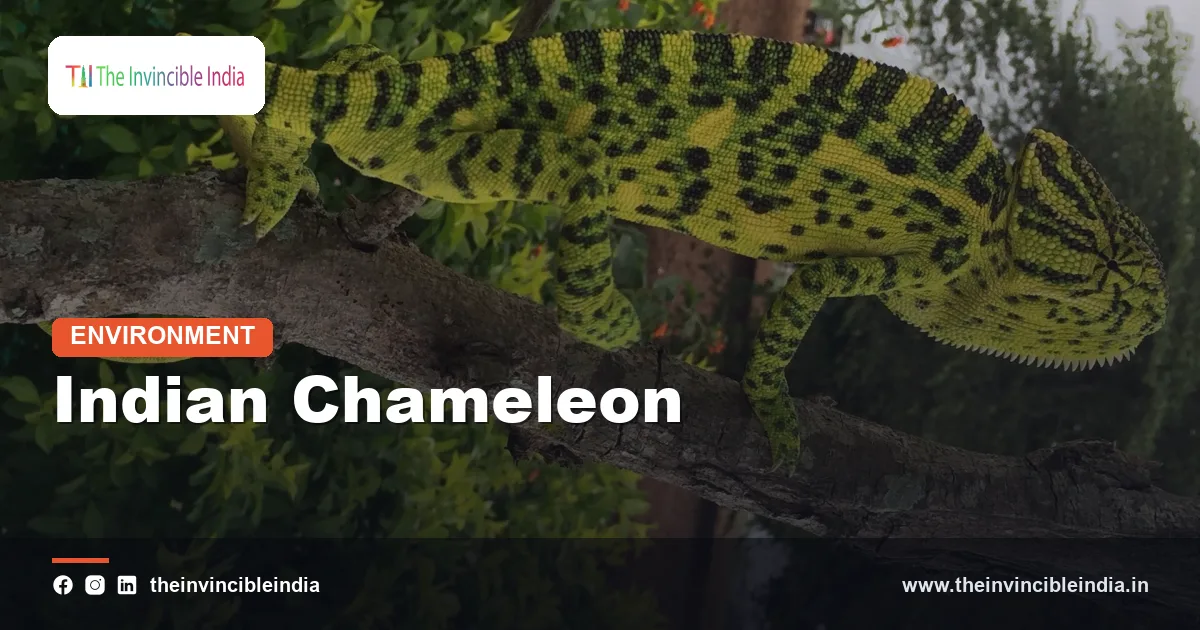
The Indian chameleon (Chamaeleo zeylanicus) is the only true chameleon species found in India, a slow-moving, tree-dwelling lizard of the peninsular scrub and dry forests that can change colour, swivel its eyes independently and shoot out a long sticky tongue to catch insects. Called “girgit” in Hindi and widely misunderstood, the Indian chameleon is a harmless insect-eater that is still persecuted because of superstition.
The Indian chameleon is legally protected under Indian wildlife law and in international trade rules, yet it continues to be killed or captured for black-magic rituals and the pet trade. This explainer covers how the animal’s body works, where it lives, why it changes colour and what protects it.
| Attribute | Detail |
|---|---|
| Scientific name | Chamaeleo zeylanicus (family Chamaeleonidae) |
| Common names | Indian chameleon, common chameleon, girgit (Hindi), with many regional names |
| Status in India | The only chameleon species native to the country |
| Typical size | Roughly 30 to 40 cm in total length including the tail, with considerable variation |
| Range | Peninsular India, with records also from Sri Lanka and parts of Pakistan |
| Habitat | Dry scrub, thorny forests, open woodland, plantations, gardens and hedges |
| Diet | Mainly insects such as grasshoppers, caterpillars and mantises; occasionally small vertebrates |
| Legal and conservation status | Protected under the Wildlife (Protection) Act, 1972 (schedule placements have been revised, so check the current text); listed in CITES Appendix II; assessed as Least Concern by the IUCN, with local declines reported |
Key Takeaways
- The Indian chameleon (Chamaeleo zeylanicus) is the only chameleon species native to India and is found mainly in peninsular India.
- The Indian chameleon changes colour mostly to communicate mood, to react to stress and to regulate body temperature, not simply to match its background.
- Each eye of the Indian chameleon can swivel independently, and the animal can fire a sticky, club-tipped tongue at prey in a fraction of a second.
- The Indian chameleon has zygodactyl feet, in which the toes are fused into two opposing bundles that grip branches like tongs.
- The Indian chameleon is harmless to people, yet it is killed in some places because of superstitions about bad luck and black magic.
- The Indian chameleon is legally protected in India and its international trade is controlled through CITES Appendix II, so capturing or keeping one is an offence.
What Is the Indian Chameleon?
The Indian chameleon is a medium-sized lizard of the family Chamaeleonidae, and Chamaeleo zeylanicus is the only chameleon species that occurs naturally across India. The family contains many species mostly in Africa and Madagascar, so the Indian chameleon is the subcontinent’s single representative of this unusual group.
The animal is laterally flattened, with a high-ridged back, a casque-like crest on its head, a long prehensile tail and huge, cone-shaped eyes set in rotating turrets. Its normal colour is a mixture of green, olive, brown or grey, often with darker blotches or bands along the sides. Males and females look similar to a casual observer, although males are sometimes slightly larger.
The Indian chameleon moves slowly with a swaying gait, rocking back and forth as it steps, which is thought to make it look like a leaf stirred by the breeze. It spends most of its life on shrubs and small trees, although it descends to the ground to cross open patches, to lay eggs and to find new territories.
Where Does the Indian Chameleon Live?
The Indian chameleon lives mainly in the drier parts of peninsular India, including scrub forests, thorny woodland, hedgerows and plantations across states such as Karnataka, Tamil Nadu, Andhra Pradesh, Telangana, Maharashtra, Kerala and neighbouring regions, with additional records from Sri Lanka and parts of Pakistan. Its exact range limits are not fully settled, and sightings are still sometimes reported outside the usual distribution.
The species prefers places with dense, low vegetation where it can climb, hide and ambush insects. It is often seen in village hedges, farm borders, cashew and tamarind groves, gardens and even on urban fringes. Wet evergreen forests are less typical habitat, though the animal appears at their margins.
Because the Indian chameleon is camouflaged and slow, many people live near populations without ever seeing one. Local numbers are difficult to survey, and national population figures are not available with confidence.
Why Does the Indian Chameleon Change Colour?
The Indian chameleon changes colour mainly for communication and temperature control, not just to blend in with its surroundings. Colour shifts signal mood and intent to other chameleons, show stress or aggression, help the animal warm up or cool down, and reflect health and breeding condition.
The common belief that chameleons simply match any background is a popular myth. In practice, the range of colours is limited to a set of greens, browns, yellows, greys and darker tones, and the animal cannot copy a chequered cloth or a bright red wall. Camouflage is a secondary benefit, since many of its colour states do resemble foliage.
Typical colour behaviours include:
- Darkening: a warming response that absorbs more heat on cool mornings, or a sign of stress or fear.
- Pale or bright patterns: a display used in aggressive encounters or courtship.
- Green or leafy tones: a relaxed, hidden state when resting among foliage.
How Does the Indian Chameleon Change Colour?
The Indian chameleon changes colour by adjusting layers of specialised skin cells that scatter and reflect light, which alters the colour seen by an observer. Research on other chameleons has shown that the skin contains cells called iridophores holding tiny nanocrystals, and that the spacing of these crystals can be tuned as the skin is excited or relaxed, shifting which wavelengths of light are reflected.
Other pigment-containing cells, such as those with yellow or dark pigments, work together with the reflecting layer to produce the final shade. The process is controlled by the nervous system and hormones, which is why it happens within seconds to minutes. Scientific detail has mostly been worked out in a few other chameleon species, and researchers generally assume that the Indian chameleon uses similar principles.
The change is not a magical or instant disappearing act. It is a physical, energy-linked process, and a sick, cold or exhausted animal may remain dull and dark for long periods.
How Do the Eyes and Tongue of the Indian Chameleon Work?
The Indian chameleon can rotate each of its eyes independently, scanning nearly all around the body, and then it points both eyes forward to judge distance before firing its tongue. The eyes sit inside cone-shaped scaly lids with only a small pinhole opening for the pupil, and this arrangement allows the animal to follow two things at once.
The tongue of the Indian chameleon is a muscular, elastic projectile with a sticky, club-shaped tip. It is stored folded in the mouth and launched with a catapult-like mechanism, in which stored elastic energy is released rapidly. The tongue can reach a distance comparable to the animal’s body length, and the sticky tip grips an insect, which is then pulled into the mouth.
These features make the Indian chameleon an ambush hunter that waits motionless for prey rather than chasing it. The visual system gives it a wide field of view, while the ballistic tongue lets it capture insects without moving closer and giving itself away.
What Are the Zygodactyl Feet and Prehensile Tail?
The Indian chameleon has zygodactyl feet, meaning that its five toes are fused into two opposing groups on each foot, which work like tongs to clamp thin branches. On the front feet, three toes face inward and two face outward, while on the hind feet the arrangement is reversed.
The tail of the Indian chameleon is prehensile, meaning that it can coil around twigs to act as a fifth limb. Together with the feet, the tail allows the animal to move cautiously through thin shrubs and hold on even in strong winds. When the animal is resting, the tail is often curled into a spiral.
These features reflect a lifestyle of climbing and clinging rather than running. The Indian chameleon does not sprint away from predators and relies instead on stillness, camouflage and defensive displays such as opening its mouth, hissing and puffing its body.
What Does the Indian Chameleon Eat and How Does It Breed?
The Indian chameleon eats mainly insects, including grasshoppers, crickets, caterpillars, beetles and mantises, and it may occasionally take small lizards or nestlings. Its slow, ambush style of hunting means that it consumes relatively little, and it can go for days between meals when prey is scarce.
Breeding takes place when conditions are favourable, usually linked to the rains in much of its range. After mating, the female descends to the ground and digs a tunnel or hole in soft soil, where she lays a clutch of eggs, often in the range of a few dozen, and then covers it. The eggs incubate for several months and the young hatch as miniature copies of the adults. Reported clutch sizes and incubation periods vary and have not been documented in equal detail everywhere.
The female is especially vulnerable while digging and laying, because she must leave the safety of the trees. Roadsides, farm tracks and dogs add to the risks. Hatchlings are tiny and are preyed on by birds, snakes and other lizards, so only a small fraction survive to adulthood.
Why Is the Indian Chameleon Killed Because of Superstition?
The Indian chameleon is killed in some places because of superstitious beliefs, including ideas that it brings bad luck, possesses magical powers or can be used in black-magic rituals. These beliefs are not supported by evidence, but they put the species at direct risk, particularly in rural areas where chameleons are common but poorly understood.
Several forms of harm have been reported:
- Ritual killing: animals have been captured or killed in tantric and black-magic practices, sometimes after being sold for high prices.
- Fear-based killing: people kill the animal because they believe its bite or touch is harmful, which is untrue.
- Pet trade and collection: chameleons are removed from the wild for private keeping, and most die quickly in captivity because their needs are demanding.
- Habitat loss: clearing of scrub, hedges and orchards removes shelter and hunting grounds.
- Road and farm accidents: slow-moving animals are easily run over or crushed.
The Hindi word “girgit” is also used as a phrase for a person who changes opinions to suit the moment, which has added a mildly negative cultural meaning to the animal. The reptile itself is simply an insect-eater that has done nothing to deserve this reputation.
Is the Indian Chameleon Protected in India?
Yes, the Indian chameleon is protected in India under the Wildlife (Protection) Act, 1972, which prohibits hunting, capturing, keeping and trading the species. The act has been amended several times, including a significant revision in 2022 that reorganised the schedules, so readers who need the exact schedule number should check the current official text.
At the international level, the Indian chameleon is listed in Appendix II of CITES, which means that commercial international trade is regulated through permits. On the IUCN Red List, the species has been assessed as Least Concern because of its relatively wide range, although the assessment acknowledges threats from collection and killing.
Practical conservation measures include:
- Community awareness campaigns that explain that chameleons are harmless.
- Enforcement against ritual and pet trade.
- Protection of scrub and hedgerow habitats on farmland.
- Rescue and release of animals found in unsuitable places.
How Does the Indian Chameleon Compare With a Typical African Chameleon?
The Indian chameleon shares the core chameleon traits with African and Madagascan species, but it is plainer, more modest in size and less brightly coloured than many of its relatives. The table below compares the main features.
| Feature | Indian chameleon | Many African or Madagascan chameleons |
|---|---|---|
| Number of species in the region | One in India | Dozens of species, many in Madagascar |
| Typical colours | Green, olive, brown, grey with darker patches | Often vivid blues, reds, oranges and patterns |
| Size | Medium, roughly 30 to 40 cm | From tiny leaf chameleons to large species over 60 cm |
| Head ornaments | Low casque and crest | Horns, large casques and sails in some species |
| Habitat | Dry scrub and thorny forest | Rainforest, montane forest, savanna and scrub |
| Core traits | Rotating eyes, ballistic tongue, zygodactyl feet, prehensile tail | The same set of core traits |
Bottom Line
The Indian chameleon is a harmless, slow and remarkably specialised insect-eater whose colour changes are about signalling and temperature rather than simple camouflage. It is protected by Indian law and CITES, and the most useful public action is to stop the killing born of superstition and to leave wild chameleons where they are.
Frequently Asked Questions
Is the Indian chameleon poisonous or dangerous?
No, the Indian chameleon is not poisonous and is not dangerous to humans. It has no venom, and its small teeth can only give a minor nip if it is handled roughly. The idea that its touch or bite brings harm is a myth.
How many chameleon species are there in India?
India has only one native chameleon species, the Indian chameleon (Chamaeleo zeylanicus). Chameleons are otherwise concentrated in Africa and Madagascar. Reports of other species in India are usually escaped pets or misidentifications.
Why does the Indian chameleon change colour?
The Indian chameleon changes colour mainly to signal mood, show stress and control its body temperature. Camouflage is only a partial benefit, since the animal cannot copy any background. The colour change works through special skin cells that reflect light in different ways.
Is it legal to keep an Indian chameleon as a pet?
No, it is illegal to capture, keep or trade the Indian chameleon in India because it is protected under the Wildlife (Protection) Act, 1972. International trade is also regulated through CITES Appendix II. Wild chameleons also do poorly in captivity and often die within a short time.
What does the Indian chameleon eat?
The Indian chameleon eats mainly insects such as grasshoppers, caterpillars, crickets and mantises. It waits motionless and catches prey with a rapid, sticky tongue. Occasionally it may take a small lizard or nestling.
What should I do if I find a chameleon in my garden?
If you find an Indian chameleon in your garden, leave it alone or gently move it onto a nearby shrub without squeezing it. The animal is harmless and will move on by itself. If it is injured or in a dangerous place, contact the local forest department or a wildlife rescue group.
{“@context”:”https://schema.org”,”@graph”:[{“@type”:”FAQPage”,”mainEntity”:[{“@type”:”Question”,”name”:”Is the Indian chameleon poisonous or dangerous?”,”acceptedAnswer”:{“@type”:”Answer”,”text”:”No, the Indian chameleon is not poisonous and is not dangerous to humans. It has no venom, and its small teeth can only give a minor nip if it is handled roughly. The idea that its touch or bite brings harm is a myth.”}},{“@type”:”Question”,”name”:”How many chameleon species are there in India?”,”acceptedAnswer”:{“@type”:”Answer”,”text”:”India has only one native chameleon species, the Indian chameleon (Chamaeleo zeylanicus). Chameleons are otherwise concentrated in Africa and Madagascar. Reports of other species in India are usually escaped pets or misidentifications.”}},{“@type”:”Question”,”name”:”Why does the Indian chameleon change colour?”,”acceptedAnswer”:{“@type”:”Answer”,”text”:”The Indian chameleon changes colour mainly to signal mood, show stress and control its body temperature. Camouflage is only a partial benefit, since the animal cannot copy any background. The colour change works through special skin cells that reflect light in different ways.”}},{“@type”:”Question”,”name”:”Is it legal to keep an Indian chameleon as a pet?”,”acceptedAnswer”:{“@type”:”Answer”,”text”:”No, it is illegal to capture, keep or trade the Indian chameleon in India because it is protected under the Wildlife (Protection) Act, 1972. International trade is also regulated through CITES Appendix II. Wild chameleons also do poorly in captivity and often die within a short time.”}},{“@type”:”Question”,”name”:”What does the Indian chameleon eat?”,”acceptedAnswer”:{“@type”:”Answer”,”text”:”The Indian chameleon eats mainly insects such as grasshoppers, caterpillars, crickets and mantises. It waits motionless and catches prey with a rapid, sticky tongue. Occasionally it may take a small lizard or nestling.”}},{“@type”:”Question”,”name”:”What should I do if I find a chameleon in my garden?”,”acceptedAnswer”:{“@type”:”Answer”,”text”:”If you find an Indian chameleon in your garden, leave it alone or gently move it onto a nearby shrub without squeezing it. The animal is harmless and will move on by itself. If it is injured or in a dangerous place, contact the local forest department or a wildlife rescue group.”}}]}]}


