

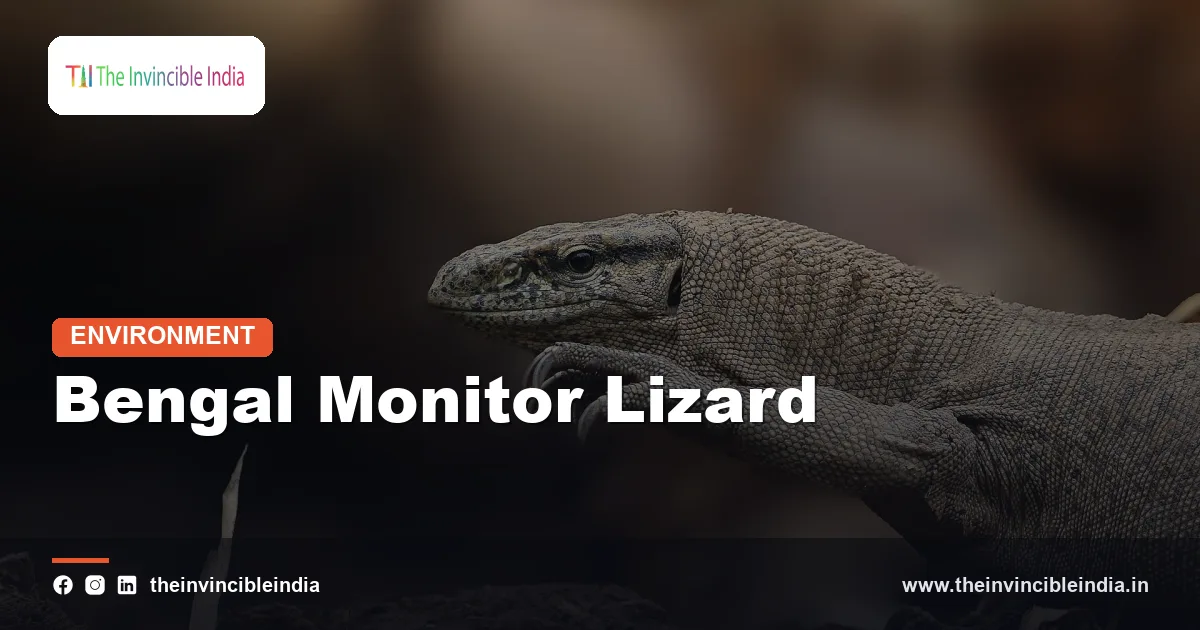
The Bengal monitor lizard (Varanus bengalensis) is the most widespread and best-known monitor lizard of the Indian subcontinent, a large, long-tailed, forked-tongued reptile that hunts on land, digs burrows and plays a quiet but real role as a predator and scavenger. Known in Hindi as “goh” or “goh saap” and often wrongly feared as a venomous snake-like creature, the Bengal monitor lizard is harmless to people unless it is cornered, and it is legally protected in India.
Despite that protection, the Bengal monitor lizard has been hunted for centuries for its skin, meat, fat and a bogus charm sold as “hatha jodi”. This explainer covers the animal’s biology, burrowing habits, diet, ecological role, the threats it faces and the legal protection it enjoys.
| Attribute | Detail |
|---|---|
| Scientific name | Varanus bengalensis (family Varanidae) |
| Common names | Bengal monitor, common Indian monitor, goh or goh saap (Hindi), with many other local names across regions |
| Typical size | Commonly about 60 to 100 cm in total length, with large adults reported to reach roughly 1.5 m or more |
| Range | Much of the Indian subcontinent, including Pakistan, Nepal, Bangladesh and Sri Lanka, extending west into Iran and east into parts of Southeast Asia |
| Habitat | Scrub, farmland, dry and moist forest edges, rocky areas, village outskirts and mangrove margins |
| Diet | Carnivorous and opportunistic: insects, crabs, rodents, frogs, eggs, snakes, birds and carrion |
| Indian legal status | Listed in Schedule I of the Wildlife (Protection) Act, 1972 (schedule placements have been revised by amendments, so check the current text) |
| International status | Listed in CITES Appendix I; assessed as Least Concern by the IUCN at the global level, with local declines reported |
Key Takeaways
- The Bengal monitor lizard (Varanus bengalensis) is the most common and widespread monitor lizard in India and is found across most of the subcontinent.
- The Bengal monitor lizard is not venomous in any way that threatens people, though its claws, tail and bite can injure and cause infection when the animal is handled or cornered.
- “Hatha jodi”, sold as a magical plant root, has been repeatedly identified by wildlife forensic workers as dried hemipenes of male monitor lizards, and it has no proven supernatural or medicinal power.
- The Bengal monitor lizard is protected under Schedule I of the Wildlife (Protection) Act, 1972, which means hunting, trade and possession of the animal or its parts are punishable offences.
- Bengal monitor lizards dig burrows, sometimes several metres long, that shelter other animals and help the species survive heat, cold and predators.
- Bengal monitor lizards eat rodents, crabs, insects and carrion, so they help control pests and clear dead animals from fields and village margins.
What Is the Bengal Monitor Lizard?
The Bengal monitor lizard is a large terrestrial lizard in the monitor family Varanidae, and it is the monitor species that most Indians encounter around fields, scrub, ruins and the edges of villages. Its scientific name is Varanus bengalensis, and the species is also called the common Indian monitor to distinguish it from the water monitor, the yellow monitor and the desert monitor found elsewhere in the region.
Adults have a heavy body, strong limbs with sharp curved claws, a long muscular tail and a long neck topped by a narrow head. The skin is covered in small rough scales and is usually olive, grey or brownish above with darker spots and bands. Younger animals often show clearer yellowish spotting and bands, which tend to fade with age. A Bengal monitor lizard flicks a long, deeply forked tongue to pick up chemical traces from the air, much as snakes do.
Many people mistake the animal for a baby crocodile or a snake with legs. In reality, the Bengal monitor lizard is a true lizard, and its sturdy build is one reason monitors are often described as a window into the body plan of ancient reptiles.
Where Does the Bengal Monitor Lizard Live in India?
The Bengal monitor lizard lives across most of mainland India, from the dry plains of the north-west to the coastal belt and the forested hills of the south, and it is generally absent only from very high mountains and some of the wettest or driest extremes. It is recorded outside India in Nepal, Bangladesh, Pakistan, Sri Lanka and in the wider region extending towards Iran in the west and Southeast Asia in the east.
The species is a habitat generalist. It uses dry scrub, agricultural land, open forests, river banks, rocky hillsides, village outskirts and sometimes mangrove edges. Because it tolerates human-modified land, a Bengal monitor lizard is occasionally spotted crossing a road, sunning on a wall or raiding a poultry shed, which is often when conflict begins.
Distribution is wide, but local populations vary. Some areas hold healthy numbers, while others have lost animals to hunting, road deaths and habitat clearing. Precise national population figures are not reliably known and should be treated with caution.
How Big Is a Bengal Monitor Lizard and How Does It Look?
A Bengal monitor lizard is a large lizard that most commonly measures roughly 60 to 100 cm from snout to tail tip, with exceptional adults reported to be considerably longer. The tail makes up more than half of the total length, and body weight in adults is usually a few kilograms, though heavy individuals can be much more.
The main visible features are:
- Forked tongue: used for scent tracking, along with a sensory organ in the roof of the mouth.
- Nostrils: set in a position nearer the eye than the snout tip, a trait that helps separate it from some other Indian monitors.
- Claws: long and strong, used for digging, climbing and gripping prey.
- Tail: rounded and muscular, used for balance and as a defensive whip.
- Teeth: sharp and slightly curved, suited to tearing flesh and crushing small animals.
Males are generally larger than females. Colour can vary with habitat and age, so identification by colour alone is unreliable. Wildlife officers usually identify the species from a combination of body proportions, nostril position and scale patterns.
What Does the Bengal Monitor Lizard Eat?
The Bengal monitor lizard is an opportunistic carnivore that eats almost any animal it can overpower, including insects, crabs, scorpions, frogs, small reptiles, rodents, birds’ eggs and carrion. This broad menu is one of the reasons the species has survived so well in farmland and scrub.
Diet shifts with age and place. Juveniles lean heavily on insects such as beetles and grasshoppers, while adults take rats, snakes and larger prey. Near the coast, crabs form a big share of the menu. A Bengal monitor lizard often digs out prey from burrows and mounds, and it will turn over stones and logs in search of food.
Because it takes rodents, insects and other crop-damaging animals, the Bengal monitor lizard is considered a benefit to farmland. It also eats carrion, which helps clean up dead animals in the countryside. A reputation for raiding poultry is real in some villages, but the damage is usually modest compared with the harm done by rats, civets or dogs.
Why Does the Bengal Monitor Lizard Dig Burrows?
The Bengal monitor lizard digs burrows to shelter from extreme heat, cold and predators, to rest at night and to lay eggs. Burrows are dug with the strong forelimbs and long claws, usually in loose soil, at the base of shrubs, in embankments or among tree roots, and a single burrow can extend for a few metres underground.
These tunnels matter beyond the lizard itself. Abandoned or shared burrows may be used by snakes, rodents, insects and other small animals, so the Bengal monitor lizard acts as a modest ecosystem engineer. The animal spends much of the night underground and is most active in daylight, especially in the warmer hours of the morning.
A Bengal monitor lizard may also climb trees and swim when needed, which gives it access to nests and escape routes. In the breeding season, females lay clutches of eggs, commonly in the range of a dozen or two, in a burrow or similar sheltered spot, and the eggs hatch after several weeks to a few months depending on temperature. Exact clutch sizes vary with region and female size.
What Is the Ecological Role of the Bengal Monitor Lizard?
The Bengal monitor lizard serves as a mid-level predator and scavenger that helps regulate populations of rodents, insects and crabs while also becoming prey for larger animals. Young monitors are taken by birds of prey, snakes and mammals, and even adults can fall victim to big cats, dogs and humans.
Its ecological contributions can be summarised as follows:
- Pest control: eating rats, grasshoppers and other crop pests in agricultural landscapes.
- Carrion clearing: reducing dead animals that would otherwise rot in fields and village edges.
- Burrow creation: providing refuges used by other small animals.
- Food web link: serving as prey for raptors, wild cats and other carnivores.
A decline in monitor numbers can therefore ripple through local ecosystems, even if it is rarely noticed by the public.
Why Is the Bengal Monitor Lizard Hunted?
The Bengal monitor lizard is hunted for its skin, meat, fat and body parts, driven by commercial demand and by superstition. The strong skin has been used for drum membranes and leather goods, the meat is eaten in some communities, and the fat has been sold as a folk remedy. Because the animal is large, easy to find near burrows and slow to flee when cornered, it is a common target of poachers.
Several forms of exploitation have been documented:
- Skin trade: historically exported in large numbers as leather before trade restrictions, and still used locally for some percussion instruments.
- Meat and local consumption: hunted for food in several regions, sometimes by traditional hunting communities.
- Traditional medicine: oils and fats are sold with unproven claims of curing joint pain and other ailments.
- Superstitious trade: body parts are sold as talismans, including the infamous hatha jodi.
- Roadkill and retaliation: vehicles and village dogs kill many animals, and some are killed from fear.
What Is Hatha Jodi and Is It Really a Plant Root?
Hatha jodi is not a plant root: forensic examination of seized samples by Indian wildlife researchers has repeatedly shown it to be the dried hemipenes of male monitor lizards, the paired copulatory organs that the males carry internally. The item is sold in markets and online as a lucky charm said to bring wealth, win court cases, attract partners or ward off evil, and it is often shaped to resemble a tiny hand with fingers, which is the meaning of its name.
No scientific evidence supports any of these claims. The trade has nevertheless encouraged the killing of monitors, and a single animal produces only one pair of organs. Sellers sometimes pass off carved or doctored roots, and genuine monitor parts are illegal to trade in India because of the animal’s Schedule I status.
Wildlife agencies have also warned about related scams in which a monitor is killed in front of a customer to prove authenticity. Anyone offered hatha jodi should treat the sale as a wildlife crime and report it to the forest department or a local wildlife helpline.
Is the Bengal Monitor Lizard Protected by Law in India?
Yes, the Bengal monitor lizard is protected in India under Schedule I of the Wildlife (Protection) Act, 1972, which gives it the highest level of domestic protection and attracts strict penalties for hunting, trade or possession. Schedule placements have been revised by amendments, including a major one in 2022, so readers should confirm the current schedule text when citing legal detail.
Internationally, the species has been listed in Appendix I of the Convention on International Trade in Endangered Species of Wild Fauna and Flora (CITES), which restricts commercial international trade. On the IUCN Red List, the Bengal monitor lizard has been assessed as Least Concern at the global level, reflecting its wide range, although the assessment also notes pressure from hunting in several areas.
Protected status does not always stop poaching, because enforcement is difficult across a species this widespread and mobile. Awareness, prosecution of traders and community education remain the main tools.
How Does the Bengal Monitor Compare With Other Indian Monitors?
The Bengal monitor lizard is the most widespread of the four monitor lizard species generally recorded in India, and it differs from the others in size, habitat and appearance. The table below gives a simple comparison.
| Species | Common name | Typical habitat in India | Notable feature |
|---|---|---|---|
| Varanus bengalensis | Bengal monitor | Scrub, farmland, forest edges across most of the country | Most widespread; burrowing, mostly terrestrial |
| Varanus flavescens | Yellow monitor | Floodplains and wetlands, mainly in the north and east | Yellowish colouring; more tied to water and moist ground |
| Varanus salvator | Water monitor | Mangroves, wetlands and rivers in the east and the islands | Large, semi-aquatic and strong swimmer |
| Varanus griseus | Desert monitor | Arid regions of western India | Adapted to dry desert terrain |
Because the species look similar to the untrained eye, poaching and trade often involve mixed monitor species, and identification by trained officers is important in prosecution.
Is the Bengal Monitor Lizard Dangerous to Humans?
The Bengal monitor lizard is not dangerous to humans in normal circumstances, since it is shy and prefers to flee or hide, and it has no medically significant venom delivery that threatens people. When cornered it can hiss, puff up its throat, lash its tail and bite, and its claws can scratch deeply, so wounds should be cleaned promptly and checked by a doctor to prevent infection.
There is an old myth that a monitor, once it grips, will not let go, and Indian folklore often links this to the “ghorpad”, a monitor said to have been used with ropes to climb fort walls. The stories are part of oral tradition and cannot be verified as historical fact, but they show how the animal has long held a place in popular imagination.
If a Bengal monitor lizard enters a home or compound, the safest approach is to keep pets away, give the animal an exit and call the forest department or a trained rescuer if it does not leave.
Bottom Line
The Bengal monitor lizard is a hardy, adaptable and ecologically useful reptile that has survived widely across India, but it remains under pressure from poaching for skin, meat and the false “hatha jodi” charm. It is protected under Schedule I of the Wildlife (Protection) Act, 1972, and the best help the public can give is to avoid buying any monitor product and to report illegal sales.
Frequently Asked Questions
Is the Bengal monitor lizard venomous?
The Bengal monitor lizard is not considered dangerously venomous to humans. Like some other monitors it has oral glands that produce mild secretions, but bites from this species are mainly a risk because of tearing wounds and bacterial infection. Any bite or deep scratch should be washed and seen by a doctor.
What is hatha jodi made from?
Hatha jodi is made from the dried hemipenes of male monitor lizards, not from a plant root. Wildlife forensic examinations in India have identified seized samples as monitor lizard organs. It has no proven magical or medical value, and trading in it is illegal.
Is it illegal to keep or kill a Bengal monitor lizard in India?
Yes, it is illegal to hunt, keep or trade the Bengal monitor lizard in India because the species is protected under Schedule I of the Wildlife (Protection) Act, 1972. Penalties can include imprisonment and fines. Schedule placements have been revised by amendments, so the current text should be checked for exact details.
What does the Bengal monitor lizard eat?
The Bengal monitor lizard eats a wide range of animals, including insects, crabs, rodents, frogs, snakes, birds’ eggs and carrion. Young animals eat more insects, while adults take larger prey. This diet makes the species useful for controlling pests.
Can a Bengal monitor lizard climb walls and trees?
Yes, the Bengal monitor lizard can climb trees, rough walls and rocky surfaces thanks to its strong limbs and sharp claws. It also digs burrows and swims when needed. Folk tales about monitors helping soldiers scale forts are traditional stories and are not verified history.
What should I do if a monitor lizard enters my house?
If a Bengal monitor lizard enters a house, stay calm, keep children and pets away and open a clear path for it to leave. Do not corner, beat or grab the animal, as it may bite or lash its tail. If it does not leave, contact the local forest department or a trained wildlife rescuer.
{“@context”:”https://schema.org”,”@graph”:[{“@type”:”FAQPage”,”mainEntity”:[{“@type”:”Question”,”name”:”Is the Bengal monitor lizard venomous?”,”acceptedAnswer”:{“@type”:”Answer”,”text”:”The Bengal monitor lizard is not considered dangerously venomous to humans. Like some other monitors it has oral glands that produce mild secretions, but bites from this species are mainly a risk because of tearing wounds and bacterial infection. Any bite or deep scratch should be washed and seen by a doctor.”}},{“@type”:”Question”,”name”:”What is hatha jodi made from?”,”acceptedAnswer”:{“@type”:”Answer”,”text”:”Hatha jodi is made from the dried hemipenes of male monitor lizards, not from a plant root. Wildlife forensic examinations in India have identified seized samples as monitor lizard organs. It has no proven magical or medical value, and trading in it is illegal.”}},{“@type”:”Question”,”name”:”Is it illegal to keep or kill a Bengal monitor lizard in India?”,”acceptedAnswer”:{“@type”:”Answer”,”text”:”Yes, it is illegal to hunt, keep or trade the Bengal monitor lizard in India because the species is protected under Schedule I of the Wildlife (Protection) Act, 1972. Penalties can include imprisonment and fines. Schedule placements have been revised by amendments, so the current text should be checked for exact details.”}},{“@type”:”Question”,”name”:”What does the Bengal monitor lizard eat?”,”acceptedAnswer”:{“@type”:”Answer”,”text”:”The Bengal monitor lizard eats a wide range of animals, including insects, crabs, rodents, frogs, snakes, birds’ eggs and carrion. Young animals eat more insects, while adults take larger prey. This diet makes the species useful for controlling pests.”}},{“@type”:”Question”,”name”:”Can a Bengal monitor lizard climb walls and trees?”,”acceptedAnswer”:{“@type”:”Answer”,”text”:”Yes, the Bengal monitor lizard can climb trees, rough walls and rocky surfaces thanks to its strong limbs and sharp claws. It also digs burrows and swims when needed. Folk tales about monitors helping soldiers scale forts are traditional stories and are not verified history.”}},{“@type”:”Question”,”name”:”What should I do if a monitor lizard enters my house?”,”acceptedAnswer”:{“@type”:”Answer”,”text”:”If a Bengal monitor lizard enters a house, stay calm, keep children and pets away and open a clear path for it to leave. Do not corner, beat or grab the animal, as it may bite or lash its tail. If it does not leave, contact the local forest department or a trained wildlife rescuer.”}}]}]}


