

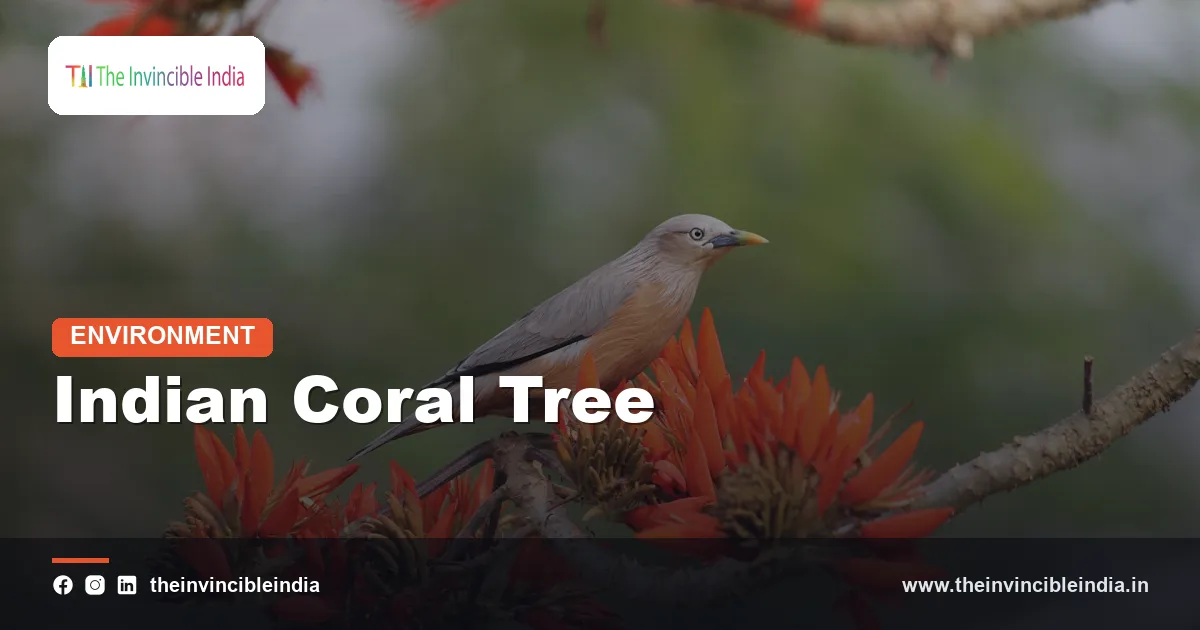
The Indian coral tree (Erythrina variegata) is a fast-growing, thorny, deciduous tree of the pea family that sheds its leaves in winter and then bursts into dense clusters of scarlet, coral-like flowers in late winter and spring. Native to the tropical coasts and lowlands of India and the wider Indo-Pacific, the Indian coral tree has long been planted as a living fence, a support for climbing crops such as pepper and betel, and a source of green manure.
The Indian coral tree is also an ecological resource, because its nectar-rich flowers feed birds and insects at a time when few other trees are in bloom. This explainer sets out what the tree is, how to identify it, where it grows, how it is used and what precautions apply.
| Attribute | Detail |
|---|---|
| Common names | Indian coral tree, tiger’s claw, sunshine tree; pangara (Hindi and Marathi), mandar, kalyana murungai (Tamil), badisa (Telugu), murikku (Malayalam) |
| Scientific name | Erythrina variegata (also written Erythrina indica) |
| Plant family | Fabaceae (pea or legume family) |
| Native range | Tropical Asia, including coastal India, extending to the Pacific |
| Growth form | Deciduous tree with prickly trunk and branches, up to about 20 metres |
| Flowering season | Roughly January to April, while the tree is leafless or nearly so |
| Flower colour | Bright scarlet to orange-red, in dense racemes |
| Main uses | Living fence, crop support, green manure, shade, traditional medicine, light wood |
| Pollinators | Mostly birds, along with some insects |
Key Takeaways
- The Indian coral tree (Erythrina variegata) is a deciduous, prickly legume tree that flowers in scarlet while leafless in late winter and spring.
- Indian coral tree branches root easily from cuttings, which is why farmers use them as quick-growing living fences and as live supports for pepper and betel vines.
- As a member of the pea family, the Indian coral tree harbours nitrogen-fixing root bacteria, and its leaves are used as green manure.
- The flowers of the Indian coral tree produce abundant nectar and are pollinated mainly by birds such as mynas, bulbuls, sunbirds and crows.
- Parts of the Indian coral tree contain alkaloids, so traditional preparations should be used only with qualified guidance.
- The wood of the Indian coral tree is light and soft, suited to packing boxes, floats and simple carved items rather than heavy construction.
What is the Indian coral tree?
The Indian coral tree is a medium to large deciduous tree, Erythrina variegata, belonging to the legume family Fabaceae, and it is known for its thorny trunk and its vivid red flower clusters. The genus name Erythrina comes from the Greek word for red, which refers to the flowers of the many species in this group.
The tree is found wild in coastal forests, river banks and moist lowland areas, and it is also cultivated around fields and villages. It grows quickly, often adding a metre or more of height a year in good conditions, and reaches heights of around 15 to 20 metres in the open when mature. In English-speaking countries it is also called the tiger’s claw, a reference to the curved, claw-like shape of the flower buds and petals.
Because Erythrina is a large genus found across the tropics, other species such as Erythrina suberosa and Erythrina stricta also occur in India. The Indian coral tree discussed here is the best-known and most widely planted of them.
How can you identify an Indian coral tree?
An Indian coral tree can be identified by three features: a grey, prickly trunk, leaves made of three broad leaflets, and upright clusters of red flowers that open on bare branches. The trunk and younger branches carry short, sharp, cone-shaped prickles, which give the tree its reputation as a good barrier plant.
Leaves
Each leaf is trifoliate, meaning it has three leaflets, and the terminal leaflet is the largest, often 10 to 20 centimetres across and broadly triangular or diamond-shaped. Some forms have leaflets splashed with pale yellow-green patches, which explains the species name variegata, meaning variegated.
Flowers
The flowers are bright scarlet, tubular and arranged in dense terminal racemes that stand upright from the branch tips. Each flower has a large standard petal, a feature typical of pea-family flowers, which folds around the smaller petals. The tree flowers heavily when leafless, so the crown appears to be covered in red torches against a pale sky.
Pods and seeds
The pods are long, narrow and constricted between seeds, rather like a string of beads. They turn dark as they ripen and contain glossy red to dark-brown seeds. Seeds should never be eaten, because many Erythrina seeds contain toxic alkaloids.
When and why does the Indian coral tree flower?
The Indian coral tree flowers from about January to April in most parts of India, at the end of the cool dry season and while the branches are bare. Leaf fall in winter and early spring is triggered by the dry season, and the flower buds then develop on leafless shoots.
Flowering without leaves has an ecological benefit. The red flowers are fully visible to birds, which are the principal pollinators. Birds perch on the sturdy flower stalks and sip the nectar, and in the process pollen is deposited on their heads and bills and carried to other flowers.
- The flowers secrete large quantities of nectar, which is watery and rich in sugars.
- The red colour and sturdy structure suit bird visitors more than bees.
- New leaves appear soon after flowering, and the tree is fully green again by the start of the monsoon.
- The flowering period varies slightly with latitude and weather, so a tree in Kerala may bloom somewhat earlier or later than one in northern India.
The timing overlaps with other leafless spring bloomers such as the palash or flame of the forest (Butea monosperma) and the silk cotton tree (Bombax ceiba), and together they form a recognisable seasonal display across the country.
Where does the Indian coral tree grow in India?
The Indian coral tree grows across peninsular India, the Western Ghats, the eastern coast, the Andaman and Nicobar Islands and the plains of many states, from sea level to moderate elevation. It prefers warm, humid, frost-free climates and well-drained soil, although it adapts to a range of conditions including saline coastal sand.
The tree is common as a boundary and shade planting in Kerala, Karnataka, Tamil Nadu, Maharashtra, Goa, Odisha and West Bengal. It is also grown as an ornamental in towns and gardens elsewhere. In very cold or arid regions it grows poorly, since frost damages young growth and dry soils slow its development.
Because the tree comes up readily from cuttings and seeds, it can sometimes spread near villages and watercourses. It is generally regarded as a useful native or long-naturalised species in India rather than a weed.
How is the Indian coral tree used as a living fence and crop support?
The Indian coral tree is used as a living fence by planting thick branch cuttings, called stakes, at close intervals, where they take root and grow into a thorny barrier that livestock avoid. The cuttings are often a metre or two long and are planted at the start of the rains.
The same ease of rooting makes the tree a live standard, or living post, for climbing crops. In Kerala and coastal Karnataka, black pepper vines are trained up Erythrina trunks, and betel vine plantations often use them as support and shade. Compared with dead wooden posts, a living support grows with the crop, does not rot and can provide light shade and leaf litter.
Why farmers value it
- Cuttings root without special treatment.
- The prickly trunk deters cattle and goats.
- Regular lopping provides fodder in some areas and leafy mulch.
- Light shade suits crops that dislike direct heat.
Lopping must be done with care, since heavy pruning at the wrong season can weaken the tree. Trunks are also brittle compared with many hardwoods, so large branches can break in storms.
Why is the Indian coral tree good for soil?
The Indian coral tree improves soil because, like other legumes, its roots host nitrogen-fixing bacteria, and its fallen leaves add organic matter and nitrogen when they decay. Farmers collect the leaves and lopped twigs as green manure and mulch for field crops and plantations.
Plantation systems have used Erythrina trees as shade and nitrogen sources in crops such as coffee, cocoa and tea in various tropical countries. In India the tree is most visible in pepper and betel gardens and on field bunds.
| Benefit | How the Indian coral tree provides it |
|---|---|
| Soil nitrogen | Root nodules with nitrogen-fixing bacteria; leaf litter |
| Organic matter | Leaves and twigs used as green manure and mulch |
| Shade | Open canopy gives light shade to understory crops |
| Erosion control | Rooted bund and boundary plantings hold soil on slopes |
| Livestock barrier | Prickly trunk and branches |
Which birds and insects visit the Indian coral tree?
The Indian coral tree attracts nectar-feeding birds such as sunbirds, bulbuls, mynas, crows, parakeets and drongos, along with honeybees and other insects. A flowering tree in February or March often has noisy groups of birds moving through the crown from dawn.
The tree matters ecologically because it offers a dependable nectar supply at the end of the dry season, when other food is scarce. Birdwatchers often find that one flowering coral tree can be a more productive place to watch than a stretch of open scrub.
Some birds take nectar without carrying much pollen, and others act as true pollinators. In either case, a stand of flowering coral trees supports local bird activity and, indirectly, seed dispersal and insect control around villages and orchards.
What are the traditional uses and cautions of the Indian coral tree?
Traditional medicine systems in India have used the bark, leaves and flowers of the Indian coral tree for a variety of household remedies, but the plant contains alkaloids, and it should not be taken without professional advice. In parts of Tamil Nadu and Kerala, young leaves of the related kalyana murungai are used in home cooking and in folk practice, which has made the tree a common backyard plant.
The tree is also associated with Sanskrit and Hindu tradition under the name mandara, one of the trees named in mythological descriptions of heavenly gardens. Names vary regionally and several different plants share similar-sounding names, so identification should be done by botanical features and not by a single local word.
- Seeds and some other parts contain erythrina alkaloids and should not be eaten.
- Prickles can cause injuries during pruning, so gloves are advisable.
- Any medicinal use should follow guidance from a qualified practitioner.
- Branches are brittle and may drop in storms, so planting near buildings needs forethought.
The wood is light, soft and pale, and it has been used for packing cases, floats, scabbards, simple toys and similar items. It is not durable outdoors and is a poor fuel compared with denser trees.
What problems threaten the Indian coral tree?
The main modern threat to the Indian coral tree is the Erythrina gall wasp (Quadrastichus erythrinae), an invasive insect that causes galls on young shoots and leaves, and has damaged Erythrina trees across the Asia-Pacific region since the early 2000s. The wasp distorts growth, can defoliate trees and sometimes kills them.
Other problems include fungal leaf spots, borers in old wood and storm damage. Loss of trees through clearing for construction and roads also reduces the number of old, flower-rich specimens.
Growing an Indian coral tree
The tree can be grown from seed soaked in water overnight or from large cuttings. It prefers a sunny site, moderate watering during establishment and well-drained soil. Planting it away from buildings, drains and overhead cables gives the roots and brittle branches room, and gentle pruning after flowering keeps the shape manageable.
Bottom Line
The Indian coral tree is a practical and spectacular tree: a thorny fence post that grows by itself, a soil improver, and a late-winter beacon for birds. It deserves a place along farm boundaries and in large gardens, provided that its brittle branches, prickles and toxic seeds are respected.
Frequently Asked Questions
What is the Indian coral tree known for?
The Indian coral tree is known for its brilliant scarlet flower clusters that appear on bare branches in late winter and spring. It is also known for its thorny trunk, its use as a living fence and as a support for pepper and betel vines, and its nectar for birds.
Is the Indian coral tree the same as the palash?
No, the Indian coral tree and the palash (Butea monosperma) are different trees, although both belong to the pea family and flower in red-orange shades in spring. The Indian coral tree has prickly bark and trifoliate leaves with scarlet tubular flowers, while the palash has velvety, orange-red, curved flowers and no prickles.
Is the Indian coral tree poisonous?
Parts of the Indian coral tree, especially the seeds, contain alkaloids and should not be eaten. Traditional uses of leaves and bark exist, but they should be followed only with advice from a qualified practitioner. Handling the tree is safe if the prickles are avoided.
When does the Indian coral tree bloom in India?
The Indian coral tree typically blooms between January and April, while the branches are leafless or nearly so. The exact timing shifts with latitude and local weather. New leaves appear after the flowers and the tree is fully green by the monsoon.
How is the Indian coral tree propagated?
The Indian coral tree is easily propagated from thick branch cuttings planted in moist soil, and it can also be grown from seed. Cuttings usually root quickly at the start of the rains, which is why farmers use them for living fences.
Why do birds visit the Indian coral tree?
Birds visit the Indian coral tree because its red flowers produce large amounts of nectar at the end of the dry season. Sunbirds, bulbuls, mynas, crows and parakeets feed on the nectar and, in doing so, help to pollinate the flowers.
{“@context”:”https://schema.org”,”@graph”:[{“@type”:”FAQPage”,”mainEntity”:[{“@type”:”Question”,”name”:”What is the Indian coral tree known for?”,”acceptedAnswer”:{“@type”:”Answer”,”text”:”The Indian coral tree is known for its brilliant scarlet flower clusters that appear on bare branches in late winter and spring. It is also known for its thorny trunk, its use as a living fence and as a support for pepper and betel vines, and its nectar for birds.”}},{“@type”:”Question”,”name”:”Is the Indian coral tree the same as the palash?”,”acceptedAnswer”:{“@type”:”Answer”,”text”:”No, the Indian coral tree and the palash (Butea monosperma) are different trees, although both belong to the pea family and flower in red-orange shades in spring. The Indian coral tree has prickly bark and trifoliate leaves with scarlet tubular flowers, while the palash has velvety, orange-red, curved flowers and no prickles.”}},{“@type”:”Question”,”name”:”Is the Indian coral tree poisonous?”,”acceptedAnswer”:{“@type”:”Answer”,”text”:”Parts of the Indian coral tree, especially the seeds, contain alkaloids and should not be eaten. Traditional uses of leaves and bark exist, but they should be followed only with advice from a qualified practitioner. Handling the tree is safe if the prickles are avoided.”}},{“@type”:”Question”,”name”:”When does the Indian coral tree bloom in India?”,”acceptedAnswer”:{“@type”:”Answer”,”text”:”The Indian coral tree typically blooms between January and April, while the branches are leafless or nearly so. The exact timing shifts with latitude and local weather. New leaves appear after the flowers and the tree is fully green by the monsoon.”}},{“@type”:”Question”,”name”:”How is the Indian coral tree propagated?”,”acceptedAnswer”:{“@type”:”Answer”,”text”:”The Indian coral tree is easily propagated from thick branch cuttings planted in moist soil, and it can also be grown from seed. Cuttings usually root quickly at the start of the rains, which is why farmers use them for living fences.”}},{“@type”:”Question”,”name”:”Why do birds visit the Indian coral tree?”,”acceptedAnswer”:{“@type”:”Answer”,”text”:”Birds visit the Indian coral tree because its red flowers produce large amounts of nectar at the end of the dry season. Sunbirds, bulbuls, mynas, crows and parakeets feed on the nectar and, in doing so, help to pollinate the flowers.”}}]}]}


