

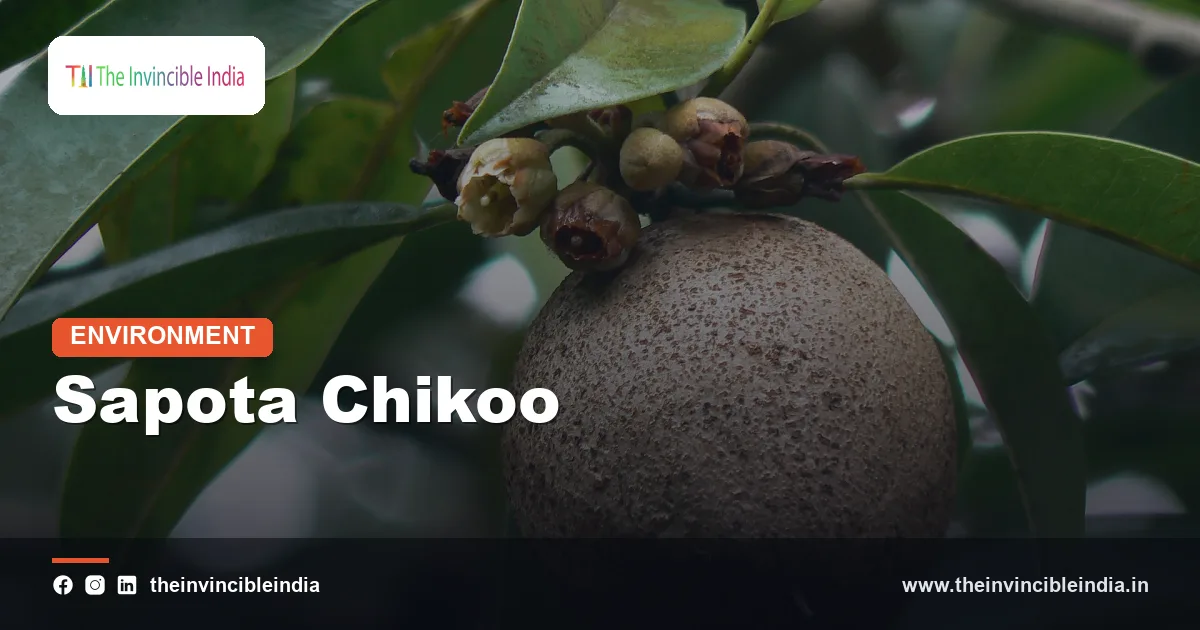
The sapota (Manilkara zapota), known in most of India as chikoo or chiku, is an evergreen fruit tree of the family Sapotaceae that bears sweet, soft, grainy-textured brown fruit and is one of the most important orchard crops of western and southern India. Although the tree is native to southern Mexico and Central America, it has been grown in India for well over a century and now thrives in coastal and semi-arid districts of Gujarat, Maharashtra, Karnataka, Andhra Pradesh and Tamil Nadu.
The sapota is valued for three reasons: its fruit, which is eaten fresh and blended into milkshakes and ice cream; its hardiness in dry, warm and even slightly saline conditions; and its milky latex, called chicle, which was the original base of chewing gum. This explainer covers the tree’s origin, appearance, varieties, cultivation, ripening and uses in plain, quotable terms.
| Attribute | Detail |
|---|---|
| Common names | Sapota, chikoo, chiku, sapodilla, naseberry |
| Scientific name | Manilkara zapota |
| Plant family | Sapotaceae |
| Native range | Southern Mexico and Central America |
| Introduced to India | Nineteenth century, from tropical America |
| Tree type | Slow-growing, long-lived evergreen with milky latex |
| Main Indian growing states | Gujarat, Maharashtra, Karnataka, Andhra Pradesh, Tamil Nadu, West Bengal |
| Leading variety | Kalipatti |
| Notable by-product | Chicle, the latex once used as chewing-gum base |
Key Takeaways
- The sapota (Manilkara zapota) is an evergreen tree of the family Sapotaceae whose scientific name and original home lie in tropical America, not India.
- Chikoo is the everyday Indian name for the sapota fruit, which has a brown, rough skin, sweet pulp and glossy black seeds.
- Gujarat, Maharashtra, Karnataka, Andhra Pradesh and Tamil Nadu account for most of India’s sapota orchards, and Kalipatti is the best-known commercial variety.
- Sapota fruit is climacteric, meaning mature hard fruit ripens off the tree, and unripe fruit is astringent because of latex and tannins.
- Chicle, the sticky latex of the sapota tree, was the original raw material of chewing gum before synthetic gum bases replaced it.
- Grafted sapota trees start bearing in about three to four years and can remain productive for several decades.
What is the sapota tree and where does it come from?
The sapota tree is a slow-growing evergreen, Manilkara zapota, native to the lowland tropical forests of southern Mexico, Guatemala, Belize and neighbouring Central America. In its wild habitat the tree can reach 30 metres or more, but orchard trees in India are usually kept to around 6 to 10 metres so that fruit can be picked easily.
The tree belongs to the family Sapotaceae, a group of tropical trees that produce milky latex. Close Indian relatives include the khirni or rayan tree (Manilkara hexandra), the mahua tree (Madhuca longifolia) as well as the argan tree of Morocco in the same family. The English names sapodilla and naseberry are used in the Caribbean and Africa, while Indian languages generally say chikoo, chiku, chikku or sapota.
The fruit’s popularity has moved well beyond its native range. Today the sapota is grown across tropical Asia, the Caribbean, parts of Africa and Florida, and India is widely counted among the largest producers in the world.
How did the sapota reach India?
The sapota reached India from tropical America in the nineteenth century, probably through plant exchanges between colonial-era botanical gardens and traders on the western coast. The Gholvad and Dahanu belt of what is now Palghar district in Maharashtra is commonly associated with the earliest commercial plantings, and the area later became famous for its chikoo orchards.
Several factors helped the tree settle in. Western India offered warm winters, moderate rainfall and sandy coastal soils that suit the crop. Farmers also found that the sapota needs relatively little irrigation once established, tolerates strong winds and bears fruit almost throughout the year, which gave it an advantage over many seasonal fruit trees.
Over the twentieth century, state horticulture departments and agricultural universities selected local seedlings, released improved varieties and promoted grafting. Dahanu Gholvad chikoo has since received a Geographical Indication (GI) tag, which recognises its link with the region where it is grown.
What does the sapota tree look like?
The sapota tree has a dense, rounded crown of glossy, dark green, oval leaves that are clustered at the tips of branches, and a trunk that exudes white latex when cut. The leaves are leathery, about 7 to 15 centimetres long, and the tree stays green through the year, which makes it a good shade provider in orchards and gardens.
Flowers
The flowers are small, bell-shaped and creamy white to pale brown, and they appear singly in the leaf axils. Flowering can occur in more than one season, so a sapota tree often carries flowers, young fruit and mature fruit at the same time.
Fruit and seeds
The fruit is a berry, usually round to oval, 5 to 10 centimetres across, with thin, rough, russet-brown skin. Ripe pulp is soft, light brown to yellowish brown and sweet with a slightly malty, caramel-like flavour. Each fruit carries one to five flat, glossy black seeds with a small hooked scar on the edge. The seeds should be removed before eating because the hooked end can catch in the throat.
Wood and growth habit
The sapota grows slowly and produces hard, reddish, durable wood that has traditionally been used for beams, tool handles and railway sleepers in tropical countries where the tree is common. The tree’s slow growth, strong branches and wind tolerance make it well suited to coastal belts.
Which sapota varieties are grown in India?
Kalipatti is the most widely planted sapota variety in India, followed by Cricket Ball, Pala, Dhola Diwani and a series of selections released by agricultural universities. Each variety differs in fruit shape, size, sweetness, grain texture and bearing habit, and growers choose according to local soil, climate and market demand.
| Variety | Fruit features | Notes |
|---|---|---|
| Kalipatti | Oval to ovate, thin skin, sweet and less gritty pulp | Leading commercial variety, associated with Gujarat and neighbouring states |
| Cricket Ball | Large, nearly round fruit with thick skin | Heavy, attractive fruit; pulp is somewhat grainier than Kalipatti |
| Pala | Medium-sized, oval fruit | Popular in parts of Tamil Nadu and southern India |
| Dhola Diwani | Round to oval, pale-skinned fruit | Grown in Gujarat and used in regional orchards |
| DHS-1 and DHS-2 | Selections from Dharwad, Karnataka | Released by horticultural researchers to improve yield and fruit quality |
| Guthi and other local types | Variable shapes | Older seedling-based types found in village orchards |
Fruit quality depends on more than the variety. Total soluble sugar, grain size in the pulp and shelf life all vary with climate, rootstock, orchard management and harvest maturity, which is why the same variety can taste noticeably different from one district to another.
Where is sapota grown in India and why?
Sapota is grown mainly in Gujarat, Maharashtra, Karnataka, Andhra Pradesh and Tamil Nadu, with smaller orchards in West Bengal, Odisha, Kerala and Telangana. These regions offer the warm, frost-free climate that the evergreen tree needs and have deep, well-drained soils in which its roots can anchor firmly.
- Gujarat: Districts such as Navsari and Valsad are known for Kalipatti orchards and for wide use of grafted plants.
- Maharashtra: The Dahanu and Gholvad coastal belt of Palghar district is a historic centre of chikoo cultivation.
- Karnataka: The Dharwad and Belagavi regions have long-running research and orchard activity on the crop.
- Andhra Pradesh and Tamil Nadu: Sapota fits well in warm, drier tracts with limited irrigation.
The tree’s strengths explain this distribution. The sapota tolerates drought better than many fruit crops, withstands moderately saline soil and irrigation water, and thrives from sea level up to roughly a thousand metres in suitable climates. It does poorly where winters bring regular frost and where soil stays waterlogged.
How is the sapota propagated and cultivated?
Commercial sapota orchards are propagated by grafting, usually by softwood or approach grafting a scion of a chosen variety onto a rootstock of khirni (Manilkara hexandra). Grafting is preferred over raising trees from seed because seedlings are slow to bear and vary widely in fruit quality, while grafted plants reproduce the parent variety reliably.
Planting and spacing
Grafted plants are set out at the start of the rains in pits filled with soil and farmyard manure. Traditional spacing is wide, often around 8 to 10 metres between trees, because the crown spreads as the tree matures. Some modern orchards use closer spacing with regular pruning to raise early returns per hectare.
Water and nutrition
Young trees need regular watering in their first summers, but mature trees can survive on modest irrigation. Drip irrigation is common in newer orchards. Organic manure and balanced fertiliser applications support steady flowering and fruit set, and mulching helps conserve soil moisture.
Bearing age and lifespan
Grafted trees usually begin fruiting in about three to four years, reach full production after roughly a decade, and may stay productive for forty years or more. Fruit takes several months to mature after flowering, and the tree commonly yields two main crops a year in suitable climates.
Pests and diseases
Common problems include leaf webbers, bud borers, scale insects and various fruit-damaging pests, along with sooty mould and leaf-spot diseases. Integrated pest management, including orchard sanitation, pruning and targeted control, is the usual approach.
How do you tell when a sapota is ripe?
A ripe sapota gives slightly under gentle finger pressure, has lost its green latex tinge under the scratched skin, and smells sweet. Unripe fruit is hard and sticky with latex; eating it produces an astringent, mouth-drying sensation because of tannins and latex compounds.
A simple field test is to scratch the skin lightly with a fingernail. If the scratched patch shows greenish tissue and white latex oozes out, the fruit has not matured; a yellowish-brown patch with no latex indicates that the fruit is mature enough to ripen. Growers harvest at this stage because the sapota is a climacteric fruit, meaning it continues to ripen after picking.
- Mature, firm fruit is kept at room temperature and ripens in roughly three to seven days.
- Placing fruit in a paper bag speeds ripening by trapping ethylene.
- Ripe fruit is fragile and keeps only a few days at room temperature, so cold storage is used commercially.
- Fruit that is picked too early may never develop full sweetness and often stays astringent.
What is chicle and how is it linked to the sapota?
Chicle is the dried milky latex of the sapota tree, and it was the principal raw material of chewing gum from the nineteenth century until synthetic gum bases took over in the mid-twentieth century. Maya communities had chewed the latex long before it became a commercial product, and gum makers in the United States later popularised it worldwide.
Chicle was collected by cutting a zigzag pattern of grooves in the trunk and gathering the latex that flowed into containers, after which it was boiled down into blocks. The practice was concentrated in the forests of Mexico, Guatemala and Belize, and it affected forest management in those countries for decades.
In India the sapota is grown as a fruit crop and not tapped for chicle. Latex in Indian orchards is a nuisance rather than a product, since it stains hands and unripe fruit. The connection nonetheless explains the tree’s wider economic history and the botanical interest in the family Sapotaceae.
What is the nutritional and culinary value of the sapota?
The sapota is a high-energy fruit because its pulp contains a large share of natural sugars, along with dietary fibre, some vitamin C and minerals such as potassium and calcium. Exact values vary with variety and ripeness, so the fruit is better described as an energy-rich, fibre-containing fruit than a fixed set of numbers.
In Indian kitchens the sapota is eaten in several ways:
- As a fresh fruit, peeled and deseeded, often chilled.
- As chikoo milkshake, one of the most common fruit shakes in Mumbai, Gujarat and Karnataka.
- As ice cream, kulfi and smoothies, where its caramel-like taste blends well with milk.
- In fruit salads and desserts, sometimes with custard or yogurt.
- As dried chikoo chips and fruit leather, produced by food processors in orchard regions.
People who manage blood sugar should treat the sapota as a sugary fruit and take dietary advice, since its sweetness is high compared with many other fruits.
What challenges do sapota growers face?
Sapota growers face four main challenges: slow tree maturity, a short shelf life of ripe fruit, price swings in local markets, and pests that damage buds and fruit. The long wait for the first crop means farmers must invest for years before earning a return.
| Challenge | Cause | Common response |
|---|---|---|
| Short shelf life | Ripe fruit softens quickly after harvest | Harvest at mature-firm stage, cold storage, processing into pulp or chips |
| Price volatility | Heavy supply in peak seasons | Staggered harvest, direct marketing, processing units |
| Pests and disease | Leaf webber, bud borer, scales, sooty mould | Pruning, sanitation, integrated pest management |
| Water stress | Erratic rainfall in semi-arid districts | Drip irrigation and mulching |
| Uneven fruit quality | Seedling variation, wrong harvest maturity | Grafted plants, training in harvest practices |
Cyclone and storm damage can also affect coastal orchards, although the sapota’s strong wood and flexible branches give it better wind resilience than many other fruit trees.
Bottom Line
The sapota is a tree from Mexico that became a quiet success story of Indian horticulture, thanks to its hardiness, long productive life and reliably sweet fruit. For gardeners and farmers, the main lesson is to choose a grafted plant of a proven variety and harvest at the right maturity. For consumers, the key is to let mature fruit ripen fully before eating.
Frequently Asked Questions
Is chikoo the same as sapota?
Yes, chikoo and sapota are two names for the same fruit, produced by the tree Manilkara zapota. Chikoo (also spelled chiku or chikku) is the common Hindi, Marathi and Gujarati name, while sapota is widely used in southern India and in trade. In English the fruit is also called sapodilla.
Is the sapota native to India?
No, the sapota is native to southern Mexico and Central America and was introduced to India in the nineteenth century. It adapted well to the warm coastal and semi-arid climate of western and southern India, and the country is now among the world’s major producers.
How long does a sapota tree take to bear fruit?
A grafted sapota tree normally begins to bear fruit in about three to four years after planting. Trees raised from seed take much longer and give uneven fruit. Productive life often exceeds forty years under good care.
Why does unripe chikoo make the mouth feel dry?
Unripe chikoo feels dry and sticky because its skin and flesh contain latex and tannins, which are astringent. These compounds break down as the fruit ripens, leaving soft, sweet pulp. Eating chikoo only when it is soft to gentle pressure avoids the problem.
What is chicle and does India produce it?
Chicle is the milky latex of the sapota tree, which was historically the base of chewing gum. India does not produce chicle commercially, because Indian sapota trees are grown for their fruit. Modern chewing gum mostly uses synthetic bases instead of natural chicle.
Can the sapota seeds be eaten?
No, sapota seeds are not eaten and should be removed before the fruit is consumed. The seeds are hard, glossy and black, with a small hooked scar that can catch in the throat. Only the soft pulp is edible.
{“@context”:”https://schema.org”,”@graph”:[{“@type”:”FAQPage”,”mainEntity”:[{“@type”:”Question”,”name”:”Is chikoo the same as sapota?”,”acceptedAnswer”:{“@type”:”Answer”,”text”:”Yes, chikoo and sapota are two names for the same fruit, produced by the tree Manilkara zapota. Chikoo (also spelled chiku or chikku) is the common Hindi, Marathi and Gujarati name, while sapota is widely used in southern India and in trade. In English the fruit is also called sapodilla.”}},{“@type”:”Question”,”name”:”Is the sapota native to India?”,”acceptedAnswer”:{“@type”:”Answer”,”text”:”No, the sapota is native to southern Mexico and Central America and was introduced to India in the nineteenth century. It adapted well to the warm coastal and semi-arid climate of western and southern India, and the country is now among the world’s major producers.”}},{“@type”:”Question”,”name”:”How long does a sapota tree take to bear fruit?”,”acceptedAnswer”:{“@type”:”Answer”,”text”:”A grafted sapota tree normally begins to bear fruit in about three to four years after planting. Trees raised from seed take much longer and give uneven fruit. Productive life often exceeds forty years under good care.”}},{“@type”:”Question”,”name”:”Why does unripe chikoo make the mouth feel dry?”,”acceptedAnswer”:{“@type”:”Answer”,”text”:”Unripe chikoo feels dry and sticky because its skin and flesh contain latex and tannins, which are astringent. These compounds break down as the fruit ripens, leaving soft, sweet pulp. Eating chikoo only when it is soft to gentle pressure avoids the problem.”}},{“@type”:”Question”,”name”:”What is chicle and does India produce it?”,”acceptedAnswer”:{“@type”:”Answer”,”text”:”Chicle is the milky latex of the sapota tree, which was historically the base of chewing gum. India does not produce chicle commercially, because Indian sapota trees are grown for their fruit. Modern chewing gum mostly uses synthetic bases instead of natural chicle.”}},{“@type”:”Question”,”name”:”Can the sapota seeds be eaten?”,”acceptedAnswer”:{“@type”:”Answer”,”text”:”No, sapota seeds are not eaten and should be removed before the fruit is consumed. The seeds are hard, glossy and black, with a small hooked scar that can catch in the throat. Only the soft pulp is edible.”}}]}]}


