

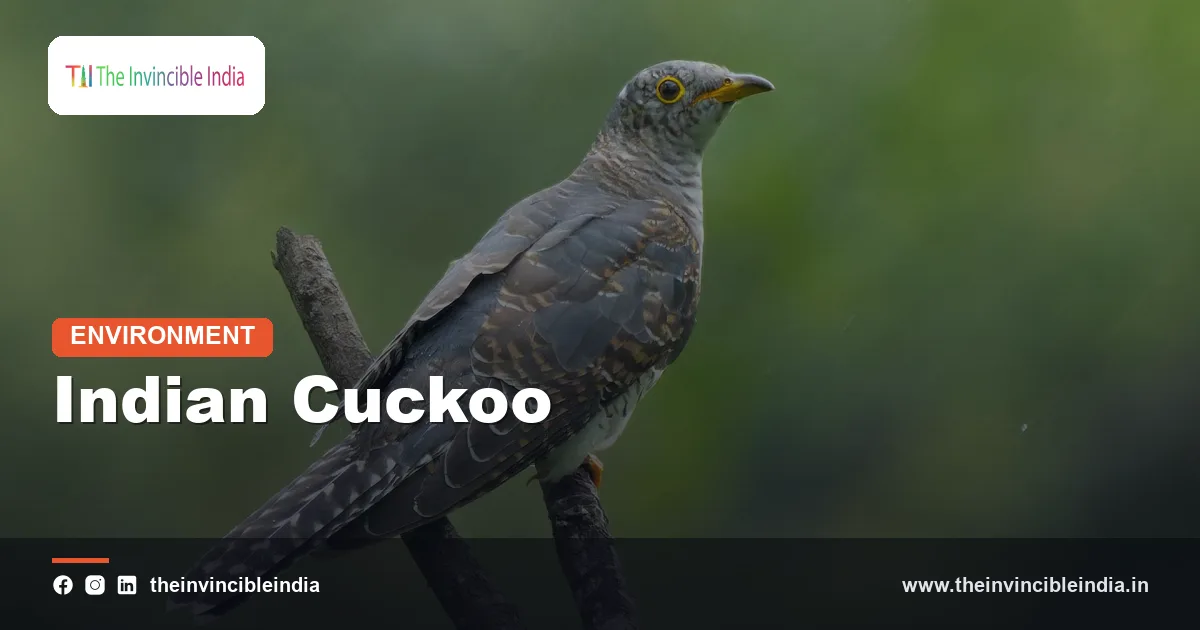
The Indian cuckoo (Cuculus micropterus) is a grey-headed, brown-backed forest cuckoo of South and Southeast Asia, famous for a loud, four-note call that Indians have long transcribed as “bo-ko-ta-ko” and that rings through woodlands during the hot weather and the monsoon. The Indian cuckoo is a brood parasite, which means that the female lays her eggs in the nests of other birds, especially drongos, and leaves the foster parents to raise the chick.
The Indian cuckoo is a different species from the Asian koel, the common hawk-cuckoo (the “brainfever bird”) and the Eurasian cuckoo, although all of them are cuckoos and all are heard in the Indian summer. This explainer covers how to identify the Indian cuckoo, where it lives, what it sounds like, how it parasitises other birds, what it eats and how it is faring in the wild.
| Quick Facts: Indian Cuckoo | |
|---|---|
| Common name | Indian cuckoo |
| Scientific name | Cuculus micropterus |
| Family and order | Cuculidae (cuckoos), order Cuculiformes |
| Size | Roughly 31-33 cm long, about the size of a collared dove, with a long tail |
| Key field marks | Grey head and throat, brown back and wings, barred underparts, broad dark band near the tip of the tail |
| Call | A loud four-note song often rendered as “bo-ko-ta-ko” |
| Habitat | Deciduous and evergreen forest, woodland, plantations and well-wooded gardens |
| Breeding | Brood parasite, laying eggs in the nests of other birds, notably drongos |
| IUCN status | Least Concern |
Key Takeaways
- The Indian cuckoo (Cuculus micropterus) is a forest cuckoo with a grey head, brown upperparts, barred underparts and a broad dark band near the end of the tail.
- The Indian cuckoo gives a loud four-note song, commonly written as “bo-ko-ta-ko”, and calls often during the hot, dry season and the early monsoon.
- The Indian cuckoo is a brood parasite that lays its eggs in the nests of other birds, particularly drongos, whose parents then raise the cuckoo chick.
- The Indian cuckoo is a different species from the Asian koel, the common hawk-cuckoo and the Eurasian cuckoo, and each of them has a distinct call.
- The Indian cuckoo feeds mainly on insects, especially hairy caterpillars that most other birds avoid, which it picks from foliage in the forest canopy.
- The IUCN lists the Indian cuckoo as Least Concern because it has a very large range, though it depends on wooded habitat and on the survival of its host species.
What is the Indian cuckoo?
The Indian cuckoo is a medium-sized, long-tailed bird of the family Cuculidae that is native to the Indian subcontinent and parts of Southeast Asia, where it lives in forest and well-wooded country. It was described by the English ornithologist John Gould in 1838, and the species name micropterus means “small-winged” in Greek, although the wings of the bird are not noticeably small.
The Indian cuckoo is one of the “true cuckoos” of the genus Cuculus, a group that also includes the Eurasian cuckoo (Cuculus canorus), the Himalayan cuckoo (Cuculus saturatus) and the lesser cuckoo (Cuculus poliocephalus). These species look broadly alike and are often distinguished more reliably by voice than by plumage.
The bird is secretive and tends to stay high in leafy trees, so many people hear the Indian cuckoo for years before they see one. Its call is a familiar sound of Indian forests in the months before the rains, and in many regional traditions it is linked with the season.
How can you identify an Indian cuckoo?
You can identify an Indian cuckoo by its combination of a pale grey head and throat, a brown (not grey) back and wings, white underparts with dark bars and a long tail marked by a broad blackish band close to its tip. The eye is dark brown, with a yellow ring around it, and the bill is dark above with a yellowish base below.
The two sexes are similar, though females are generally slightly duller and may show a buffish wash on the breast. Young birds are browner, with pale feather edges on the upperparts and a more heavily barred appearance. In flight the Indian cuckoo is falcon-like, with pointed wings, a fast direct flight and a long tail, which can lead to confusion with a small hawk.
Key points for identification
- Brown back and wings contrasting with a grey head, unlike the uniformly grey upperparts of the Eurasian cuckoo.
- A single wide black subterminal band on the tail, with a narrow pale tip, as a good field mark.
- Widely spaced dark bars on a white belly, which are broader than in the hawk-cuckoo.
- A habit of perching high on a bare or leafy branch while calling repeatedly.
Where does the Indian cuckoo live?
The Indian cuckoo lives in forests and wooded areas across the Indian subcontinent, from the foothills of the Himalayas and the Western Ghats to the north-east and the Eastern Ghats, and it extends eastwards through Southeast Asia to Indonesia. It is more common in hilly and well-forested country than in open plains or deserts.
Preferred habitats in India include moist and dry deciduous forest, evergreen and semi-evergreen forest, bamboo forest, plantations and old, well-wooded gardens and groves. In the Himalayas the bird reaches the lower and middle hills.
Some populations are resident while others move seasonally. Birds that breed in the northern part of the range, such as the Himalayan foothills, are largely summer visitors that withdraw to warmer forest in winter, while those in the peninsular forests and the north-east are present for much of the year but call mostly in the breeding season.
What does the Indian cuckoo sound like?
The Indian cuckoo gives a loud, ringing four-note call that is usually transcribed in India as “bo-ko-ta-ko”, with the third note often slightly higher and the whole phrase repeated at short intervals for long periods. The call is the most dependable way to identify the bird, because the species is easily hidden by foliage.
English-speaking birdwatchers have rendered the same phrase with other mnemonics, such as “one more bottle”, “crossword puzzle” and “orange pekoe”, all of which capture the four-note rhythm. Different people hear different syllables, so the useful point is the pattern: four notes, repeated, with a distinct rhythm.
The song is delivered from a high perch and may be repeated dozens of times in a series, sometimes starting before dawn and continuing into the night in the breeding season. Calling peaks from roughly March to July in much of India, covering the hot weather and the first rains.
How is the Indian cuckoo different from other Indian cuckoos?
The Indian cuckoo differs from other Indian cuckoos mainly in voice and back colour: its call has four notes and its back is brown, whereas the Asian koel gives a rising “kuoo” and the common hawk-cuckoo gives a screaming, rising “brain-fever” phrase. Comparing the species side by side helps avoid mix-ups.
| Species | Appearance | Call |
|---|---|---|
| Indian cuckoo | Grey head, brown back, barred belly, broad subterminal tail band | Four notes, “bo-ko-ta-ko” |
| Eurasian cuckoo | Grey upperparts and head, barred underparts; a visitor and passage migrant | Two-note “cuck-oo” |
| Himalayan cuckoo | Grey like the Eurasian cuckoo, finer bars | Repeated deep “hoop-hoop-hoop” |
| Common hawk-cuckoo | Greyish back, rufous breast, hawk-like in flight | Escalating, screaming “brain-fever” phrase |
| Asian koel | Male glossy black, female brown with white spots; red eye | Rising “koo-ooo” notes, then a rapid “ko-ko-ko” |
The Indian cuckoo should therefore not be mixed up with the hawk-cuckoo, which has a very different song and is named for its resemblance to a sparrowhawk, or with the koel, which belongs to a separate genus and is a large, noisy bird of towns and gardens.
How does the Indian cuckoo breed as a brood parasite?
The Indian cuckoo breeds as a brood parasite, meaning the female lays her egg in the nest of another bird and leaves the host pair to hatch and raise the chick. The host species most often recorded for the Indian cuckoo are drongos, which are bold, aggressive birds that often chase off other intruders, along with a few other medium-sized songbirds.
The female watches a nest while the hosts are away, quickly lays a single egg and may remove one of the host eggs. The cuckoo egg is usually timed to hatch slightly earlier than the host eggs. Because the egg of the Indian cuckoo often resembles that of the host in colour and pattern, it is less likely to be rejected, a result of evolution between the parasite and its hosts.
- Egg laying: the female lays one egg per host nest, though she may lay many eggs in total over a season in different nests.
- Chick behaviour: the newly hatched cuckoo usually pushes the host eggs or chicks out of the nest, so that it receives all the food.
- Growth: the host parents feed the growing chick until it fledges, even when it has become larger than they are.
- Independence: the young cuckoo leaves the nest after some weeks and is fed for a short time afterwards before becoming independent.
Brood parasitism does not mean that cuckoos are “bad parents” in any moral sense. It is a successful reproductive strategy that has evolved many times in birds, and the interaction between cuckoos and their hosts is a classic example of an evolutionary arms race, in which hosts evolve better egg recognition and cuckoos evolve better mimicry.
What does the Indian cuckoo eat?
The Indian cuckoo eats mainly insects, with a strong preference for caterpillars, including hairy and spiny ones that many birds refuse, as well as beetles, grasshoppers and other forest insects. It forages quietly in the leafy canopy, often by sitting still and then dropping or flying to snatch prey from the foliage.
Because the cuckoo gizzard can handle hairy caterpillars, it is one of the few predators that help control outbreaks of forest caterpillars. The bird is known to shed the lining of its stomach periodically, along with the accumulated caterpillar hairs, which is a habit seen in several cuckoo species. Occasionally the Indian cuckoo may also take small fruits or berries, but insects form the bulk of the diet.
The role of the bird in controlling insect pests makes it quietly useful to forests and plantations, even though most people notice it only because of its voice.
When does the Indian cuckoo breed and migrate?
The Indian cuckoo breeds mainly from about April to August in most of India, a period that covers the hot weather and the monsoon, when host birds are nesting and caterpillars are abundant. The exact timing varies with region and local rainfall.
The northern and hill populations show seasonal movements, arriving in the foothills in spring and leaving after the breeding season. Cuckoos often migrate at night and are seldom noticed on their journeys. In many peninsular forests the birds remain throughout the year, but they are much less vocal outside the breeding season, so they can seem to disappear after July.
Because the timing of breeding is tied to the nesting season of the hosts and to the emergence of caterpillars, shifts in the monsoon and in the timing of the rains can influence how well young cuckoos are fed. Long-term monitoring is needed to understand whether climate change is altering these links.
Is the Indian cuckoo threatened?
No, the Indian cuckoo is not globally threatened, and the International Union for Conservation of Nature (IUCN) lists it as Least Concern because it has a very large range across South and Southeast Asia and appears to be reasonably common in suitable forest. Its numbers are, however, tied to the health of the forests and the host birds it depends on.
- Forest loss and fragmentation: clearing and degradation of woodland reduce the habitat of both the cuckoo and its hosts.
- Pesticides: spraying that kills caterpillars and other insects removes the cuckoo’s main food.
- Loss of host species: declines in drongos and other hosts would reduce breeding success.
- Climate variation: irregular rainfall can disturb the timing of insect outbreaks and nesting.
In India all wild birds benefit from protection under the Wild Life (Protection) Act, 1972, and the Indian cuckoo occurs in many national parks, sanctuaries and reserved forests. Protecting mixed, mature forest with a good canopy is the best way to safeguard the species.
Where and when can you watch the Indian cuckoo in India?
The best time to hear and see the Indian cuckoo in India is from March to July, when the males call all day, and the best places are the forests of the Western Ghats, central India, the north-east and the Himalayan foothills. A calling bird can often be traced to an exposed branch near the top of a tall tree.
Tips for birdwatchers
- Learn the four-note call first; most records of the species begin with hearing it.
- Scan the upper branches of tall trees in the early morning, when the bird is vocal and active.
- Use binoculars to check for the brown back and the broad dark band across the tail.
- Watch the behaviour of drongos in the area, as an agitated drongo calling loudly may indicate a cuckoo nearby.
- Avoid disturbing nests, and do not use recorded calls during the breeding season, as this can distract both cuckoos and their hosts.
National parks and tiger reserves with good canopy cover, such as those in the Western Ghats and central India, are reliable places to hear the species. Birders who record the call and note the date help build useful seasonal records for the bird.
Bottom Line
The Indian cuckoo is a shy canopy bird whose four-note call is among the best-known sounds of the Indian hot weather. A brood parasite that relies on drongos and other hosts and a hunter of hairy caterpillars, it plays a distinctive part in forest ecology. It is not at risk globally, but its future depends on keeping forests healthy and the bird community intact.
Frequently Asked Questions
What is an Indian cuckoo?
The Indian cuckoo (Cuculus micropterus) is a forest cuckoo with a grey head, brown back and barred underparts that is native to the Indian subcontinent and Southeast Asia. It is a brood parasite known for its loud four-note call.
What is the call of the Indian cuckoo?
The Indian cuckoo gives a loud four-note call that is commonly written as “bo-ko-ta-ko” in India. English-speaking birdwatchers have also rendered it as “one more bottle” or “crossword puzzle”, and the call is heard mostly from March to July.
Is the Indian cuckoo the same as the Asian koel?
No, the Indian cuckoo is a different species from the Asian koel (Eudynamys scolopaceus). The koel is a larger bird with a red eye and a rising “koo-ooo” call, while the Indian cuckoo is a slimmer grey-and-brown bird with a four-note song.
Does the Indian cuckoo lay eggs in other birds’ nests?
Yes, the Indian cuckoo is a brood parasite that lays its eggs in the nests of other birds, particularly drongos. The host parents hatch the egg and feed the cuckoo chick, which usually removes the host eggs or chicks.
What does the Indian cuckoo eat?
The Indian cuckoo eats mainly insects, especially caterpillars, including hairy ones that many other birds avoid. It also takes beetles and grasshoppers and, occasionally, small fruits.
Is the Indian cuckoo endangered?
No, the Indian cuckoo is listed as Least Concern by the IUCN because of its wide range across South and Southeast Asia. It still depends on healthy forest and on the survival of the host birds in which it lays its eggs.
{“@context”:”https://schema.org”,”@graph”:[{“@type”:”FAQPage”,”mainEntity”:[{“@type”:”Question”,”name”:”What is an Indian cuckoo?”,”acceptedAnswer”:{“@type”:”Answer”,”text”:”The Indian cuckoo (Cuculus micropterus) is a forest cuckoo with a grey head, brown back and barred underparts that is native to the Indian subcontinent and Southeast Asia. It is a brood parasite known for its loud four-note call.”}},{“@type”:”Question”,”name”:”What is the call of the Indian cuckoo?”,”acceptedAnswer”:{“@type”:”Answer”,”text”:”The Indian cuckoo gives a loud four-note call that is commonly written as “bo-ko-ta-ko” in India. English-speaking birdwatchers have also rendered it as “one more bottle” or “crossword puzzle”, and the call is heard mostly from March to July.”}},{“@type”:”Question”,”name”:”Is the Indian cuckoo the same as the Asian koel?”,”acceptedAnswer”:{“@type”:”Answer”,”text”:”No, the Indian cuckoo is a different species from the Asian koel (Eudynamys scolopaceus). The koel is a larger bird with a red eye and a rising “koo-ooo” call, while the Indian cuckoo is a slimmer grey-and-brown bird with a four-note song.”}},{“@type”:”Question”,”name”:”Does the Indian cuckoo lay eggs in other birds’ nests?”,”acceptedAnswer”:{“@type”:”Answer”,”text”:”Yes, the Indian cuckoo is a brood parasite that lays its eggs in the nests of other birds, particularly drongos. The host parents hatch the egg and feed the cuckoo chick, which usually removes the host eggs or chicks.”}},{“@type”:”Question”,”name”:”What does the Indian cuckoo eat?”,”acceptedAnswer”:{“@type”:”Answer”,”text”:”The Indian cuckoo eats mainly insects, especially caterpillars, including hairy ones that many other birds avoid. It also takes beetles and grasshoppers and, occasionally, small fruits.”}},{“@type”:”Question”,”name”:”Is the Indian cuckoo endangered?”,”acceptedAnswer”:{“@type”:”Answer”,”text”:”No, the Indian cuckoo is listed as Least Concern by the IUCN because of its wide range across South and Southeast Asia. It still depends on healthy forest and on the survival of the host birds in which it lays its eggs.”}}]}]}


