

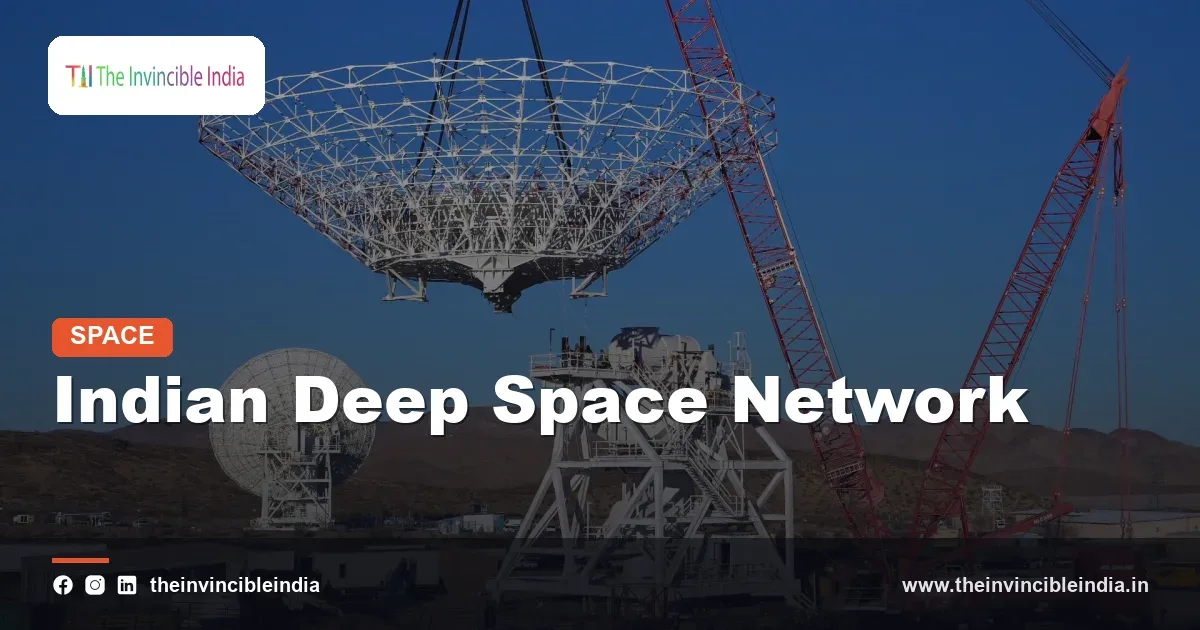
The Indian Deep Space Network (IDSN) is the Indian Space Research Organisation’s system of large ground antennas at Byalalu near Bengaluru that track, receive data from and send commands to spacecraft travelling far beyond Earth orbit, such as India’s lunar, Mars and solar missions. It was commissioned around 2008 to support Chandrayaan-1, India’s first mission to the Moon, and it is operated by the ISRO Telemetry, Tracking and Command Network (ISTRAC).
The Indian Deep Space Network is built around a 32-metre antenna and an 18-metre antenna, which together form the backbone of India’s deep-space communications. It gives India its own ability to talk to missions such as Chandrayaan, Mangalyaan (the Mars Orbiter Mission) and Aditya-L1, and it works alongside NASA’s Deep Space Network and the European Space Agency’s tracking network. This explainer covers what the IDSN is, how it works and why it matters.
| Attribute | Details |
|---|---|
| Full name | Indian Deep Space Network (IDSN) |
| Location | Byalalu, near Bengaluru, Karnataka |
| Commissioned | Around 2008, ahead of the Chandrayaan-1 mission |
| Main antennas | A 32-metre antenna and an 18-metre antenna |
| Operated by | ISRO Telemetry, Tracking and Command Network (ISTRAC), Bengaluru |
| Parent organisation | Indian Space Research Organisation (ISRO), Department of Space |
| Missions supported | Chandrayaan-1, Mars Orbiter Mission, Chandrayaan-2, Chandrayaan-3, Aditya-L1 |
| Radio bands | Mainly S-band and X-band |
| Counterparts abroad | NASA Deep Space Network, ESA’s ESTRACK network |
Key Takeaways
- The Indian Deep Space Network (IDSN) is the Indian Space Research Organisation’s ground system for communicating with spacecraft that travel to the Moon, Mars and beyond.
- The IDSN is located at Byalalu near Bengaluru and was commissioned around 2008 for the Chandrayaan-1 lunar mission.
- The IDSN uses large dish antennas of 32 metres and 18 metres in diameter to track spacecraft, receive scientific data and send commands.
- The ISRO Telemetry, Tracking and Command Network (ISTRAC) operates the IDSN and has its headquarters in Bengaluru.
- The IDSN has supported India’s major deep-space missions, including Chandrayaan-1, Mangalyaan, Chandrayaan-2, Chandrayaan-3 and Aditya-L1.
- The IDSN complements NASA’s Deep Space Network and the European Space Agency’s ESTRACK network, because spacecraft need antennas at different longitudes to maintain continuous contact.
What is the Indian Deep Space Network?
The Indian Deep Space Network is a ground station complex that provides tracking, telemetry and command services for Indian spacecraft operating at lunar distance and beyond. It is also known by the acronym IDSN, and the facility is located in a quiet rural site at Byalalu village, about 40 kilometres from Bengaluru.
A deep-space mission cannot be controlled with small dishes or with the stations used for near-Earth satellites. Signals from the Moon, Mars or the Sun-Earth Lagrange point are extremely faint by the time they reach Earth, so receivers need very large antennas, sensitive low-noise electronics and powerful transmitters. The IDSN supplies those capabilities, and the same site also houses the Indian Space Science Data Centre (ISSDC), which stores and distributes data from India’s space-science missions.
Why was the Indian Deep Space Network built?
The Indian Deep Space Network was built because India’s first lunar mission, Chandrayaan-1, planned for launch in October 2008, needed a dedicated high-sensitivity ground station to communicate with a spacecraft about 384,000 kilometres away. India’s existing tracking stations, which were designed for satellites in low or geostationary orbit, did not have the antenna size and sensitivity required.
ISRO therefore planned and built the new facility at Byalalu in the years before the launch. Having its own network reduced India’s reliance on foreign stations for routine operations, gave mission teams control over scheduling and allowed ISRO to build indigenous expertise in large antennas, receivers and signal processing.
Why was Byalalu chosen as the site?
Byalalu was chosen because it is close to ISRO’s headquarters and mission control in Bengaluru, has low levels of man-made radio interference, offers a stable location with suitable terrain and has good infrastructure. Proximity to the mission operations complex and to the ISRO Satellite Centre makes it easier to coordinate operations and maintenance.
How does the Indian Deep Space Network work?
The Indian Deep Space Network works by pointing large dish antennas at a spacecraft, receiving its radio signals and sending commands in the opposite direction. The dish collects very weak signals and focuses them onto a feed, where amplifiers and receivers convert them into data that can be processed and sent to mission control.
The network provides three core services:
- Telemetry: receiving data about the spacecraft’s health, such as temperature, power and fuel, along with scientific data from onboard instruments.
- Tracking: measuring the spacecraft’s position and speed using the Doppler shift of the radio signal and the time taken for signals to travel to the spacecraft and back, which is known as ranging.
- Command: sending instructions from the ground, such as orbit corrections, instrument settings and landing sequences.
Accurate tracking data allow navigation teams to determine the orbit, plan manoeuvres and confirm that the spacecraft is following its planned trajectory. Because radio signals travel at the speed of light, the delay between sending a command and receiving a reply can be a few seconds at lunar distance and many minutes for Mars, so missions must carry onboard autonomy for time-critical operations.
What antennas does the Indian Deep Space Network have?
The Indian Deep Space Network has two main parabolic dish antennas, a 32-metre antenna and an 18-metre antenna, built to operate in the S-band and X-band frequencies used for deep-space communication. The 32-metre dish is the larger of the two and offers greater sensitivity for distant missions, while the 18-metre dish serves nearer or less demanding mission phases and adds operational flexibility.
Both antennas are steerable, meaning that they can follow a moving spacecraft across the sky with high pointing precision. Their size determines how much signal they can gather: a larger dish collects more radio energy, which allows higher data rates or communication with farther spacecraft.
| Antenna | Approximate diameter | Typical role |
|---|---|---|
| IDSN large antenna | 32 metres | Primary deep-space tracking, telemetry and command for lunar, Mars and solar missions |
| IDSN medium antenna | 18 metres | Support for launch, early orbit, lunar-orbit operations and additional capacity |
Who operates the Indian Deep Space Network?
The Indian Deep Space Network is operated by the ISRO Telemetry, Tracking and Command Network (ISTRAC), the unit of ISRO responsible for ground support to satellites and launch vehicles. ISTRAC has its headquarters in Bengaluru and runs a network of ground stations in India and abroad, together with the Mission Operations Complex that controls many Indian satellites.
ISRO functions under the Department of Space of the Government of India. ISTRAC handles tracking and operation, while other ISRO centres design the spacecraft, develop launch vehicles and analyse scientific data. This division of work lets each centre specialise while the IDSN serves as the shared communications link.
Which missions has the Indian Deep Space Network supported?
The Indian Deep Space Network has supported Chandrayaan-1 (2008), the Mars Orbiter Mission or Mangalyaan (launched in 2013), Chandrayaan-2 (2019), Chandrayaan-3 (2023) and the solar observatory Aditya-L1 (launched in 2023). Each mission used the network for telemetry, tracking and commanding during critical phases such as orbit raising, trans-lunar or trans-Mars injection and orbit insertion.
How did the IDSN support Chandrayaan missions?
The IDSN received data and tracked the Chandrayaan spacecraft through lunar transfer, orbit insertion and operations in lunar orbit. For Chandrayaan-2 and Chandrayaan-3, which involved lander and rover components, the network was part of the chain that handled communications with the orbiter and the lander modules, supported by ISRO’s mission control in Bengaluru.
How did the IDSN support Mangalyaan and Aditya-L1?
The IDSN tracked the Mars Orbiter Mission as it travelled for about ten months to Mars and entered Mars orbit in September 2014, a journey with one-way signal delays of several minutes. For Aditya-L1, India’s first dedicated solar mission, the network supported communication during the transfer to the first Sun-Earth Lagrange point (L1) around 1.5 million kilometres from Earth, and the spacecraft’s insertion into its halo orbit there in January 2024.
How does the Indian Deep Space Network compare with NASA’s and ESA’s networks?
The Indian Deep Space Network is smaller than NASA’s Deep Space Network (DSN) and the European Space Agency’s ESTRACK network, but it fills a similar role and increasingly operates alongside them. NASA’s DSN has three complexes, at Goldstone in California, near Madrid in Spain and near Canberra in Australia, placed roughly 120 degrees apart in longitude so that at least one site can see a spacecraft at any time, and these sites use antennas as large as 70 metres.
ESA’s ESTRACK network includes deep-space stations with 35-metre antennas in Australia, Spain and Argentina, along with other ground stations. India’s IDSN, at about 77 degrees east, sits between the European and Australian longitudes, which makes it a useful additional site on the globe.
Space agencies often exchange tracking support through cross-support agreements. ISRO has used and offered cross-support to other agencies for launch and early orbit phases and for deep-space missions, which increases reliability and shares costs. A spacecraft cannot be seen from a single station all the time because the Earth rotates, so a network with global coverage or partnerships is needed to keep contact during critical events.
| Network | Operator | Main sites | Notable feature |
|---|---|---|---|
| Indian Deep Space Network | ISRO (ISTRAC) | Byalalu, near Bengaluru | 32-metre and 18-metre antennas; supports Indian lunar, Mars and solar missions |
| Deep Space Network | NASA / JPL | Goldstone, Madrid, Canberra | Three complexes spaced around the globe; antennas up to 70 metres |
| ESTRACK | European Space Agency | Australia, Spain, Argentina and others | 35-metre deep-space antennas plus a wider ground network |
Why does the Indian Deep Space Network matter for India?
The Indian Deep Space Network matters because it gives India sovereign control over communications with its deep-space missions, supports scientific data return and allows ISRO to plan more ambitious interplanetary and lunar projects. A national network also builds domestic capabilities in antenna design, microwave electronics and navigation that benefit other sectors.
The network supports India’s growing space programme, which includes future lunar missions, planetary exploration, solar and astronomy missions and the crewed Gaganyaan programme for low Earth orbit. As missions go farther and carry more instruments, they produce more data and demand higher-capacity links, which may require additional or upgraded antennas and wider use of higher-frequency bands.
For international partnerships, an active deep-space network also makes India a more useful partner. It can offer tracking support to other agencies, join joint missions and take part in global efforts to coordinate space operations.
What are the limits of the IDSN?
- A single site can see a spacecraft only when it is above the local horizon, so continuous coverage needs more stations or cross-support from other agencies.
- Larger antennas than 32 metres would be needed for very distant missions or higher data rates.
- Signal travel times to Mars or beyond mean that real-time control is not possible for those missions.
- Weather, particularly heavy rain at higher frequencies, can degrade signal quality at ground stations.
Bottom Line
The Indian Deep Space Network at Byalalu is the communications backbone of India’s missions beyond Earth orbit, built for Chandrayaan-1 around 2008 and operated by ISTRAC. With its 32-metre and 18-metre antennas, it supports Indian lunar, Mars and solar missions and works with NASA’s and ESA’s networks to give India dependable contact with spacecraft far from home.
Frequently Asked Questions
What is the Indian Deep Space Network?
The Indian Deep Space Network (IDSN) is ISRO’s set of large ground antennas at Byalalu near Bengaluru that tracks, receives data from and commands spacecraft travelling beyond Earth orbit. It supports missions to the Moon, Mars and the Sun-Earth Lagrange point. ISRO’s ISTRAC operates the facility.
Where is the Indian Deep Space Network located?
The Indian Deep Space Network is located at Byalalu village, about 40 kilometres from Bengaluru in Karnataka. The site was chosen for its closeness to ISRO’s mission control, low radio interference and good infrastructure. It also hosts the Indian Space Science Data Centre.
When was the Indian Deep Space Network commissioned?
The Indian Deep Space Network was commissioned around 2008, in time to support the Chandrayaan-1 lunar mission launched in October 2008. It was built because existing Indian ground stations could not communicate with a spacecraft at lunar distance. The network has been used for all of India’s major deep-space missions since then.
How big are the antennas of the Indian Deep Space Network?
The Indian Deep Space Network has two main antennas, one 32 metres and the other 18 metres in diameter. The larger dish provides the sensitivity needed for faraway missions, while the smaller one provides additional capacity and flexibility. Both operate mainly in the S-band and X-band.
Which Indian missions use the Indian Deep Space Network?
Chandrayaan-1, the Mars Orbiter Mission (Mangalyaan), Chandrayaan-2, Chandrayaan-3 and Aditya-L1 have all used the Indian Deep Space Network. It handles tracking, telemetry and commanding at critical stages such as orbit insertion and landing. Future lunar and planetary missions are expected to rely on it as well.
How does the Indian Deep Space Network compare with NASA’s Deep Space Network?
The Indian Deep Space Network is smaller than NASA’s Deep Space Network, which has three complexes in the United States, Spain and Australia and antennas up to 70 metres. The IDSN has one site with 32-metre and 18-metre dishes. The agencies can provide cross-support to each other, which improves coverage for important mission events.
{“@context”:”https://schema.org”,”@graph”:[{“@type”:”FAQPage”,”mainEntity”:[{“@type”:”Question”,”name”:”What is the Indian Deep Space Network?”,”acceptedAnswer”:{“@type”:”Answer”,”text”:”The Indian Deep Space Network (IDSN) is ISRO’s set of large ground antennas at Byalalu near Bengaluru that tracks, receives data from and commands spacecraft travelling beyond Earth orbit. It supports missions to the Moon, Mars and the Sun-Earth Lagrange point. ISRO’s ISTRAC operates the facility.”}},{“@type”:”Question”,”name”:”Where is the Indian Deep Space Network located?”,”acceptedAnswer”:{“@type”:”Answer”,”text”:”The Indian Deep Space Network is located at Byalalu village, about 40 kilometres from Bengaluru in Karnataka. The site was chosen for its closeness to ISRO’s mission control, low radio interference and good infrastructure. It also hosts the Indian Space Science Data Centre.”}},{“@type”:”Question”,”name”:”When was the Indian Deep Space Network commissioned?”,”acceptedAnswer”:{“@type”:”Answer”,”text”:”The Indian Deep Space Network was commissioned around 2008, in time to support the Chandrayaan-1 lunar mission launched in October 2008. It was built because existing Indian ground stations could not communicate with a spacecraft at lunar distance. The network has been used for all of India’s major deep-space missions since then.”}},{“@type”:”Question”,”name”:”How big are the antennas of the Indian Deep Space Network?”,”acceptedAnswer”:{“@type”:”Answer”,”text”:”The Indian Deep Space Network has two main antennas, one 32 metres and the other 18 metres in diameter. The larger dish provides the sensitivity needed for faraway missions, while the smaller one provides additional capacity and flexibility. Both operate mainly in the S-band and X-band.”}},{“@type”:”Question”,”name”:”Which Indian missions use the Indian Deep Space Network?”,”acceptedAnswer”:{“@type”:”Answer”,”text”:”Chandrayaan-1, the Mars Orbiter Mission (Mangalyaan), Chandrayaan-2, Chandrayaan-3 and Aditya-L1 have all used the Indian Deep Space Network. It handles tracking, telemetry and commanding at critical stages such as orbit insertion and landing. Future lunar and planetary missions are expected to rely on it as well.”}},{“@type”:”Question”,”name”:”How does the Indian Deep Space Network compare with NASA’s Deep Space Network?”,”acceptedAnswer”:{“@type”:”Answer”,”text”:”The Indian Deep Space Network is smaller than NASA’s Deep Space Network, which has three complexes in the United States, Spain and Australia and antennas up to 70 metres. The IDSN has one site with 32-metre and 18-metre dishes. The agencies can provide cross-support to each other, which improves coverage for important mission events.”}}]}]}


