

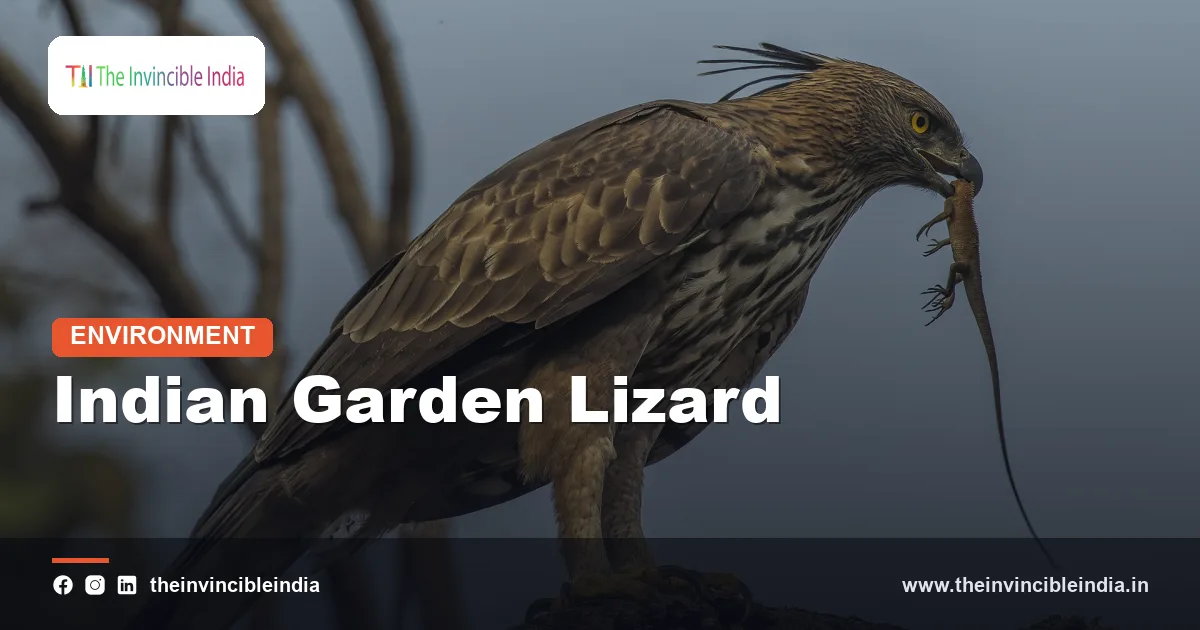
The Indian garden lizard (Calotes versicolor), also called the oriental garden lizard, changeable lizard or “bloodsucker”, is a common, harmless, tree-dwelling agamid lizard of South and Southeast Asia that is best known for the bright red or orange-red head and shoulders of breeding males. The Indian garden lizard is one of the reptiles most people in India see every day, on fences, hedges, tree trunks and garden walls.
Despite its fierce nickname and its blood-red display, the Indian garden lizard is not venomous and does not suck blood. It is a sit-and-wait insect hunter that does a quiet service by eating pests. This explainer, last reviewed 23 October 2026, explains how to recognise the lizard, why males turn red, what the colour-change story really means and why the animal is nothing to fear.
| Attribute | Detail |
|---|---|
| Scientific name | Calotes versicolor (a species complex under ongoing taxonomic review) |
| Family and order | Agamidae (agamid lizards); order Squamata |
| Size | Total length commonly around 35 to 40 cm, of which the tail forms about two-thirds |
| Appearance | Slender body, brown to olive-grey, spiny crest along the neck and back, long whip-like tail |
| Breeding colour | Males develop a bright red, orange-red or crimson head, throat and shoulders |
| Diet | Mainly insects and other invertebrates, occasionally small lizards and soft plant matter |
| Reproduction | Egg-laying; clutches buried in soil, commonly during the rains |
| Danger to people | Not venomous; may bite in self-defence but poses no real threat |
Key Takeaways
- The Indian garden lizard (Calotes versicolor) is a harmless agamid lizard whose breeding males develop a bright red or orange-red head and shoulders.
- The Indian garden lizard is not a blood-sucker; the nickname comes from the red colour of the male’s head and has no basis in the animal’s diet.
- The Indian garden lizard can alter its shade between browns, greens and darker tones, but it is not a true chameleon and does not change colour to match any background.
- Male Indian garden lizards perform head-bobbing and push-up displays to claim territory and attract females.
- The Indian garden lizard eats mostly insects such as ants, grasshoppers, beetles and flies, so it helps limit garden pests.
- The Indian garden lizard is a common species of Least Concern, and killing it out of fear or superstition is both unnecessary and unwarranted.
What is the Indian garden lizard?
The Indian garden lizard is a medium-sized, arboreal lizard in the family Agamidae, the same group that includes fan-throated lizards, flying dragons and many other Asian lizards with spiny crests. It lives in gardens, scrub, fields, hedgerows and light forest across a wide part of Asia.
The scientific name Calotes versicolor translates roughly as “changeable-coloured beautiful one”, a nod to its shifting hues. The species is also known in different parts of India by dozens of local names. Taxonomists now recognise that what was once treated as a single widespread species is actually a complex, and several populations have been separated into distinct species, so the exact identity of a lizard can depend on the region.
Whatever its precise name, the animal fills the same everyday niche. It basks on a fence post in the morning, hunts insects from a perch through the day and retreats to dense foliage at night. For many Indians, it is the first wild reptile they learn to recognise.
How do you recognise an Indian garden lizard?
An Indian garden lizard is recognised by its slender, laterally flattened body, long tapering tail, brownish or olive colouring and a row of spiny scales running from the neck down the back. Its head is triangular and its eyes are alert, and the lizard turns its head sharply to track movement.
Males are larger and have a more developed head and throat, while females are slightly smaller and plainer. A thin dark line often runs from the eye across the cheek, and bands of darker brown may cross the back. Juveniles are mostly pale brown or green and blend into leaves. The tail, which is long and rope-like, helps the lizard balance on thin branches.
| Lizard | How it differs from the Indian garden lizard |
|---|---|
| Indian chameleon | Prehensile tail, independently swivelling eyes, slow gait and much larger colour changes |
| Fan-throated lizard (Sitana) | Smaller and ground-dwelling, with a large coloured throat fan |
| Common house gecko | Pale, nocturnal, with sticky toe pads and no spiny crest |
| Common skink | Smooth, shiny scales and short legs |
| Peninsular rock agama | Stockier, rock-dwelling, with a black-and-orange breeding male |
Why does the male Indian garden lizard turn red?
The male Indian garden lizard turns red because the colour is a breeding signal: during the mating season, hormone changes cause the skin of the head, throat and shoulders to flush bright red, orange or crimson. The display tells rival males that the owner is ready to defend a territory and tells females that he is in breeding condition.
The effect is produced by pigment cells in the skin called chromatophores, which can expand or contract. Red and orange pigments, such as carotenoids and pteridines, become more visible in breeding males. The change is gradual rather than instant, and it is usually strongest when the male is excited, displaying or confronting a rival. After the breeding season, the colour typically fades back to a duller brown.
Is the red colour a sign of anger or danger?
The red head is not a warning that the lizard is poisonous. It is a social signal aimed at other lizards, not at people. A red-headed male is simply a lizard in breeding mood, and he is no more dangerous than a duller one.
Does the Indian garden lizard really change colour?
The Indian garden lizard can change colour, but only in a limited way: it shifts between lighter and darker shades of brown, olive and green depending on temperature, stress, mood and breeding state. It cannot match arbitrary backgrounds the way some chameleons can, so the popular idea of a lizard that copies every colour is a myth.
The ability to alter shade does have practical uses. A cool lizard darkens to absorb more heat when it basks. A frightened lizard may turn paler or darker as part of its stress response. Males brighten when displaying. Together, these changes give the species its descriptive name, versicolor, which means “of changing colour”.
- Temperature: Darker tones warm the body faster in the morning.
- Mood and stress: Colour can shift when the lizard is startled or cornered.
- Breeding: The male’s red head is the most dramatic change.
- Camouflage: Overall, the lizard’s brown and green tones blend into bark and leaves, but the change is not an active matching process.
Why is it called the bloodsucker?
The Indian garden lizard is called the bloodsucker because the male’s red head looks like it has been dipped in blood, and folk belief linked that sight to drinking blood. In reality, the lizard has no ability or inclination to feed on blood, and its teeth and jaws are designed for catching insects.
The nickname has been used in English-speaking regions of South Asia for generations and appears in older field guides. Because the term sounds sinister, it has fuelled myths: that the lizard bites cattle, that its bite is poisonous, or that it brings bad luck. None of these claims has scientific support.
The lizard may bite if it is grabbed, as any cornered animal might, but the bite is minor and not venomous. Washing the area and applying antiseptic is sufficient. The lizard’s real habits are far more ordinary: it spends most of the day sitting still on a perch watching for movement.
How does the Indian garden lizard behave?
The Indian garden lizard is a diurnal, territorial lizard that spends most of its time on trees, shrubs, fences and walls, and it uses head-bobbing and push-up displays to communicate. Males perch in prominent places, bob their heads in a rhythmic way, puff out the throat and flatten the body to appear larger.
When threatened, the lizard first freezes, relying on camouflage. If approached closely it runs up the far side of a trunk, circling around so that the tree is between it and the observer. It can also leap short distances between branches and sprint along fences and walls. At night it sleeps on thin twigs and leaves, where a predator climbing along the branch would shake it awake.
Territory and rivalry
Males defend patches of trees or hedge against rivals, using their red colouring and push-ups as warnings. When two males meet, they may chase each other, and fights can involve biting and tail whipping, though serious injuries are uncommon. Females tend to occupy overlapping home ranges within a male’s territory.
Predators
The species is preyed on by birds of prey, crows, shrikes, snakes, mongooses, cats and monitor lizards. Its tail can break off under strain, although this ability is less developed than in geckos and skinks, and the regrown tail is usually shorter and less neatly formed.
What does the Indian garden lizard eat?
The Indian garden lizard eats mainly insects and other invertebrates, including ants, termites, grasshoppers, beetles, flies, caterpillars and spiders. It is a sit-and-wait predator: it perches motionless, watches for movement and then dashes out to seize prey, often returning to the same spot afterwards.
Larger lizards will also eat small lizards, including hatchlings of their own species, as well as occasional frogs. Some plant matter such as flowers, buds and soft fruit is taken in small amounts, but animal prey makes up the bulk of the diet. Because it consumes so many insects, the lizard is helpful in gardens and farms.
- Ants and termites are a regular part of the diet in many habitats.
- Grasshoppers, crickets and beetles are taken when abundant.
- Moths, flies and caterpillars are caught on leaves and walls.
- Small lizards and young geckos are eaten opportunistically.
How does the Indian garden lizard breed?
The Indian garden lizard breeds by laying eggs: the female digs a small hole in soft, moist soil, deposits a clutch of eggs and covers them, usually around the time of the monsoon. The clutch commonly contains somewhere between about ten and twenty-five eggs, though numbers vary with the size of the female and the region.
The eggs are soft-shelled and develop in the warmth of the soil. They hatch after several weeks, and the young emerge as miniature versions of the adults, fully independent from the start. Hatchlings are green or brown and hide in low vegetation, where they feed on tiny insects. They grow fast and may reach breeding size within their first year or two.
The breeding season varies with local climate. In much of India, courtship and nesting peak in the warm, humid months before and during the monsoon, which is the time the red-headed males are most conspicuous. In regions with a milder or wetter pattern, breeding may extend over a longer period.
Where does the Indian garden lizard live?
The Indian garden lizard lives across a large part of South and Southeast Asia, including India, Pakistan, Nepal, Bangladesh, Sri Lanka, Myanmar and parts of southern China and mainland Southeast Asia, with introduced populations recorded in some other regions. In India it is present in most states, from plains and hill foothills to coastal areas.
It prefers open woodland, scrub, plantations, farmland, parks and residential gardens. Hedges, bamboo clumps and mature trees are especially favoured, because they provide perches and cover. The lizard is often abundant in towns, where gardens substitute for forest edge, and it tolerates moderate disturbance. Because taxonomists have split the complex, the range assigned to the true Calotes versicolor is narrower than the older, broader range under that name.
Is the Indian garden lizard harmful or protected?
The Indian garden lizard is not harmful to people, is not venomous and is generally regarded as a beneficial species. It is common and widespread, and the International Union for Conservation of Nature (IUCN) has assessed it as Least Concern, although the assessment applies to the species in the traditional sense and the complex has been revised since.
In Indian law, wildlife is covered by the Wildlife (Protection) Act, 1972, but the common garden lizard is not among the species that attract special attention in schedules in the way tigers or pangolins do. Readers who need the exact legal position should check the current schedules. In any case, killing or catching the animal is unnecessary, and biodiversity guidance encourages leaving it undisturbed.
Superstitions and myths
- Myth: the lizard’s bite is deadly. Fact: it is not venomous.
- Myth: it sucks blood from people or animals. Fact: it eats insects.
- Myth: it can copy any colour. Fact: its colour range is narrow.
- Myth: it brings bad luck. Fact: it is simply a harmless reptile.
How can people live with garden lizards?
People can live with garden lizards by leaving hedges and trees in place, avoiding insecticide sprays and not harassing or catching the animals. A garden with native shrubs, a patch of leaf litter and some bare soil for nesting will usually hold a few lizards without any special effort.
Pets such as cats and dogs sometimes chase lizards, and cutting a lizard’s tail or capturing it for amusement causes stress and injury. Children can be taught to watch the head-bobbing display from a distance, which is a good first lesson in animal behaviour. Anyone who finds a lizard indoors can guide it gently out with a piece of cardboard. Because the species depends on insects, its presence is also a sign that a garden’s food web is working.
Bottom Line
The Indian garden lizard is a common, harmless and useful reptile whose red-headed breeding males are often misread as dangerous. The “bloodsucker” label and the colour-change myth both exaggerate the facts. The lizard is simply an insect hunter that bobs its head, defends a hedge and leaves people alone.
Frequently Asked Questions
Is the Indian garden lizard poisonous?
No, the Indian garden lizard is not poisonous or venomous. It may bite if handled roughly, but the bite is minor and can be cleaned with soap and water. The belief that it is dangerous is a myth.
Why is the Indian garden lizard called a bloodsucker?
The nickname comes from the bright red head of the breeding male, which people imagined to be stained with blood. The lizard does not drink blood and eats insects. The name has stuck in popular speech even though it is inaccurate.
Why does the garden lizard’s head turn red?
The head turns red because breeding males develop bright red or orange pigment during the mating season, driven by hormones. The colour signals readiness to defend a territory and to mate. It usually fades after the breeding period.
Can the Indian garden lizard change colour like a chameleon?
The Indian garden lizard can shift between lighter and darker shades, and males can brighten in the breeding season, but it cannot match any background like a chameleon. Its colour changes respond mainly to temperature, mood and breeding state. It is a different animal from the true Indian chameleon.
What does the Indian garden lizard eat?
The Indian garden lizard eats mostly insects, including ants, termites, grasshoppers, beetles and flies, and sometimes small lizards. It hunts by sitting still and darting out at passing prey. This makes it a useful natural pest controller in gardens.
Is the Indian garden lizard the same as a chameleon?
No, the Indian garden lizard is an agamid, while the Indian chameleon belongs to a different family, Chamaeleonidae. Chameleons have a prehensile tail, swivelling eyes and a slow gait. The garden lizard is a fast runner with a long whip-like tail.
{“@context”:”https://schema.org”,”@graph”:[{“@type”:”FAQPage”,”mainEntity”:[{“@type”:”Question”,”name”:”Is the Indian garden lizard poisonous?”,”acceptedAnswer”:{“@type”:”Answer”,”text”:”No, the Indian garden lizard is not poisonous or venomous. It may bite if handled roughly, but the bite is minor and can be cleaned with soap and water. The belief that it is dangerous is a myth.”}},{“@type”:”Question”,”name”:”Why is the Indian garden lizard called a bloodsucker?”,”acceptedAnswer”:{“@type”:”Answer”,”text”:”The nickname comes from the bright red head of the breeding male, which people imagined to be stained with blood. The lizard does not drink blood and eats insects. The name has stuck in popular speech even though it is inaccurate.”}},{“@type”:”Question”,”name”:”Why does the garden lizard’s head turn red?”,”acceptedAnswer”:{“@type”:”Answer”,”text”:”The head turns red because breeding males develop bright red or orange pigment during the mating season, driven by hormones. The colour signals readiness to defend a territory and to mate. It usually fades after the breeding period.”}},{“@type”:”Question”,”name”:”Can the Indian garden lizard change colour like a chameleon?”,”acceptedAnswer”:{“@type”:”Answer”,”text”:”The Indian garden lizard can shift between lighter and darker shades, and males can brighten in the breeding season, but it cannot match any background like a chameleon. Its colour changes respond mainly to temperature, mood and breeding state. It is a different animal from the true Indian chameleon.”}},{“@type”:”Question”,”name”:”What does the Indian garden lizard eat?”,”acceptedAnswer”:{“@type”:”Answer”,”text”:”The Indian garden lizard eats mostly insects, including ants, termites, grasshoppers, beetles and flies, and sometimes small lizards. It hunts by sitting still and darting out at passing prey. This makes it a useful natural pest controller in gardens.”}},{“@type”:”Question”,”name”:”Is the Indian garden lizard the same as a chameleon?”,”acceptedAnswer”:{“@type”:”Answer”,”text”:”No, the Indian garden lizard is an agamid, while the Indian chameleon belongs to a different family, Chamaeleonidae. Chameleons have a prehensile tail, swivelling eyes and a slow gait. The garden lizard is a fast runner with a long whip-like tail.”}}]}]}


