

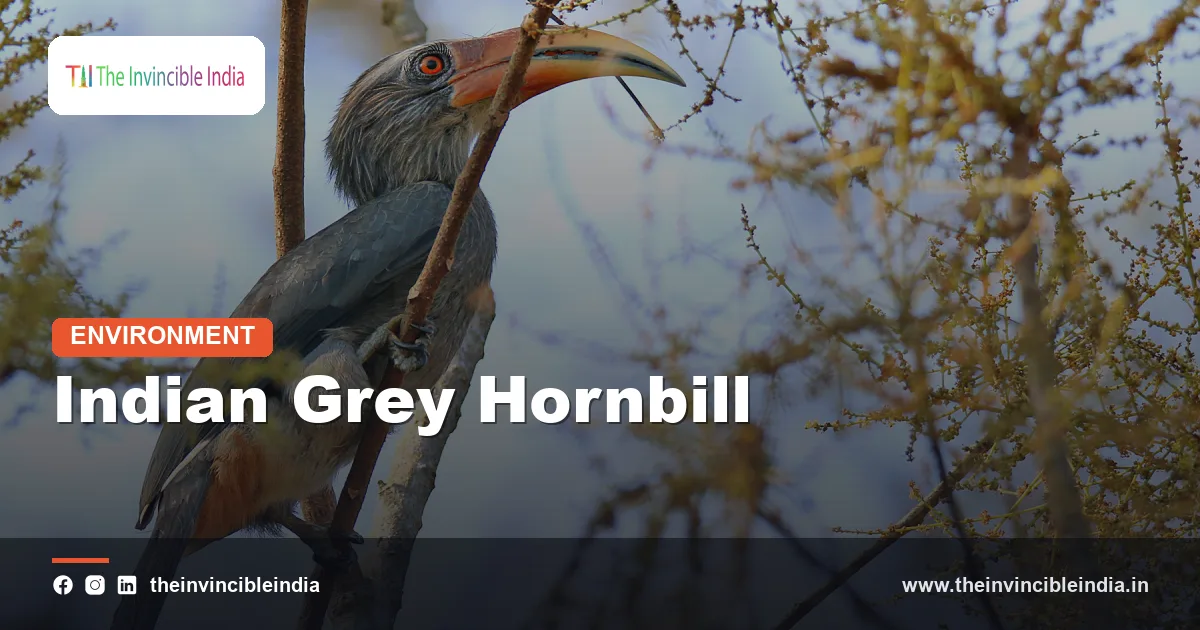
The Indian grey hornbill (Ocyceros birostris) is a medium-sized, grey-brown hornbill with a curved bill topped by a horn-like casque, found across much of the Indian subcontinent in open forests, village groves, temple compounds and city avenues. It is probably the hornbill that most Indians are likely to see in everyday life, because it has adapted so well to fruiting trees in towns, campuses and gardens.
The Indian grey hornbill is best known for an unusual breeding habit: the female seals herself inside a tree hollow with a plaster of mud, droppings and fruit pulp, leaving only a narrow slit through which the male passes food. This explainer covers how to identify the bird, where it lives, what it eats, how the nest-sealing works, and how the species copes with life beside people. Last updated: 23 October 2026.
| Quick Facts | Indian grey hornbill |
|---|---|
| Scientific name | Ocyceros birostris |
| Family | Bucerotidae (hornbills) |
| Other names | Common grey hornbill, Indian grey hornbill |
| Approximate length | About 60 cm from bill tip to tail tip |
| Range | Indian subcontinent, mostly peninsular and central India and the Gangetic plains |
| Habitat | Dry and moist deciduous forest, scrub, groves, orchards, roadside avenues and urban parks |
| Diet | Mainly figs and other fruit; also insects, lizards and occasionally small mammals or eggs |
| Nesting | Natural tree hollow, with the female sealed inside by mud-and-dropping plaster |
| Conservation status | IUCN Least Concern; protected under the Wildlife (Protection) Act, 1972 |
Key Takeaways
- The Indian grey hornbill (Ocyceros birostris) is a grey-brown hornbill of the Indian subcontinent, about 60 cm long, with a curved bill and a pointed casque on top.
- The female Indian grey hornbill seals herself inside a tree cavity during nesting, and the male feeds her through a narrow slit until the chicks are partly grown.
- Figs and other wild fruits form the core diet of the Indian grey hornbill, which makes the species an important seed disperser for trees.
- The Indian grey hornbill tolerates towns better than most hornbills, nesting and feeding in older trees in cities such as Delhi and Bengaluru.
- The IUCN lists the Indian grey hornbill as Least Concern, but the loss of old hollow trees remains the main long-term pressure on its nesting.
- The Indian grey hornbill differs from the Malabar grey hornbill, which is restricted to the Western Ghats, and from the much larger great hornbill of forests in the north-east and the Western Ghats.
What is the Indian grey hornbill?
The Indian grey hornbill is a species of hornbill, a family of birds characterised by large down-curved bills, in which the grey-brown plumage and the pale underparts make the bird look quiet in colour but unmistakable in profile. Its scientific name, Ocyceros birostris, places it in a small genus of grey hornbills that also contains the Malabar grey hornbill and the Sri Lankan grey hornbill.
The species is endemic to the Indian subcontinent in the sense that almost its whole range lies within it, with India holding the bulk of the population. It is often called the common grey hornbill because, among India’s several hornbill species, it is the most widely distributed and the easiest to find outside protected forests.
Hornbills are named for their bills, and many species carry a casque, a hollow or lightly structured growth on the upper mandible. In the Indian grey hornbill the casque rises from the base of the bill and tapers towards the tip, giving the bird its characteristic pointed, helmet-like look in profile. Researchers have suggested that casques may help with signalling between individuals and possibly with amplifying calls, although the exact function in each species is still debated.
The bird is sociable. Indian grey hornbills are usually seen in pairs or small groups of up to a dozen or so, and they often gather to feed in a single heavily fruiting tree. Their loud, squealing calls carry across a campus or orchard and are often the first sign that the birds are around.
How can you identify an Indian grey hornbill?
An Indian grey hornbill can be identified by its overall grey-brown body, paler greyish-white belly, long tail with a white tip, and a large curved bill topped by a tapering casque. The long graduated tail is dark with a band near its end and white corners, and these white tail tips flash clearly when the bird flies from tree to tree.
Key field marks
- Upperparts are ash-grey to brownish-grey, with pale edges to the wing feathers that give a lightly scaled look.
- A pale stripe above the eye gives the face a slightly lined appearance, and the dark eye is set against a dusky face patch.
- The underparts are dull white to pale buff, with a soft rusty wash near the vent in many birds.
- The long tail has a dark subterminal band and a pale or white tip, a feature that is easy to see in flight.
- The bill is dull yellowish-horn to dark in colour, depending on age and sex, and carries the pointed casque.
Male and female differences
The male Indian grey hornbill generally has a larger, more prominent casque and a darker bill with a dark patch toward the front of the casque. The female has a smaller casque and a bill that tends to look paler or yellowish at the base. These differences are subtle, and a reliable sex identification in the field usually needs a good view of a pair together.
Flight and voice
The flight of the Indian grey hornbill is characteristic: a few heavy wingbeats, then a glide, producing a gently undulating path. The wings look broad and rounded, and the long tail trails behind. The call is a high, piping, squealing series of notes, often described as a cat-like or gull-like cry, and it is given especially around fruiting trees and at dawn and dusk.
Where does the Indian grey hornbill live in India?
The Indian grey hornbill lives across most of peninsular and central India, extending into the Gangetic plains and the foothills of the Himalaya, in habitats ranging from dry deciduous forest to well-wooded towns. Its distribution generally avoids the dense wet evergreen forests of the Western Ghats, where the Malabar grey hornbill takes over, and it is largely absent from the far north-east.
The bird needs two things: large fruiting trees and old trees with natural hollows. Where those are present, it can live in a surprisingly wide range of conditions, including semi-arid scrub in parts of Rajasthan and Gujarat, the open woodland of the Deccan, and irrigated mango and tamarind groves in rural districts.
Typical habitats
- Dry and moist deciduous forests, including edges and clearings.
- Scrub forest and thorn woodland with scattered large trees.
- Village groves, sacred groves, temple compounds and orchards.
- Avenue trees, botanical gardens, university campuses and urban parks.
The species is mostly resident, meaning it stays in or near one area through the year. Some local movements follow the fruiting seasons of figs and other trees, but there is no large-scale migration. Pairs tend to be faithful to a good nesting tree and may return to it over several years if the cavity remains suitable.
What does the Indian grey hornbill eat?
The Indian grey hornbill eats mainly fruit, especially wild figs, and supplements this with insects, small reptiles and occasionally small mammals or the eggs and nestlings of other birds. This mixed diet is described as omnivorous with a strong fruit bias, and fig trees in particular act as a lifeline during dry months.
Fig trees of the genus Ficus, including the banyan, peepal and several wild figs, fruit in staggered cycles through the year. Because individual trees ripen at different times, the Indian grey hornbill can move from one to another and find food even in lean periods. Other fruit trees commonly used include neem, jamun, tamarind and, in orchards, mango and papaya.
Feeding technique is distinctive. The bird picks up a fruit at the tip of its bill, tosses its head back and flicks the fruit into its throat, a movement that is easy to watch from below a fruiting tree. Insects such as beetles, grasshoppers and caterpillars are taken from bark and foliage, and lizards are caught in the branches or on the ground.
Why the Indian grey hornbill matters for forests and gardens
The Indian grey hornbill acts as a seed disperser because the fruit it swallows is digested while the hard seed passes through or is regurgitated, often far from the parent tree. Large frugivores like hornbills are important for moving the seeds of large-fruited trees that smaller birds cannot handle. In towns, this behaviour contributes to the spread of figs and other trees in gardens, wall cracks and old buildings.
How does the female Indian grey hornbill seal herself in a nest?
The female Indian grey hornbill seals herself in a tree cavity by plastering the entrance with a mixture of mud, her own droppings and fruit pulp, leaving a vertical slit just wide enough for the male to pass food to her. This behaviour is shared by most hornbills in Asia and Africa, and the Indian grey hornbill is one of the best-known Indian examples.
The process begins when a pair selects a suitable natural hollow, usually in a large old tree. The female enters the cavity, and from inside, with some help from the male outside, she builds up the barrier. The material hardens as it dries, and the cavity becomes closed to snakes, monitor lizards, squirrels and other nest predators.
What happens inside the sealed nest
- The female lays a small clutch of white eggs, generally two to four, on the floor of the cavity.
- The female incubates the eggs herself, and the male brings food, mainly figs, which he regurgitates item by item through the slit.
- The female goes through a moult of her flight feathers during this period, and she can be temporarily unable to fly, so the sealed cavity also protects her while she is vulnerable.
- The female keeps the nest clean by ejecting droppings and food remains through the slit.
- After the eggs hatch, the female may break out of the nest while the chicks remain, in many cases re-sealing the opening, and the male and female then both feed the young.
The overall time that the female spends enclosed differs between nests and regions, from several weeks to a couple of months. In all cases the system depends heavily on the male: if he is lost, the female and chicks may starve. This heavy reliance on one provider is one reason why pair bonds in hornbills are strong, and it also explains why the loss of an adult can end a nesting attempt.
Why does this behaviour exist?
Biologists generally explain nest sealing as a defence against predators, since a narrow slit allows little room for a snake or monkey to reach inside. It may also help in protecting the female while she moults and in keeping the cavity warm and stable. These explanations are supported by field observations, although details differ by species.
How has the Indian grey hornbill adapted to towns and cities?
The Indian grey hornbill has adapted to towns by using mature avenue trees, campus woodlands and old gardens as feeding and roosting sites, and it often nests in large trees that have survived inside city limits. This ability sets it apart from many other hornbills, which depend on large tracts of continuous forest.
Several features help in urban settings. The bird is a generalist feeder, so it can switch among fig, neem, jamun and other planted trees. It is also tolerant of moderate human activity, and it often keeps feeding even when people walk beneath the trees. Mature trees planted by earlier generations, for example in cantonments, old colleges and heritage gardens, offer both food and hollows.
Urban pressures
- Tree felling and pruning for road widening, construction and safety removes both fruit sources and nest hollows.
- Replacement of native fig and fruit trees with ornamental species lowers food supply.
- Noise, light and the use of pesticides in gardens can reduce insect prey.
- Collisions with glass, wires and vehicles occasionally injure birds.
Urban hornbills are therefore dependent on the survival of a relatively small number of old trees. Many city naturalists and bird groups track nesting sites and request that known nest trees not be cut or heavily trimmed during the breeding season. Retaining dead standing wood, where it is safe, also helps because natural cavities form in older trees.
How is the Indian grey hornbill different from other Indian hornbills?
The Indian grey hornbill is smaller, plainer and more widespread than most other Indian hornbills, and it is the only grey hornbill of the northern and central plains. India hosts several hornbill species, mostly in the Western Ghats and the north-east, and they differ in size, plumage and habitat.
| Hornbill | Approximate size | Where it is found in India | Distinguishing feature |
|---|---|---|---|
| Indian grey hornbill (Ocyceros birostris) | About 60 cm | Across much of peninsular and central India, in forests and towns | Grey-brown with a pointed casque and white-tipped tail |
| Malabar grey hornbill (Ocyceros griseus) | Smaller than the Indian grey hornbill | Western Ghats | Darker body with a bright, yellowish bill and a smaller casque |
| Malabar pied hornbill (Anthracoceros coronatus) | Larger than the grey hornbills | Western Ghats and parts of peninsular India | Black and white with a large casque |
| Oriental pied hornbill (Anthracoceros albirostris) | Similar to the Malabar pied | North-east India and adjoining regions | Black and white, with a casque that is mostly black |
| Great hornbill (Buceros bicornis) | Up to about 1 metre or more | Western Ghats, Himalayan foothills and north-east India | Very large with a yellow casque; state bird of Kerala and Arunachal Pradesh |
The Indian grey hornbill is thus the “everyday” hornbill, and the others, such as the great hornbill, are more specialised forest birds. In the Andaman and Nicobar region and on isolated islands, other hornbill species such as the Narcondam hornbill occur, but these have very small ranges. The grey and pied hornbills share the nest-sealing habit, although behaviour can vary in the detail.
Is the Indian grey hornbill endangered and how is it protected?
The Indian grey hornbill is not endangered at present: the International Union for Conservation of Nature (IUCN) lists it as Least Concern, which reflects its wide range and ability to live near people. Like all hornbills in India, however, it is protected under the Wildlife (Protection) Act, 1972, and trapping, hunting or keeping the birds is illegal.
Population figures for the species are uncertain, and no precise national count exists. Observers generally describe it as locally common in suitable habitat, although the trend in some regions may be downward where old trees are lost. A stable global rating therefore does not mean that every local population is secure.
Main threats
- Loss of large old trees with natural cavities, which can take many decades to form.
- Felling of fig and other fruit trees in farmland, roadsides and urban areas.
- Local hunting or capture for meat, traditional use or the pet trade, which still occurs in some places despite the law.
- Habitat fragmentation that isolates breeding groups.
What helps
Protecting old trees, planting native fig species along roads and in parks, and keeping nest trees undisturbed during the breeding season all assist the species. Community groups and bird clubs also contribute through records submitted to citizen-science platforms, which help show where birds nest and when.
How can you watch Indian grey hornbills responsibly?
The best way to watch Indian grey hornbills is to look and listen near large fruiting fig trees in the early morning, keep a respectful distance and avoid disturbing any nest cavity. Because the birds are noisy and conspicuous, patient observation from a distance is usually enough to see feeding, calling and flight.
- Visit parks, campuses and old gardens at dawn or late afternoon, when the birds are most active.
- Check ripe fig, banyan and peepal trees, since the birds return to them repeatedly.
- Use binoculars rather than approaching a nest tree; a sealed cavity should never be tapped, probed or photographed at close range.
- Do not use call playback near nests, since it can stress breeding birds.
- Record sightings through a recognised citizen-science platform so that nest sites can be tracked responsibly.
Photographers should avoid baiting the birds with fruit or cutting branches for a better angle. Disturbance during incubation can cause a pair to abandon the nest, and with a female sealed inside, the consequences are serious.
Bottom Line
The Indian grey hornbill is India’s most approachable hornbill, a fruit-eating, tree-dependent bird whose sealed-cavity nesting is among the most remarkable breeding strategies of any Indian species. It is currently secure, but its future in towns and countryside rests on the survival of old fruiting and hollow-bearing trees.
Frequently Asked Questions
What is the Indian grey hornbill?
The Indian grey hornbill (Ocyceros birostris) is a grey-brown hornbill of the Indian subcontinent, about 60 cm long, with a curved bill topped by a pointed casque. It lives in forests, groves and towns, and is the hornbill most people in India are likely to encounter. Its diet is mainly fruit, especially figs.
Why does the female Indian grey hornbill seal herself inside the nest?
The female seals herself in the tree hollow to protect her eggs, chicks and herself from predators such as snakes, monitor lizards and squirrels. She uses mud, droppings and fruit pulp to narrow the entrance to a slit. The male then feeds her through that opening until the chicks are partly grown.
What does the Indian grey hornbill eat?
The Indian grey hornbill eats mainly fruit, especially wild figs from banyan, peepal and other Ficus trees. It also takes insects, lizards and sometimes small mammals or the eggs of other birds. This mixed diet lets it survive in dry seasons and in towns.
Is the Indian grey hornbill found in cities?
Yes, the Indian grey hornbill is found in many Indian cities, where it feeds and nests in large old trees in parks, campuses and avenues. Cities such as Delhi and Bengaluru have records of the species. Its survival in towns depends on keeping mature fruiting and hollow-bearing trees.
Is the Indian grey hornbill an endangered species?
No, the Indian grey hornbill is not endangered; the IUCN lists it as Least Concern because of its wide range. It is still legally protected in India under the Wildlife (Protection) Act, 1972. Local declines can occur where old nesting trees are cut.
How is the Indian grey hornbill different from the great hornbill?
The Indian grey hornbill is much smaller, plainer and more widespread than the great hornbill. The great hornbill is a very large forest bird with a bright yellow casque, found in the Western Ghats, Himalayan foothills and north-east India. The Indian grey hornbill is grey-brown and often lives near people.
{“@context”:”https://schema.org”,”@graph”:[{“@type”:”FAQPage”,”mainEntity”:[{“@type”:”Question”,”name”:”What is the Indian grey hornbill?”,”acceptedAnswer”:{“@type”:”Answer”,”text”:”The Indian grey hornbill (Ocyceros birostris) is a grey-brown hornbill of the Indian subcontinent, about 60 cm long, with a curved bill topped by a pointed casque. It lives in forests, groves and towns, and is the hornbill most people in India are likely to encounter. Its diet is mainly fruit, especially figs.”}},{“@type”:”Question”,”name”:”Why does the female Indian grey hornbill seal herself inside the nest?”,”acceptedAnswer”:{“@type”:”Answer”,”text”:”The female seals herself in the tree hollow to protect her eggs, chicks and herself from predators such as snakes, monitor lizards and squirrels. She uses mud, droppings and fruit pulp to narrow the entrance to a slit. The male then feeds her through that opening until the chicks are partly grown.”}},{“@type”:”Question”,”name”:”What does the Indian grey hornbill eat?”,”acceptedAnswer”:{“@type”:”Answer”,”text”:”The Indian grey hornbill eats mainly fruit, especially wild figs from banyan, peepal and other Ficus trees. It also takes insects, lizards and sometimes small mammals or the eggs of other birds. This mixed diet lets it survive in dry seasons and in towns.”}},{“@type”:”Question”,”name”:”Is the Indian grey hornbill found in cities?”,”acceptedAnswer”:{“@type”:”Answer”,”text”:”Yes, the Indian grey hornbill is found in many Indian cities, where it feeds and nests in large old trees in parks, campuses and avenues. Cities such as Delhi and Bengaluru have records of the species. Its survival in towns depends on keeping mature fruiting and hollow-bearing trees.”}},{“@type”:”Question”,”name”:”Is the Indian grey hornbill an endangered species?”,”acceptedAnswer”:{“@type”:”Answer”,”text”:”No, the Indian grey hornbill is not endangered; the IUCN lists it as Least Concern because of its wide range. It is still legally protected in India under the Wildlife (Protection) Act, 1972. Local declines can occur where old nesting trees are cut.”}},{“@type”:”Question”,”name”:”How is the Indian grey hornbill different from the great hornbill?”,”acceptedAnswer”:{“@type”:”Answer”,”text”:”The Indian grey hornbill is much smaller, plainer and more widespread than the great hornbill. The great hornbill is a very large forest bird with a bright yellow casque, found in the Western Ghats, Himalayan foothills and north-east India. The Indian grey hornbill is grey-brown and often lives near people.”}}]}]}


