

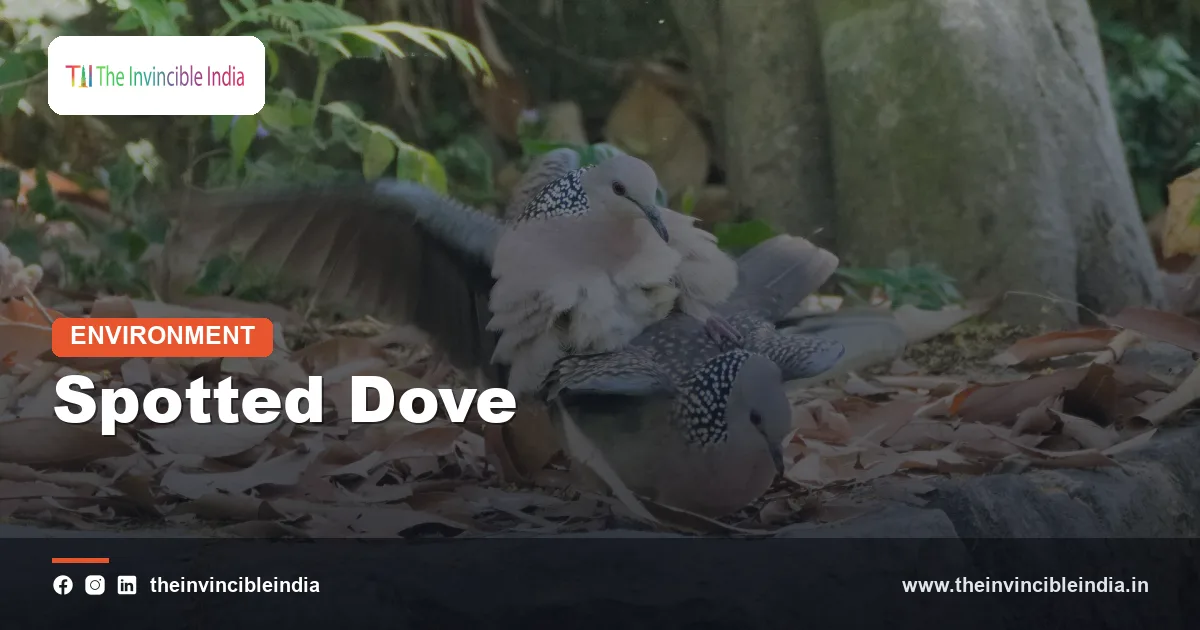
The spotted dove (Spilopelia chinensis) is a gentle, pinkish-brown dove of South and Southeast Asia, easily recognised by the black collar patch on its neck that is covered in small white spots and by its soft, repeated cooing. It is a regular visitor to Indian gardens, farms, village paths and city parks, where it walks quietly on the ground in search of seeds and grain.
The spotted dove is among the most approachable of India’s common birds, often feeding calmly at the edge of lawns and roads and nesting just above head height. This explainer covers its appearance, range, food, call, nesting habits and the best ways to separate it from look-alike doves, so that each section can stand alone as a reliable reference.
| Attribute | Details |
|---|---|
| Common name | Spotted dove (also called the spotted-necked dove or lace-necked dove) |
| Scientific name | Spilopelia chinensis (earlier placed in the genus Streptopelia) |
| Family | Columbidae (pigeons and doves) |
| Body length | About 30 cm, with a fairly long, rounded tail |
| Range | Native across the Indian subcontinent and Southeast Asia, and introduced to several other regions |
| Habitat | Gardens, farmland, light woodland, villages, town parks and roadsides |
| Nest and eggs | A flimsy platform of twigs holding usually two white eggs |
| Conservation status | Least Concern on the IUCN Red List, a common and widespread species |
Key Takeaways
- The spotted dove is a pinkish-brown dove, scientifically named Spilopelia chinensis, that is identified by a black neck patch densely marked with white spots.
- The spotted dove feeds mainly on the ground, taking small seeds, grains and fallen fruit, and walks with a nodding gait instead of hopping.
- The spotted dove builds a flimsy platform nest of twigs and usually lays two white eggs, which both parents incubate.
- The call of the spotted dove is a soft, rolling, repeated coo that is often heard in the early morning and at dusk in gardens.
- The spotted dove is native across the Indian subcontinent and Southeast Asia and has been introduced to regions such as Australia, New Zealand and parts of the United States.
- The spotted dove is classed as Least Concern and is a regular garden bird in much of India.
What is a spotted dove?
A spotted dove is a small to medium-sized, slender member of the pigeon family that lives close to people across much of Asia. The bird is named for the distinctive collar of black feathers tipped with white spots, which looks like a lace or pearl necklace around the back and sides of its neck.
The species was long placed in the genus Streptopelia, along with the collared doves and turtle doves. Genetic studies led to some of these birds, including the spotted dove, being moved to the genus Spilopelia, and recent checklists use the name Spilopelia chinensis. Older books and websites may still list it as Streptopelia chinensis, which refers to the same bird.
In everyday life, the spotted dove is one of the doves that Indians see most often alongside the larger rock pigeon. Compared to pigeons, it is smaller, more slender and less likely to flock in large numbers.
What does a spotted dove look like?
The spotted dove looks like a slender, long-tailed, pinkish-brown dove with a grey head, a pale underside and a black collar patch freckled with white spots. In good light, the neck patch is the surest feature to separate the species from similar doves.
- Head: pale grey to pinkish-grey, with a small dark bill.
- Neck: a broad black patch, closely spotted with white, on the sides and back of the neck.
- Back and wings: warm brown with darker centres to the feathers, giving a scaly pattern.
- Underparts: pinkish-buff to vinous.
- Tail: long and rounded, with white tips on the outer tail feathers that flash when the bird takes off or lands.
- Legs: pinkish-red.
Males and females look alike. Young birds lack the spotted collar and look plainer and more scaly, acquiring the full neck pattern as they mature. Several subspecies are recognised across Asia, and they vary slightly in the tone of the plumage.
Where does the spotted dove live?
The spotted dove lives throughout most of the Indian subcontinent, in lowlands and foothills, as well as in Southeast Asia and southern China. It is a bird of open or semi-open country with scattered trees, and it adapts easily to human habitats.
In India, typical places to find the species include:
- Gardens, lawns and compounds in towns and cities.
- Farmland with hedges, orchards and tree lines.
- Village paths, temple grounds and the edges of tanks and ponds.
- Light deciduous woodland and scrub.
The spotted dove tends to avoid dense, closed forest and extremely dry desert. A resident population is generally non-migratory, meaning individuals stay around the same neighbourhood through the year, although some local movements occur with the seasons.
What does the spotted dove eat?
The spotted dove eats mainly small seeds and grains, supplemented by fallen fruit, buds and, occasionally, small invertebrates. It is a ground feeder, and it collects most of its food by walking slowly and pecking at the soil, leaf litter and the edges of paths.
Typical food items include:
- Seeds of grasses and weeds.
- Cereal grains from harvested fields, grain stores and spilled sacks.
- Fallen berries and small fruits.
- Termites and other tiny insects, taken from time to time.
- Bread, rice and scattered grain, in towns.
Like other doves, the spotted dove drinks by sucking water without tilting the head back, and it visits ponds, shallow dishes and puddles daily, particularly in hot weather. It also swallows grit to help grind hard seeds in its gizzard.
What does the call of the spotted dove sound like?
The call of the spotted dove is a soft, mellow, repeated cooing, often written as “croo-krrroooo-croo” or “who-poo-poo”. The sound is gentle and rhythmic, and it is most often heard in the early morning, in the evening and during the breeding season.
Males call from a perch such as a rooftop, wire or tree branch, often with the head bobbing and the neck puffed out. The call serves both to attract a mate and to announce ownership of a nesting territory. The sound carries well in quiet gardens, and many urban Indians recognise it without ever having seen the bird.
When startled, the spotted dove takes off with a sharp clatter of wings and flashes the white tips on its tail. It does not usually give a separate alarm call, and the noisy takeoff itself acts as a warning to other birds nearby.
How does the spotted dove build its nest and breed?
The spotted dove builds a flimsy, loose platform of twigs in a tree, shrub, creeper or on a ledge, and typically lays two white eggs. The structure is so thin that the eggs can sometimes be seen from below, which is a well-known feature of dove nests.
The breeding cycle usually runs as follows:
- Courtship: the male bows, fans his tail, coos and performs short display flights.
- Nest site: usually a tree fork, dense shrub, creeper, or building ledge between roughly two and six metres up, though lower and higher sites are used.
- Eggs: two white eggs, incubated by both parents for roughly two weeks.
- Chicks: fed on crop milk, a nutritious secretion produced by both parents, and they leave the nest roughly two weeks after hatching.
- Season: breeding can take place through much of the year in warm regions, with peaks that vary by locality.
A pair may raise several broods in a year. Nests are frequently raided by crows, squirrels, cats and snakes, so many nesting attempts fail, which the birds offset by breeding repeatedly.
How can you tell a spotted dove from other doves?
The spotted dove can be told from other doves by its black neck patch with white spots, its pinkish-brown colour and its long, white-tipped tail. Several similar doves share its habitats, and the table below compares the most common ones.
| Species | Scientific name | Key identifying features |
|---|---|---|
| Spotted dove | Spilopelia chinensis | Pinkish-brown, black neck patch densely spotted with white, white-tipped tail |
| Laughing dove | Spilopelia senegalensis | Smaller and more reddish, with a chequered rufous-and-black patch on the upper breast and no full neck collar |
| Eurasian collared dove | Streptopelia decaocto | Pale buff-grey with a narrow black half-collar and no spots |
| Red collared dove | Streptopelia tranquebarica | Small, males brick-red with a grey head and a black half-collar |
| Rock pigeon | Columba livia | Larger and stouter, grey with two dark wing bars |
The laughing dove is the closest relative and is placed in the same genus. It is smaller, with a chequered rather than a spotted pattern, and it generally has a more upright, quick-stepping look.
Is the spotted dove found outside India?
Yes, the spotted dove is found across Southeast Asia and southern China, and it has also been introduced to several other parts of the world. Introduced populations exist in regions such as eastern Australia, New Zealand, Hawaii, parts of California and some Indian Ocean islands.
Many of these populations began in the nineteenth and early twentieth centuries, when people released doves as ornamental or familiar birds. In some places, the introduced spotted dove has spread widely in cities and farmland. The effects on native birds differ by region and are still discussed by ecologists.
Within its natural Asian range, several subspecies are recognised. These include forms of the Indian peninsula and Sri Lanka, which are generally pinker and paler, and forms of Southeast Asia and China, which differ in the tone of the plumage and the size of the neck patch.
How does the spotted dove behave around people?
The spotted dove behaves calmly around people, often feeding within a few metres of houses and roads, and it flies off only when approached closely. This tolerance makes it a favourite of beginner bird watchers and gardeners.
Feeding behaviour
The bird walks with a slow, nodding gait and often feeds alone or in pairs, although small groups can gather where food is plentiful. It prefers bare or short-grass ground, where seeds are easy to see.
Resting behaviour
During the heat of the day, spotted doves rest quietly in the shade of dense trees or on wires. They preen, sun themselves with one wing lifted, and sometimes dust-bathe on dry ground.
Courtship and pairing
Pairs tend to stay together for the breeding season and often longer. A courting male follows the female closely, bowing and cooing, and the pair may sit side by side on a wire or branch.
What threatens spotted doves, and how can gardens help them?
The main threats to individual spotted doves are predators, window collisions, pesticides and the loss of nesting cover, while the species as a whole is not endangered. Domestic cats, crows, shikras and snakes take adults, eggs and chicks, and these pressures are strongest in gardens with little shelter.
Gardeners and residents can help by:
- Planting dense shrubs and small trees that offer safe nesting forks.
- Leaving patches of bare ground or short grass where doves can feed.
- Putting out a shallow dish of clean water, refreshed daily.
- Keeping pet cats indoors, especially in the breeding season.
- Avoiding chemical pesticides and rat poisons that contaminate seeds and the food chain.
- Using decals or screens on large windows to reduce collisions.
Native wild birds in India are generally covered by the Wildlife (Protection) Act, 1972, so the spotted dove should not be trapped or kept as a cage bird. The species is common and classed as Least Concern.
Bottom Line
The spotted dove is a quiet, graceful and widespread bird that rewards even a casual glance with its spotted collar and gentle call. It thrives in gardens, farmland and towns, needs little more than seed, water and a leafy fork for its nest, and is a good first dove for anyone learning Indian birds.
Frequently Asked Questions
What is the scientific name of the spotted dove?
The scientific name of the spotted dove is Spilopelia chinensis. Older sources list it as Streptopelia chinensis, which refers to the same species in the pigeon and dove family Columbidae.
How can I identify a spotted dove?
A spotted dove is identified by its pinkish-brown body and the black patch on its neck that is heavily marked with white spots. It also has a long, rounded tail with white tips on the outer feathers that show in flight.
What does the spotted dove eat?
The spotted dove eats mainly small seeds, grains and fallen fruit, which it collects while walking on the ground. It occasionally takes tiny insects such as termites, and it needs a daily supply of drinking water.
How many eggs does a spotted dove lay?
A spotted dove usually lays two white eggs on a flimsy platform of twigs. Both parents incubate the eggs for roughly two weeks and feed the chicks on crop milk.
What is the difference between a spotted dove and a laughing dove?
The spotted dove is larger and pinkish-brown with a black neck collar spotted white, while the laughing dove is smaller and more reddish with a chequered patch on the upper breast. The laughing dove has no full spotted collar.
Is the spotted dove common in India?
Yes, the spotted dove is common across much of India and is classed as Least Concern. It is regularly seen in gardens, farmland, villages and town parks, though it is less frequent in dense forest and dry desert.
{“@context”:”https://schema.org”,”@graph”:[{“@type”:”FAQPage”,”mainEntity”:[{“@type”:”Question”,”name”:”What is the scientific name of the spotted dove?”,”acceptedAnswer”:{“@type”:”Answer”,”text”:”The scientific name of the spotted dove is Spilopelia chinensis. Older sources list it as Streptopelia chinensis, which refers to the same species in the pigeon and dove family Columbidae.”}},{“@type”:”Question”,”name”:”How can I identify a spotted dove?”,”acceptedAnswer”:{“@type”:”Answer”,”text”:”A spotted dove is identified by its pinkish-brown body and the black patch on its neck that is heavily marked with white spots. It also has a long, rounded tail with white tips on the outer feathers that show in flight.”}},{“@type”:”Question”,”name”:”What does the spotted dove eat?”,”acceptedAnswer”:{“@type”:”Answer”,”text”:”The spotted dove eats mainly small seeds, grains and fallen fruit, which it collects while walking on the ground. It occasionally takes tiny insects such as termites, and it needs a daily supply of drinking water.”}},{“@type”:”Question”,”name”:”How many eggs does a spotted dove lay?”,”acceptedAnswer”:{“@type”:”Answer”,”text”:”A spotted dove usually lays two white eggs on a flimsy platform of twigs. Both parents incubate the eggs for roughly two weeks and feed the chicks on crop milk.”}},{“@type”:”Question”,”name”:”What is the difference between a spotted dove and a laughing dove?”,”acceptedAnswer”:{“@type”:”Answer”,”text”:”The spotted dove is larger and pinkish-brown with a black neck collar spotted white, while the laughing dove is smaller and more reddish with a chequered patch on the upper breast. The laughing dove has no full spotted collar.”}},{“@type”:”Question”,”name”:”Is the spotted dove common in India?”,”acceptedAnswer”:{“@type”:”Answer”,”text”:”Yes, the spotted dove is common across much of India and is classed as Least Concern. It is regularly seen in gardens, farmland, villages and town parks, though it is less frequent in dense forest and dry desert.”}}]}]}


