

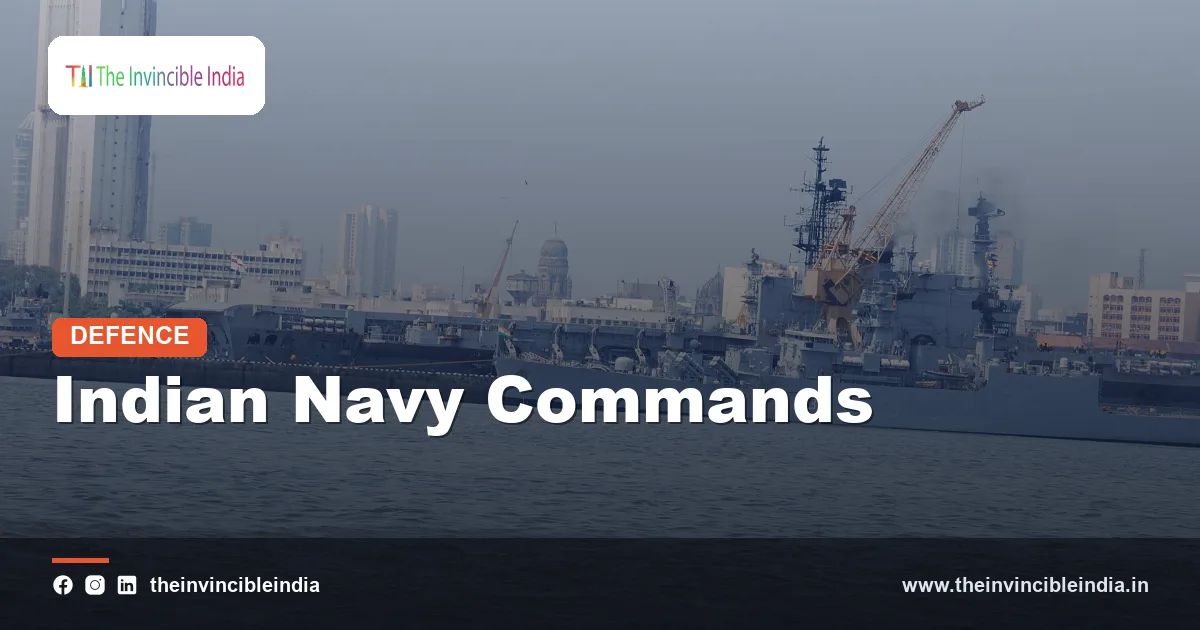
The Indian Navy commands are the three regional organisations through which the Navy is administered and operated: the Western Naval Command at Mumbai, the Eastern Naval Command at Visakhapatnam and the Southern Naval Command at Kochi. Each is headed by a Flag Officer Commanding-in-Chief holding the rank of Vice Admiral, and all three report to Naval Headquarters in New Delhi under the Chief of the Naval Staff.
The Western and Eastern Naval Commands are the Navy’s operational commands, each with its own fleet, while the Southern Naval Command is its training command. Alongside these three sits the tri-service Andaman and Nicobar Command, which is a joint structure rather than a purely naval one. This article explains how the commands divide India’s maritime responsibilities and what each one does.
Quick Facts
| Attribute | Detail |
|---|---|
| Service | Indian Navy |
| Naval Headquarters | New Delhi |
| Head of the Navy | Chief of the Naval Staff (Admiral) |
| Number of naval commands | Three |
| Western Naval Command | Headquarters at Mumbai, Maharashtra; Arabian Sea; Western Fleet |
| Eastern Naval Command | Headquarters at Visakhapatnam, Andhra Pradesh; Bay of Bengal; Eastern Fleet |
| Southern Naval Command | Headquarters at Kochi, Kerala; training command |
| Head of each command | Flag Officer Commanding-in-Chief (Vice Admiral) |
| Tri-service theatre command | Andaman and Nicobar Command, Port Blair (raised 2001) |
Key Takeaways
- The Indian Navy is organised into three commands: the Western Naval Command at Mumbai, the Eastern Naval Command at Visakhapatnam and the Southern Naval Command at Kochi.
- Each Indian Navy command is headed by a Flag Officer Commanding-in-Chief, who holds the rank of Vice Admiral.
- The Western Naval Command and the Eastern Naval Command are operational commands, while the Southern Naval Command is the Indian Navy’s training command.
- The Western Fleet is the sword arm of the Western Naval Command, and the Eastern Fleet is the sword arm of the Eastern Naval Command.
- The Andaman and Nicobar Command, raised in 2001 at Port Blair, is India’s first tri-service theatre command and is separate from the three naval commands.
- All three Indian Navy commands report to Naval Headquarters in New Delhi, which is led by the Chief of the Naval Staff, an Admiral.
What are the Indian Navy commands?
The Indian Navy commands are the three major regional headquarters that run the Navy’s ships, bases, personnel and training across India’s coastline. Each command covers a defined geographical area, and between them they span the west coast, the east coast and the southern peninsula.
Naval Headquarters in New Delhi sets policy, plans force development and directs the Navy as a whole. The commands translate that direction into day-to-day action. A command is responsible for operating the ships and aircraft allotted to it, maintaining its shore establishments, and administering the personnel posted there.
The arrangement is geographical for the two operational commands, which correspond to the two sides of the Indian peninsula. The third command is functional, because it concentrates on training rather than on the operation of a fleet.
The three commands at a glance
| Command | Headquarters | Primary role | Associated fleet |
|---|---|---|---|
| Western Naval Command | Mumbai | Operational, Arabian Sea | Western Fleet |
| Eastern Naval Command | Visakhapatnam | Operational, Bay of Bengal | Eastern Fleet |
| Southern Naval Command | Kochi | Training | No operational fleet |
What is the Western Naval Command?
The Western Naval Command is the Indian Navy’s operational command for the west coast, with its headquarters in Mumbai, Maharashtra. It looks after the Navy’s responsibilities in the Arabian Sea, which carries a large proportion of India’s seaborne trade and energy imports.
Mumbai has been a naval base since the days of the British Royal Navy and the Royal Indian Navy, and the city’s naval dockyard is one of the oldest and most important in the country. The command also controls other establishments along the western seaboard, including the major naval base at Karwar in Karnataka, which was developed as part of a large expansion of west coast infrastructure.
The Western Naval Command is headed by a Flag Officer Commanding-in-Chief, a Vice Admiral. Its principal fighting formation is the Western Fleet, and its responsibility includes defence of the western maritime approaches, protection of offshore assets and cooperation with the Indian Coast Guard and other agencies.
Why does Mumbai matter?
Mumbai is India’s largest port city and a financial hub, and it has a naval presence that dates back centuries. Locating the headquarters of the Western Naval Command in the city allows close coordination with civilian port authorities, shipyards and the offshore energy sector.
What is the Eastern Naval Command?
The Eastern Naval Command is the Indian Navy’s operational command for the east coast, headquartered at Visakhapatnam in Andhra Pradesh. Its area of responsibility is the Bay of Bengal, which connects India to the Strait of Malacca and to Southeast Asia.
Visakhapatnam has a natural harbour and is home to a large naval dockyard and a major base for the Navy’s submarine arm. The eastern seaboard also includes naval establishments in other states, and the Navy’s presence in the east has grown in significance as strategic attention has shifted towards the wider Indo-Pacific region.
Like the Western Naval Command, the Eastern Naval Command is headed by a Flag Officer Commanding-in-Chief of the rank of Vice Admiral. Its principal fighting formation is the Eastern Fleet. The command also works closely with the Andaman and Nicobar Command, since the island territories lie on the eastern side of India’s maritime domain.
What is the Southern Naval Command?
The Southern Naval Command is the Indian Navy’s training command, with its headquarters at Kochi in Kerala. Unlike the Western and Eastern Naval Commands, it does not command a fleet, because its main job is to train the personnel who serve across the Navy.
Kochi is home to a large cluster of training institutions, including schools that train sailors and officers in technical and professional subjects. The Indian Naval Academy at Ezhimala in Kerala, which trains officer cadets, is also associated with the Southern Naval Command. The command additionally has responsibility for naval establishments, aviation facilities and shipyards in the region.
The Southern Naval Command is also headed by a Flag Officer Commanding-in-Chief, a Vice Admiral. Its role means that nearly every sailor and officer of the Indian Navy passes through its institutions at some point in their careers.
Why is training concentrated in the south?
The concentration of training establishments at Kochi dates from the Navy’s early decades after Independence, when the southern peninsula offered suitable harbours, training sites and existing facilities. Over time, the location developed into the Navy’s central training hub.
Who heads each Indian Navy command?
Each Indian Navy command is headed by a Flag Officer Commanding-in-Chief (FOC-in-C), a Vice Admiral who exercises operational and administrative control over the command. The title is a long-established Navy appointment and reflects the seniority required to run a regional headquarters.
The Chief of the Naval Staff, an Admiral, sits above the three commands at Naval Headquarters. The Flag Officers Commanding-in-Chief report to him on all matters concerning their commands. Within each command, the staff is organised into branches covering operations, personnel, logistics, material and training, supported by a Chief Staff Officer and other flag and senior officers.
Appointments are made by the Government of India, and officeholders change regularly, so the names of current commanders are best checked against official sources rather than relied upon from any fixed article.
How the command structure is arranged
| Level | Appointment | Rank |
|---|---|---|
| Naval Headquarters | Chief of the Naval Staff | Admiral |
| Each command | Flag Officer Commanding-in-Chief | Vice Admiral |
| Each fleet | Flag Officer Commanding the fleet | Rear Admiral |
| Naval areas and establishments | Flag officers and commanding officers | Varies |
What is a fleet and what does the sword arm mean?
A fleet is the main group of warships, submarines and aircraft assigned to a naval command for sea operations, and in the Indian Navy it is often called the sword arm of the command. The term expresses the idea that the command provides the support and administration, while the fleet carries out the actual fighting and patrolling at sea.
The Indian Navy has two main fleets: the Western Fleet, which is the sword arm of the Western Naval Command, and the Eastern Fleet, which is the sword arm of the Eastern Naval Command. Each fleet is headed by a Flag Officer Commanding, who is a Rear Admiral. The fleets consist of a mix of surface combatants such as destroyers, frigates and corvettes, along with supporting vessels and, where assigned, aviation assets.
The Southern Naval Command does not have a fleet in this sense. The organisation of ships between fleets can change as new vessels are commissioned and older vessels retire, so the precise composition of a fleet at any moment is not a fixed fact.
How are the Indian Navy commands different from the Andaman and Nicobar Command?
The Andaman and Nicobar Command (ANC) differs from the three naval commands because it is a tri-service command, which means it draws on the Army, Navy and Air Force together. It was raised in 2001 at Port Blair and is considered India’s first joint theatre command.
The idea behind it was to bring military forces in a strategically important island chain under a single commander. The Commander-in-Chief of the ANC is rotated among the three services, so he may be from the Navy, the Army or the Air Force. The Andaman and Nicobar Islands lie close to the entrance of the Strait of Malacca, one of the busiest shipping lanes in the world, which accounts for their importance.
The ANC works alongside the Eastern Naval Command and other agencies on surveillance and security tasks. It functions as a joint command within the framework of the Chiefs of Staff Committee, rather than being part of the naval chain of command in the same way as the three commands.
What is the role of Naval Headquarters?
Naval Headquarters in New Delhi is the apex headquarters of the Indian Navy, responsible for policy, planning, force structuring and overall direction. It is headed by the Chief of the Naval Staff, who is also a member of the Chiefs of Staff Committee.
The Navy operates under the Ministry of Defence, and Naval Headquarters is part of the Integrated Headquarters of the Ministry of Defence (Navy). Principal staff officers there look after areas such as operations, personnel, material, and plans. The commands operate under its direction and are not independent of it.
Since the creation of the post of Chief of Defence Staff (CDS) in 2019, the Navy, along with the other two services, has also been working towards greater integration. The idea of creating tri-service theatre commands has been under discussion, and any such changes would affect how the existing structure is arranged in the future.
How does the Navy use its bases and naval areas?
Within each command, the coastline is divided into naval areas and sub-areas, each placed under a senior officer who is responsible for local security, administration and coordination. These naval areas cover the coastal states and work with state authorities, ports and coastal security agencies.
Major bases and establishments include naval dockyards, air stations, submarine bases and training schools. Together, they provide the infrastructure needed to keep ships at sea, from refit and repair to supply, medical care and accommodation. A command’s headquarters coordinates these facilities and ensures that the fleet has the support it needs.
Naval bases are distributed to protect the length of India’s coastline, which runs for thousands of kilometres and includes island territories. This wide spread explains why the Navy needs both regional headquarters and a fleet organisation that can operate across the Indian Ocean region.
Bottom Line
The Indian Navy commands divide the service into two operational commands at Mumbai and Visakhapatnam and one training command at Kochi, each led by a Vice Admiral. The Western and Eastern Fleets serve as their sword arms, while the tri-service Andaman and Nicobar Command adds a joint layer in the island territories. Understanding this structure helps make sense of how India’s maritime responsibilities are shared.
Frequently Asked Questions
How many commands does the Indian Navy have?
The Indian Navy has three commands: the Western Naval Command at Mumbai, the Eastern Naval Command at Visakhapatnam and the Southern Naval Command at Kochi. The first two are operational commands and the third is the training command. All three report to Naval Headquarters in New Delhi.
Where is the headquarters of each Indian Navy command?
The Western Naval Command is headquartered at Mumbai in Maharashtra, the Eastern Naval Command at Visakhapatnam in Andhra Pradesh, and the Southern Naval Command at Kochi in Kerala. Naval Headquarters for the whole Navy is in New Delhi.
Who heads an Indian Navy command?
Each Indian Navy command is headed by a Flag Officer Commanding-in-Chief, who holds the rank of Vice Admiral. These officers report to the Chief of the Naval Staff, who is an Admiral. Appointments are made by the Government of India and change periodically.
What is the Southern Naval Command responsible for?
The Southern Naval Command is the Indian Navy’s training command, based at Kochi. It oversees the training of naval officers and sailors across many specialisations. It does not command an operational fleet like the Western and Eastern Naval Commands.
What is the sword arm of a naval command?
The sword arm of a naval command is its fleet, which carries out the fighting and patrolling at sea. The Western Fleet is the sword arm of the Western Naval Command, and the Eastern Fleet is the sword arm of the Eastern Naval Command. Each fleet is headed by a Rear Admiral.
Is the Andaman and Nicobar Command part of the Navy?
No, the Andaman and Nicobar Command is a tri-service command rather than a purely naval one. It was raised in 2001 at Port Blair and draws on the Army, Navy and Air Force. Its Commander-in-Chief is rotated among the three services.
{“@context”:”https://schema.org”,”@graph”:[{“@type”:”FAQPage”,”mainEntity”:[{“@type”:”Question”,”name”:”How many commands does the Indian Navy have?”,”acceptedAnswer”:{“@type”:”Answer”,”text”:”The Indian Navy has three commands: the Western Naval Command at Mumbai, the Eastern Naval Command at Visakhapatnam and the Southern Naval Command at Kochi. The first two are operational commands and the third is the training command. All three report to Naval Headquarters in New Delhi.”}},{“@type”:”Question”,”name”:”Where is the headquarters of each Indian Navy command?”,”acceptedAnswer”:{“@type”:”Answer”,”text”:”The Western Naval Command is headquartered at Mumbai in Maharashtra, the Eastern Naval Command at Visakhapatnam in Andhra Pradesh, and the Southern Naval Command at Kochi in Kerala. Naval Headquarters for the whole Navy is in New Delhi.”}},{“@type”:”Question”,”name”:”Who heads an Indian Navy command?”,”acceptedAnswer”:{“@type”:”Answer”,”text”:”Each Indian Navy command is headed by a Flag Officer Commanding-in-Chief, who holds the rank of Vice Admiral. These officers report to the Chief of the Naval Staff, who is an Admiral. Appointments are made by the Government of India and change periodically.”}},{“@type”:”Question”,”name”:”What is the Southern Naval Command responsible for?”,”acceptedAnswer”:{“@type”:”Answer”,”text”:”The Southern Naval Command is the Indian Navy’s training command, based at Kochi. It oversees the training of naval officers and sailors across many specialisations. It does not command an operational fleet like the Western and Eastern Naval Commands.”}},{“@type”:”Question”,”name”:”What is the sword arm of a naval command?”,”acceptedAnswer”:{“@type”:”Answer”,”text”:”The sword arm of a naval command is its fleet, which carries out the fighting and patrolling at sea. The Western Fleet is the sword arm of the Western Naval Command, and the Eastern Fleet is the sword arm of the Eastern Naval Command. Each fleet is headed by a Rear Admiral.”}},{“@type”:”Question”,”name”:”Is the Andaman and Nicobar Command part of the Navy?”,”acceptedAnswer”:{“@type”:”Answer”,”text”:”No, the Andaman and Nicobar Command is a tri-service command rather than a purely naval one. It was raised in 2001 at Port Blair and draws on the Army, Navy and Air Force. Its Commander-in-Chief is rotated among the three services.”}}]}]}


