

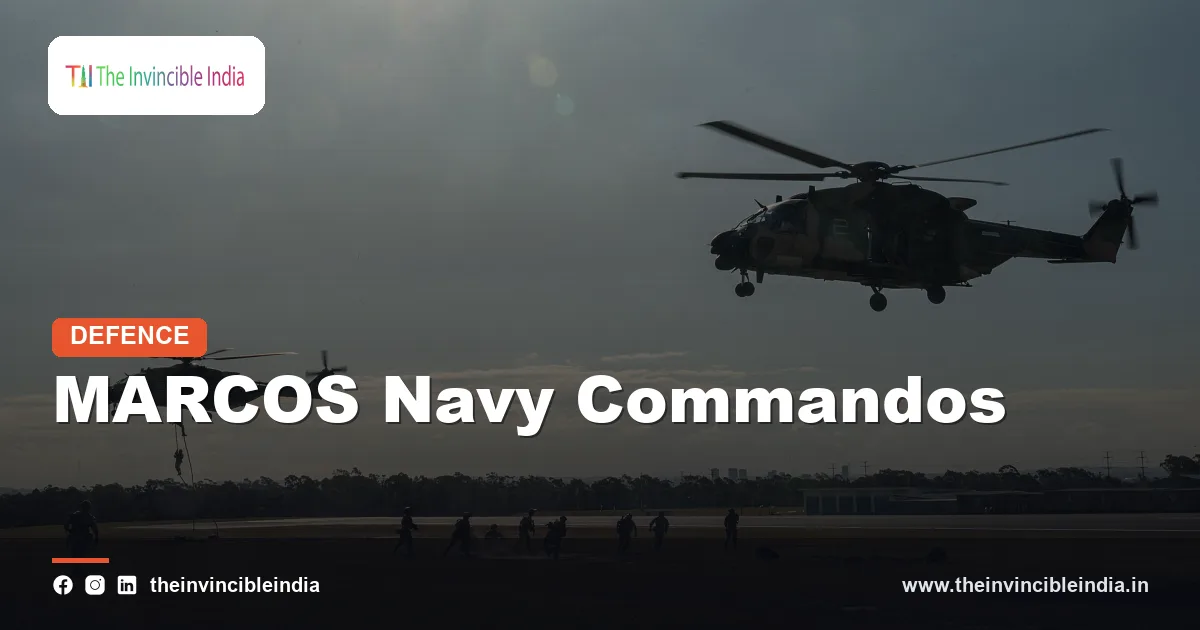
MARCOS, short for Marine Commandos, is the special operations unit of the Indian Navy, formally known as the Marine Commando Force (MCF) and raised in 1987 to carry out special missions in the maritime environment. The force is trained for operations at sea, on coasts, in rivers and in inland waters, and it is one of several elite special forces units maintained by the Indian armed forces.
MARCOS is among the best-known names in Indian special operations, in part because of its public association with the response to the 2008 Mumbai attacks. This explainer covers only well-established, publicly known facts: how the unit came about, what its broad role is, how it fits among India’s other special forces, and how it is regarded. Operational details, tactics and current numbers are deliberately left out.
Quick Facts
| Attribute | Detail |
|---|---|
| Full name | Marine Commando Force (MCF), commonly called MARCOS |
| Parent service | Indian Navy |
| Raised | 1987, initially as the Indian Marine Special Force |
| Renamed | Marine Commando Force in 1991 |
| Role | Maritime special operations |
| Base | INS Abhimanyu, Mumbai |
| Ministry | Ministry of Defence |
| Unit motto | The Few. The Fearless. |
Key Takeaways
- MARCOS is the Marine Commando Force of the Indian Navy, raised in 1987 as the Indian Marine Special Force and given its present name in 1991.
- MARCOS is trained for special operations in maritime settings, including amphibious tasks, counter-terrorism at sea and special reconnaissance.
- The selection process for MARCOS is widely described as one of the most demanding in the Indian armed forces, and only a small proportion of volunteers are finally accepted.
- MARCOS personnel were among the first Indian special forces to be deployed after the 2008 Mumbai attacks began, before the National Security Guard took over the main counter-terror effort.
- India’s special forces include the Para (Special Forces) of the Army, MARCOS of the Navy, the Garud Commando Force of the Air Force and the National Security Guard under the Ministry of Home Affairs.
- The base associated with MARCOS is INS Abhimanyu in Mumbai, and the force is made up of volunteers drawn from the Indian Navy.
What is MARCOS?
MARCOS is the Indian Navy’s marine commando force, a small, highly trained unit meant for special operations in and around water. The name is a contraction of Marine Commandos, and its official designation is the Marine Commando Force.
Like most special forces, MARCOS is not a large formation. It is a specialised unit that draws on volunteers from within the Navy and focuses on missions that conventional forces are not designed for. The unit functions under the Navy’s chain of command, and its tasks are decided by the needs of the Navy and the broader security establishment.
The official designation remains the Marine Commando Force, while MARCOS is the name used in everyday speech and media. Public information about the unit’s structure is limited, as is normal for special forces.
When and why was MARCOS raised?
MARCOS was raised in 1987, when the Indian Navy created the Indian Marine Special Force (IMSF) to develop a dedicated capability for special operations at sea. The effort was a response to the growing recognition of the need for specialists who could operate across the maritime domain.
The initial group is reported to have received guidance from friendly foreign special forces in the early days, which is a common feature of how new special forces units are established. After a few years of development, the unit was renamed the Marine Commando Force in 1991, and the abbreviation MARCOS became the popular name.
The Indian Navy’s creation of a specialised commando unit also reflected the wider expansion of India’s naval role in the 1980s. As the Navy grew, so did the need to protect coastal assets, offshore installations and sea lanes against asymmetric threats.
Timeline of well-known milestones
| Year | Development |
|---|---|
| 1987 | Indian Marine Special Force raised by the Indian Navy |
| 1991 | Renamed the Marine Commando Force (MCF) |
| 1990s | Unit becomes publicly associated with inland water operations in Jammu and Kashmir |
| 2008 | Deployed during the Mumbai terror attacks |
What is the role of MARCOS?
The role of MARCOS is to carry out special operations in maritime and littoral environments, and its tasks are generally described as covering amphibious operations, counter-terrorism at sea, special reconnaissance and similar missions. These categories are widely stated in public sources and do not reveal how any individual mission is carried out.
In broad terms, the roles are as follows.
- Amphibious operations: Operating across the boundary between sea and land, such as shores, creeks and coastal areas.
- Counter-terrorism at sea: Responding to terrorist threats to ships, offshore installations and coastal sites.
- Special reconnaissance: Gathering information in areas that are difficult for conventional forces to access.
- Counter-piracy and hostage-related tasks: Supporting the Navy’s efforts to secure sea lanes and respond to hijackings.
- Support to other forces: Working alongside the Army, the Air Force and other agencies when joint action is needed.
The unit has also been publicly linked with operations in the inland waters of Jammu and Kashmir, including the Wular Lake area, where it has been deployed in support of the security forces. This shows that the force is not limited to the open sea but also works in rivers, lakes and marshes.
Who joins MARCOS and how are they selected?
MARCOS recruits are volunteers from within the Indian Navy who choose to undergo a demanding selection process, and the process is widely reputed to be among the toughest in the Indian armed forces. Both officers and sailors can volunteer, subject to physical and medical standards.
Public accounts describe the selection as a multi-phase process with a very high attrition rate, meaning that only a small share of volunteers complete it. The process is understood to test physical endurance, mental resilience, teamwork and the ability to function under stress. Beyond this level of general description, the details of selection are not made public and are not discussed here.
Those who successfully complete the process are inducted into the force and go on to further specialised training. The reputation for rigour is part of the identity of the unit, and it is often cited as the reason for MARCOS’s standing. The Navy does not publish the strength of the force, and figures that appear in media reports should be treated cautiously.
What qualities are valued?
Descriptions of special forces selection across the world commonly emphasise fitness, discipline, adaptability and teamwork rather than any single attribute. MARCOS is generally described in the same terms, and the selection is meant to identify those who can work in small teams under difficult conditions.
Where is MARCOS based?
MARCOS is publicly associated with INS Abhimanyu, a Navy establishment in Mumbai, which serves as the base and training location of the Marine Commando Force. The base is located on the west coast and falls within the area of the Western Naval Command.
The base is named after Abhimanyu, a warrior from the Mahabharata who is traditionally remembered for his courage. The Navy names its shore establishments after various figures, places and ideas, and INS Abhimanyu follows that tradition.
Elements of the force are also deployed or based at other locations as the Navy requires. As with other special forces, the details of where personnel are stationed at any given time are not made public.
What role did MARCOS play in the 2008 Mumbai attacks?
MARCOS was among the first special forces to be deployed in Mumbai after the terror attacks of November 2008 began, and its personnel were reported to have been sent to the area around the Taj Mahal Palace hotel. The deployment came within hours of the start of the attacks, because the unit is based in the city.
The National Security Guard (NSG), India’s federal counter-terror force, subsequently took over the principal operation to clear the attacked sites, which was code-named Operation Black Tornado. MARCOS and other forces provided support during the early stages of the response. The attacks lasted several days and were among the deadliest terror attacks in India.
The incident brought MARCOS into greater public view and contributed to its wider reputation. It also led to a review of coastal security, since the attackers had arrived by sea, and to the strengthening of maritime security arrangements. These included expanded coastal surveillance and closer coordination between the Navy, the Coast Guard and the marine police.
How does MARCOS compare with India’s other special forces?
MARCOS is the Navy’s special forces unit and is one of four principal Indian special forces formations, alongside the Army’s Para (Special Forces), the Air Force’s Garud Commando Force and the National Security Guard. Each is rooted in a different service or ministry and was established for a different purpose.
| Force | Parent organisation | Broad focus |
|---|---|---|
| MARCOS (Marine Commando Force) | Indian Navy | Maritime special operations |
| Para (Special Forces) | Indian Army | Land-based special operations |
| Garud Commando Force | Indian Air Force | Airfield protection and air-related special tasks |
| National Security Guard (NSG) | Ministry of Home Affairs | Counter-terrorism and anti-hijacking |
The NSG was raised in 1984 and is built from personnel on deputation from the Army and other forces. The Garud Commando Force was formed in the early 2000s. The Para (Special Forces) is the oldest of these, with roots in the Parachute Regiment.
In 2019 the Government of India approved the creation of the Armed Forces Special Operations Division, intended to integrate special forces elements of the three services. This was part of the broader push toward joint operations, and it indicates how India’s special forces are being brought closer together over time.
Is MARCOS a part of the Indian Navy or an independent force?
MARCOS is a part of the Indian Navy and is not an independent force. It is organised under the Navy’s command structure and reports through naval channels to the Chief of the Naval Staff, who is an Admiral, and ultimately to the Ministry of Defence.
The force operates in coordination with the other services when tasked, and its deployments are decided by the government through established procedures. Special forces are used selectively because of the specialised nature of their training and the risks of the tasks assigned to them.
This position within the Navy distinguishes MARCOS from the NSG, which comes under the Ministry of Home Affairs, and from the Garud Commando Force, which is part of the Air Force.
What is the reputation and public image of MARCOS?
MARCOS has a reputation as one of India’s most capable special forces, and its public image is shaped by its demanding selection and its association with high-profile security situations. Media coverage and popular culture have also contributed to a sense of mystique around the unit.
It is important to separate public perception from verifiable fact, since much of what appears in popular media about special forces is dramatised or inaccurate. The Indian Navy itself discloses very little about the unit, as is standard practice, and it is best to rely on official statements for reliable information.
Gallantry awards have been conferred on MARCOS personnel over the years, in recognition of acts of courage in the line of duty. These awards form part of the public record and are a reflection of the risks that the unit’s members face.
Bottom Line
MARCOS, the Marine Commando Force of the Indian Navy, was raised in 1987 and is trained for special operations in the maritime domain. It has a strong reputation, a demanding selection process, and a well-known association with the 2008 Mumbai attacks, but the detailed workings of the force are kept confidential, as is usual for special forces. It stands alongside the Army’s Para (Special Forces), the Air Force’s Garud Commando Force and the NSG as one of India’s core special operations units.
Frequently Asked Questions
What does MARCOS stand for?
MARCOS is short for Marine Commandos, the popular name for the Marine Commando Force (MCF) of the Indian Navy. The unit was raised in 1987 as the Indian Marine Special Force and renamed in 1991. It specialises in maritime special operations.
When was MARCOS formed?
MARCOS was formed in 1987 by the Indian Navy as the Indian Marine Special Force. In 1991 it was renamed the Marine Commando Force. The abbreviation MARCOS has since become its common name.
What does MARCOS do?
MARCOS carries out special operations in maritime and coastal environments. Its publicly described roles include amphibious operations, counter-terrorism at sea and special reconnaissance. The force also works in inland waters, such as lakes and rivers.
Where is MARCOS based?
MARCOS is publicly associated with INS Abhimanyu, a naval establishment in Mumbai. The base falls within the Western Naval Command. The Navy does not publish the locations of its personnel at any given time.
Was MARCOS involved in the 2008 Mumbai attacks?
Yes, MARCOS personnel were among the first special forces to be deployed in Mumbai after the November 2008 attacks began. The National Security Guard later took over the main operation, known as Operation Black Tornado. The attacks led to major reforms in India’s coastal security.
How is MARCOS different from the NSG?
MARCOS is the special forces unit of the Indian Navy and focuses on maritime operations, while the National Security Guard is a federal counter-terror force under the Ministry of Home Affairs. The NSG was raised in 1984 and draws personnel on deputation from the Army and other forces. The two forces can work together during joint operations.
{“@context”:”https://schema.org”,”@graph”:[{“@type”:”FAQPage”,”mainEntity”:[{“@type”:”Question”,”name”:”What does MARCOS stand for?”,”acceptedAnswer”:{“@type”:”Answer”,”text”:”MARCOS is short for Marine Commandos, the popular name for the Marine Commando Force (MCF) of the Indian Navy. The unit was raised in 1987 as the Indian Marine Special Force and renamed in 1991. It specialises in maritime special operations.”}},{“@type”:”Question”,”name”:”When was MARCOS formed?”,”acceptedAnswer”:{“@type”:”Answer”,”text”:”MARCOS was formed in 1987 by the Indian Navy as the Indian Marine Special Force. In 1991 it was renamed the Marine Commando Force. The abbreviation MARCOS has since become its common name.”}},{“@type”:”Question”,”name”:”What does MARCOS do?”,”acceptedAnswer”:{“@type”:”Answer”,”text”:”MARCOS carries out special operations in maritime and coastal environments. Its publicly described roles include amphibious operations, counter-terrorism at sea and special reconnaissance. The force also works in inland waters, such as lakes and rivers.”}},{“@type”:”Question”,”name”:”Where is MARCOS based?”,”acceptedAnswer”:{“@type”:”Answer”,”text”:”MARCOS is publicly associated with INS Abhimanyu, a naval establishment in Mumbai. The base falls within the Western Naval Command. The Navy does not publish the locations of its personnel at any given time.”}},{“@type”:”Question”,”name”:”Was MARCOS involved in the 2008 Mumbai attacks?”,”acceptedAnswer”:{“@type”:”Answer”,”text”:”Yes, MARCOS personnel were among the first special forces to be deployed in Mumbai after the November 2008 attacks began. The National Security Guard later took over the main operation, known as Operation Black Tornado. The attacks led to major reforms in India’s coastal security.”}},{“@type”:”Question”,”name”:”How is MARCOS different from the NSG?”,”acceptedAnswer”:{“@type”:”Answer”,”text”:”MARCOS is the special forces unit of the Indian Navy and focuses on maritime operations, while the National Security Guard is a federal counter-terror force under the Ministry of Home Affairs. The NSG was raised in 1984 and draws personnel on deputation from the Army and other forces. The two forces can work together during joint operations.”}}]}]}


